
A Republic — If We Can Keep It
Clip: 7/7/2026 | 3m 36sVideo has Closed Captions
How can democracy last 250 more years? The Deadlock panel wrestles with the question.
How can democracy endure another 250 years? What will it really take to keep the republic going? The BREAKING the DEADLOCK panel wrestles with this question, exploring tensions around leadership, generational divides, and the challenges of a fragmented information age.
Problems playing video? | Closed Captioning Feedback
Problems playing video? | Closed Captioning Feedback
Funding for this program was provided in part by grants from The Rosalind P. Walter Foundation and by a grant from Anne Ray Foundation and by contributions from viewers like you. Thank you. Location furnished by The New York Historical.
A Republic — If We Can Keep It
Clip: 7/7/2026 | 3m 36sVideo has Closed Captions
How can democracy endure another 250 years? What will it really take to keep the republic going? The BREAKING the DEADLOCK panel wrestles with this question, exploring tensions around leadership, generational divides, and the challenges of a fragmented information age.
Problems playing video? | Closed Captioning Feedback
Where to Watch Breaking the Deadlock
Breaking the Deadlock is available to stream on pbs.org and the PBS app.
Buy Now
Providing Support for PBS.org
Learn Moreabout PBS online sponsorshipAs we think about the conditions that led us to declare our independence 250 years ago, I'm wondering what can we do as ordinary citizens, elected officials to make sure our democracy survives for 250 more?
I'm actually quite, the optimist Sounds like it.
And I think it's unfortunate that it felt a little difficult for you to hear the optimism because in real life, I actually am a believer, and I'm optimistic because I'm descended of those who survived.
I remain optimistic because the solution to our problem is to support people who have enough optimism to lift their voices even when it's hard, even when it's under threat, even when it can get you sued, destroyed, or killed.
Because if this is supposed to be a government and a country of the people for the people, then it's time to actually listen to the people, especially the people who know America better than she knows herself because we've had to survive it for all 250 years.
The question is how we survive another 250 years.
Our founders created a very, very stable legal framework, which is why we've survived this long, and they put defining principles at the very beginning that allowed us to evolve and keep evolving.
And excuse me, for not hearing all of the optimism.
I think we're optimistic about maybe the same things, perhaps.
Politics is the art of disagreeing without war.
That's the whole point.
And our constitution has upheld, has been upheld remarkably well.
It's the oldest in the world for being one of the youngest countries.
I think that when we look to the next 250, but even to the next 25 years, the current leadership needs to empower.
The next generation needs to lift up.
The next generation needs to really show a good example for the next generation because we live in such a divisive time.
Young people are more divided than ever before, and it's if you truly wanna live by the idea that you're gonna leave this nation better off than how you found it, do it.
So I think you're right about the older generation in power.
They don't truly understand how young people are getting their information.
They truly don't understand how distorted their world can become because of the way they're getting their information.
If we can't agree on what the facts are, then democracy becomes impossible because we have to pass on to the next generation a respect for facts and how they can get 'em.
I think the system held, but it taught us a lesson that leadership is as important, if not more important than the system itself.
And if we don't understand that, then we can really have fundamental democratic problems.
In the end.
The only thing that will determine whether survive the stress tests are the character of the men and women who we put into leadership.
And that's why Franklin said, after the constitution, when the woman asked him, what kind of government have you given us, Mr.
Franklin?
He said, A republic.
If you can keep it, a republic if you can keep it.
And that's gonna be up to everybody who votes and chooses what the criteria is for who your leader should be.
Breaking the Deadlock: How to Fix an Election — Open
Video has Closed Captions
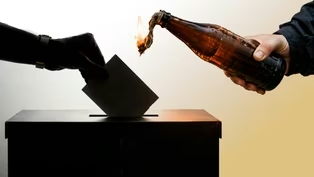
Panelists face a dramatic hypothetical scenario against the backdrop of America’s 250th anniversary. (56s)

How to Fix an Election: Preview
Video has Closed Captions
Nine voices, one election crisis. How far would you go to defend democracy? (30s)
Protect the Vote — or Step Aside?
Video has Closed Captions
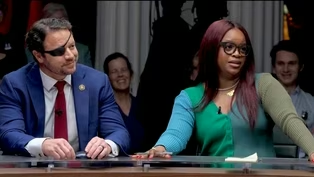
Would you risk arrest to protect the democratic process? A tense, hypothetical showdown over protest (2m 18s)
Providing Support for PBS.org
Learn Moreabout PBS online sponsorship New Episode
- News and Public Affairs

Top journalists deliver compelling original analysis of the hour's headlines.
 New Episode
- News and Public Affairs

Today's top journalists discuss Washington's current political events and public affairs.
 New Episode
 New Episode
 New Episode
 New Episode
 New Episode


 New Episode
 New Episode

Support for PBS provided by:
Funding for this program was provided in part by grants from The Rosalind P. Walter Foundation and by a grant from Anne Ray Foundation and by contributions from viewers like you. Thank you. Location furnished by The New York Historical.