
Families worry Americans imprisoned by Iran are forgotten
Clip: 7/9/2026 | 6m 49sVideo has Closed Captions
As diplomacy stalls, families worry Americans imprisoned by Iran are forgotten
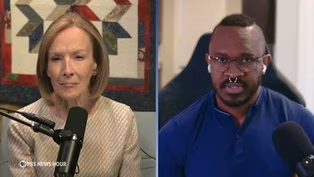
As tensions with Iran continue to escalate, another issue that remains unresolved is the Americans still imprisoned there. U.S. officials say those cases remain part of ongoing diplomacy, but families worry their loved ones could be overshadowed by the broader crisis. Amna Nawaz reports.
Problems playing video? | Closed Captioning Feedback
Problems playing video? | Closed Captioning Feedback
Major corporate funding for the PBS News Hour is provided by BDO, BNSF, Consumer Cellular, American Cruise Lines, and Raymond James. Funding for the PBS NewsHour Weekend is provided by...
Families worry Americans imprisoned by Iran are forgotten
Clip: 7/9/2026 | 6m 49sVideo has Closed Captions
As tensions with Iran continue to escalate, another issue that remains unresolved is the Americans still imprisoned there. U.S. officials say those cases remain part of ongoing diplomacy, but families worry their loved ones could be overshadowed by the broader crisis. Amna Nawaz reports.
Problems playing video? | Closed Captioning Feedback
Where to Watch PBS News Hour
PBS News Hour is available to stream on pbs.org and the PBS app.
Providing Support for PBS.org
Learn Moreabout PBS online sponsorshipGEOFF BENNETT: As tensions with Iran continue to escalate, another urgent issue remains unresolved, the Americans still imprisoned there.
U.S.
officials say their cases remain part of ongoing diplomatic efforts, but their families fear the broader crisis could push their loved ones even further from view.
Amna Nawaz has more.
AMNA NAWAZ: The ongoing conflict with Iran has renewed concerns about Americans still detained there.
Among them are Reza Valizadeh, a 49-year-old Iranian-American journalist, and Kamran Hekmati, a 61-year-old Iranian-American grandfather from Long Island who was arrested while visiting family.
Both have been designated by the U.S.
State Department as wrongfully detained, and both are held in Iran's notorious Evin prison.
With us now to discuss is Neda Sharghi, whose brother Emad was held in that same prison for years before being freed in a 2023 prisoner exchange.
She's now on the board at the Foley Foundation, which advocates for U.S.
hostages overseas.
Neda, welcome back.
Thanks for being here.
NEDA SHARGHI, James W. Foley Legacy Foundation: Thank you for having me.
AMNA NAWAZ: So we know that Reza and Kamran are believed to be among a handful of Americans who are detained in Iran.
Reza's been held almost two years, Kamran since July of last year.
What do you know, if anything, about how they're doing?
NEDA SHARGHI: Well, it's very difficult to communicate with them directly.
I can tell you from my experience with my brother that they are fearful for their lives and they are desperately looking for the American government to secure their release.
There's been a lot of back-and-forth conflict.
And the Evin prison was hit.
Families are not able to visit them.
There's no phone contact.
So it's a really difficult time for them right now and for their families.
AMNA NAWAZ: Well, tell me more about that because you know very well what it's like to be on this end of it, worried about your loved one detained in Iran.
What are their families going through right now?
What do you remember from your experience?
NEDA SHARGHI: Well, one thing that families have going for them right now is that the Trump administration has proven that they care a great deal about wrongful detainees.
And they have a great track record.
They have brought home over 100 Americans since President Trump has taken office.
I think what families are thinking now is, why aren't we seeing the same efforts towards the Americans in Iran?
The detainees were not part of the MOU.
President Trump gave an interview early June in which he said, we have no Americans being detained in Iran.
So I think there's just a lot of confusion and wonder as to why Iran is different than the other countries from which Americans have been released recently.
AMNA NAWAZ: As you know, the U.S.
and Israel launched that war in late February.
It's obviously complicated efforts and talks around this, as we can assume.
But Secretary Rubio was asked in late June why the Americans held in Iran haven't been released yet.
Here's what he said in part.
MARCO RUBIO, U.S.
Secretary of State: I don't want to discuss any specific cases.
It complicates them.
And that's not just true with Iran.
That's true in other parts of the world as well.
But just know that the that the issue of wrongfully detained Americans, we have an entire office that's dedicated to that.
And we raise it in every forum and in every opportunity we get, and we make it our highest priority.
AMNA NAWAZ: Neda, we also asked the State Department for a statement.
They reiterated what Secretary Rubio said, and they also said the Iranian regime should immediately release all Americans unjustly detained in Iran.
But the secretary seems to be saying this issue has been raised in talks.
Do you know if that's true?
NEDA SHARGHI: I don't know.
What I do know is that special envoy Witkoff, who has been tasked with all things Iran related, including the detainees, has not met with the families of the detainees, nor has he spoken with them.
AMNA NAWAZ: And why is that important, based on what you live through?
Because you have been publicly critical, saying that none of the families have heard from Jared Kushner or from the special envoy Steve Witkoff on this.
Why is that important here?
NEDA SHARGHI: You know, it's simple.
It's out of mind -- out of sight, out of mind, right?
And I have watched special envoy Witkoff talk about how important it was to meet with the families of the hostages in Gaza, how it touched him, how it motivated him.
And I think that, if he would take the opportunity to do this with the families of the Americans in Iran, it would humanize them.
You know, for me, it's like a surgeon operating on a patient without having ever met the patient.
These are ordinary Americans.
They each have stories.
They each have the right to be heard.
These families have a right to be heard.
And I know envoy Witkoff cares.
And I think it would go a long, long way.
AMNA NAWAZ: Are you and the other families worried that the priority to negotiate for their release is further down on the list than other parts of this conversation, like reopening the Strait of Hormuz, reaching some kind of cease-fire?
NEDA SHARGHI: Absolutely.
I mean, this has always been the case when we're dealing with Iran.
When I was advocating for my brother, it was the same thing.
The nuclear file and issues were always more of a priority than the Americans who were detained there.
And I understand why that is the case in some ways.
But we have an administration now that has done incredible work bringing back Americans.
I don't think -- I don't think it's mutually exclusive.
You can have those conversations about the nuclear file and the Strait of Hormuz and all the other important issues, but you can also emphasize that there are Americans being detained there and that we need to bring them home.
And I think this is one of the reasons why I would love the special presidential envoy for hostage affairs to be more involved.
I know everything is in the hands of envoy Witkoff, but if Adam Boehler was more involved, if he was in the room every time these conversations were happening, he would make sure that the Americans wouldn't be forgotten.
AMNA NAWAZ: Neda Sharghi, board member of the Foley Foundation, thank you so much for being here.
NEDA SHARGHI: Thank you.
Thank you for having me.
Dems search for new Senate candidate after Platner drops out
Video has Closed Captions
Democrats search for Maine Senate candidate after allegations force Platner out (5m 33s)

Hermanos Gutiérrez perform 'Los Ojos del Cóndor'
Video has Closed Captions
Hermanos Gutiérrez perform 'Los Ojos del Cóndor' and reveal inspiration for new album (7m 3s)
News Wrap: Olympian pleads not guilty on pool damage charges
Video has Closed Captions
News Wrap: Olympian pleads not guilty on Reflecting Pool damage charges (6m 16s)
Rahm Emanuel on calling for new approach to U.S.-Israel ties
Video has Closed Captions
Rahm Emanuel on criticizing Netanyahu, calling for new approach to U.S.-Israel ties (9m 26s)

Renewed U.S.-Iran fighting threatens hopes of ending war
Video has Closed Captions
Renewed U.S.-Iran fighting threatens shipping and hopes of ending war (4m 42s)
Some Medicare beneficiaries get weight loss drug discount
Video has Closed Captions
Some Medicare beneficiaries eligible for weight loss drug discounts (7m 13s)
What political satire can reveal about the strength of a democracy
Video has Closed Captions
What political satire can reveal about the strength of a democracy (5m)
Providing Support for PBS.org
Learn Moreabout PBS online sponsorship New Episode
- News and Public Affairs

Today's top journalists discuss Washington's current political events and public affairs.

- News and Public Affairs

FRONTLINE is investigative journalism that questions, explains and changes our world.
 New Episode

 New Episode
 New Episode
 New Episode


 New Episode
Support for PBS provided by:
Major corporate funding for the PBS News Hour is provided by BDO, BNSF, Consumer Cellular, American Cruise Lines, and Raymond James. Funding for the PBS NewsHour Weekend is provided by...