
August 18, 2026 - PBS News Hour full episode
8/18/2026 | 57m 46sVideo has Closed Captions
August 18, 2026 - PBS News Hour full episode
August 18, 2026 - PBS News Hour full episode
Problems playing video? | Closed Captioning Feedback
Problems playing video? | Closed Captioning Feedback
Major corporate funding for the PBS News Hour is provided by BDO, BNSF, Consumer Cellular, American Cruise Lines, and Raymond James. Funding for the PBS NewsHour Weekend is provided by...
August 18, 2026 - PBS News Hour full episode
8/18/2026 | 57m 46sVideo has Closed Captions
August 18, 2026 - PBS News Hour full episode
Problems playing video? | Closed Captioning Feedback
Where to Watch PBS News Hour
PBS News Hour is available to stream on pbs.org and the PBS app.
Providing Support for PBS.org
Learn Moreabout PBS online sponsorshipAMNA NAWAZ: Good evening.
I'm Amna Nawaz.
GEOFF BENNETT: And I'm Geoff Bennett.
On the "News Hour" tonight: ABC sues the FCC, claiming the agency is infringing its First Amendment rights as part of the dispute involving late-night host Jimmy Kimmel.
AMNA NAWAZ: In primaries across several states today, election deniers continue their runs for office.
GEOFF BENNETT: And the new way scientists are trying to target mosquitoes and control the spread of disease.
STEPHEN DOBSON, President, MosquitoMate: This is a naturally occurring bacterium.
We're just moving the bacterium from one mosquito to another.
(BREAK) GEOFF BENNETT: Welcome to the "News Hour."
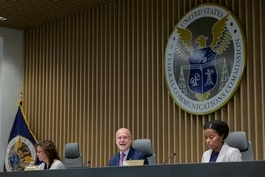
The television network ABC today sued the FCC, arguing the agency is waging what it calls a retaliatory campaign of censorship and violating its right to free speech.
AMNA NAWAZ: In the unprecedented suit, ABC says the commission has wielded its regulatory power to punish and pressure the network through investigations and, more recently, threats to strip local stations of their broadcast licenses.
The move is a major escalation in a long-simmering feud between the Trump administration, ABC and its parent company, Disney.
The FCC is currently comprised of three commissioners, Chairman Brendan Carr and Olivia Trusty, both appointed by President Trump, and Anna Gomez, appointed by President Biden in 2023.
And Commissioner Gomez joins us now.
Commissioner, welcome back.
Thanks for joining us.
ANNA GOMEZ, Commissioner, Federal Communications Commission: Good to be with you.
AMNA NAWAZ: So the suit in particular point to a decision the FCC made in April requiring eight Disney-owned local news stations to renew their broadcast licenses in some cases years before they are set to expire.
Just for context, how common is it for the FCC to take that kind of step?
ANNA GOMEZ: It's extremely unprecedented.
Never has the FCC gone after network content by targeting all of its local broadcast stations.
And it's been over a half-a-century since the FCC actually called in any license for early renewal.
AMNA NAWAZ: So, in a statement, we know the FCC says it's been examining claims Disney engaged in what it calls illegal DEI discrimination for over a year.
Chairman Carr told Reuters today he thinks Disney went to court to try to stop this proceeding because he says Disney is nervous.
In his words, he said: "Disney seems to be a little concerned about what the record's showing."
ABC says they have handed over thousands of documents already in compliance with this investigation.
Have you, in your role, seen those?
Do you believe there's any evidence that Disney is nervous about what those documents show?
ANNA GOMEZ: No one believes that this is about Disney's diversity, equity and inclusion policies.
Clearly, this is just a pretext to go after Disney because this administration does not like the content it's seeing on Disney, and Disney has refused to bow to the intimidation and to the pressure.
I'm very heartened to see Disney stand up for its First Amendment rights and its editorial decisions and filing to challenge the actions that this FCC has taken.
It's very important to note that the FCC is not the EEOC.
In fact, the FCC has lost previously in court where it was told the FCC is not the EEOC, and license renewals are not proceedings that can challenge Title VII rights.
So the FCC is outside of its remit with this pretext, but it's -- clearly, it's about the content of Disney's and ABC's programs, not about this investigation.
AMNA NAWAZ: Well, there's a separate probe, we should mention, into the ABC Daytime talk show "The View," and Chairman Carr was asked about these probes recently in an interview on FOX Business late last month.
Take a listen to what he had to say.
BRENDAN CARR, Commissioner, Federal Communications Commission: You broadcasters get subsidized access, free access to a valuable public resource, the airways, worth billions of dollars.
In exchange, you have to operate in the public interest.
That means you can't run news distortions, broadcast hoax.
You can't be engaging in this invidious form of DEI discrimination, and so the FCC is really enforcing rules that have been on the books for a very long time.
AMNA NAWAZ: Commissioner Gomez, what do you make of that argument that broadcasters, the chairman alleges, are not operating in the public interest in terms of what they broadcast?
ANNA GOMEZ: The FCC cannot target content based on this nebulous public interest standard.
The public interest for the FCC traditionally has been whether these broadcasters are serving their local communities.
You serve your local communities when you have weather, sports, when you are talking about breaking news.
That is serving your local communities.
The problem with the way this administration is banding about the term public interest is they basically use it to mean anything this administration doesn't like.
We are bound by the First Amendment and by the Constitution.
There is no generalized exception to the First Amendment just because you're a broadcast licensee.
AMNA NAWAZ: I want to point out the FCC in different forms is looking into a number of networks, CBS, ABC, NBC, notably not into FOX.
Chairman Carr has also sent a letter to the BBC about its editing of a Trump speech.
And, full disclosure, we should note that last year the FCC opened a probe into NPR, PBS, and some of their member stations, alleging they might be airing prohibited commercial ads.
PBS and NPR insist they are in compliance with federal laws and regulations.
But, Chairman -- Commissioner Gomez, the fact that ABC is now suing the FCC after earlier settling with the administration for some $15 million, does this signal to you a change in tactics or a change in the landscape?
Why now?
ANNA GOMEZ: I think what we have learned watching this administration over the last year-and-a-half is that you cannot buy peace from this administration.
You only buy time.
This administration demands that it be covered in the way that it wants to be covered.
It demands that there would be no critics, and it will simply keep coming back.
And that is what we have seen.
So I am very glad that Disney has found its courage.
And it is -- it should be encouraging to all other broadcasters not to cave to this administration's pressure, but rather to support the First Amendment, the freedom of the press and viewers' rights to see and to hear editorial content of their choosing.
AMNA NAWAZ: That is FCC Commissioner Anna Gomez joining us tonight.
Commissioner Gomez, thank you for your time.
We appreciate it.
ANNA GOMEZ: Thank you.
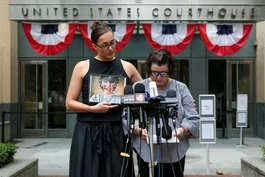
GEOFF BENNETT: In the day's other headlines: A federal trial against social media giant Meta kicked off today with four states laying out their case that the company's platforms harm children.
In their opening statements, California, Colorado, Kentucky, and New Jersey accused Meta of intentionally hooking users to harvest their data.
Meta denies any wrongdoing and says it has safeguards to protect young users.
But, outside the court, parents blamed the company for harming their children.
One mother spoke about her daughter Coco, who started using Instagram when she was 12 and later died at 17 of an overdose with drugs she bought on the platform.
JULIANNA ARNOLD, Founding Member, Parents Rise!
: By her teens, she could not look away.
Her scrolling became depression, then anxiety she could not escape.
GEOFF BENNETT: The states are seeking a financial penalty as high as $1.4 trillion and changes to how Meta operates its platforms; 25 other states are also suing the company.
Those trials will start at a later date.
In Hawaii, crews are working to clear roads and restore power to tens of thousands of people in the wake of Hurricane Lala.
The storm uprooted trees and caused flash floods from Honolulu to the Big Island this past weekend.
Officials have announced one fatality, a 90-year-old woman.
The state's governor says the damage, as he put it, could have been a lot worse.
Meantime, parts of Indiana are still reeling from catastrophic flooding that submerged entire neighborhoods.
In Indianapolis, floodwater has finally receded enough for some families to retrieve belongings from their homes.
Others have nowhere to go.
OLIVER RIGGLE, Indianapolis Resident: Got this just a few months ago, and now it's not livable, at least right now.
No one was going to take it from me, except for apparently Mother Nature.
GEOFF BENNETT: Authorities say some infrastructure will take months to repair, with roads and bridges washed out entirely.
Also today, nearly 100 million Americans across much of the South and Southeast were under heat alerts with triple-digit highs from Texas to the Carolinas through the end of the week.
Turning now to the war in Iran, President Trump said today that there are no talks taking place between the U.S.
and Iran, and none are scheduled.
On his social media platform, the president added, the U.S.
blockade of the Strait of Hormuz is -- quote -- "in full force and effect, and the strait is open and operating."
But that contradicted remarks from Iran's top negotiator, who today said the strait will remain closed.
MOHAMMAD BAGHER QALIBAF, Chief Iranian Negotiator (through translator): Let me be clear.
Until the United States fulfills its commitments under the agreement, including lifting the blockade, releasing frozen assets, lifting oil sanctions, ending threats and military operations on all fronts, the Strait of Hormuz will not reopen.
GEOFF BENNETT: Meantime, officials in Qatar said an agreement between Iran and Oman over the waterway would -- quote -- "make it much easier" for Iran and the U.S.
to resume talks.
President Trump has threatened to bomb Oman if it, in his words, gets in the way of efforts to reach a deal.
In Gaza, hospital officials say an Israeli strike on a fishing seaport killed at least six people, including a child, and wounded more than a dozen others.
This footage from the "News Hour"'s producer on the ground shows blood-stained shoes, scattered chairs, and debris littering the cafe.
Israel's military says it targeted Hamas commanders and several other militants, but did not provide evidence.
It comes a day after President Trump's envoy and son-in-law Jared Kushner wrapped up a trip to the region with no major progress made after talks with Israeli and Hamas leaders.
Ukraine launched nearly 800 drones across Russia overnight in one of its largest such attacks since Moscow's invasion more than four years ago.
Most of the drones targeted the Moscow region, where a local official posted this image of destruction at a local construction site.
Ukraine is increasingly using swarms of long-range drones to try to overwhelm Russian air defenses.
Meantime, in Northeastern Ukraine, authorities say at least 10 people were killed and more than a dozen injured when a Russian missile strike destroyed homes and businesses.
A resident whose cafe was hit described a scene of chaos.
YANNA CHELOMYTSKO, Cafe Owner (through translator): There was dust, smoke, screams, and cars were burning.
Some girls in my cafe managed to run into a basement.
We called out to each other to find out who was alive, who was not.
So many people died.
GEOFF BENNETT: Ukrainian President Volodymyr Zelenskyy described that strike as a brutal attack on civilians.
On Wall Street today, struggling A.I.
stocks weighed on the broader markets.
By the close, the Dow Jones industrial average was down more than 100 points.
The Nasdaq fell by 1.33 percent.
The S&P 500 ended lower for a third strait session.
And ESPN co-founder Bill Rasmussen has died.
A sports fan and former broadcaster himself, Rasmussen, along with his son, came up with the idea for a 24-hour cable sports channel in the late 1970s.
Host Lee Leonard helped launch the channel on September 7, 1979.
LEE LEONARD, ESPN: From football to soccer to baseball to basketball to tennis to track to golf, we will be with you covering it on ESPN.
GEOFF BENNETT: Rasmussen became known as the father of sports television and was inducted into the Sports Broadcasting Hall of Fame in 2025.
He died today in his Florida home from the effects of Parkinson's disease.
He was 93 years old.
Also today, Frank Beard, the only member of ZZ Top without that trademark facial hair, has died.
For more than five decades, Beard provided the propelling beat on hits like "Sharp Dressed Man" and "Gimme All Your Lovin'."
The Texas trio started out in the 1970s with a blend of Southern rock and blues and went on to sell more than 50 million records.
His publicist said Beard died today at his ranch in Texas.
Frank Beard was 77 years old.
Still to come on the "News Hour": the U.S.-South Korea alliance frays amid President Trump's pressure to scale back joint military drills; we speak to a pastor recently freed from a Chinese prison; and a new exhibit showcases the artwork of a former inmate turned criminal justice activist.
Voters head to the polls today to vote for primary election candidates in Alaska, Florida, and Wyoming.
We're taking a closer look now at a couple of themes emerging in this year's contests.
First up, election deniers running for office across the country.
AMNA NAWAZ: In several key battleground states, Republican candidates who've questioned the legitimacy of the 2020 election are on the ballot.
If elected to statewide offices like governor and secretary of state, these candidates could shape how elections are administered and certified in the years ahead.
Our White House correspondent, Liz Landers, has been tracking all of this and joins us now.
So, Liz, who are some of these election deniers running in key states, and could some of them win?
LIZ LANDERS: The answer is yes.
The Constitution says that states decide the time, place, and manner of conducting their own elections.
So that's why we wanted to look at who was running for governor and secretary of state in some of these key swing states.
In five of the most important swing states, looking at these governor's races, there's a Republican nominee who has a record of election denialism.
Let's start with Arizona, Andy Biggs.
He voted against certifying the 2020 election in his own state there as a sitting member of Congress.
In Michigan, John James has said that the 2020 election was -- quote -- "rigged and manipulated" against himself and Donald Trump.
In Wisconsin, Tom Tiffany objected to the 2020 certification for both Arizona and Pennsylvania.
In Georgia this cycle, we have Rick Jackson.
He ran ads against the current secretary of state, Brad Raffensperger, who did certify that 2020 election.
He ran in that gubernatorial primary.
He likened him to Judas for his resistance to Trump's pressure to overturn the 2020 election result in that state.
And then, finally, in Pennsylvania, we have Stacy Garrity.
She's pointed to irregularities, she says, in the 2020 vote.
Amna, Georgia, Michigan, and Arizona, of course, are all states where the Trump administration has shown up for various investigations into the 2020 election.
And one more state I want to mention, Florida, as we said, is voting today.
They're not a swing state anymore, but they do have the gubernatorial likely Republican nominee.
Byron Donalds does have an election denier history and he would appoint the secretary of state in that state.
AMNA NAWAZ: So what about some of the downballot races, offices like secretary of state, that are more directly involved with election administration?
LIZ LANDERS: So, two of these key swing states.
Arizona and also Nevada, have Republican nominees right now who have a history of questioning the 2020 election results.
In Arizona, Alex Kolodin represented some of the alternate electors as an attorney himself.
He also filed a lawsuit to try to overturn Biden's election win in 2020.
In Nevada, there's also a candidate who's running again there, Jim Marchant.
He's been a vocal election denier, and he has been closely tied to the fake electors scheme and been photographed with those people in late 2020.
Arizona is particularly concerning, though, because the slate of Republican candidates, they're all election deniers.
We mentioned Biggs and Kolodin.
And also the attorney general nominee there is an election denier too.
So if all of these candidates win in November, they could play a key role in overseeing the elections and voting laws in that state.
Arizona has also been a focal point of the Trump administration with Secretary Noem visiting there, making a speech about election integrity.
And this is not a swing state either, but Nebraska also has an interesting candidate, Republican Scott Petersen.
He has election denier history himself and has amplified conspiracies about the 2020 election there for years and has also questioned the voting machines in that state.
AMNA NAWAZ: So, Liz, we have some examples we can look back on in history, right?
In 2022, there were some election deniers who also ran for office.
How did they do?
And for those that won, what did they do once they got into office?
LIZ LANDERS: Sure.
Let's look at some of the governors who won in 2022.
In Texas, Governor Abbott, in Florida, Governor DeSantis, and in Alabama, Governor Ivey have all overseen mid-decade redistricting efforts, which is a big push that obviously happened in the last few months that we have been covering.
There were, of course, Republicans that won governor's races in that cycle who did not push those kinds of policies.
But then when you also look at secretary of state candidates that won in 2022 as well, Wes Allen is an interesting example of this from Alabama, because he led that state to leave ERIC, which is this electronic voter registration system that most election officials that I have talked to have said is really helpful for them to cross-reference voters registration in those states.
But there were also a number of secretary of state candidates, election deniers in 2022, who lost, Kristina Karamo in Michigan, Mark Finchem in Arizona, Jim Marchant again in Nevada, and Jody Hice in Georgia.
But if those candidates had won, they could have had a pretty big impact on this election cycle because they would have been overseeing these.
AMNA NAWAZ: We have seen election denialism become more mainstream in the Republican Party.
We have also seen efforts in Congress to try to clarify election certification.
So what exactly has changed since 2020?
LIZ LANDERS: After January 6, 2021, there was a big push in Congress to further clarify what the role of Congress is and the role of the vice president is in the certification process.
Congress passed the Electoral Count Reform Act in December of 2022.
And two points, I think, that really stick out based on what happened at the Capitol on January 6, this piece of legislation has made it absolutely clear that the vice president's role in the electoral vote-counting process is ministerial.
The vice president cannot reject electors.
That was something that President Trump at the time was pushing Vice President Mike Pence to do.
It also makes it more difficult for members of Congress to make objections to state election results.
That was another part of what happened on January 6 that snowballed the whole insurrection of the Capitol that day, Amna.
AMNA NAWAZ: All right, Liz Landers, thank you very much.
LIZ LANDERS: Of course.
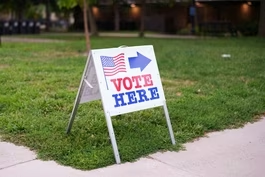
GEOFF BENNETT: Well, voters heading to the polls in Alaska today are also considering a ballot measure that aims to reduce the influence of big money donors in state and local elections.
It's part of a wider national conversation about money in politics sparked by a Supreme Court decision earlier this year that struck down limits on how much political parties can spend in coordination with their candidates in national elections.
For more, we're joined now by Daniel Weiner, senior director of the Elections and Government Program at the Brennan Center for Justice.
Thanks for coming in.
DANIEL WEINER, Brennan Center for Justice: It's a pleasure to be here.
GEOFF BENNETT: So, Alaska voters are considering a $2,000 cap on individual campaign contributions.
Why has campaign finance become a big issue in Alaska?
DANIEL WEINER: Well, Alaska voters actually have a pretty long history of caring about this issue.
They had actually lower limits that were enacted a while back, and a court struck those down in 2021.
So this is an effort to enact new limits that would comply with the court's decision, slightly higher, but I think it's pretty clear that there's a desire to have limits on money in politics in Alaska.
GEOFF BENNETT: And how significant is that Supreme Court ruling in this era of massive outside spending?
DANIEL WEINER: I think the best way to understand their ruling is part of a series of rulings that have chipped away at safeguards.
Obviously, one the most famous ruling was Citizens United decided in 2010.
And what that has basically done is eliminated most of the guardrails around money in our elections.
And what we see, of course, is that voters don't like this.
Upwards of 80, 90 percent of voters think corruption is a big problem, and they don't like the amount of money in politics.
GEOFF BENNETT: Well, yes, on that point, there's a Brennan Center poll from earlier this year found that nine in 10 voters believe that corruption is a big problem in politics.
So why the disconnect?
DANIEL WEINER: I mean, I think this is one area where the Supreme Court is really on the wrong side of public opinion.
Now, politics costs money.
You're not going to get money out of politics.
But the idea that you should have so much money coming from such a tiny number of Americans, voters don't like that.
They think it breeds undue influence and they're not happy.
They see it as a type of corruption.
And you see that in initiatives like Alaska.
Voters really want to see change.
GEOFF BENNETT: Who benefits the most from that Supreme Court ruling, especially heading into 2028?
DANIEL WEINER: I mean, I think that both parties have adapted to Supreme Court rulings.
I think this specific Supreme Court rule, clearly,.
the Republicans think that they're going to benefit more.
Democrats seem to think that too.
I predict over, the long term, though, the both parties tend to adapt to fund-raising.
The real losers, honestly, are the voters, who don't like having their elections run this way.
And I think obviously another big beneficiary is the interests that can afford to make these gigantic contributions.
GEOFF BENNETT: We're also seeing more dark money in politics and groups using supposedly supportive ads that actually hurt candidates.
Are disclosure laws keeping pace with how campaign money is actually being spent?
DANIEL WEINER: No, they're not.
There's more and more dark money in elections.
It's actually also becoming harder to track.
So what happens now is, a lot of these groups that keep their donors secret, they give to super PACs, which supposedly do disclose their donors.
But then, if you look at the report, there's actually no way to tell who's actually behind the group.
So we're seeing more and more secret money is another thing voters are not happy about, upwards in our poll 85 percent wanted to see more transparency in elections.
GEOFF BENNETT: We have also seen big spenders lose this year.
In Michigan, you had Haley Stevens, despite this huge spending advantage over Abdul El-Sayed.
Does money matter less than we think?
DANIEL WEINER: You know, that's such a great question.
I think money matters.
It doesn't mean that there's a one-to-one correspondents of dollars to votes.
I think, if you talk to most candidates, they think they need enough money.
They don't necessarily need more money, and there certainly are diminishing returns.
So you have seen candidates like in Michigan who get outspent.
I would say, though, that victorious candidates generally do have enough money to compete.
And so it's not that money is irrelevant.
I think it can mean oversimplification to just say whoever has the most money in their corner is always going to win.
GEOFF BENNETT: Daniel Weiner, senior director of the Elections and Government Program at the Brennan Center for Justice, thanks for being here.
DANIEL WEINER: Thank you so much for having me.
GEOFF BENNETT: President Trump is putting new strain on one of America's closest military alliances and raising broader questions about what the U.S.
now expects from its allies.
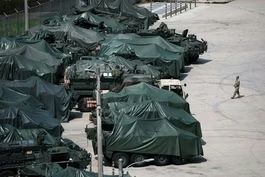
The president has ordered the Pentagon to substantially scale back joint military exercises with South Korea, citing their cost, his relationship with North Korean leader Kim Jong-un, and Seoul's refusal to join the U.S.
effort against Iran.
DONALD TRUMP, President of the United States: Why are we doing it?
So all I want is fairness.
And South Korea, I get along with them very well.
But we can't go around and protect all of these countries, especially when they're not there to help us.
GEOFF BENNETT: The annual drills are a cornerstone of the decades-old alliance intended to prepare American and South Korean forces for a potential conflict with the nuclear-armed North.
Mr.
Trump's decision has prompted fresh questions in Seoul about America's reliability as a security partner.
President Lee responded earlier today.
LEE JAE MYUNG, South Korean President (through translator): A strong South Korea-U.S.
alliance in strengthening our independent defense capabilities are mutually reinforcing.
A strong alliance makes the foundation of security stronger, and strengthening our own capabilities increases our value and necessity as an ally.
GEOFF BENNETT: The dispute is the latest example of President Trump taking a more transactional approach to traditional alliances, pressing partners not just to spend more on their own defense, but to support U.S.
priorities elsewhere in the world.
For more, we're joined now by retired Rear Admiral Mark Montgomery.
He's had a 32-year career in the U.S.
Navy, served on the National Security Council staff, and later as policy director on staff of the Senate Armed Services Committee.
He's now a senior fellow at the Foundation for Defense of Democracies.
Thank you for being with us.
REAR ADM.
MARK MONTGOMERY (RET.
), Foundation for Defense of Democracies: Thank you for having me.
GEOFF BENNETT: President Trump linking military cooperation with South Korea to Seoul's decision not to support the war in Iran, how significant a shift is that in the way the U.S.
manages alliances?
REAR ADM.
MARK MONTGOMERY (RET.
): This is really unusual.
I mean, the United States -- throughout my whole military career, and I think in general, the United States has always said one of our greatest strengths are our allies and partners.
We should be leveraging them, not punishing them.
And in this case, South Korea has a significant challenge to face in North Korea.
North Korea is getting stronger and more powerful because of its relationship with Russia and its contributions to the Russian war effort in Ukraine.
And they have a greater threat to South Korea right now.
So South Korea is really trapped on the peninsula worried about North Korea.
So I think it's very inappropriate for the president to try to transactionally place South Korea in extremis for their failure to support Iranian -- operations in Iran.
GEOFF BENNETT: Well, what's the through line here?
Do you see an identifiable strategy, or is this policy being driven by the president's own relationships, grievances, preferences, and instincts?
REAR ADM.
MARK MONTGOMERY (RET.
): I would say yes, yes, yes, and yes.
And what I mean is, he actually did this in 2019 as well.
He believes he has this kind of personal relationship with other -- with authoritarian leaders, and that he can somehow change them.
Kim Jong-un is not going to give up his nuclear weapons.
He's not going to come to an agreement with South Korea.
And the president's not going to get a Nobel Prize, going to negotiate some big deal with North Korea.
And what he's really doing is working with one of the members of the kind of axis of aggressors that's challenging the United States around the world, whether it's in China with Taiwan or Russia and Ukraine in Eastern Europe or North Korea and South Korea.
So he's really -- he's really trying to work with the other team and not with his allies and partners in South Korea and Japan.
GEOFF BENNETT: I want to return to this word transactional.
How do you distinguish between effective burden-sharing and an alliance becoming transactional?
REAR ADM.
MARK MONTGOMERY (RET.
): But, first, let's be clear.
The president was correct in his criticism of Europe and even Japan, Taiwan, Korea at some point.
They were not spending enough on defense.
Particularly in Europe, they were down in the below 2 percent on average before he started to complain about it in 2017 and 2018.
And they have changed, mostly because of Putin's invasion of Ukraine, but also because of their own investment.
So he has achieved something there.
But the problem is, not everything is this -- is a -- can be viewed for the prism of, you support me here, I will support you there.
And his attacks on -- his threatening of Greenland, his disinvestment from Ukraine, they really send a strong signal that the United States is not a credible partner in Europe, for example.
This removing -- dropping out of these critical exercises that drive U.S.
and Korean force readiness sends a strong signal that we're not a credible partner to Korea, Japan, and Taiwan.
There's a real risk in this transactional approach that far exceeds the benefit of getting them to spend a little more money on their defense.
GEOFF BENNETT: And what does China learn from tensions between Washington and its Asian allies?
REAR ADM.
MARK MONTGOMERY (RET.
): Well, China's learning that we're easy to distract.
I mean, we have been just distracted in Europe and Ukraine, and others got involved in that and created bad relations between the United States and its European NATO allies.
We have been distracted in the Middle East.
We're using our munitions up significantly there.
China's learning that the United States has a simultaneity problem.
We can't deal with two theaters simultaneously.
The George Washington carrier strike group is leaving the Indo-Pacific now to go to the Middle East, and we will be with basically a destroyer or two spread throughout the whole Western Pacific.
So if China were in a position to take advantage of it, which I'm not sure they are at this moment, but, if they were, they could take advantage of it.
So it's a really strong negative deterrent signal from the United States that we're unable to handle two theaters simultaneously.
GEOFF BENNETT: And the USS Abraham Lincoln, as you well know, has spent an extraordinary amount of time at sea.
You commanded a carrier strike group, as I understand it.
What does 270 days, nearly nine months without a port visit, mean for the sailors, the ship, and its overall readiness?
REAR ADM.
MARK MONTGOMERY (RET.
): So it's hard.
I mean, I commanded a carrier strike group whose maximum deployment was about 4.5 months because we worked out of the -- out of Japan.
I have done deployments of seven and eight months in length.
They're very hard.
A nine-month deployment on the Lincoln is hard on the crew.
It's also hard because they had 250 days between port visits, and that number will get larger, like you said, to about 270 days.
That's unprecedented.
And on top of it, they had no end date.
That's the killer in terms of angst and eventually depression in your sailors, is not knowing when it's going to end, when they can resolve their problems with their family, when they can see their new children, things like that.
So I'm glad that Admiral Brad Cooper stepped up, put an end date to this by getting the George Washington named as its relief and visiting the ship.
That's the kind of leadership you expect from the military, not the kind of leadership we got from the president, where he kind of made it -- he kind of minimized the impact on the ship.
I'm not sure he really understands what nine months in the very limited living spaces are for our junior enlisted folks.
It's not comfortable and it is stressful.
GEOFF BENNETT: And what does it signal more broadly about the demands being placed on the U.S.
military right now?
REAR ADM.
MARK MONTGOMERY (RET.
): Well, that's the real key here is that if this kind of where we're doing blockade ops, protecting the Bab al-Mandab, protecting two carrier strike groups, maintaining a defense of Israel with ballistic missile assets, and both at sea and ashore and extra fighter squadrons to potentially do attacks, we're really stressing the military.
It's very -- another six to eight months of this, and we're going to have a massive what we call a readiness bathtub.
That's where 18 months from now to two years from now, our fighter squadron readiness is down around 30 percent, we're unable to deploy aircraft carriers,we don't have enough destroyers at sea, we don't have enough army ballistic missile defense systems.
The systems we use in Iran are key to a war fight with China or Russia.
And so if you have a readiness decline in those, a significant one, two to three years from now, we're not going to be ready for a conflict with just one opponent in two or three years, and that's because of this -- these long 12-to-18-month deployment span that we're looking at total for the force to deal with this Iran issue.
GEOFF BENNETT: Retired Rear Admiral Mark Montgomery, now a senior fellow at the Foundation for Defense of Democracies, thank you for being with us.
REAR ADM.
MARK MONTGOMERY (RET.
): Thank you for having me.
GEOFF BENNETT: And a note that we will have another perspective on U.S.
relations with its historic allies tomorrow on the program.
AMNA NAWAZ: It doesn't have sharp teeth or claws, but the bite of a small mosquito kills more people than any other animal on Earth.
And as the climate warms, mosquito season is lasting longer, giving them more time to spread dangerous diseases.
Ben Tracy with Climate Central reports on the surprising way scientists are fighting back.
BEN TRACY: It's delivery day in the San Gabriel Valley... MAN: Oh, good.
Heck yes.
BEN TRACY: ... just east of Los Angeles.
TRISTAN HALLUM, Director of Scientific Programs, San Gabriel Valley Mosquito and Vector Control District: This is completely bonkers.
BEN TRACY: And Tristan Hallum'S latest shipment... TRISTAN HALLUM: All 25 tubes are here.
BEN TRACY: ... is not something you normally find in a box.
TRISTAN HALLUM: What I'm listening for is the sound of 600 adults flying around.
All right, let's head on in.
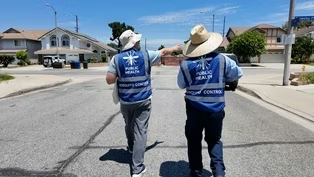
BEN TRACY: Their blue vests are a pretty good clue as to what's inside.
So what's in the tube?
TRISTAN HALLUM: So inside this tube is actually 600 male Aedes aegypti mosquitoes that we just received overnight from Kentucky.
BEN TRACY: Hallum oversees scientific programs for the San Gabriel Valley Mosquito Control District.
Do you like mosquitoes?
TRISTAN HALLUM: I enjoy working with them, but I like to kill them.
(LAUGHTER) BEN TRACY: He's targeting invasive mosquitoes that can spread diseases, including Zika, West Nile virus, and dengue fever.
TRISTAN HALLUM: San Gabriel valley was one of the first agencies to see local dengue transmission just a few years back.
BEN TRACY: Oh, yikes.
There they come.
They're releasing 30,000 mosquitoes every week containing a bacteria that helps block disease transmission.
TRISTAN HALLUM: So, in total, we're going to be releasing just under half-a-million mosquitoes.
BEN TRACY: And how effective is this?
TRISTAN HALLUM: That's one of the things that we're hoping to find out.
In previous studies, they have seen upwards of 80 to 95 percent control reduction in the areas that they have been releasing.
BEN TRACY: As the climate warms, mosquito seasons are getting longer.
Climate Central found nearly 95 percent of the cities it analyzed now have more days each year suitable for some of the most common species of mosquitoes to spread disease, 18 more days on average than in the early 1970s.
TRISTAN HALLUM: What we would used to refer to as the mosquito season would only be, say, May to September.
But now we have individuals treating for mosquito control activity all season long.
BEN TRACY: For these releases, they don't need bug spray.
I don't see any bites on your arms.
Because they're all male mosquitoes, and males don't bite.
STEPHEN DOBSON, President, MosquitoMate: I tell people it's the opposite of the human species.
It's the females that cause trouble in the mosquito world.
BEN TRACY: Professor Stephen Dobson supplies those mosquitoes.
He's president of MosquitoMate in Lexington, Kentucky.
STEPHEN DOBSON: The common name for this mosquito is the yellow fever mosquito, and yellow fevers are really nasty.
BEN TRACY: His team breeds this specific species of mosquito in their lab and ships them to control districts across the country.
These males carry a naturally occurring bacteria called Wolbachia, which makes them incompatible with females they try to mate with.
STEPHEN DOBSON: And when they do, those females are then sterile for the rest of their lives.
They will lay eggs, but those eggs don't hatch.
If enough of the females are not producing any offspring, then the population goes down.
BEN TRACY: Are these things genetically modified in some way?
STEPHEN DOBSON: They are not.
This is a naturally occurring bacterium.
We're just moving the bacterium from one mosquito to another.
BEN TRACY: This EPA-approved approach can cut certain mosquito populations by 70 to 95 percent.
The World Mosquito Program is using similar methods in 16 countries, including Brazil, where it produces 110 million Wolbachia mosquitoes each week.
Some communities there have seen dengue cases fall by 89 percent.
STEPHEN DOBSON: These are the immature mosquitoes.
BEN TRACY: Dobson says new tools are needed because climate change isn't just making mosquito seasons longer.
It's expanding their range.
STEPHEN DOBSON: The general trend is, they're moving northward into places that historically have been too cold.
BEN TRACY: Overall, temperatures are going up and the atmosphere is becoming wetter.
Is that a good thing for mosquitoes in terms of their ability to survive?
STEPHEN DOBSON: For these mosquitoes, unfortunately, yes.
It's exactly what they like, a nice warm, humid environment.
TRISTAN HALLUM: Let's see what's inside.
BEN TRACY: Tristan Hallum says if his traps catch fewer disease-carrying females this summer, he will know the boy bugs are doing their job.
TRISTAN HALLUM: As long as we're not seeing females recollected in this trap, we know that we're seeing a reduction in the population in this area.
BEN TRACY: For the "PBS News Hour," I'm Ben Tracy with Climate Central.
GEOFF BENNETT: China recently took a rare step.
It released a detainee at the request of the U.S.
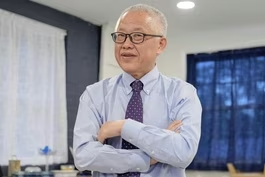
Pastor Ezra Jin Mingri was picked up by Chinese authorities last October, one of dozens of Christians targeted by the Chinese Communist Party, which only allows authorized churches to serve China's estimated 80 million Christians.
Pastor Jin, as he is known, is now free after a personal request by President Trump to Chinese leader Xi Jinping.
He and his daughter spoke to our Nick Schifrin, who begins his story in an underground church in Beijing.
NICK SCHIFRIN: On the sixth floor of a Beijing apartment building, an unmarked door, inside, a secret church for those prohibited from praying in public.
It's 2019, and Xu Yonghai was the pastor of the Holy Love Fellowship, a congregation of China's most vulnerable Christians, critics of the communist government, his sanctuary also his apartment and bedroom.
There was good reason for secrecy.
In 2014, he and his entire parish was detained.
XU YONGHAI, Pastor, Holy Love Fellowship (through translator): We were arrested because we defended the rights of other churches.
NICK SCHIFRIN: Christian activists say the government has demolished thousands of unsanctioned churches and targeted their parishioners, including the largest unsanctioned church, Zion.
In 2018, Beijing detained its leader, Ezra Jin Mingri, for refusing to install facial recognition cameras.
The church was forced to go mostly virtual, which meant it grew dramatically from 1,500 to more than 10,000 worshipers across 40 cities.
Last year, Beijing's security officials came for Zion again, detaining church leaders during a retreat for elderly church members.
It was one of Beijing's largest ever crackdown on Christians, including Pastor Ezra Jin Mingri's second detention.
DONALD TRUMP, President of the United States: I think he's giving very serious consideration to the pastor.
NICK SCHIFRIN: In May, President Trump told reporters he had brought up the case during meetings with Xi in Beijing.
And then, last month, after 266 days in detention, Jin was freed into the embrace of his daughter Grace, who hadn't seen him because he was banned from leaving China more than five years ago.
I spoke to them in our studio last month.
GRACE JIN DREXEL, Daughter of Pastor Ezra Jin Mingri: When I saw him, I didn't even recognize him.
We haven't seen each other in the last six years for me.
So it's just incredible.
When I first heard in October, we were like deer in the highlights.
We just didn't know what to do, and just shocked, and there was always this sense of like the world was collapsing, and we are in a sense competing or trying to have the second most powerful nation in the world to change their policies or change their decisions, and that that seemed impossible.
That seemed so insurmountable.
NICK SCHIFRIN: Can you tell me about your detention?
What were the conditions inside?
PASTOR EZRA JIN MINGRI, Founder, Zion Church (through translator): The conditions were obviously very bad.
The food and 30 or so people living in a tight space, there isn't any freedom.
We just sit on a stool.
We need to raise our hands to ask for permission to walk around.
All my communications were cut off.
NICK SCHIFRIN: When Beijing police targeted Zion, they first charged parishioners and Pastor Jin with -- quote -- "illegally using information networks."
Beijing ended up prosecuting them for operating an illegal business and fraud.
There are Chinese government-approved ministries that display banners like this one, implement the basic direction of the Communist Party's religious work.
But Chinese President Xi Jinping has long described minorities and their cultures and religions as threats to the stability of the Communist Party and therefore the country.
It's not only Christians.
In 2017, Beijing set up what activists called concentration camps for Muslim Uyghurs.
It was part of a crackdown on Uyghur language and culture and later became forced labor.
On the last day of the first Trump administration, the U.S.
accused Beijing of genocide.
PASTOR EZRA JIN MINGRI (through translator): Chinese society is a totalitarian society.
Therefore, the party is in charge of everything.
Ethnic minorities and various religious beliefs, and even some opinionated people, as well as independent intellectuals, are facing huge pressure in China, even oppression.
NICK SCHIFRIN: Do you believe that your release was the product of a personal appeal by President Trump to Xi Jinping?
PASTOR EZRA JIN MINGRI (through translator): Of course, only if the American president said so in person and Chinese Chairman Xi decided that this could happen.
NICK SCHIFRIN: Today, eight Zion Church leaders remain imprisoned.
Their families are desperate for international help, but Beijing vows to put them on trial.
That's a fate that Grace Drexel feared for her and her father.
WOMAN: Free Pastor Jin.
NICK SCHIFRIN: This past May, Grace Jin helped lead a Washington, D.C., rally, calling for Beijing to release its prisoners.
Her father's detention was especially difficult because, when he was detained, she was pregnant.
GRACE JIN DREXEL: I told my father a week before that we were pregnant.
And then my dad got detained.
My father's been detained this whole time.
And now the baby's about to be born and he is still detained.
My father's situation, we were looking at very easily 15 years in prison.
And so in my mind, if my father was in there for 15 years, and we're not allowed to see him or not allowed to communicate with him, like, we would -- that might have been the end of -- he knew that I was pregnant.
I was able to tell him about that a week actually before that he was arrested.
But we were still first trimester, and we were not sure about whether -- the tremendous pressure that we were also going through, on whether the baby would come be with us.
NICK SCHIFRIN: But the baby is with them.
His name is Ezra, named for his grandfather.
GRACE JIN DREXEL: So incredibly, incredibly grateful and so incredibly just without -- like, I'm without words.
I don't really know how to explain this overwhelming opportunity or joy or miracle that we have seen.
NICK SCHIFRIN: It's very important for you, isn't it, to be with your grandson?
PASTOR EZRA JIN MINGRI: Yes.
NICK SCHIFRIN: What change, Pastor Jin, would you like to see in China for your grandson's generation?
PASTOR EZRA JIN MINGRI (through translator): I think that many imprisoned Christians love their country and motherland.
I hope that in China's future people can worship God without fear.
NICK SCHIFRIN: But there is still fear, and Chinese Christians often have to hide their faith.
For the "PBS News Hour," I'm Nick Schifrin.
AMNA NAWAZ: Well, his work is now shown in major museums and galleries, but Jesse Krimes created some of his first artwork in prison.
GEOFF BENNETT: And following his release, he's also become a strong advocate for the formerly incarcerated and for reforming the overall system of mass incarceration.
Senior arts correspondent Jeffrey Brown reports from Philadelphia for our Art in Action series exploring the role of art in democracy, which is part of our Canvas coverage.
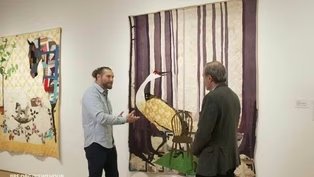
JEFFREY BROWN: A correctional facility in Philadelphia, a mural high on a city wall, a quilt hanging in a downtown museum, all with a common name, Riverside, and all connected by artist Jesse Krimes.
JESSE KRIMES, Artist: The connection for me is - - me personally, is how to be a conduit.
How do I create things out in the world that can help amplify or make visible or create new narratives and ways of seeing and thinking for people who are quite literally hidden behind walls?
JEFFREY BROWN: Well, they have been taken out of the community.
JESSE KRIMES: Right.
JEFFREY BROWN: At Philadelphia's Fabric Workshop and Museum, Krimes' latest exhibition is titled Elegy Quilts, from a series he began in 2020 during the pandemic.
Each quilt is a kind of portrait of an incarcerated individual, but without the actual person, other than pieces of his her own clothing or bedsheets that were sent to Krimes.
JESSE KRIMES: Up there, you can see the button from a shirt.
And so this entire striped tree is actually from a button-up shirt that someone had given me.
JEFFREY BROWN: Also missing, the prison.
Instead, Krimes asked people to send them a favorite memory of home, an animal they love.
He then created a scene and an absence.
You wanted us to see something other.
JESSE KRIMES: Yes, because the viewer senses some kind of absence.
Like, why are all of these empty chairs or empty beds or empty bathtubs or - - and so you get a sense of that loss.
JEFFREY BROWN: Krimes taught himself to sew and quilt specifically for the project.
The goal, as with much of his work: JESSE KRIMES: Challenging just these kind of damaging, harmful narratives that have existed for a very long time around the stigma of people who happen to have made a mistake and end up behind prison walls, because, for me, some of the most amazing people I have ever met in my life were behind those walls.
JEFFREY BROWN: Between 2001 and 2013, Krimes -- and that is his real name -- spent nearly eight years in state and federal prisons on nonviolent drug charges.
An only child born to a 16-year-old single mother growing up in rural Lancaster County, Pennsylvania, and often left alone, he says making things has always been a place of safety, something he could call his own.
Later, he would study at the Tyler School of Art and then Millersville University's in Pennsylvania.
But from his teens on, he was in and out of trouble, capped by a federal drug charge, and, while awaiting sentencing, nearly a year in solitary, punishment he says was meant to coerce him to give information on others, which he refused.
JESSE KRIMES: Literally, every part of my identity out in the world has been removed.
But I realized there was one thing that they couldn't take from me, and that was my ability to create and actually make something that is mine.
That gave me autonomy.
And so I just decided from that moment on that, no matter what kind of time I got as a sentence, I was going to use every minute and every hour of every day to make something positive in the world.
And that was my artwork.
JEFFREY BROWN: He made works that years later have been exhibited at the Metropolitan Museum of Art, altering materials at hand in prison.
In Apokaluptein:16389067, his inmate number, he used bedsheets and hair gels, in Purgatory (2009), playing cards, prison-issued bars of soap and mug shots, creating piece by piece what he would later on the outside assemble into a large work.
JESSE KRIMES: I started collecting the cards from the guys and I would buy them new decks of cards and take their old ones, and I would cut off the faces of the kings, jacks and queens and glue them together to create like a container that I would then house the soaps in, putting the mug shot of the offender where the royalty was and cover it up and put them in envelopes and kind of sneak them out of the prison.
JEFFREY BROWN: You must have been a little surprised some years later that they were in the Metropolitan Museum of Art.
JESSE KRIMES: I was quite surprised.
JEFFREY BROWN: Released in 2014, Krimes has since combined his own art making with work on behalf of others, including the creation of the Center for Art and Advocacy in Brooklyn, New York, aimed at supporting and exhibiting formerly incarcerated artists, while also calling attention to what he sees as a brutal system of mass incarceration, one he says makes all of us less safe.
JESSE KRIMES: We're putting them behind prison not for rehabilitation, but for storage, often for decades, and then those people eventually get released and come back to the community.
And there's no support systems, there's no mental health, there's no wellness, there's no real programs, there's no programs inside, there's no real programs outside to support that transition, and you're basically ensuring that you have future victims.
JEFFREY BROWN: At 43, Krimes also continues to work with Mural Arts Philadelphia, a group dedicated to public art of all kinds, including arts programs inside and out of local correctional facilities.
The Elegy Quilts exhibition features a series of small collages made by formerly incarcerated individuals who joined in workshops with Krimes, again prompted to think about places of comfort.
December Collins did that and more.
DECEMBER COLLINS, Artist: I... JEFFREY BROWN: I see your name.
DECEMBER COLLINS: Yes, December.
(LAUGHTER) DECEMBER COLLINS: And... JEFFREY BROWN: You couldn't resist?
DECEMBER COLLINS: No, I couldn't.
It just popped out to me at the end of me cutting out pictures through magazines and all these things.
But it was just more so, like, I felt like my life was just like a big old jumble of good and bad, shall I say.
So I just felt like me being a centerpiece, and it created the space for who I was becoming.
JEFFREY BROWN: For his part, Jesse Krimes took various images from the collages, including December's, and put them into the quilt titled Riverside.
His own life experience, he says, continues to compel his art, as well as his advocacy.
But I also asked about the victims of Krimes or their loved ones, who may not always get a second chance to turn around their lives.
What do you say to people like that?
JESSE KRIMES: I don't claim to have those answers.
Everyone has the right to think and feel how they want on this issue.
But for me personally, I want to have the space to heal, and I want to create the space for others to heal.
JEFFREY BROWN: Jesse Krimes' Elegy Quilts exhibition is on through November 1.
For the "PBS News Hour," I'm Jeffrey Brown at the Fabric Workshop and Museum in Philadelphia.
GEOFF BENNETT: Be sure to check our Web site for live election results from today's primary elections in Alaska, Florida, and Wyoming.
You can find up-to-the-minute coverage at PBS.org/NewsHour.
AMNA NAWAZ: And that is the "News Hour" for tonight.
I'm Amna Nawaz.
GEOFF BENNETT: And I'm Geoff Bennett.
For all of us here at the "News Hour," thanks for spending part of your evening with us.
 New
NewABC says FCC waging a retaliatory campaign
Video has Closed Captions
ABC says FCC waging a retaliatory campaign violating free speech rights (6m 11s)
 New
NewElection deniers run for key offices in battleground states
Video has Closed Captions
2020 election deniers on the ballot for key offices in battleground states (6m 5s)
 New
NewFreed pastor describes China's crackdown on religion
Video has Closed Captions
'The party is in charge of everything,' freed pastor says of China's crackdown on religion (7m 15s)
 New
NewThe growing debate over big money in American politics
Video has Closed Captions
The growing debate over big money influence in American politics (4m 28s)
 New
NewNews Wrap: Meta faces trial over arguments it harms children
Video has Closed Captions
News Wrap: Meta faces trial over arguments its platforms harm children (6m 40s)
 New
NewQuilt exhibit showcases artwork of inmate turned activist
Video has Closed Captions
Quilt exhibit showcases artwork of inmate turned criminal justice activist (7m 25s)
 New
NewScientists fight mosquitoes as warming climate expands threat
Video has Closed Captions
Scientists explore new ways to target mosquitoes as warming climate expands threat (4m 35s)
 New
NewSouth Korea shift highlights Trump's transactional approach
Video has Closed Captions
South Korea relationship shift highlights Trump's transactional approach to allies (9m 9s)
Providing Support for PBS.org
Learn Moreabout PBS online sponsorship New Episode
- News and Public Affairs

Today's top journalists discuss Washington's current political events and public affairs.

- News and Public Affairs

FRONTLINE is investigative journalism that questions, explains and changes our world.
 New Episode
 New Episode
 New Episode
 New Episode
 New Episode
 New Episode
 New Episode
 New Episode
 New Episode
Support for PBS provided by:
Major corporate funding for the PBS News Hour is provided by BDO, BNSF, Consumer Cellular, American Cruise Lines, and Raymond James. Funding for the PBS NewsHour Weekend is provided by...