
August 28, 2024
8/28/2024 | 55m 49sVideo has Closed Captions
Victoria Nuland; Albin Kurti; Gen. Wesley Clark (Ret.); Ruth Whippman
World leaders are descending on Washington for NATO’s 75th anniversary summit. Veteran diplomat Victoria Nuland joins the program to discuss. What can the NATO leaders learn from the past? General Wesley Clark and Prime Minister of Kosovo Albin Kurti weigh in. Ruth Whippman on her new book, "BoyMom: Reimagining Boyhood in the Age of Impossible Masculinity."
Problems playing video? | Closed Captioning Feedback
Problems playing video? | Closed Captioning Feedback
August 28, 2024
8/28/2024 | 55m 49sVideo has Closed Captions
World leaders are descending on Washington for NATO’s 75th anniversary summit. Veteran diplomat Victoria Nuland joins the program to discuss. What can the NATO leaders learn from the past? General Wesley Clark and Prime Minister of Kosovo Albin Kurti weigh in. Ruth Whippman on her new book, "BoyMom: Reimagining Boyhood in the Age of Impossible Masculinity."
Problems playing video? | Closed Captioning Feedback
How to Watch Amanpour and Company
Amanpour and Company is available to stream on pbs.org and the free PBS App, available on iPhone, Apple TV, Android TV, Android smartphones, Amazon Fire TV, Amazon Fire Tablet, Roku, Samsung Smart TV, and Vizio.
Watch Amanpour and Company on PBS
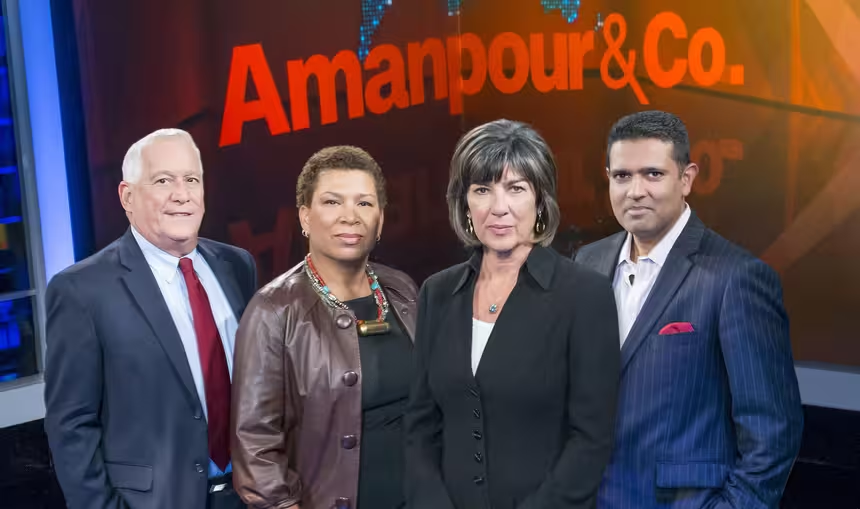
PBS and WNET, in collaboration with CNN, launched Amanpour and Company in September 2018. The series features wide-ranging, in-depth conversations with global thought leaders and cultural influencers on issues impacting the world each day, from politics, business, technology and arts, to science and sports.Providing Support for PBS.org
Learn Moreabout PBS online sponsorship(dramatic electronic and string music) - Hello everyone, and welcome to Amanpour & Company.
Here's what's coming up.
Leaders gather in Washington for the 75th NATO Summit, amid growing challenges from Russia and concerns around a potential Trump presidency.
I'm joined by Victorian Nuland, who served as US Ambassador to the Alliance.
Then... - We can save Ukraine if we step up and do it, and that's our duty as NATO.
- [Christiane] Historical insight.
25 years since NATO intervened in the Kosovo War, what can be learned today?
I asked General Wesley Clark, who led NATO's military then, and Kosovo Prime Minister, Albin Kurti.
Also ahead... - It's not like being a man is all benefit and no downside.
You know, there are very real harms built into the system.
- [Christiane] "BoyMom."
Michel Martin sits down with author Ruth Whippman to discuss her new book that's reimagining boyhood.
(dramatic electronic and string music continues) - [Announcer] Amanpour & Company is made possible by Jim Attwood and Leslie Williams, Candace King Weir, the Sylvia A. and Simon B. Poyta Programming Endowment to Fight Anti-Semitism, the Family Foundation of Leila and Mickey Straus, Mark J. Blechner, the Filomen M. D'Agostino Foundation, Seton J. Melvin, the Peter G. Peterson and Joan Ganz Cooney Fund, Charles Rosenblum, Koo and Patricia Yuen, committed to bridging cultural differences in our communities, Barbara Hope Zuckerberg, Jeffrey Katz and Beth Rogers, and by contributions to your PBS station from viewers like you.
Thank you.
- Welcome to the program everyone.
I'm Christiane Amanpour in London.
World leaders are descending on Washington now for NATO's 75th Anniversary Summit.
But this family gathering is a pretty tense one, because at the moment, the Alliance faces the threats from foreign antagonists and from within, and the stakes could not be higher.
As if these leaders needed reminding, the gruesome images keep coming of Russia's latest missal barrage against Ukraine, including a children's hospital, a clear message from Vladimir Putin, hundreds killed and wounded there.
Narendra Modi, the newly reelected Indian prime minister, hugging his host in Moscow, deeply disturbed the West, but he seems to have denounced that Putin missile attack.
(Narendra Modi speaking in foreign language) - [Translator] Every person who believes in humanity feels the pain when they see death, especially when innocent children are killed.
The sight of innocent children dying shatters your heart, and this pain is extremely horrific.
- The Ukrainian leader, Volodymyr Zelenskyy, calls Modi's visit a huge disappointment, and at the summit in Washington, he'll be pushing hard for accelerated NATO membership.
Meantime, the Alliance is already trying to Trump-proof support for Ukraine, should the former president return to power.
And I'm joined now by veteran diplomat Victoria Nuland.
She has served Republican and Democrat administrations, been America's NATO ambassador, and most recently, US Deputy Secretary of State under Joe Biden.
Victoria Nuland, welcome back to the program.
- Thank you Christiane.
It's good to be with you in this very historic week.
- Yeah, and you have retired from the State Department, and I wonder whether you can speak really openly about (chuckles) the challenges ahead.
So what must the Alliance achieve this week to make this summit actually meaningful, beyond just a script?
- Well, first and foremost, we have to demonstrate the unity of the democratic world.
Not only do we have the 32 members of NATO, including our newest member, Sweden, but there'll also be a meeting between NATO and four big Asian democracies, Japan, Korea, Australia, and New Zealand, to show that we believe in our system, we believe in our open democratic free way of life, and that we are determined to protect it for the long term, and that tyrants and autocrats like Putin and others around the world cannot wait us out.
That is one thing that has to happen.
The second thing that has to happen is Vladimir Putin has to get the message that we are in support of Ukraine for the long term and that Ukraine will prevail, and I think there will be some significant support for Ukraine that is concrete and meaningful to them that comes out of this summit.
But most importantly, we need to show that democracies are standing up to the autocracies around this world and that that is the better way of life for our citizens.
- So, you know, there's just so much important to follow up in what you've just said.
First and foremost, clearly President Biden, you know, gathered a historic coalition.
NATO's expanded, not decreased, as everybody likes to say, which is what Putin wanted, but the thing is, most people now, watching from the outside, including former SACEUR Wesley Clark and others who support Ukraine's right to self-defense and victory, are worried that the fear of Putin still exists, even in America, the most powerful country in the world, and that it's been piecemeal at best.
Yes, a lot of money and a lot of weapons, but often late, often not the right thing, often broken, and often, as you see, well, at least once, after a seven-month delay that clearly upended the front line.
You know, at what point does NATO have to get serious and say, "Okay, no more inch by inch.
"Now we've really gotta make Ukraine win."
- Well Christiane, you're not wrong that in some cases, the delays have cost the Ukrainians seriously, including the six-month delay waiting for the US $60 billion.
But I think what's most important for Putin to understand, for Ukrainians to get comfort from is that 85 to 90% of Americans believe that Putin is a bully and he must be stopped in our own national security interest.
And when candidate Trump opposed the 60 billion, the Republicans in the House and Senate prevailed on him to change his view, because that's where the American people are.
They understand the stakes.
So we need to stay in this fight.
Ukraine is fighting for its life and its survival, but it's also standing up for the principles of freedom and an open world order, and that you can't just have a tyrannical neighbor bite off a piece of your country or your whole country and get away with it if we wanna live in this peaceful, open world.
- [Christiane] So all that is absolutely correct, well, and good, but again, Wesley Clark, who's prosecuted a war or two, says in this case, we are not fighting this as war.
We're fighting this as a diplomatic holding action, hoping that somehow Putin will say after a couple of years, "Gee, I've made a mistake.
"I really want out of this."
- I mean, you know, I disagree with that for the following reason.
First of all, we have intentionally been careful not to give Putin his own desire, which is to make this not his invasion of Ukraine, but a larger war with NATO or with us, and not to give him reasons to escalate.
He has escalated anyway, and therefore, we had to allow the Ukrainians to do more.
That is why the president agreed to allow the Ukrainians to use American weapons beyond the lines into Russia to stop Putin's vicious attacks on Kharkiv, the second largest city, which wasn't even on the front lines, that attack on Kharkiv has been stopped.
The other thing is that the Ukrainians are actually now making some serious strategic advances that are lost in this fog of worry about the nibbling that the Russians are doing on the front lines.
And by that I mean, the longer range weapons are allowing the Ukrainians to degrade the back office of Russia's war effort, to hit their logistics spaces in Russia.
They recently hit two of the ferries that resupply Crimea, they've done serious damage to the big weapons dump that Putin turned Crimea into, and they've pushed the Black Sea fleet off of its main base in Sevastopol further out.
So yes, the Russians are nibbling at the edges, and yes, they are losing up to 1,000 guys a day because Putin doesn't care about the human life of his citizens, but he is reduced to finding allies in criminal places like North Korea, Iran, and using the Chinese as his Lego kit back office, while we are gathering 32 nations plus the Asian allies who will give a big brand new package to Ukraine in the next couple of days, including some of the desperately needed air defenses that will further roll Putin back.
So I believe that Ukraine will hold, and I believe as we start to rebuild our own weapons systems and weapons bases, that we will wear him out in Ukraine, we'll convince him that it's either gonna be his job or his war, and he'll have to make a hard choice.
- Well, he clearly sent a message to Ukraine and to NATO with that massive missile barrage that has just done more damage than anybody can remember since the beginning of the war, including in Kyiv and elsewhere.
I mean, hundreds killed and wounded there.
But you talk about allies, so how worried are you that Narendra Modi, which is an American ally, decided to go to Moscow hugging, hugging Putin in a very big bear hug, which is his Modi trademark.
Also, an actual EU member of NATO, the Hungarian Prime Minister Orban included Moscow on his latest trip around the various hotspots.
How does that help the coherence, if you like, of the Alliance trying to isolate and persuade Putin that he's on the wrong path?
- Well, Orban's been in Putin's pocket for years and years and years and that has deep historic roots, and it obviously was the wrong move to make, especially because he's chair of the European Union right now.
He got nothing out of it and Putin got nothing out of it, as the summit is going to show.
On the Modi side, you know, the Indians, as you know, have a 30-year relationship with Russia.
It's about their concern about China or has been.
Modi believes that he can be a broker, so I think that's why he went to Moscow to try to broker, but the fact that Putin stepped on his own tail during the Modi's visit with this egregious, horrific attack in Ukraine, including on the children's hospital, caused even Modi, one of his bigger supporters, to have to criticize him just speaks to the fact that Putin has completely lost his way and is losing friends around the world.
- So what can Ukraine expect in terms of accelerating?
Obviously it's not gonna get an invitation to join NATO this year.
President Zelenskyy was incredibly upset and irritable publicly about it last summit.
This year, he presumably will act differently because there seems to be some kind of additional, you know, sort of help, I don't know what the right word is, additional support for his eventual, you know, entry into Ukraine.
What do you think is gonna come out of this for Ukraine?
- I think Ukraine is gonna get four things that are really, really significant and needed now and that go to the long-term commitment of NATO allies, but more broadly, the democratic world to Ukraine, and that Putin cannot wait us or Ukraine out.
The first thing is that Ukraine is likely to get a designated mission from NATO, that includes NATO taking over the logistics for coordinating all of the weapons supplies that go to Ukraine.
This is also part of the future-proofing, if you will.
Ukraine is gonna get a long-term monetary commitment from allies.
Ukraine is also gonna get significant air defenses, including more patriot missile batteries.
Each missile battery protects a city, like Kharkiv, and some lower level air defenses that can address these Russian glide bombs, but it is also gonna see 20, 25 allies sign 10-year memoranda of understanding to help Ukraine build its military of the future, the most highly deterrent military in Europe, potentially the strongest military in Europe.
So it knows that that will be built even as it fights, and should Putin, even if this war were to end, were to be settled, it will also ensure that if Putin tries to come back, he's gonna face a much spikier porcupine in the future.
- So do you think Trump is a spiky porcupine for Putin or a welcome arrival in the White House if he does?
'Cause you just talked about proofing, you know, trying to make sure that Ukraine is not left to the whims of any one country or whatever in terms of getting the weapons it needs.
What are you hearing from allies, people who you know and have worked with, about the expectation level of a second Trump term and what it'll mean for NATO?
- Allies are very worried about a reelection of President Trump.
You know, he spent far more time in his four years in office criticizing our closest friends, our democratic family, than he did criticizing Putin or Kim Jong Un or the Iranians or anybody else.
He created chaos in terms of US support for the Alliance.
He has called NATO obsolete, at the very moment when it is, again, doing what it was born for, which is to hold the line against Putin being able to come to our territory, so I think they're very concerned about what he would do and about the uncertainty.
Ukrainians are concerned that he might try to push them into a bad piece.
He said he can solve this in a matter of days, and he said that in the context of Putin saying, "By the way, "I want even more Ukrainian territory than I've been able "to win on the battlefield."
So I think there is great concern, and they need to ensure that they are well coordinated on the European side of the pond, that we are well-resourced, and that the structures that the US has led to supply Ukraine stay in place.
But as I said, Christiane, the American people don't want Putin to succeed, and Trump already has had to backtrack and support the supplemental.
So even if Trump is elected, and I personally don't believe he will be, but even if he's elected, I think the American people will have something to say about continued support for Ukraine.
- Okay, so you just raised the elephant in the room and I'm gonna go with it 'cause I was going to anyway, there is a deep disquiet about whether President Biden, A, will be reelected and B, is even, you know, up to continuing a campaign.
Let me just read for you what the historian Sergey Radchenko has written.
He's the Johns Hopkins School of Advanced International Studies.
He's basically saying, "This election is doing more "to discredit American democracy than Putin "or Xi could ever hope to do.
"I am worried," he says, "about the image projected "to the outside world.
"It is not an image of leadership, "it's an image of terminal decline."
He's obviously referring to the debate and to the debate about the debate that's been going on ever since.
- Look, one of the great strengths of democracy is that we are open about our differences.
We debate these things in public.
You know, Putin just locked up three women for a play that they wrote.
So I think, again, this demonstrates, as did the moves in France and the fresh election in the UK, the vibrancy of our democracy.
President Biden has said he is running.
Whatever happens on the US side, I am confident that there will be a strong choice for the American people in favor of freedom and standing up for Putin.
So I don't see decline, on the contrary, we've got the strongest economy on the planet at a time that everybody else is struggling.
That is one of the things I think we have to address with NATO allies and other democratic allies, we've all gotta start growing again, and Putin is destroying Russia and the Russian economy to feed his imperial ambition and he cannot do it forever, which is why we have to make this long-term commitment and the Russian people have to see what complete folly this adventure of his is, not only in terms of achieving his Ukraine goals or his global goals, but in terms of the future for them that he is mortgaging and sacrificing for this Peter the Great fantasy.
- You've worked for President Biden.
Is the Biden you know the same Biden that appeared on the stage?
Are you concerned?
- President Biden has among the strongest moral core, the strongest sense of America's importance as a leader of the free world of any of the presidents I've worked for, and every single one of them was strong on that front.
He will make his decision, the American people will make their decision.
I think what is important is that American leadership has been absolutely essential over the last four years.
The alliances that we've rebuilt, we've talked about Europe, we've talked about Asia, but also between Europe and Asia, must be continued, and even in the context of China, we've made great advances in helping countries understand that they've got to be resilient.
They can't allow coercion, they can't allow, as my friend Senator Murphy says, "China to own the pipes," the piping of the international system.
And so all of those efforts have to continue if we wanna have the free and open lifestyle that we've enjoyed for all of these decades, these 75 decades that NATO's been in place.
- I can see you're defending the president and his leadership so far, and you're not ready to say anything else about it I think.
But I wanna know what you make of a recent article about how NATO has got way beyond its original, you know, its original mandate.
General Eisenhower, of course, NATO's first commander, felt the mission was to stand up Europe's own self-defense and protect Europe while the Marshall Plan was rebuilding physically and their democracies.
But now, all these years later, there's tens of thousands of US troops still stationed there.
I think he envisioned them coming home within, I think it said five or 10 years.
Is that a failure of NATO or a success of NATO to still be out there?
- You know, I see it the other way around, Christiane.
The fact that we have allies around the world, not just in Europe, but in Japan, in Korea, in Philippines, in other parts of the world who want to have American forces have a relationship with their militaries, want to have us in their countries as a bulwark against guys like Putin, guys like Xi Jinping, is a strength for the United States.
We have greatly reduced, since the end of the Cold War, the US footprint in Europe, but the fact that we work and train with all of these countries around the world means that we can turn on a dime if we face a threat and we can work together, as we did when Putin went into Ukraine and we were able to greatly strengthen the eastern flank, as we have been in working with Taiwan and working with Philippines and other countries in Asia.
So I think it's actually a strength that we are invited, and we are welcomed.
- Okay.
Great to hear from you, Victoria Nuland, thanks for being with us.
And as we said in recent history, the Balkans have directly benefited from NATO's intervention.
The Alliance helped and the wars in Bosnia and Kosovo back in the 1990s.
So with Ukraine fighting for its very existence, what can the NATO leaders currently gathering in Washington learn from this recent past?
Ahead of this summit, I asked two people who know best.
I quoted, of course, General Wesley Clark in our conversation with Victorian Nuland.
He served as the Supreme Allied Commander at that time, and of course, he's joining Albin Kurti, Kosovo's current prime minister.
Here's our conversation.
Prime Minister Albin Kurti and General Wesley Clark, welcome to the program.
- Thank you.
- I want to ask you to reflect on what NATO did and what Kosovos did all those years ago when General Clark was SACEUR, the head of NATO, and led a campaign to save and stabilize Kosovo.
First let me ask you, Prime Minister, 'cause you've written about it, in a nutshell, what did NATO do for your country?
- Last month, we celebrated 25 years of liberation of our country and it wouldn't have been possible without NATO intervention, without NATO airplanes bombing for 78 days, police and military forces of the Serbian leader and Yugoslav President Slobodan Milosevic.
It was the fourth war that he was launching in the territory of former Yugoslavia throughout the '90s.
Beforehand, there has been dozens of massacres against civilian population in Kosovo where women, children, and elderly have been killed, women have been raped, houses, villages, entire villages have been burned down, and all of this was within the genocidal project of regime of Milosevic to have Kosovo without its people, without Albanians.
So basically, they saw our country as a territory, not as people, and they wanted those people either killed or out.
And Operation Horseshoe was undergoing when basically NATO intervened and stopped the genocide of Serbia.
So stopping the genocide and liberating our country and getting the peace, finally, were one and the same thing enabled, and later on, guaranteed, by NATO.
- So General Clark, given what we're watching in Ukraine and how reluctant NATO is to get involved for all the reasons, that they don't want to go head to head with Russia, can you walk us back to how the decision was made to actually do what the Prime Minister has laid out, to intervene in a way that ended this genocidal project?
- Well we started, when the genocide first began in the spring of 1998, NATO got engaged.
NATO said, you can't have security in Europe if you have an ongoing conflict.
NATO said, we've got to work outside the defensive boundaries of NATO member states in order to provide security for those member states.
It's exactly the same situation as now.
But what's different is, of course, Russia was only indirectly involved in promoting Serb ethnic cleansing in 1999.
Now they're directly involved, they are the aggressor, and it's been a matter of mutual deterrence.
Putin knows that we don't want a provocation that leads to a nuclear confrontation, and so he continues to warn us by doing nuclear exercises and having his spokesmen talk about it, and then he, of course, it's not gonna happen.
He knows that NATO is fearful of this, and yet this is the very purpose for which NATO was created, to provide stability and security in Europe.
And I remember during the 50th anniversary, which occurred during the time this happened, NATO was full of hand-wringing, doubt, concern, "Oh my goodness, we're bombing a country, we're in a war.
"Should we stop it?
"Should we have a pause?
"What can we do?"
There was all kinds of internal struggle, and yet we persisted.
NATO persisted because the United States as the leader persisted, and Britain was also, Prime Minister Blair was a big part of this, as well as Secretary Albright and President Clinton.
We persisted.
We didn't back off.
This is the time NATO has to double down in terms of its resolve that Putin will not win, and we have to do more than simply provide a stream of weapons that are coming in fragmented slowly and so forth.
NATO needs to do more.
Look at the example of Kosovo today.
25 years of democracy, a free country.
I was there two weekends ago looking at people.
Everybody has a horror story about it, just like the Prime Minister recounted, and everybody is grateful for NATO.
It should be this way in Ukraine.
We can save Ukraine if we step up and do it, and that's our duty as NATO.
- Prime Minister, you live in the neighborhood, so to speak.
What practical threats are there, if any, from the fact that Russia is able to carry out what it's doing against this democratic and sovereign country like Ukraine?
- Our northern neighbor, Serbia, is very aggressive towards Kosovo, first by not recognizing our country as an independent republic, like vast majority of the world does, namely 28 out of 32 NATO members and 22 out of 27 European Union members, but in addition to that, they are engaged both in hybrid war and at the same time, they have these military exercises at the vicinity of our border.
They have 48 forward operating bases around the border of Kosovo, waiting for a new window of opportunity.
And what we are asking for towards our Western democratic partners to pressure Belgrade in order to decommission these 48 forward operating bases, each one of them having 50 to 150 soldiers and officers, and nearby, having Russian equipment, ammunition, and military armament, but also Chinese one, namely the FK-3 system.
So politically speaking, Serbia is very similar with Russian Federation.
They don't really recognize properly, de facto and de jure their neighbors.
They cause problems to their neighbors because they want expansion.
And on the other hand, I must say that perhaps Russian Federation also imitates Serbia during the regime of Milosevic.
And nowadays, we can see how despotic President Putin wants to turn Ukraine into a similar Bosnian scenario country where it will be divided territorially within in order to render it dysfunctional and create opportunity for further conquering of territories.
So Kremlin and Belgrade historically, culturally, politically, but also operationally, historically have been imitating each other.
And that's why we are very much worried, because it is in the interest of Kremlin to outsource further conflicts in Europe via its proxies.
And Serbia in the Balkans is a hegemon, at the same time, a Russian proxy.
- General Clark, do you recognize that depiction of the current Serbian government, and specifically, you have traveled around, I think you were in Bosnia as well, and as you know, like the Prime Minister says, the Bosnian-Serb entity that was created after the war under the Dayton Peace Accords, the head of that entity backed by the Serbian president, is still trying to destabilize that, and you know, there's all these separatist leanings and tendencies.
What did you notice when you were there and will that be successful, do you think?
- I've watched this very closely over a period of years, Christiane, obviously, and you know, Russia's hand is felt in the Balkans.
Serbia is Russia's arm in the Balkans.
Serbia serves Russia's interests.
Now, President Vucic, he's clever.
He tries to look like he's playing both sides, but when push comes to shove, he's gonna do what Putin wants him to do, and what he wants from Putin is, of course, the authority to use his forces, come into Kosovo, at least take the northern half of Kosovo and maybe more, and at the same time, they want to break up Bosnia and take Republika Srpska back in and make it a Greater Serbia again.
And this is all about ethnic cleansing in the Balkans.
We've seen enough violence there, we've seen enough conflict, we've seen enough rapes and murders over the last 30 years, and we thought NATO had stopped it.
But the thing is, if there's trouble in Ukraine and we falter in Ukraine, that trouble's coming right back into the Balkans, and leaders like Prime Minister Kurti are gonna have to deal with it.
- So tell me, when you, you know, we're talking as this NATO summit is underway.
What do you hope comes out of this NATO Summit, General Clark, on the 75th anniversary, given all these terrible challenges that we face?
- Well I think first of all, we're going to get a strong pledge of continued military assistance to Ukraine.
But I would also note that those pledges in the past haven't always been carried out.
Weapons that were promised sometimes didn't show up and when they did, they showed up late and sometimes they showed up inoperative.
So that's not, you know, it's not everything that it looks like, but it's important.
What we really need is the bridge to Ukraine's membership in NATO.
The best deterrence of Mr. Putin is to bring Ukraine in to NATO.
And the sooner we do it, the better.
We're not gonna get the invitation apparently in this NATO Summit.
And that's unfortunate, but we're supposed to be getting a promise that there is a bridge and the bridge cannot be broken.
So we'll see.
This is about deterring Mr. Putin, and if you wanna deter him, gotta put the full force of NATO behind that deterrence.
- And Prime Minister Kurti, can you remind us what Kosovo felt when NATO troops finally did come in after the air war and help stabilize your country and as you said, also create the conditions to build a secure democracy?
- Whoever is still alive and was in Kosovo on 10th, 11th, 12th of June, 1999, those days are the happiest days of their lives.
Liberation was enabled by people's resilience and struggle and by NATO intervention.
When NATO soldiers and officers entered Kosovo, people greeted them like no one in their lives.
So we never forget that what is needed is to stay faithful, to stay faithful to that moment, which was crucial for these 25 years, which has been years of democracy and progress.
NATO, after entering Kosovo, enabled establishment of domestic institutions, we started to go to schools, we started to work, farmers, engineers, students, professors, housewives, architects, everybody was getting back to their jobs and professions, and in this way, life restarted.
So it is difficult nowadays to explain this moment, which perhaps is similar only to the liberation in continental Europe from Nazi Germany.
And I think that this is the most important memory that people have and they cherish it and they want to build upon it by further advancing our country.
- And finally, I'm going to ask you, General Clark, about, as the Prime Minister laid out, NATO is there to back up the defense of democracy as well as everything else.
Trump was asked in the debate whether he would pull out of NATO and he avoided talking about it.
He didn't commit it.
The incoming NATO chief says, "We should stop moaning and whining and nagging about Trump.
"I am not an American, I cannot vote in the US.
"We have to work with whoever is on the dance floor."
Do you think, General Clark, that a second presidency of Trump's is a threat to NATO?
- Well, based on what he says, I certainly do.
Mr. Trump says that he understands Putin's dream of Ukraine.
(chuckles) I can't understand how any American could accept a dream of overrunning a country of 40 million people, open aggression, murder, rape, filtration camps, abduction of children, horrible warfare, a country destroyed.
Why would any American, including President Trump, accept that as a legitimate dream?
That's a nightmare, and he should have been stopped at the outset and it wasn't.
And so I think that there are a lot of strong people in the Republican Party who agree with me, that we've got to stand with Ukraine and help Ukraine and be strong in NATO.
But if Mr. Trump is the president, I think you'll see a lot of effort on his part to undercut support for Ukraine and to go along with Mr. Putin's dream.
That apparently is what he believes in.
- General Wesley Clark, Prime Minister Albin Kurti, thank you so much for joining me.
- Thank you.
- Thank you for having me.
- And now, we turn to the issue of modern boyhood, which is the subject of author Ruth Whippman's new book, "BoyMom: Reimagining Boyhood in the Age "of Impossible Masculinity."
Michel Martin sat down with Whippman to discuss her surprising findings after multiple conversations with dozens of boys that actually reshaped her views of parenting.
- Thanks, Christiane.
Ruth Whippman, thank you so much for talking with us.
- Thank you for having me.
- You know, Toni Morrison once said that she wrote "The Bluest Eye," which is her kind of first, you know, seminal work, because she wrote the book she wanted to read.
And it sounds like that is true of you too, that you wrote the book that you wanted to read.
Is that right?
- Yeah, I mean, my third son was born right as the Me Too movement was going crazy.
I was suddenly, you know, a feminist, a mother of three boys, I was conflicted, and everything on the market with books seemed to be either, just had this kind of certainty that I just didn't really feel, so either they were saying, "It's a parenting book, here's the five tips "to raise the exact feminist son that you want," or it was kind of, you know, or they were written by men and they didn't really explore the mother experience, or they just weren't really, I felt like they weren't being fully honest about the conflicted feelings involved.
So I just, yes, I absolutely, I needed this book, so I was like, "Okay, I think I need to write it."
- What was your initial inquiry?
- Yeah, so I think that it was a couple of things.
It was, what was going on in the wider cultural conversation, 'cause obviously, you know, my third son was born right as the Me Too movement was going crazy.
It just seemed to be this like absolute horror show of bad news about men.
I was in labor looking at my phone and it would just be one tweet after another with yet another man being exposed as a sexual predator or a school shooter or something terrible, so I wanted to dig into that, like where are we going wrong on a cultural and systemic level?
And meanwhile, I was very invested in this from a personal point of view, because my own boys were going completely crazy, and you know, I was parenting these wild rambunctious boys in the shadow of this whole conversation about toxic masculinity, so it's really easy to think, you know, if they want a NERF gun, does that mean that they're gonna be on track to be a school shooter, or if they love to wrestle all the time, does that mean that, you know, there's something toxic or wrong going on or I'm doing something wrong?
So I wanted to put all those pieces in context and look at the personal and the political.
- It seems like what you have found out, both in your book and in an excerpt that has appeared in the Times that has gotten a lot of attention, is that boys are hurting.
Sort of describe kind of like the top line surprise for you about just how much boys and young men are hurting.
- Well, yeah, so I interviewed many boys of different backgrounds, you know, economically, racially, geographically, and the theme that kept coming up over and over again that really surprised me was just how lonely they were.
And partly, that was to do with like actual isolation, and that's showing up in a lot of data as well about boys spending a lot of time on screens and replacing that kind of real life socializing with screen-based socializing.
So boys are becoming materially more isolated.
But also, even the ones who did have a lot of friends, who did hang out with them, felt that they couldn't really find that kind of intimate connection.
They couldn't talk to their friends about this intimate, personal, sort of more, you know, more vulnerable things.
And those were kind of the old scripts of masculinity that were very much still in circulation.
So I think the top line was kind of loneliness, but also, I think these boys felt very shut down.
You know, they felt shut down from the old system of masculinity, which was like, man up, be tough, don't show your feelings, but also from these new kind of more progressive voices where it was like, you know, you're a man, you're privileged, it's not your turn to speak, you need to be quiet and let somebody else have a turn, so they kind of just really didn't know how to be, how to express themselves.
- Well Ruth, tell me some about some of the boys that you met.
- There was a really, really wide range, not just in terms of, you know, economic and social and racial backgrounds, but also just in the kind of type of kids that we're talking about, or young men.
You know, some of them were very sort of isolated and slightly socially awkward, some of them were, you know, these popular cool kids, but what was really interesting was more of the similarities in what they were saying than the differences.
I think they all felt quite hemmed in and quite oppressed by these ideas of masculinity that were being forced on them.
So they all felt that it was very hard for them to like, express their emotions, and even for them to kind of name their own emotions to themselves.
So it wasn't even, they found it really hard even to get to the point where they could figure out what they were feeling, let alone tell their friends about it.
So that was one thing.
They felt kind of isolated, they felt like they couldn't talk to their friends.
A lot of them used the same expression, you know, kids from very different backgrounds used the same expression with me, which is, you can never let your guard down.
They used the exact same phrase to describe what it was like to be a boy amongst male peers, you know, that you're always on the verge of like getting knocked down or saying the wrong thing or saying something that would like, emasculate you in some way.
- So is there a particular age group that you found to be sort of most in distress?
- Yeah, so I think what I was looking at was this kind of microgeneration of boys that were really hitting puberty right as Me Too happened, and then went through the COVID pandemic, which obviously accelerated a lot of these kinds of trends.
But you know, they were in evidence before, and that sort of microgeneration is now of voting age, they're of college age, you know, so if you were 11 when Me Too took off, you're now 18, and I think that generation, we're showing that they're moving to the right politically, they're becoming isolated, they're becoming resentful, I think they don't know their place in the world, they're dropping out of college or not going to college in the same way that girls are.
There's this whole problem with failure to launch that this is becoming increasingly serious, you know, that while kinda young women are doing things like finding partners and going to college and leaving their parents' houses, young men are increasingly being left behind.
So it was that generation that I really wanted to look at and just see, you know, what's it like to grow up in this moment, you know, this very complex and very fraught cultural moment?
- One of the points that you make is is that a lot of these constructs just don't mean anything to kids that age.
- Right, so I think this idea of privilege, you know, it's a very real thing and we need to educate our boys in the history of patriarchy, the history of privilege, the history of gendered violence and all of these things, but they are children, you know, they're not actually responsible for those things that happened.
They didn't do this stuff.
And so I think, you know, when they look at their female peers, the concept of privilege doesn't really mean so much to them.
They're sort of like, "Well, where is all this power "that we're supposed to have?"
You know, this idea that you need to be quiet because you're so privileged, and they're looking at themselves, they're high school kids, they have no economic capital, it doesn't really mean so much to them that somebody on Wall Street who's male will get a better job or a better salary than somebody who's female on Wall Street.
You know, it's just so remote to them, and I think that those very blunt, very sort of broad brush ideas of like privilege and power and oppression don't necessarily apply to teenagers in quite the same way.
- You know, this is a quote that stood out to us when we read the book.
You wrote that, "For boys, vulnerability "and privilege coexist in a complex relationship.
"Masculine norms "and expectations confer countless advantages, "but they also bring significant harm.
"The two come together in male socialization "to create a contradictory "and strangely destructive combination "of indulgence and neglect."
Can you talk a little bit more about that?
Like, what do you mean by that?
How do we see that?
- Yeah, so I think this is going back to the whole thing about privilege.
So obviously, there are real advantages to being male in this world and we know that, but there are real harms to it too, so the system of patriarchy that, you know, tells women to behave a certain way and oppresses women, also oppresses men in certain ways too and cuts them off from their emotions, tells them that they have to be strong and masculine and, you know, makes people project masculine qualities onto boys right from birth, and so in some ways boys, get very indulged, you know, there's all these research that shows that they do less chores than girls and that they get paid more for them and, you know, all of these things, so parents do indulge boys in some bad behavior, they let them get away with things, they somehow sort of give them this idea that they're kinda special and they don't have to do these difficult things, but there're also ways that they really, you know, that they're under-cared for.
They don't get that engagement with emotions.
They don't get heard, their feelings don't get heard in the same way that girls' feelings do get heard.
You know, we spend a lot of time listening to boys and male opinions, but a far less time listening to their feelings, and I think that this sort of under-nurture thing is where the neglect part comes in, you know, and there are very real harms to that, and we see that with adult men.
We see that they're lonely, we see that they're disconnected, we see that they're disconnected from their emotions.
And so, you know, this is the same system.
It is complex.
It's not simple.
It's not like being a man is all benefit and no downside.
You know, there are very real harms built into the system.
- Well, you point out that, you know, there really is a difference between, sort of neurologically, between male and female infants, how their brains develop, and also just the impact of exposure to stress and negative parenting, which I think was a shock to me.
Was it a shock to you?
- It was a real shock to me, 'cause when you sort of look at the science of sex differences, and you know, people co-op this science quite a lot, it's quite sketchy.
So there's this idea that, you know, boys will be boys.
So boys are rambunctious, they're tough, they're sturdy, they're angry, they're badly behaved, but actually, when you look at the research, a baby boy is born about a month to six weeks behind a baby girl in terms of right brain development, so that's the part that governs emotions and attachment and emotional regulation.
So because their brains are more immature, they're actually more emotionally vulnerable and sensitive.
So all of the kind of stereotypes, you know, really go against what a baby boy actually is.
And a girl is born more resilient, more independent, more able to regulate her emotions, so because of that brain fragility, it means that any kind of adverse circumstances, so, you know, poverty or neglect or poor circumstances has been shown to have a greater impact at a population level on boys than it does on girls.
But because of our ideas of masculinity, you know, and what we think a baby boy is, we tend to treat them with less kind of nurture and less of that intense emotional caregiving than we do with girls.
So it becomes this double whammy.
They need more care but they end up getting less, in a sense.
You know, we masculinize them.
There's all this research that shows that parents use a different vocabulary when they talk with girls, that they use more emotional language, they listen to their feelings more, whereas with boys, it's more of this like physical roughhousing and wrestling type play.
And so baby boys, and boys all the way through childhood, really kind of miss out on that emotional engagement.
We don't teach them the skills in that way.
- Do you think this is a new feeling?
- This feeling of-- - Of having to constantly be on your guard.
Do you think that that's new?
- I think that that is an old feeling.
I think that comes from very old systems of masculinity.
But I think what makes it more acute now, there are various sort of cultural forces that I think are making it harder to be a boy now.
So I think that they still have these, you know, those are old stories.
Men always had to kind of man up and be tough and not be vulnerable.
But I think that now, there's just so many different kinds of cultural forces, I think there's this idea that it's time for them to be quiet from the left, they're feeling like people are talking about them as if they're toxic and harmful.
I think since Me Too, you know, quite rightly, there's this whole conversation about consent, which is great, but I think it means that they also feel at the same time that they have to be extremely cautious, that they can never overstep, so at the same time, they're kind of expected to be dominant and aggressive and to kind of make the first move and be, you know, the sort of masculine appearing one with girls, but at the same time, they also have to be extremely cautious and to never overstep and otherwise they'll be seen as creepy, so I think a lot of them were just feeling like, I don't know how to be, I'd rather just be on my own in my room and watch porn by myself.
- Oh gosh.
So, (both chuckle) what reaction are you getting?
What reaction stands out to you?
- Well, I've been really surprised by actually how many men have got in touch with me and said, "Oh, I feel really seen and really heard by this."
And they've actually read the book.
You know, I thought the book, because it's called "BoyMom," that it would appeal many to women, and lots and lots of women have been getting in touch with me as well, but also I was surprised to see men saying, you know, "This is exactly what my childhood was like, "you know, all these pressures of masculinity, "I feel very shut down.
"I don't know how to be.
"Thank you for seeing this and hearing it."
So the response has been mostly extremely positive.
I think some people are concerned that there's like a little bit of both sides-ism, you know, in the sense of like, that centering boys and men somehow takes away from the work that we're doing to support women and girls.
And my view on that is that actually, you know, we're all trapped in this system together, that, you know, raising emotionally healthy men and boys benefits everybody in society.
You know, this is not a zero-sum game.
- Given that you've described what a deep stem this has, how do we get out of it?
- We have to do things like in the home and in the wider culture, you know, the way that we talk about boys and men.
So I think in the home, it's really about showing boys that nurture and emotional engagement that they need.
So really sort of naming the problem in terms of like, they're excluded from those emotional role models, from those kind of emotional conversations, and trying to kind of correct for that and to give them that kind of nurture, to talk to them about their feelings, to listen to them, you know, and to not just see them as these sorta like, tough, uncomplicated, dumb sort of, you know, and I think we need to recognize male interiority, male emotions, and to listen to them.
And I think similarly in the wider culture, when we talk about boys and men, rather than having this conversation which is like, it's a gender war time, to for men to shut up, you know, I think we need to start listening to men's feelings as well and making space for that.
We spend a lot of time listening to men's opinions, but a lot less time listening to their feelings.
- Has the way you interact with your boys changed since you started doing this work?
- Yeah, I think it really has.
It's subtle, you know, it's actually, it's not like I've done these five things differently.
It's more of a change in my orientation towards them in our relationship.
So I think it's helped me to see them better and to see them as these complex emotional creatures, rather than, you know, I think there's a stereotype of boys, you know, I hear like, boys are like dogs, all they need is food and exercise and discipline.
And actually, I think seeing them as these creatures that are vulnerable and fragile and in need of more nurture rather than less has really helped me approach them in that way, and rather than trying to, you know, punish them or discipline them out of their bad behavior, to see the kind of emotions driving them and, you know, and to try to engage with them in a more, you know, a more nurturing way.
- It does make me wonder though, after a long period of basically not preserving all-women's spaces, thinking it was like retrograde, like, oh no, we don't need women's colleges, like why do we have, you know, that, then we've become more intentional as a society about preserving sort of all-female spaces or women's spaces or all spaces for people who present as women.
I have to wonder, after doing this work, whether you think that perhaps there need to be more all-male spaces.
- That's such a great question, and I've been thinking about that.
You know, I've been talking to experts in this field, you know, people who work with boys, and they say that the boys groups are really helpful for boys.
You know, this feeling that, you know, that they can speak freely, that they don't feel like they need to sort of be quiet and let somebody else speak, but they can talk about their emotions, especially when they're led by really good facilitators, I think those all-male spaces are really helpful for boys and men.
I think they have to be done in the right way.
You know, all male spaces can easily also go in the other direction and be quite toxic and awful.
And you know, I've looked at some of those.
In the book, I go online and look at the sort of, the incel movement and some of those darker manosphere type things, and I think they can go in a really worrying direction, but I think in person, all-boys groups can be really helpful for boys.
- Hmm.
Ruth Whippman, thanks so much for talking with us.
- Thank you so much for having me on the show.
- And so many important and interesting insights there.
Finally tonight, as leaders from 32 nations gather in Washington for this year's NATO Summit, a look back at 75 years.
The Alliance was formed first and foremost to better and to deter Soviet expansion in Europe after World War II.
And in 1949, President Harry Truman laid out the principles that guide the organization to this day.
- This treaty is a simple document.
The nations which sign it agree to abide by the peaceful principles of the United Nations, to maintain friendly relations and economic cooperation with one another, to consult together whenever the territory or independence of any of them is threatened, and to come to the aid of any one of them who may be attacked.
- Words, of course, that still resonate today, especially on this 75-year anniversary summit.
Outgoing NATO Chief Jens Stoltenberg took a time out from the summit prep to throw the ceremonial first pitch for the Washington Nationals baseball team.
Wasn't exactly a fastball, but a great effort, right before he'll have to throw the even more crucial pitch for the West's continued support of Ukraine.
And that is it for our program tonight.
If you want to find out what's coming up every night, sign up for our newsletter at PBS.org/amanpour.
Thanks for watching and goodbye from London.
- [Announcer] Amanpour & Company is made possible by Jim Attwood and Leslie Williams, Candace King Weir, the Sylvia A. and Simon B. Poyta Programming Endowment to Fight Anti-Semitism, the Family Foundation of Leila and Mickey Straus, Mark J. Blechner, the Filomen M. D'Agostino Foundation, Seton J. Melvin, the Peter G. Peterson and Joan Ganz Cooney Fund, Charles Rosenblum, Koo and Patricia Yuen, committed to bridging cultural differences in our communities, Barbara Hope Zuckerberg, Jeffrey Katz and Beth Rogers, and by contributions to your PBS station from viewers like you.
Thank you.
(bright contemporary music) (moving orchestral music) - [Narrator] You're watching PBS.

- News and Public Affairs

Top journalists deliver compelling original analysis of the hour's headlines.

- News and Public Affairs

FRONTLINE is investigative journalism that questions, explains and changes our world.












Support for PBS provided by: