Capitol Journal
August 28, 2026
Season 21 Episode 88 | 56m 39sVideo has Closed Captions
Sen. Katie Britt; Greg Reed
We're covering the week that was in Alabama government & politics, with reporting from Randy Scott, Jeff Sanders and Alex Angle. Todd's studio guests: U.S. Senator Katie Britt Alabama Secretary of Workforce Greg Reed
Problems playing video? | Closed Captioning Feedback
Problems playing video? | Closed Captioning Feedback
Capitol Journal is a local public television program presented by APT
Capitol Journal
August 28, 2026
Season 21 Episode 88 | 56m 39sVideo has Closed Captions
We're covering the week that was in Alabama government & politics, with reporting from Randy Scott, Jeff Sanders and Alex Angle. Todd's studio guests: U.S. Senator Katie Britt Alabama Secretary of Workforce Greg Reed
Problems playing video? | Closed Captioning Feedback
Where to Watch Capitol Journal
Capitol Journal is available to stream on pbs.org and the PBS app.
Providing Support for PBS.org
Learn Moreabout PBS online sponsorshipFrom AP Studios in downtown Montgomery.
I'm Todd Stacey.
Welcome to Capital Journal.
Coming up later in the show, I'll sit down with U.S.
Senator Katie Brit to discuss a number of topics, including the situation with beef import and the Russia sanctions bill.
After that, Secretary of Workforce Greg Reed will be in studio to go over the latest Alabama jobs report and where we stand with workforce development.
But we begin our coverage this week with the major settlement announcement from meta, the parent company of Facebook and Instagram.
The company has reached an $18 billion agreement with more than 48 states, including Alabama, over the social media platforms impact on young people.
The agreement will also lead to sweeping changes meant to help protect children online.
Capitol Journal's Alex Angle breaks down what the settlement means for Alabama.
Alabama is set to receive at least $117 million from that settlement in annual installments over the next ten years.
Now, the state could also receive more money if TikTok and YouTube also agree to implement the same safety changes to protect kids online.
Alabama Attorney General Steve Marshall says in a statement, quote, this settlement sends a clear message that Alabama will hol Big Tech Council when it fails to protect our children onlin in, quote, under the agreement.
New safety measure will restrict teens from using Facebook and Instagram for no more than two hours a day.
Those under 18 will not receive notifications during school hours and will not be able to use special beauty filters.
Teens also will not be allowe to use the platforms overnight.
Chief Legal Officer at Meta CG Mahoney says the new changes will strengthen parental controls.
The framework we've negotiate will empower parents to easily manage their children's access to our platforms.
Our new time limit commitments, night mode features and usage limits during school hours.
Set the right path forward for our whole industry.
This settlement halts an ongoing case in California where states were suing meta, alleging addictive features on the social media platforms harmed teenagers.
Reporting in Washington, Alex Engle, Capital Journal.
Thank you Alex.
This week, the Alabama League of Municipalities continued its series of local gatherings with the state's congressional leaders.
This time, it was Congressman Shamari figures meeting with locals here in the capital city to hear their concerns.
Capitol journal's Randy Scott was there and has this story.
Progress in the capital city.
You see it in various construction projects throughout Montgomery.
Is something Congressman Shamari figures wants to talk to the people about making more progress.
He says one way is to make things more affordable.
I mean, I represent a district where the individual median income is just north of $34,000.
That's before rent for utilities, before gas, before food, before insurance, before childcare expenses, before everything.
So affordabilit is not a new issue in Alabama.
And so we need to make sure that we have government officials in place that are not amplifying the issue, the severity of the issue, but doing things that, that that make life more affordable here in the state.
The Alabama Legal Municipalitie is sponsoring a series of town hall style meetings for citizens to g one on one with state leaders.
It's very important for these officials to come back into to network with their local officials, because we think all politics is local, even in today's world of of technology.
Still, getting bac and seeing the local officials hearing from them what their local needs are is vital to the succes of building strong communities, education, health care, the economy and infrastructure.
Those are some of the things citizens of Montgomery had a chance to talk to one on one with Congressman Shamari figures, and also talk to him about what was going on in and around Washington, D.C.. Congressman figures know when he and his fellow lawmakers return to Washington, they'll have a full agenda.
First and foremost try to undo this executive order that's causing this harm to our cattle farmers here in the state of Alabama and across this country.
That's first and foremost.
Also looking at some other relief for farmers, in terms of trying to make, that profession more affordable, as well as addressin the growing data centers issue.
People just want to be involved in the process.
They want to have a say so over what's happening in their communities.
They're not anti innovation.
They're not anti data center.
They're not you know anti tech.
What they are is, is concerned citizens that are worried about the future of their communities.
And want a voice and say someone been able to do that and how to keep recent high school and college graduates in Alabama.
You want to do everything you can to either keep them here after high school and after college, or at a minimum, at least provide the sort of environment where at some point they will want to return, you know, to start a family o to continue their career here.
And so that's why it's vitally importan that we work with organizations like the League of Municipalities, also addressing ways to help improve health care in the state.
The first thing we need to do here locally is expand.
Medicaid is something that we should have done a very long time ago to expand access.
With expanding access, you also expand health care providers, in the state, and you also stabilize a lot of the shaky, rural hospitals and primary care providers, that we, you know, that we have her in the state and in Montgomery.
Randy Scott, Capital Journal.
Thank you.
Randy.
The state is moving forward with plans to build another major prison to replace Alabama's dilapidated and dangerous facilities.
The Alabama Corrections Institution Finance Authority on Thursda approved the issuance of bonds to secure up to $195 million in funding for a planned prison in Escambia County.
This stems from legislation in 2021 authorizing the construction of two new prisons, one in Elmore County, which should be completed soon and another in Escambia County.
But inflation and other factor have made the construction cost far more than what lawmakers originally anticipated.
Prisons that Alabama has, one down deteriorated Hollan and almost been completely shut down, found is almost dysfunctional.
And you can find between limestone and you know they are not and have a in some ways we had t do something we struggled with.
So it took us five years, to come up with a plan to begin to do something five years.
We finally came to terms and we took took the job and we did a lot of errors, really.
We made mistakes.
We had inflation at.
We had other matter that we had to do differently.
And with those learnin from it, we decided who we were.
We had to do.
Yet with all that, yet with all those challenges.
And if there's ever been a tim and there's been an oversight, it's been on long process.
You guys have looked at the legislature independently, individually and collectively and watched this from the get go.
I think we have done a very good job in keeping track and keeping control, and now we're fixing to open up a new one, and we're starting to see a lot more to do a great dea more to do it, because we have ignored this problem state for generations.
It's time we took it up.
Well, did you wear your college colors today?
The state's public universitie this week encourage Alabamians to wear their favorite team's colors at school and work.
Governor Kay Ivey was joine by mascots and student leaders from the state's 14 public universities at the Capitol this week.
Capitol Journal's Jeff Sanders takes us to the celebration and reports on how it also marked a milestone for the governor.
With members of the Auburn University band providing the soundtrack.
Governor Kay Ivey made her way to the step of the state Capitol Thursday.
Mascots and student leaders representing Alabama's 14 public universities join her to kick off the celebration of College Colors Day.
All across Alabama, from the Shoals to the show.
Well over a hundred thousan college students have returned to their campuses and classrooms to begin the new school year.
For Ivey, the event carr some added importance this year, with her final ter as governor ending in January.
This is her final College colors day.
Gordon Stone, executive director of the Higher Education Partnership, says Ivey has been a longtime ally of the state's public universities, but it would not be nearly as special if we didn't have the opportunity to celebrate it with Alabama's governor, Governor Kay Ivey, who has been a friend of our universities for as lon as she's been a public servant who was a servant herself at the university when she was at Auburn, who has been, an advocate for everything good that comes from our public universities.
And while Thursday's gatherin featured plenty of school spirit and friendly rivalries, Ivey made no secret about where her own allegiance lies.
Y'all kno I'm governor of all my hometown, but that does not prevent me from saying I'm also a proud Auburn Tiger.
But College Colors Day is about more than mascots and school pride.
The Higher Education Partnership represents mor than 180,000 students, faculty, staff and administrators across Alabama.
Stone says the celebration is also a chance to remind Alabamians how those institutions touch every day life across the state.
It's about having this fun event where we celebrate all the pageantry of the university.
We also want to emphasize and underline and highlight the impact of our institution from the professional services that we all enjoy every day through the safety that we have in our food or our road systems, to the medical care that we received and to the just overall economic impact of the 14 institutions at $27 billion.
And this year's celebration is now official.
Y'all, I'm thrilled to proclaim September the 4th, 2026 as College Colors Day in the state of Alabama.
Reporting in Montgomery.
I'm Jeff Sanders for Capitol Journal.
Thank you Jeff.
We'll take a quick break and we'll be back with us.
Senator Katie Britt.
Stay with us.
During the American Revolution, Yankee Doodle served as an unofficial national anthem, but the United States did not have an official national anthem until the early 20th century.
The Star-Spangled banner was designated as the official tune on March 3rd, 1931.
More than 100 year after it was originally written, Francis Scot Key wrote the poem, originally titled The Defense of Fort McHenry, in 1814.
Fort McHenry was a political stronghold for the Americans that played a crucial role in protecting the port city of Baltimore from the British during the War of 1812.
On September 14th, 1814, Fort McHenry was pummeled with British morta shells and rockets for 24 hours.
When he awoke the next morning he saw the American flag flying high above the fort, signaling victory, and wrote down the words for a poem that would later become the lyrics for the famous song.
Welcome back to Capitol Journal.
Joining me next is United States Senator Katie Britt.
Senator, thanks for stopping by.
Hey, I appreciate you having me, as always.
It's good to be home.
Absolutely.
It's August, and I know you're traveling the state, so I appreciate you taking the time to stop by.
Got a lot to talk about, but I wanted to start at the top.
We reported earlier in the program about this Metta settlement nationwide settlement.
Alabama is going to get some money.
What struck me was it's not just about money.
That'll be that'll come in handy, I'm sure.
But they're changing some o their policies, limiting time, things like that.
You've been involve in this issue about social media and children and everything.
Obviously, you're a mother of high school age children.
Does this settlemen get us where you want us to be?
Absolutely not.
So first, I am obviously thrilled to see progress be made.
And you just outlined some of the progress as a result of this, but let it not be lost on any of us that they didn't do any of this voluntarily.
They did this as a result of 52 states attorneys general coming together and saying, there has to be accountability, there has to be change.
Now, two things about this.
One, I appreciate many of the safeguards that were put in place.
I wish they had done them themselves.
But I think it's just the beginning.
I think more needs to be done.
I think it's important to note on the back end, too, that this is just meta.
So it's not any of the other platforms children be using.
Exactly.
Google, YouTube, Snapchat to, TikTok.
And so when you're thinking about this, this is this is a great first step.
But it's something I want to see across the board and I want to see more of it.
Also, you mentioned the payout.
I think it's important for people to note that they only agreed to pay 70% of this unless their peers, TikTok.
And I think they said YouTube, made these same changes, which means, then they would pay out the rest of the 30%, which means it was never about the people.
It's never about the kids.
It's about their profits and making sure that, their competitors, unfortunately, you know, have to play by the same rules as them.
I'm hopeful, though, that mor people will, in fact, do this.
I hope that others will come to the table, but I think that we have to we have to do more.
Todd I mean, we've talked about, the addiction that occurs.
They know we saw in the previous case in New Mexico against meta, where they knew that enticing this younger generation, that preteen age got them addicted in a way that then they had them for life.
We know what's happenin with pornography and children.
If someone our age wanted to go get pornography, you would have had to have really stretch.
Sure, you would have had to have, you know gone to a store and bought it.
And then, you know, a lot of people hid it from their parents or passed it to their friend.
Now it comes to the palm of their hand.
It's the same thing with gambling.
I mean, we're about to start football season.
You can go into a high school and unfortunately, even middle school classrooms and most of the young men in there are betting in some way, shape or form.
And so we've got to make sure that, we put up the proper safeguards.
I have several bills that would do this across the board that would cement this in federal law, where it's not just, you know, meta, but everyone that's having to play by these rules and that where we're keeping, you know, simple thing like gaming and sports betting, not being able to target children with your advertisement.
That's common sense.
But they're doing that now.
And I don't think anybody disputes the problem that it is the addiction and things like that or the fact that these companies should be held responsible.
But there are some First Amendment implications here, right?
I mean, how how far can laws go befor we start encroaching on those?
And, and maybe get struck down by the courts?
Yeah.
Well, you know, that obviously is something we have to take a look at.
Our government, which we lov the way that it is set up and, the freedoms and the liberties it provides.
And we want to make sure that we safeguard those.
We also have to safeguard our children.
And so when you're looking across the board you have places like Australia and other that, you know, even in the UK that have taken steps to protect children by by not allowing them to be on the social media sites of a certain age, people here will bring up some of the concerns that you mentioned.
For me, though, I think that this is a step I want to see taken.
I've been digging into that to see how do we how do we make this work?
Because I think when you're looking at kids and you know the data as well as I do, but the rate of depression among young people more than double between 2011 and 2019, which purposefully coincide with the rise of social media.
Suicide is actually the leading second leading cause of death under the age of 44.
When you're looking at pre-teens between the ages of eight and 12.
Ever since 2008, we have had an 8% increase in death by suicide in that age group.
It is it.
It is gut wrenching.
And it should every parent out there has got to be vigilant about what's happening.
We talked about a little bit of it here, but also you have AI chat bots, which is a whole New Zealand that's occurring.
I have a piece of legislation, the Guard Act, with Senator Hawley, Senato Blumenthal and Senator Murphy.
So it's a bipartisan approach.
But saying, you know, that you shouldn't be able to have these type of relationships with children.
We knew that, it was exposed in this last year that meta, that there was chat bots that were having sexual relationships as young as nine years old.
But I have sat across from five different sets of parents.
Todd, that told me their story about a chat bot, becoming involved with their child in a way that they told them to isolate themselves from their parents, encourage them to take their own life, taught them how and then said, you should do it.
And when those parents in the most devastating moments went bac and were able to look through, you know, some of the things their child was exposed to.
You know, if these are the smartest devices and machines in the world, which we know that they are certainly becoming, that the certainly should be smart enough to know not to teach children to do something like that.
So, anyway, we've got a lot of different pieces of legislation.
So I guess the long and the short of it is, while I absolutely am proud to see progress, I think it's important to not they didn't do this on their own and they're not even going to finish it all out unless others do it too.
I'm hopeful other will step forward on their own and do the right thing, but ultimately it shows that there has to be action from Congress.
I'd like to see a ban on social media, for those younger than than 16, but we'll be working on how to do that and if it's possible and when the proper time is to to make a push for something like that.
Interesting.
We'll see how that goes.
I have heard incredible feedback from teachers and principals about just banning cell phones in classrooms, and how that has changed behavior just in school.
Of course they get them back.
Yeah, they do.
And that actually is one positive thing about the settlement, is it says that they have to turn on those, turn off those devices during school hours.
They're that actual app, whic that's that is a real positive.
And it obviously has a two hour a day limit that these kids can be on that app, which is also great.
And they're another thing, you know, in the middle of the night it doesn't work.
But again, we need this applicable to everything and we've got to continue to do more.
And I do think kids, not only their mental healt and their safety, but but also, you know, being able to focus and study and have human interaction with people that I think a lot of times they're they're losing these days.
And there has to be a cultural shift.
And I think you're starting t see some of that cultural shift.
Well, speaking of technology data centers, this is the big buzzword these days.
Who knew a couple of years ago that anybody would be talking about?
I found it interesting.
You talked with Alex Angle.
It was interesting because there seems to be kind of, I don't know, one way or the highway, like, okay, you're they're all in on data centers or it's.
We got a Banham completely.
And so I found your comments interesting in terms of, you know, maybe there is a middle way.
Can you elaborate on that?
Yeah.
You know, look, I think we have to be smart and judiciou about how how we move forward.
And I do think that we've seen a lot of extremes when you know, one way or the other.
I think for many communities, these make sense.
And I think for others, that's not what they're looking for.
And so I think we've got to put the facts in front of the American people.
And my, my concern is putting them in front of Alabamians allow them to assess if this is, you know, i if the tax revenue makes sense, if it's an offset to what they believe may be, you know, some of the downsides of it, some we've seen some communities for that's been very helpful.
Other communities say said this not for me.
The opportunity cost of what happens, the amount of power that's taken, and what they're not able to recruit to the area, long term jobs.
You know, the cost benefit analysis doesn't work for them.
And so I think we have to empower people with that information.
But also know that this this is a way of the future when it comes to AI, when you're looking at the race of of what is going to create dominance across the globe, it's going to be our race in space, and it's going to be this race in AI.
In order to build these data centers, obviously it takes a lot of money.
It's a significant investment, really.
You kind of have to look at the countries that could afford to make these types of investment and then have this typ of computing power as a result, really kind of pits us with us and China.
You know, there's a lot of conversation, though, about, people not wanting these offshore because can you imagine if all of these data center were in someone else's country with all of this information, all of this power generating, all of this progress somewhere else, where they could literally flip a switch and or take the information that they're given there.
So there's a lot of reaso for us to want to do this here.
But we have to do it the right way, and we have to empower communities to have both the information and be able to make the decision about what's right for them.
So I want us to be thoughtful about how we approach it.
But I think that there's obviously a lot of benefit we've got to win this race, but it has to be right for the people, that that, you know, tha the data center is going to be.
Yeah.
What a great thing that in this country we get to have the.
That's right.
In China you don't get to decide and sure don't know if they want your data center right next to your house.
They're going to build it there.
We actually get to speak up and have the conversation.
And I do think the more information is out there, this hysteria will calm down.
And it just it came so quickly.
It did.
And I'll say two things.
One, I've been I've been on this since the very beginning, you know, talking about like let's just, let's, let's, slow roll a little bit and let's figure out what makes sense.
And this may work, and there may be some things that we want to do differently on this.
You know, one of the things that I pushed really hard for and was very proud to be ther when President Trump signed it, and that was the ratepayer protection pledge, making sure that the cost of these, bot the obviously the infrastructure surrounding it and the cost of running it, would not be passed on to the consumer.
We want to make sure that we're protecting Alabamians and ratepayers.
And that ratepayer protection pledge was the beginning of that.
I know Alabama has done significant things as well, but I was proud to be at the white House when President Trump had some of these major entities signed that pledge.
Additionally, we're looking at different pieces of legislation, making sure that, we're looking at, you know water and environmental concerns and how can we be smart about this and do it in a way that's efficient for the community?
And then give the the information that they need so tha they can really benefit from it if it is the path that they decide to go down.
What we're getting into foreign policy a little bit.
And that brings me to Russia.
And the Russia sanctions bill that you helped champion alongside your friend, the late Senator Lindsey Graham.
Yes, obviously.
My condolences.
Talk about how I mean, look, I didn't think that was going anywhere.
And then, you know, it it emerged, obviously, I think his death has something to do with it.
But this is a really big deal that y'all are doing.
Can you can you talk about his legacy a little bit?
And then maybe we can get into the nuts and bolt of what the bill actually does.
So, so Lindsey was one of a kind and, he has been immensely missed already.
You know, he was uniquely positioned to be able to talk directly with President Trump or directly with leaders therein, or directly with Speaker Johnson or directly with Chuck Schumer, or direct Lee, with with members of, you know, the grassroots and the base and try to kind of, sort of figure out how do we put the pieces of the puzzl together to actually, you know, move the ball down the field.
And he di that countless numbers of times, obviously throughout his career.
But I got to watch it up close and, the last three years.
And so there are so many things that we were able to achieve.
I mean, he was the budget committee chair when we passed the Working Families tax cut, which is the largest tax cuts in, in the history of our nation.
And he led the charge there.
He has led the charge.
He actually is was pushing for repeal of section 230 to be able to hold these social media companies accountable.
He was a fierce advocate for the unborn.
And then people know, obviously, of his work across the globe.
And I just told you, all of the people here that he could go talk directly to and try to work, on a pathway forward.
But he could also do that with world leaders.
And there were so many of them that not only showed up for his funeral, but have continued to say the impact that he had on being able to have direct conversations with the United States and, you know, talk about things that they needed and things that they had hope that we could do together, and all kinds of things.
So missing him is significant.
And I am personally just grateful for the time that he took with me and allowing me to learn, and to be a part of so many things from, from, from day one.
So with that being said, you know, immediatel when I found out about Lindsay passing away I, texted dad, Dick Blumenthal and then a few hours later texted Jeanne Shaheen.
He and Senator Blumenthal had been working on this for over a year and a half, and they ultimately had about 85 co-sponsor on the original version of this.
But many people thought that that was more of a message messaging exercise than something that would be put into law.
You know, a way for us to show the world that, you know, we stand against Putin's aggression and that we want to see peaceful resolution of this war.
And I was proud to be a co-sponsor of that.
But as we look to how can we legislate, how can we make law and how can we give President Trump the tools to drive Putin to the negotiating table to ultimately end this senseless war?
Lindsey, in his final days, he had just gone to Ukraine.
He was with Senator Shaheen, Senator Blumenthal, they were working with the white House.
He was going back and forth.
I talked to him about two days before he passed away, and he said, Katie, you know, we we did it.
And, he he had followed up with a with a message, but they had gotten the whit House on board, gotten that the, you know, Democratic, consensus around it.
And then also the Republica conference and was a big moment.
And we were ultimately we can you talk about what the.
Yeah, yeah, yeah, I know it still has to pass the house.
Yes, it still has to pass the house.
So, when I texted Senato Blumenthal and Senator Shaheen, I said, you know, let me know what I can.
I'll do any anything you need me to.
We were ultimately able to get, Senator Darlene Graham was sworn in, and, get her right there on the bill.
So it's still Graham Blumenthal, but wanted to be able to put in the work to help, hel get it across the finish line.
What it does is it tariffs.
You have both a sanctio and a tariff component in there.
On the sanctions component, we've found that a lot of people, a shadow fleet, has been helping Russia evade the sanctions that are currently there.
So it strengthens what we have, but then also goes after that shadow fleet, because the people who are helping Puti circumvent will be already have are the ones that ultimately are allowing him to continue to fund this war, along with all of those that are buying their oil and gas from Russia.
So this this takes, a 100% tariff provision within there that allows us to go afte the top five offending countries that are purchasing all of this Russian oil and gas.
And so, Todd, if they can't, if, if we can cut that money off, they have no way to fund their war machine.
And that's what this is getting at.
And ultimately, when you look at it, the the largest an the biggest offender is China.
And so when you're thinkin about that in this bill as well, we have an extensio of the Iranian sanctions bill.
So the Iranian sanctions bill that we're working on now, we have another five year extension of that.
Being able to couple those two things together.
The largest offender there is also China.
So, this will give President Trump the tools he needs to ultimately cut off the money to Russia and not only hold Putin accountable, but hold China accountable for continuing to fund bad actors.
So we do have to get it through the House.
We're working right now with some of our Democratic colleagues and Republican colleagues in the House to figure out what is that pathway.
As you know, nothing is easy these days, but I hope that we can speak with one voice in the midst of obviously, a lot of different political, debate right now with elections coming up, I think it's important for the world to see us united and saying that, you know, we stand against Putin's aggression.
We're going to hold bad actors accountable.
We want the killing to stop, and we're going to give President Trump the tools he needs to make that happen.
That's good opportunity to take a break.
Okay, okay.
So we'll be right back with more from Senator Katie Britt.
Why did the father of the Bill of right initially oppose writing them?
James Madison proposed the first 17 amendments, ten of which became the Bill of rights.
They include the freedom of press, assembly, speech, religion, petition, and to bear arms.
It prohibits unfair trial excessive bail, and unreasonable search and seizure.
During the country's founding, the founders believed in numerous inalienable rights, and Madison worried that writing a list could limit the rights of the people.
After all, the Constitution doesn't have the power to take away those rights.
So why write them down?
But his fellow delegate wouldn't ratify the Constitution without it.
So he created the nint and 10th amendments, which state that the Constitution can't deny or disparage rights of the people.
And any powers not listed are reserved to the States or to the people.
Few.
Nice save.
Madison.
You're watching Alabama Public Television.
And you.
And welcome back to Capital Journal and rejoin our conversation with Senator Katie Britt.
We talked a lot about international affairs.
I wanted to kind of return to domestic politics.
This beef situation where the president has authorize the importation of lots of beef, has really irritated the cattleman's community here in Alabama and across the country.
You've spoken out about saying, hey, we don't need this.
What's going on?
And can this be stopped?
Well, a couple of things here.
First, I share the president's concern about making sure that we make groceries more affordable and that we are driving costs down.
When I am taking a look at this, I am looking at it through the perspective of our agriculture community.
So they have had an incredibly challenging several years, and that starte with the Biden administration.
I mean, input cost under President Biden went through the roof fo our farmers and our producers.
When you looked at everything from fertilizer to gas to, just even, you know, equipment and, and those, you know, working in the area, it was really, really challenging.
And we did a number of things before President Biden left at the very end, pushing for some economic disaster relief for them.
The relief that they nee while we actually finally passed a farm bill which had not happened or we haven't finally passed a farm, but we finally passe some of the elements of the farm bill in the working families tax cuts.
And we are working to pass a farm bill, hopefully by the end of the year.
That's long overdue.
So we were able to move the reference prices through the working families tax cuts and, and try to d some of the significant things that we needed to do, but we still have to do more.
And when I am looking at this, you know, I am hopeful that, that we can move in a different direction, even though obviously there's been some forward momentum, on this, because I don't want to undercut our agriculture community at all.
So I don't want to undercut our cattlemen.
I don't want to undercut, those that are working diligently to produce and feed America.
And so I don't want to flood the market with other, you know, products, foreign beef.
I want to make sure that instead of that, I would prefer that we find a way to continue to support our farmers here, support our ranchers here and find a way by doing that to help drive down prices.
So I look while I share the common goal here.
I'm hopeful that we can fin a different route to achieve it, because I want to make sure that we've we've got our agriculture communities back.
And I think that there are other avenues that we can explore to do that.
Yeah, I know a lot of cattlemen are paying attention, and of course, we're all paying attention to grocery prices and things like that.
That is a critical industry.
We're the 17th largest.
It's about 20% of our economy here in Alabama, 1 in 5 jobs.
But as you and I have talked before, if you can't feed yourself you know nothing else matters.
And so foo security is national security.
And for so many, of our, of our farmers and cattlemen and, they are really struggling right now.
And so I think we have to be thoughtful about that in the way that we approach things.
Well, let me ask you this.
We're getting into football season.
Actually, it's Friday Night Lights tonight, right?
Yeah.
That's right.
A lot of questions still remain about this initial issue.
I mean, all these lawsuits going on, there are multiple bills out there.
There's the Cruz Cantwell bill and a Senator Tuberville had, I think, some legislation of his own.
I think, Congressman figure had some legislation of his own.
And I look, I don't know all the ins and outs of of all of them.
But in your estimation, just from talking to your colleagues, is this something that can be resolved?
Do you see the Nil transfer situation getting resolved by Congress?
I know a lot of fans out ther are wondering, just like I am.
Well, first off, the only reason we're in this position, in my personal opinion, is the NCAA has failed to do its job.
And so I think that, you know, while there certainly needed to be adjustments and young athletes needed to have the opportunity to to truly be able to utilize their name, image and likeness as another student would.
We do kno then that the pendulum swings, you know, just far too, too much the other direction.
So there definitely needs to be something done.
In the current bill, what you're talking about the Cruz, Cantwell, though, there's a lot of good things, like, only transferring one time, you know, being thoughtful about that, although that in and of itself has some nuances that we need to work through.
A cap on affiliated entities and, the university itself and kind of making sure that there was more of a level playing field.
So there's a lot of things that I think, are you know, can be positive steps in the right direction.
There are other things that I hope still that we are able to work on.
You know we want to make sure that we are crystal clear that we are not going to circumvent state law when it comes to men and women's sports.
And that that's obviously an open question, which I'm sure we'll will debate and talk about when we get back and get some real clarity around that.
There's also other things that come in the title two provision of the of the actual act, where there's some pulling dynamics and capping of conferences and people having to sit out of conferences if they choose to show to, to, to move.
So I think there's a lot of things that we need some clarity around.
We want to make sure that we, you know, if we have to get involved.
And I would prefer that we not have to be the ones getting involved.
I'd prefer, them to just do their job.
But if we do have to get involved, we want to make sure we don't have unintended consequences.
And we're thoughtful.
So I do think you'll see us talking a lot about this when we get back.
I think you'll see, Senator Cruz and Senator Cantwell work will put the market structure bill on the floor first.
That'll be the first thing we do when we get back in the Senate.
That's the the Clarity Act that talks about, you know all of the digital asset space.
And then I think tha some people will want to move to and I'll but I think that we I'm hopeful we have an opportunity to work to improve the bill.
And you said Friday Night Lights.
I want to make sure tha we protect Friday Night Lights.
There is some conversatio about the media pulling rights and, you know, right now currently, obviously we see college on we see college on Thursday or on Saturday.
If you see NFL on Sunday and Monday, we need to make sure it's very clear that we're protecting Friday for our communities and for our hometowns so that people can rally around the next generation and have, have that time together.
And I think we'll hopefully see some clarity in that as well.
Absolutely.
And, you know, we have, Friday Night Football right here on our public television Yes.
There you go.
There you go.
And don't y'all do the state championship.
Absolutely.
The whole super seven this year.
It's going to be wild because you get the private and the public.
And so, I can't find and you know, Wesley always comes.
He loves.
So.
Yeah.
And listen he studies up for that, So he.
And then he gets he'll he'll be reading all of the different things.
He's looking lookin all the different athletes up.
He'll get my kids involved like, okay, what do y'all know?
And they, you know, these these kids across the state they talk about all this stuff.
They're like, oh, you know, s and so now they're really good.
And this person that they get going here.
So he gets into it.
And I think he realizes that that investment in that next generation, it matters Yeah.
It's a it's a lot of fun.
We get a lot of viewers because of it.
And since then that it' just a great fit, for for APD.
Look, we're almost out of time, but I had something a little fun I wanted to share with you.
We have a picture here from your judiciary hearing.
Oh.
Are you recognize that?
That's Carson Miller.
Mitchell.
Yes.
I just know was Carson Miller.
Yes.
No, I do too.
Right.
We all grew up together, but, like, she's, You ran her confirmation hearing in the Judiciary Committee for us district judge in, Northern District of Texas.
I just thought that was really neat, because here, you know, this is our generation coming up, and you get, you run her confirmation hearing.
She's a Montgomery native.
Shout out to her parents and her family.
I just thought that was really neat.
How cool was that?
I mean, honestly, and thin about that full circle moment.
You know, Carson had been girl state governor and I'd had the opportunity to to do that as well.
But she came through both youth league and and girls state governor and Girls Nation.
And then she's a legend.
She's a legend.
She's an absolute legend.
And so for me to get for Chuck Grassley said, hey, will you run this hearing?
And he had to go down to the white House for something, I believe, if I recall correctly, and I said I would be so honored.
And so to have the gavel while she's sitting there and I said, you know, the only thing that I regret about this whole day and this and the fact that you're going to be a federal judge is that you're not going to be one in the great state of Alabama.
Yeah, but, boy, Texas an the country are better for her, her service.
I'm so proud of her.
She's going to do a tremendous job.
She's she is one of our stars for sure.
And so, yeah, it was just ask Bob McGehee.
You know, that's exactly right.
There got to be some perks of being a senator, right?
Well, look, we're out of time.
I know you got a football game to get to.
So, so excited.
I'm so excited.
Go, Eagles.
We've got it's a big game.
Yes a big game tonight.
But as everyone has them across across the state well thanks for your time.
We'll see you soon.
Thanks.
We'll be right back.
Alabama Public Television is your place for quality educational services.
Free professional development for educators and childcare providers.
Access to free curriculum line videos, lesson plans and instructional resources with PBS Learning Medi and all the PBS kids programs.
Parents know and trust.
Learn something new every da with Alabama Public Television.
Visit us at AP tv.org/education to learn more.
The 375,000 acres that make up the three Ranger districts of Talladega National Forest were purchased by the federal government in 1936 as part of an effor to restore clearcut timberlands and farmlands no longer capable of producing crops.
The beautiful reserve includes the 102 mile, pin holding National Trail System and Alabama's highest and second highest points, Mount Chia and Duggar Mountain.
Welcome back to Capitol Journal.
Joining me next is Alabama Secretary of Workforce Greg Reed, Mr.
Secretary.
Thanks for coming on the show.
Thank you.
Tom.
It's always a privilege to be with you.
Well, we just missed you at BCA, but you were everywhere and kind of the talk of the conference because everybody was talking about workforce.
It was a huge issue.
We'll get to that.
I wanted to because this is timely.
I just came out with the jobs report.
Let's start with the positive.
I saw 20,000 gains, job gains over the last year.
That seems to be pretty good for our economy.
It's strong.
Alabama's gains in employment has been great.
For this year, we have based on our statistical detail.
More Alabamians are working than ever in the history of the state of Alabama.
That's good news.
We've got so many economic ideas that are flourishing within our state.
Whether it's building ships and submarines or Eli Lilly in the north and all of the great things going on in that central part of the state, and I mean manufacturing and growth in every category.
And being able to add that many jobs just in this wind of time is extraordinary, and we're excited about it.
So some headlines, it is that unemployment up slightly just a couple of tenths of a percent.
Participation down.
And that's really the number that you all been focused on.
And I give Governor Ivey credit.
It was a couple of years ago when she really started.
And you all's department as well when it when y'all came in focusing on that workforce participation number.
It used to be for years, for decades it was just the unemployment rate.
Let's talk about the unemployment rate.
Yeah.
Which obviously fluctuated a lot during Covid.
It got to historic low over the last couple of years.
But I thought it was, I don't know, appropriate and responsible to say, hey, no, let's focus on this workforce participation rate.
Let's, let's focus our, our state energies on that.
So we saw it go down slightly.
What what does that say.
What message do you take away from that workforce participation rate ticking down slightly.
Well, I think that the number one focus for us is to look at every indicator, every category.
We want jobs, the number of jobs to go up.
We want the number of Alabamians that are working to go up.
We want the unemploymen rate to continue to be stable.
We want it to go down if it can.
You know, you look at every how do we move in a positive direction?
But the one thing that we've done at our agency and the governor's been supportive of this i how do we look deeper and deeper and deeper into the numbers of participation?
What are our goals and how are we analyzing this appropriately and correctly?
And when you think about workforce participation, that's an important number.
That's a federal guideline.
That's a federal statistic that every state gathers.
And we give it to the Departmen of Labor at the federal level.
In in that there' several elements that break down within that number as that participation rate, maybe go up and down, moderated from time to time, depending on time of the year and the like.
But some of the more specific statistics are important.
You know, workforce participation that federal number that counts everybody in Alabama from 16 to 100.
So you got a lot of folks, matter of fact, of those that are defined as not working, that are not participating.
62% of those people are over 56 years old.
Many of these folks are retirees.
We're recruiting folks to come and retire in Alabama, especially military folks all the time.
That's great for Alabama, but it leans in in a negative way to the workforce participation.
If you retire, that's still counted toward no participating in the workforce.
You're still counted.
That's right.
I didn't know that so well.
And in looking at that deeper and being more specific about the data of which is an enormous amount of information that we gather as an agency.
Let's look at the things tha really matter for our economy, like prime age workers, that that's workers 24 to 54.
Okay.
What's the participation rate of those folks?
Okay.
That's about 80% in Alabama, which is a great number and very comparable to other states.
So I'm pleased with that number.
Okay.
What's the number that makes me the most concerned?
The most concerned is looking at statistical detail on folks 16 to 18, 18 to 26.
What are our workforce participation numbers with younger folks?
And sometimes those number are not what we want them to be.
And if you try to think abou what are we doing as an agency?
First off let's look at the big picture.
Secondly, drill in to the areas that we think are most important.
Then go deeper into the numbers to understand as an agency in collaboration with educators and industry, with in-demand jobs that are available.
How do we capture the attention of those young people that are not participating in the workforce?
And so we've got an awareness campaign that is working on that idea.
We're marketing in some ways that's very different.
You know, we're we're marketing.
You probably aware of this, I wasn't.
People get on line by the thousands and watch other people play video games, and there's a way to advertise in that video game.
Correct?
Yeah.
And so we've got great skills from good marketers that are helping us ways to identify specifically, how do I capture the attention of that 24 year old that is not in the workforce and doesn't have a skill set?
And we need to get them involved in training.
They need to give them a job.
So looking deeper and deeper and deepe into those participation numbers is the thing that is differen to the point you made earlier.
The closer we look at that, it helps us know exactly where to market, where to go, where are the target, participation areas for us and then let's mak the most of those opportunities.
Yeah, let's get them off the couch.
Absolutely.
Well, let's talk about barriers to the workforce.
We've talked about this for years.
There's been some great survey data, and that's interesting.
You bring up the young people because absolutely you want to start young and, you know, create those habits that, hey, let's learn a paycheck.
Let's, you know, get you started in a career that early, you start the better off you're going to be.
But for older folks, not not the younger generation, but the older folks, there are barriers that we've talked about for years.
Childcare?
Yes.
It's so expensive.
In that way, like just having a job, all you're doing is paying for the childcare.
In some ways, transportation is is has come up a lot.
And I, you know, I guess we take for granted a lot of times just having a ca and being able to drive to work.
Not everybody has that.
Rural areas can be like that.
So how are we addressing barriers to the workforce and making sure the state is doing everything it can to suppor folks rejoining that workforce?
So let me kind of mention those sort of in rapid fire, when you think about national aid, certainly it's applicable in Alabama.
What are the four biggest barriers to people being involved in the workforce?
And you've mentioned some of them, childcare, housing, transportation.
Okay.
And when we think about, well, what has Alabama's legislature done to address some of these things, they've taken some initiatives to help with that childcare.
There's new incentives that offer employers that provide child childcare for their employees, incentives to be able to do that.
We've never done that in Alabama before.
Housing.
I've been to severa groundbreaking of new workforce housing.
These are not section eight houses.
This is not just an apartment complex.
This is a specific workforce housing with one that I went to 120 units.
The other was 180 units One of them is in North Alabama.
One of them south Alabama.
They're coming to other places across the state to where you've got very nice apartments.
There is child care on site.
They're after school program for children on site and people that move to those areas because they are huge job demands in those areas.
Then they have access to that kind of housing.
It's based on what their salary is in coming to those locations but it gives them an opportunity to go ther when there's not enough housing in those communities to meet the demand of the kind of job growth that we see in places like Tuscaloosa or Birmingham or Auburn, certainly Huntsville, Madison County Limestone County, Georgia County and county.
Okay.
So all that's going on, I would say health care i another one of those barriers.
And when you think about rural health care, I've said for many, many years, if Alabama's going to accomplish everything she wants to economically, she must do it statewide not just along the interstates.
Many of our workers are in rural communities.
We've got challenges with rural health care.
Now, the federal government has sent to Alabama, and the governor has put togethe a team to make decisions on $203 million in rural health care support funding.
How are we going to spend those dollars?
And all of those decisions are being made.
Workforce is a major element of that.
Our largest deficit in workers in Alabama, our health care workers across the board, not just nurses, even though that's a deficit, but every other kind of health care worker.
So looking a spending some of those dollars to support training for EMTs and paramedics, you know, if you don't have someone in a rural community that can get you to the hospital, I mean, that's the first step in the health care delivery system.
Also, businesse are not going to be comfortable in coming into an area where you don't have health care that's provided.
So those are topics and issues.
Transportation.
I've been working wit the Department of Transportation on some collaborative programs to offer businesses, other kinds of transport options that will link to some grants at the federal level that will pay for some of the transportation of their workers to and from their job sites.
And so we're working on those kinds of things.
The barriers are there.
We need to find ways to overcome them.
And I think we're moving in the right direction.
Well, I've got you only got a couple of minutes left, but I've hear the term workforce, Pell Grant.
Yeah I'm familiar with a Pell Grant, like the military and everything.
What is a workforce?
Pell.
Great news.
This is a brand new se of dollars, millions of dollars nationwid that says to industry and says to educators and says primarily to students, okay.
To those looking fo credentialing and a model of an 8 to 14 week program, some credentialing program that if that program has 70% of the people that apply, graduate in 70% of the people that graduate go to work in the area in which they trained, you can get an approval through our agency, in collaboratio with the governor from the U.S.
Department of Education and Labor for those credentialing programs to be fully paid for by the federal government.
It's basically a Pell Grant like, you know, of to go to college to get a four year degree.
It's a Pell Grant that allows you to get training in an 8 to 14 week program.
And can folks find out about that, like on your website?
Absolutely.
They can.
Okay.
Workforce.workforce.alabama.gov.
We can give you information about that.
It's exciting.
We have great need for people that train in those 8 to 14 week programs.
Whether it's like I mentioned, an EMT or a truck driver.
You you name it, a lot of different programs are going to fall within that category.
Those working in the utility business, those institutions of higher learning are going to send us though their credentialing.
We're going to vet all the statistical data, get the governor what she needs, and then have an approval at the federal level.
And then folks that sign up for those programs of which we need trained despera their training is going to be paid for by Pell Grant.
How about that?
That's good information for all of our viewers.
Secretary Greg Reed, thanks for your time.
You're welcome.
Thank you.
We'll be right back.
Melville Archeological Park contains the remains of one of the largest prehistoric Native American settlements in the United States, founded around 1120.
Melville was located o the banks of the Black Warrior River, 14 mile south of present day Tuscaloosa.
A thriving ceremonial and political center of Mississippian culture.
The site was occupie for more than three centuries, but was abandoned by the early 16th century.
You can watch past episodes of Capital Journal online anytime at Alabama Public Television's website.
App tv.org.
Click on the online video tab on the main page.
You can also connect with Capital Journal and link to past episodes o Capital Journal's Facebook page.
That's our show for this week.
Thanks for watching.
We'll be back next week at the same time, right here on Alabama Public Television for our Capital Journal team.
I'm Todd Stacey.
We'll see you next time.
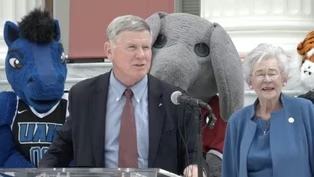
Ivey celebrates Alabama's public universities ahead of College Colors Day
Clip: S21 Ep88 | 2m 40s | Ivey celebrates Alabama's public universities ahead of College Colors Day (2m 40s)
Providing Support for PBS.org
Learn Moreabout PBS online sponsorship New Episode
- News and Public Affairs

Top journalists deliver compelling original analysis of the hour's headlines.
 New Episode
- News and Public Affairs

Today's top journalists discuss Washington's current political events and public affairs.

 New Episode
 New Episode
 New Episode
 New Episode


 New Episode
 New Episode

Support for PBS provided by:
Capitol Journal is a local public television program presented by APT