
Human Nature
Season 12 Episode 3 | 54m 9sVideo has Audio Description
An international group of artists explore fundamental questions around what it means to be human.
Viewers travel from a former 15th-century monastery in Seville, Spain, to the countryside outside of Bogotá, Colombia, to a 3D photography studio in Brooklyn, New York, with featured artists Lenka Clayton, Josh Kline, Delcy Morelos and Sin Wai Kin. “Human Nature” premieres in 2026.
See all videos with Audio DescriptionADProblems playing video? | Closed Captioning Feedback
Problems playing video? | Closed Captioning Feedback
Human Nature
Season 12 Episode 3 | 54m 9sVideo has Audio Description
Viewers travel from a former 15th-century monastery in Seville, Spain, to the countryside outside of Bogotá, Colombia, to a 3D photography studio in Brooklyn, New York, with featured artists Lenka Clayton, Josh Kline, Delcy Morelos and Sin Wai Kin. “Human Nature” premieres in 2026.
See all videos with Audio DescriptionADProblems playing video? | Closed Captioning Feedback
Where to Watch Art21
Art21 is available to stream on pbs.org and the PBS app.
Buy Now
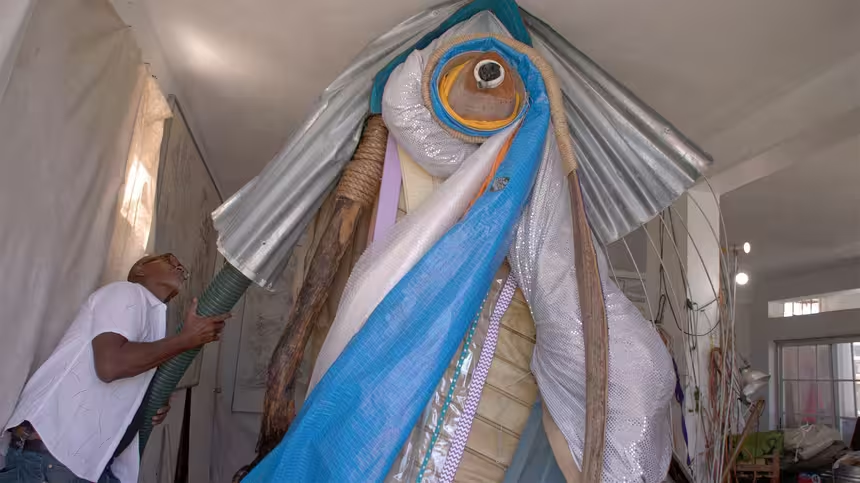
Everyday Icons
Learn more about the artists featured in "Everyday Icons," see discussion questions, a glossary, and more.Providing Support for PBS.org
Learn Moreabout PBS online sponsorship♪soft pensive music♪ ♪pensive ambient music♪ Así.
Mira, los dedos, no así.
Si no... Y va entrando, porque como tiene una capita de tierra-- - Se adhiere al suelo - Si Aquí hay tierra súper fértil.
La obra va a oler muchísimo a clavos de olor y canela.
- Necesito que se vea como un paisaje como si fuera una cueva.
- Vale.
- Siempre trabajo con materiales de la región, con la tierra del lugar.
Todas las tierras son distintas.
Todos los lugares son distintos.
Aquí estamos trabajando en un antiguo monasterio cartujo.
♪soft orchestral music♪ Esta tierra sacraliza y es sacralizada en esta iglesia.
Estamos viendo la tierra como un ser vivo y sagrado.
♪♪♪ Yo no creo esculturas, yo diseño una experiencia.
♪♪♪ En varias culturas ancestrales, la Madre Tierra es llamado el gran útero del que nosotros provenimos.
♪♪♪ Esta tierra amarilla que se llama albero tiene este color tan fuerte.
Quería ponerla en el altar por su simbología.
Está presente en las plazas de toros, en un rito de muerte.
Quería que estuviera en un lugar sagrado.
Yo planeo una obra pero a medida en que la voy haciendo, empieza a cambiar.
La naturaleza nos da sorpresas que nos hace de verdad sonreír cuando estamos viéndolo, porque es realmente inesperado.
♪soft uplifting music♪ Yo crecí en un pueblo del Caribe Colombiano que se llama Tierralta, Córdoba.
Era un paraíso lleno de mariposas, las calles sin pavimentar.
Hola, bebés.
Hola.
Esos años fueron maravillosos junto a mi abuela con su gran huerta.
Ella estaba muy en contacto con la tierra.
Así crecí yo, corriendo descalza.
Así empezó mi contacto con la tierra.
Pasaron los años, todo fue cambiando y llegó las construcciones de cemento.
Llegó la guerrilla, después llegó los paramilitares.
Llegó la muerte y el dolor.
No sabíamos quién iba a ser desaparecido el día siguiente.
Así transcurrió mi adolescencia.
Me separé de ese entorno tan natural.
Fui a estudiar arte a Cartagena.
Fui pintora.
♪pensive ethereal music♪ En los años 90, la lucha contra el narcotráfico hizo que mi obra se transformara en algo muy fuerte, mostrando la violencia.
Son como gotas de sangre tejiéndose, como ordenando ese dolor interior que sentimos todos.
Mi obra era mi respuesta a la pregunta ¿Por qué podíamos ser tan violentos con el otro ser humano?
En mi serie "Color Que Soy", quería que el color de la piel fuera lo importante.
Tratar de entender su profundidad, el dolor manifestado en la forma de un ataúd sangrante.
Después de pintar con acrílicos, encontré la tierra.
♪♪♪ Estos son mis tesoros, objetos hechos por animales.
Cuando hago mi trabajo estoy pensando en estos materiales, la paja y la arcilla.
♪♪♪ Estaba trabajando con tierra roja con ese color maravillos cuando falleció mi padre.
Cuando fui a enterrar a mi padre, hablaba con mis amigas y ocurría un lapsus linguae.
En vez de decir: "Yo estaba enterrando a mi papá en Tierraalta", decía: "Yo estaba sembrando a mi padre".
♪♪♪ Entendí que la vida alimenta la muerte y la muerte alimenta la vida.
♪♪♪ En esta capilla de la Cartuja estuvo enterrado Colón, pero para mí, sembrado.
Aquí se sembró semillas de chía, que es una planta que viene de los Andes.
Acá arriba tenemos el maíz.
♪♪♪ Creé esa conexión entre el viejo continente y el nuevo continente.
Estos canastos vienen de la selva amazónica, de varias etnias.
En el universo, aquí podemos ver cómo empieza, es un espiral que se va ampliando.
Todo está tejido, todo está relacionado.
Mucha gente se creer que está en una burbuja y por eso puede hacer cosas que dañan a la naturaleza, dañan a los otros, dañándose también a sí mismo.
[scribbling] El dibujo es el origen de mi trabajo.
¿Qué es lo que quiero que ese espectador sienta?
El dibujo me ayuda a extraer esas formas de tan infinitas las posibilidades.
♪pensive ethereal music♪ En el "Cielo Terrenal", a medida que el espectador va acostumbrándose a la luz, los objetos salen de esa oscuridad.
♪♪♪ Usé elementos que estaban a punto de ser desechados y les di una nueva vida.
♪♪♪ Y después llegas a esa gran altura que es la obra "El Abrazo".
Sientes una gran montaña que levita.
La puse a levitar para que el espectador sentira la tierra en su forma más sagrada.
♪♪♪ ♪spirited orchestral music♪ Cuando estoy trabajando con tierra, cuando estoy dialogando con ella, me siento completa.
Me siento que soy parte de ella.
Igual que cuando estoy caminando en Matarredonda descalza.
♪♪♪ Es un espacio absolutamente natural, donde la niebla alimenta los ríos.
Nubes tan cercanas que las podemos tocar.
♪♪♪ Vengo aquí por la claridad de pensamiento para poder hacer mi trabajo bien.
El ser humano está entendiendo que si no tiene una relación armoniosa con la naturaleza, está a punto de ser destruido.
Porque somos parte de ella, estamos tejidos con ella.
♪pensive ethereal music♪ [Josh VO] I don't believe in a timeless art.
I think that all art is inherently tied -- inexorably -- to the era in which it's made.
♪♪♪ My work, it's a form of speculation... about where we might go -- as individuals, as a society, as a species.
And at the core of it is a series of questions: Is this the future that we wanna live in?
If not, what kind of future do we wanna live in?
[woman] And three, two, one... [flash] ♪soft curious music♪ [Josh VO] My parents were both scientists.
On a deep level, I think their view of the world as scientists has really informed how I view the world.
My mom was a pharmaceutical chemist, and my dad was a biochemist, but he lost his job in the early '90s, and then eventually ended up working as a high school science teacher.
That really helped me understand how central to people's identity in America -- and in most places in the world -- a career is, especially for people in the middle class.
And when that career disappears, people are left really trying to understand who they are outside of work.
It's a question that comes up again and again in my own art -- you know, like, are you... a human being, or are you your job?
♪pensive ambient music♪ The body of work that I was making between 2009 and 2014 about creative labor, it was influenced by what I saw going on with my friends -- like, no boundaries between your private... -[phone dings] -and your professional life... [typing into phone] with your boss feeling entitled to contact you -at any hour of the day.
-[cell phone notifications] "Sleep is for the Weak" -- it's a series of three French press coffee makers filled with different liquids and substances.
One of them is Red Bull infused with Vivarin, another is DayQuil infused with Dentyne Ice gum, and the third is Coke Zero infused with ibuprofen.
Thinking about what lengths will people go to to modify themselves to make themselves good workers.
♪♪♪ In 2014, when I was finally able to leave my day job and go out on my own as an artist, I was working out of the back of a friend's design studio.
We were both ordering stuff on Amazon, not thinking very clearly about its ramifications at the time.
I started thinking about all the delivery people, wondering about their lives in comparison to my life and the lives of the people I knew.
♪pensive ethereal music♪ I decided to make portraits of waitresses, FedEx delivery workers, hotel maids, paying them to sit for 3D scanning sessions and video interviews where I would ask them about their professions.
I don't-- I don't eat breakf-- I don't eat breakfast, I don't eat lunch.
I don't got time for...for breakfast.
[Josh] How often do people leave without giving you a tip?
Probably every third table.
After taxes, I get maybe 2.60 a hour.
That's, what, a bus fare?
[chuckles] [Josh VO] Some of these people, they had no sick days, they had no vacation days, they had no health insurance.
♪♪♪ The sculptures are a portrait of objectification -- of people turned into a service -- and that speaks to how they're treated.
I wanted to give them a platform to speak in their own words, and to elicit an emotional response.
Each of these bodies of work looks at different economic classes.
♪♪♪ I knew I wanted to make sculptures that took the form of a virus.
Unemployment's spreading like a contagion through the middle class.
Inside are cardboard file boxes with fictional possessions of a different unemployed middle-class professional.
♪pensive orchestral music♪ I made a series of life-sized portraits.
Each one is a portrait of a real unemployed person who had worked in fields predicted to be eliminated by AI and automation.
There's a small business owner, there's an administrator, there's a secretary, there's an accountant, there's a lawyer.
Later, I made a portrait of a journalist, and now, myself as an artist.
[Josh] Yeah.
[woman] Okay.
And... -ready?
-Yup.
[woman] In three, two, one... [flash] -Let me have a look.
-[man] Sure.
[Josh] I might need to be directed to figure out how to do it, 'cause it feels like I'm pretty curled up, but maybe it's just that I'm not very flexible.
[laughs] -It's those hips.
-Yeah, exactly.
[woman] Okay, I'm just gonna check your position really quick.
In three, two, one... [flash] [Frank VO] There are 162 cameras that are focused on Josh.
They all go off at the same time, and then we collect the images and use photogrammetry software to recreate the model, and then do the texturing.
Ah, this is better.
-[woman] Yeah.
-Yeah.
-Okay.
-Yeah!
Great.
[Frank] That's how it looks without the color texture there.
-I mean, these look great.
-[Frank] Yeah!
Yeah.
I mean... this is amazing.
[Frank] Yeah, this one turned out well.
♪pensive ambient music♪ [Josh VO] I'm not divorced from these phenomena that I am dealing with.
There is no "outside of capitalism"; we're all complicit.
[printer whirring] I felt like it was time to implicate myself in the work -- my own image -- in the same way that I have with other people.
♪♪♪ [Josh] These are really... The printer prints plastic, and at the same time that it's printing the plastic, it's coloring it.
This is the color test.
So, we'd look at it and we'd say, "Oh, it's too green.
It needs to be more red."
The process is also important to me.
Like, the work is about the digitization of people, objects, skills.
Like, it's become oddly normalized, but it is weird to see, like, these faces and, like, a tray full of, like, my fingers and stuff.
It's-- it's-- it is a little weird.
♪curious ethereal music♪ [Josh VO] The architecture that I'm using in the show is the architecture of art fairs, which are these trade fairs that the art industry holds all over the world where art collectors and museum curators will go shopping.
♪♪♪ I'm merging myself with the art that I've made, and I'm merging myself with the credit cards that have paid for a lot of it.
So many people in the US are only a paycheck or two away from losing everything, and precarious conditions are at the heart of what it means to be an American artist today.
There's this phrase "human capital" that economists use, which means treating people as resources instead of as human beings, and this very much applies to artists as well.
They can become a product to be used up and then discarded as waste afterwards.
♪♪♪ People really have to kind of present this image of success at all times in order to keep things moving, and I... wanted to kind of puncture that a little bit with a little bit of honesty.
[birds chirping] [Josh] Should we put the raft together?
[Sandy] Yeah, let's do it!
This is actually our first time, like, doing the full kind of install from scratch with all the components here.
[drilling] We could put the TV in as well if you want.
[Josh] I-- I think that we should.
[Sandy] Yeah.
[Josh] Let's do that.
This looks pretty good.
So this was very productive.
-Yeah, yeah, definitely.
-Look at us.
-That makes sense.
-[chuckles] [Josh VO] I had had the idea for an installation based on a climate refugee camp.
♪curious ambient music♪ It became a project about what is America's role in bringing about the climate crisis, what it could feel like if you transposed that into the future.
There are eight sculptures, each of which is based on an actual shelter that has housed refugees or migrants somewhere in the world during the 21st century, and also fictional interviews with future climate refugees.
It's the end of the world and it's still "No work, no soup for you."
There are rich people with big houses further inland up in Westchester and... wherever, Connecticut.
These people have plenty of dry rooms that we could all be living in.
I mean, Heaven forbid that someone should give up their home office to a refugee.
That would be socialism, wouldn't it?
[Josh VO] I made this work to talk about the myth of personal responsibility, how Americans really see each person as responsible for their own circumstances.
You succeed or fail as an autonomous individual rather than as a part of society.
♪♪♪ It's not about us helping each other, it's about you versus everybody else.
Ruthless competition.
♪♪♪ I think scientists do a great job at laying out the facts, but not at communicating the urgency and potential personal impact of catastrophic climate change -- like, why does this matter in our own lives?
A challenge that I set for myself was: could I make an artwork that would make someone feel something as intensely as a novel does, or a film, or a piece of music?
♪♪♪ Look, everyone is going to have to start over after this -- to build new lives, to rebuild the country.
I mean, if we're given a chance, we... ♪pensive ethereal music♪ [Josh VO] Fundamentally, I am a Humanist.
I do believe in human beings.
And I believe in the capacity and possibility of human beings in the world.
♪♪♪ You know, humans are just another animal on Earth, but with the capacity to create tremendous change, both good and bad, and also to create true wonder.
I think art is part of that.
♪curious ambient music♪ [Lenka VO] I grew up in Cornwall.
That's in southwest England.
It's like as far as you can go from London on the train, and it's the end of the line.
I think I barely saw art in museums until I was at least in my late teens.
Growing up, I didn't really have an idea of what a life as an artist would look like.
I always felt like in a sort of unknown place, figuring it out... which I think was actually quite good [chuckles] in the end, so I could make it up.
Looking at things that are supposed to behave a certain way and purposefully misunderstanding how they should be used, it's really important to me.
The typewriter was originally a tool that created work opportunities for women, but often as a transcribing machine, so I've used it to different ends.
♪♪♪ I work in all kinds of materials, all kinds of scale.
So much of my work, regardless of the medium, was just about paying attention to what was around me and collecting it, and then going through some kind of editing process and making collaborative work with people... It started just to become the way that I naturally wanted to work.
♪snare drum rhythm♪ I co-directed a film with James Price called 'People in Order.'
We populated different, commonly accepted scales with people who we randomly met.
The first scale was age, so there's one person of every age from one to 100.
-16.
-♪snare tapping♪ [Lenka VO] All these scales that govern everything about the way we live, but they're normally interior, hidden, personal things.
But here, that was the organizing system for the films.
99.
100.
Is that it?
[Lenka VO] I've lived in Pittsburgh for 14 years.
I had never been to Pittsburgh.
It was a complete leap into the unknown, and I like that feeling.
Five years ago, we moved to this very small neighborhood in Pittsburgh called Troy Hill.
It's kind of a unique and isolated community.
It sits on a clifftop, which I really love.
It's the perfect place to work.
I love this silver.
Oh, thank you.
[Lenka VO] My husband, Phillip Andrew Lewis, he's my primary collaborator.
Working collaboratively, there's so many more skills, and you can sort of improvise.
There's a certain kind of madness to making art that feels like what's the point?
But we give one another permission, and it feels important.
It's a part of our relationship and our life.
♪sparse curious music♪ [Lenka VO] When I became pregnant, I'd only been here, like, a very short period of time, and I was invited to be part of this group show called the Pittsburgh Biennial.
It was gonna open when my child was gonna be eight weeks old.
There was a lot of questions swirling around in my mind about childcare, finances, space, and time.
These questions and concerns kind of became the frame for the work.
It was called "Maternity Leave."
[baby crying] [Lenka over monitor] Hello, Otto.
[baby grumbling] The baby monitor was live-linked to our bedroom where Otto, my son, slept.
And for the entire duration of the show, which was several months, if you were in the museum, you would hear everything that was happening in our private home.
[baby grumbles] It was called "Maternity Leave" because, here in the US, there is no federal standard for maternity leave.
[Lenka unintelligible over monitor] [Lena VO] I've always worked with my everyday life, but that piece complicated the ideas of public and private, and created a direction for me to work, which became "An Artist Residency in Motherhood."
I kind of reframed motherhood as materials to make work out of.
And so I would work with the material of anxiety, for example.
There was a very particular new scale of measurement within myself.
It's an emotional scale, and I was interested in trying to sort of quantify that.
I would try as long as possible to stand behind the camera.
At a certain point, there was a moment where my parent mind took over from my artist mind, and I would just run and grab him, and then I measured what that distance was.
[Otto giggles] Another work that I made during that time -- it's hard to say "made" -- I had "noticed" [chuckles] was a piece called "63 Objects Taken From My Son's Mouth."
♪sparse curious music♪ He was an incredible curator.
The rule to be included in the collection was that I had to have personally pulled it out of his mouth, and I had to have had a real fear that it would cause some sort of damage to him, and then it became part of the collection.
♪♪♪ The whole practice was about being visible and taking up space as a parent and artist, which is usually kind of hidden.
♪♪♪ The closer I went into something very private and personal, actually, the more it was able to connect with people.
Anything I made would be put on this website.
People would see the work that I'd made, and they were emailing me and saying, "This is what I've been looking for.
Can I do it?"
I decided I had to create a frame that would work for other people to do the residency.
Very quickly, people started taking part.
There's a world map.
Every time somebody signs up for the residency, I receive an email and add them to the map.
You can navigate that map and connect with other people.
♪upbeat jazzy music♪ We've had extraordinary experiences with our neighbors.
We've been asking, like, the pizza restaurant, "Can we set up a temporary museum in your window?"
And without asking a single other question, he said, "Yes."
[chuckles] And that's very much been the experience of this neighborhood.
[Lenka] What have pup to the windowg?Well,g and they're looking and they're just going like this, you know?
And you just have to stand there and laugh.
We have very limited art exposure.
It just wasn't something that you did, okay?
And if it gets people talking and it just gets any kind of activity along the streets, then why not?
It's been fun!
It's been an experience for me -- a learning one, too.
♪♪♪ [Phillip] "Gallery Closed" is two windows, essentially, that peer into our building.
[Lenka VO] And all of the artwork that we show is designed to be seen through these windows.
We're harnessing people's nosiness -- "nebiness," as they call it in Pittsburgh.
♪♪♪ Our neighbors are a part of our practice, as well as viewers of the work that we've installed.
[Lenka] Hi, I'm Lenka!
[indistinct].
This is my husband, Joe.
[Lenka] Hey, Joe.
So this is "Darkhouse Lighthouse."
We made the lighthouse together, and it's part of Troy Hill Art Houses.
It's a permanent public artwork.
[woman] I can't tell you how many times I've come down this way, and I'm looking at it and I'm thinking... -[woman] There's a lighthouse.
-I had no idea!
♪pensive ambient music♪ [Lenka] There was a fire in the kitchen of the original house, and it burned up throughout the whole structure, so when we got the house, there was kind of a void right up through the middle of the building.
♪♪♪ This lighthouse is kind of describing a person who would live in a lighthouse and tend to it.
What would they bring into this building?
How would they spend their time?
[woman] This is awesome.
We just slowly started collecting objects, and through these objects, we're describing... a life.
[woman] And this could be the calendar.
That's probably what they had, huh?
[man] Yeah, look at the curve in the bed.
[woman] Yeah, they've got a curvy bed.
[chuckles] [Phillip] Yeah, it's a traditional lighthouse keeper bed, so it's called a banana bed.
Every lighthouse will have a different shape and diameter, and so we made this one.
[man, chuckling] That's really neat.
♪curious ambient music♪ [whispering] Wow!
♪♪♪ This craftsmanship is outstanding!
This is amazing.
It's... incredible.
♪♪♪ One of the ways that we work together is we just get incredibly obsessed with something.
We're interested in the lighthouse as a piece of architecture, but also as a kind of state of mind.
Even if you've never been to the ocean before, you know what a lighthouse is.
You have a feel for it.
[chuckles] I think Troy Hill's the perfect place for a lighthouse!
-[woman] Yeah!
-[man] Now that I see it!
-♪♪♪ -[fog horn] [Lenka VO] Okay.
[Phillip] Hi, dearie!
[woman] Hi.
Thank you.
So what's the next project?
[Lenka] It's called "The Lights Going On and Off."
Everything stays the same, except the lights in the room go off for one second, then on for one second.
[woman] Sounds good to me.
[chuckles] [Lenka VO] I think being an artist and making art, it's an excuse, really, and an invitation for people to take part in something that otherwise wouldn't make any sense.
[lights flicking] For all of us working as artists, you conjure a logic of the world of the idea, and then bring people into that.
If I asked them to turn their lights on and off for two months straight without it being art, people would say no.
♪♪♪ Early goes to school here.
Our recent project is able to kind of activate the whole classroom.
[Phillip VO] Working with kids is something we've both done quite a bit.
They can get behind nonsense a lot quicker, and we can sort of reach the same plane.
[lights flicking] [Lenka VO] There is only connection in life, but we don't see it that way.
You know, we see ourselves... sort of isolated, and to connect with someone is a kind of effort or decision that we make.
My work is just looking at those connections.
It's using them, isolating them so that we can see them to create a shared experience.
♪soft ethereal music♪ [Wai Kin VO] I'm working on the moon, which appears... um, in the background of this kind of cosmic scene.
I usually don't let people film me doing my makeup, because it is, like, such a solitary moment for me -- like, preparing for a performance.
Before I put on the makeup, I am performing in ways that I'm unconscious of and sometimes conscious of.
And after I put on the makeup, I am performing in a way that is, like, very intentional.
So this moment in between is almost like the only time that's not performative.
♪♪♪ [gibberish] [Wai Kin VO] I kind of think about my practice as a whole universe that I'm building, and every work is like another window into, like, a different part of that.
♪uplifting pensive music♪ It's a fantasy that builds on itself.
♪♪♪ I spent a lot of time with my grandmother, and her hobby was Cantonese opera.
Her two favorite actors were these two women, and they played romantic lead roles opposite each other.
Pak Suet-sin was the "dan" role -- the female lead role -- who was usually the romantic interest of Yam Kim-fai, who would play the "sang" role.
And they were rumored to actually be lesbian lovers.
This was one of my earliest memories of really seeing, like, queer representations anywhere.
I was very aware of these different roles and archetypes, but also aware that, even though the roles were strict, the kind of rules of who was allowed to play the roles weren't.
When I came to London from Toronto, I became involved in the queer community before I started studying.
I was making a lot of flyers for lesbian and queer nights.
I was doing murals in clubs.
That was the context that I started to do drag in.
♪jovial piano playing♪ [cheering] I actually really kept it very separate from my art practice.
Using film, I felt that I could have some agency over how I was being framed.
I could narrate people's experience of looking, so that I could create a kind of interruption.
[Wai Kin video VO] Look at her.
Look at her mouth.
Look at the way she parts her lips slightly to give the appearance of being receptive.
[Wai Kin VO] A lot of my characters bleed in and out of each other a little bit.
They kind of change every time they appear in a different part of the universe.
Today's top story: I want to perform something I am not until it comes naturally, and I do it so well, you are convinced of it too.
[Wai Kin VO] Wai King is a character that I use to just play with masculinity and try to push it to its limits -- enjoying that performance of it, but at the same time making fun of it a little bit.
As soon as I had four masculine characters, I was like, "It's time to make the boy band."
♪pop beat♪ [Wai Kin video VO] It's always you.
You're like infinity.
♪♪♪ [Wai KinVO] I grew up with NSYNC and Backstreet Boys.
They were everywhere in popular culture when I was a kid, so they definitely are there in my consciousness.
And when I started to make this work, I was also becoming interested in some K-pop groups.
a Hong Kong boy band called Mirror.
They were a big influence.
I think their byline on Instagram is "Together, we reflect infinite possibilities" or something like that, which was just... was like a sign.
♪♪♪ Boy bands are this perfect representation of how identity is constructed and consumed within capitalism.
♪♪♪ Each member is usually hyper-individualized, but really, they can't exist on their own.
Together, they form a whole person.
[Wai Kin] So that's the sunlight and that's the moonlight.
[Wai Kin] Um, okay.
So that's good.
I think, uh... I do wanna make sure that there is enough, uh, face light for both of them.
-This is the key light.
-Okay.
[Wai Kin VO] Many parts of my practice are incredibly solitary.
There's the writing part of it, the research part of it.
But as soon as I have a script and a shot list, I need other people to help me realize it.
Should we photograph the white shoes first?
[Matt] Uh-huh.
That's it.
That feels like... a moment.
[Wai Kin chuckles] This is doing it, yeah, definitely.
For an artist, like, working on, like, the presentation of characters and what their background might be, the fitting is a place that you kind of really, like... refine that and figure it out and... [chuckles] It's like finding the look that makes me be the character.
I know when my body language starts to change that that is kind of, you know... getting warmer.
[Wai Kin] I love this tassel -- almost feels like a bit Chinese opera.
♪upbeat quirky music♪ Yes.
All right.
I'm happy with that.
[Wai Kin VO] On a shoot, I am wearing lots of hats.
You know, I'm doing my makeup, first of all.
[Wai Kin] Like, don't be precious with it.
-[Fillo] Okay.
clocks a little bit further in.
[Fillo] Okay.
[Wai Kin VO] I am acting and directing at the same time.
-Let's try it again.
-Okay.
[Wai Kin VO] It's this constant doing the thing and then looking at the thing and refining it.
♪♪♪ But I hate being told what to do, so I wouldn't let anybody direct me.
[laughs] [Wai Kin video VO] Today's [indistinct]... Cut.
So this is a script of 'The Time of Our Lives' -- of the science fiction sitcom.
It's really modeled off of these sitcoms that, like, represent these, like, stereotypical or, like, archetypal families.
Do you wanna run through both the scripts all the way through?
[Wai Kin] Like I was pulling at what was... intrinsic to my nature or... pulling at the very nature of nature.
[Wai Kin VO] The writing of this work was really thinking about time and how it's not fixed, and the fact that everybody has their own experience of reality.
It must have been a looooong... minute!
[laughter] [Wai Kin VO] It's a two-channel work where one channel is the sitcom itself and the other channel is the live studio audience that is watching the sitcom and reacting to the sitcom and the cues that are being given to them.
Pulling at the very nature of nature.
[Wai Kin character] My goodness!
That sounds painful!
Did you go to a doctor?
[chuckles] Funnily enough, the doctors just didn't believe me!
[laughter] [Wai Kin VO] Your relationships with other people and, of course, yourself become solidified by how people react to you.
[audience] Ooh!
I thought the reactions were good.
[Wai Kin] Yeah, I thought they were really good.
So maybe if I kind of do this, then kind of get more intense.
[audience hooting and cheering] ♪soft curious music♪ [Wai Kin VO] "Portraits" is a series of moving image portraits of five of my characters, inspired by works of the art canon.
♪♪♪ The Universe poses as Lu Zhi's "Dreaming of a Butterfly," inspired by Taoism, where a philosopher has a dream so vivid if he's a man dreaming he's a butterfly or a butterfly dreaming he's a man.
It was almost like a key to unlock things like self and other, performance and authenticity, fantasy and reality, waking and dreaming.
There are so many ways that we split ourselves into binaries and categories, and actually, all of these things -- all of these systems -- are connected.
♪♪♪ Frida Kahlo's "Self-Portrait with Cropped Hair"... It references a really personal moment of transformation.
Cutting my hair was a real act of care for myself.
They pose with a large meat cleaver -- a Cantonese cooking utensil.
It belonged to my grandmother, and is a tool that I now use to cook meals for my friends.
There are a lot of things that are incredibly personal in my work, but I hide them behind fantasy and science fiction or symbols to try to reflect on universal experiences.
♪tender pensive music♪ I really try to have elements in the work in the installation that literally invite people into the works -- showing all of the costumes and tools that have been used to create the fantasy.
That's really important to me because I feel that we live in a society that does not show how things are constructed, and teaches you that they're natural or somehow really true.
♪♪♪ Our nature, our beliefs, our ethics are all narratives.
Storytelling not only represents but creates realities.
♪♪♪ Storytelling is a tool to construct other perspectives that you can immerse yourself in, and then be able to see the world that we exist in in a different light.
♪soft pensive music♪ [woman VO] 'Art in the 21st Century' is available on Amazon Prime Video.
Episode 3 Preview | Human Nature
Video has Closed Captions
Preview: S12 Ep3 | 30s | An international group of artists explore fundamental questions around what it means to be human. (30s)
Providing Support for PBS.org
Learn Moreabout PBS online sponsorship New Episode
- Arts and Music

Innovative musicians from every genre perform live in the longest-running music series.
 New Episode
- Arts and Music

Intimate portraits of six of the most influential and celebrated classical music artists.


 New Episode

 New Episode
 New Episode
 New Episode
Support for PBS provided by: