
January 26, 2026 - PBS News Hour full episode
1/26/2026 | 57m 46sVideo has Closed Captions
January 26, 2026 - PBS News Hour full episode
Monday on the News Hour, President Trump sends his border czar to Minnesota after the killing of a man protesting immigration raids further inflames tensions. The situation threatens a homeland security funding bill in Congress, increasing the chances of another government shutdown. Plus, hundreds of thousands are without power as most of the country deals with the aftermath of a winter storm.
Problems playing video? | Closed Captioning Feedback
Problems playing video? | Closed Captioning Feedback
Major corporate funding for the PBS News Hour is provided by BDO, BNSF, Consumer Cellular, American Cruise Lines, and Raymond James. Funding for the PBS NewsHour Weekend is provided by...
Support provided by:

January 26, 2026 - PBS News Hour full episode
1/26/2026 | 57m 46sVideo has Closed Captions
Monday on the News Hour, President Trump sends his border czar to Minnesota after the killing of a man protesting immigration raids further inflames tensions. The situation threatens a homeland security funding bill in Congress, increasing the chances of another government shutdown. Plus, hundreds of thousands are without power as most of the country deals with the aftermath of a winter storm.
Problems playing video? | Closed Captioning Feedback
How to Watch PBS News Hour
PBS News Hour is available to stream on pbs.org and the free PBS App, available on iPhone, Apple TV, Android TV, Android smartphones, Amazon Fire TV, Amazon Fire Tablet, Roku, Samsung Smart TV, and Vizio.
Providing Support for PBS.org
Learn Moreabout PBS online sponsorshipAMNA NAWAZ: Good evening.
I'm Amna Nawaz.
GEOFF BENNETT: And I'm Geoff Bennett.
On the "News Hour" tonight: President Trump sends his border czar to Minnesota after the killing of a man protesting immigration raids further inflames tensions in the state and across the country.
GIL KERLIKOWSKE, Former Customs and Border Protection Commissioner: Border Patrol is clearly the wrong tool to be leading this effort to be working in an urban environment.
AMNA NAWAZ: The situation in Minnesota threatens a Homeland Security funding bill in Congress, increasing the chances of another government shutdown.
GEOFF BENNETT: And hundreds of thousands of people are without power, as most of the country deals with the aftermath of the massive winter storm.
(BREAK) GEOFF BENNETT: Welcome to the "News Hour."
President Trump sent his border czar to Minneapolis today and shifted his response a bit following bipartisan backlash to the fatal shooting of a second U.S.
citizen by federal agents this weekend.
AMNA NAWAZ: Both the president and Minnesota Governor Tim Walz signaled some progress in the Twin Cities.
Border Patrol senior official Greg Bovino and some agents are now reportedly leaving the state.
But anger over the conduct of ICE and the Border Patrol is high.
And a federal judge is deciding whether the immigration crackdown can continue.
Special correspondent Fred de Sam Lazaro begins our coverage with the latest from Minneapolis.
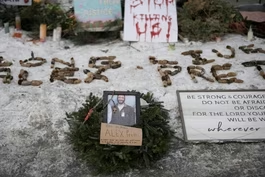
FRED DE SAM LAZARO: On a frigid morning in south Minneapolis, another makeshift memorial grew larger today for another U.S.
citizen killed at the hands of federal agents.
For residents showing up to honor Alex Pretti, a mixture of sadness, anger and exhaustion.
Rose Zelee lives just steps from the site of Saturday's shooting.
ROSE ZELEE, Minneapolis Resident: I was, like, really right there at the end of the corner.
And I was walking towards this way.
And I heard the gunshots.
And I just started running.
I just hope we can all get together and have an understanding and stop this.
This is very terrifying.
And it's not good.
I pray every day for us all.
FRED DE SAM LAZARO: Emily and Brandon Del Bel drove in from neighboring St.
Louis Park.
EMILY DEL BEL, St.
Louis Park Resident: We woke up, we got our kid to school, and we were paralyzed.
Don't know how to take the grief that we're dealing with right now.
BRANDON DEL BEL, St.
Louis Park Resident: I drove into work, got in there, and I just -- I realized I couldn't be there today.
Just nothing feels real.
So I need to prove to my body that this is real.
So I need to come here, even though it's really hard.
FRED DE SAM LAZARO: But by mid-morning came the first hint of some conciliation.
President Trump in a TRUTH Social post wrote: "Governor Tim Walz called me with the request to work together with respect to Minnesota.
It was a very good call and we actually seemed to be on a similar wavelength."
The president also said he was sending border czar Tom Homan to Minnesota.
In a statement shortly after, Governor Walz said he had a -- quote -- "productive call" with President Trump, writing: "The president agreed that he would talk to his Department of Homeland Security about ensuring the Minnesota Bureau of Criminal Apprehension is able to conduct an independent investigation."
He also said the president agreed to look into reducing the number of federal agents in Minnesota and to coordinate with state officials.
In an interview with Minnesota public radio this afternoon, Walz was asked about reports that Border Patrol Commander Greg Bovino would be leaving the state tomorrow.
GOV.
TIM WALZ (D-MN): That is really good news and I will acknowledge it here.
That is the president following through apparently with our conversation.
FRED DE SAM LAZARO: It comes after Pretti, a 37-year-old ICU nurse, was killed by ICE agents during a scuffle that was captured on video by bystanders.
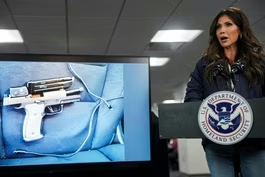
(GUNSHOTS) (SCREAMING) FRED DE SAM LAZARO: The Department of Homeland Security officials were quick to say that Pretti had been - - quote -- "brandishing a firearm."
KRISTI NOEM, U.S.
Homeland Security Secretary: This looks like a situation where an individual arrived at the scene to inflict maximum damage on individuals and to kill law enforcement.
FRED DE SAM LAZARO: And hours after the killing, White House Deputy Chief of Staff Stephen Miller called Pretti -- quote -- "a would-be assassin in a social media post."
But numerous bystander videos from the encounter paint a different picture.
A frame-by-frame analysis of the video by The New York Times and several other news organizations shows Pretti holding a phone, not a gun.
And they show agents removing the gun from his hip one second before the first shots were fired.
ROB DOAR, General Counsel, Minnesota Gun Owners Caucus: You don't have to choose between your first and Second Amendment rights.
FRED DE SAM LAZARO: Rob Doar with the Minnesota Gun Owners Caucus, the state's largest Second Amendment advocacy group.
He says there's no evidence Pretti was trying to shoot agents.
ROB DOAR: I'm just very disheartened by the inaccurate messaging that's being put out.
And I think it's being done for two reasons, one to give the public the impression that Mr.
Pretti was in violation of the law, so, therefore, the use of force was justified against him, and to try to discourage people from exercising the rights that they're entitled to.
You have a right to carry a firearm in Minnesota if you have a permit, which Mr.
Pretti did., You have a right to carry openly or concealed.
You have a right to carry backup in magazines and you have a right to carry at a protest.
FRED DE SAM LAZARO: It's all sparked a political firestorm, with numerous Republican politicians criticizing the ongoing ICE and Border Patrol operation in Minnesota now over a month old.
In a social media post over the weekend, Louisiana Republican Senator Bill Cassidy described the shooting as -- quote -- "disturbing" and called for a full joint federal and state investigation.
Meanwhile, Minnesota officials were in court on two fronts today.
One case aims to preserve evidence in Alex Pretti's shooting after state investigators were shut out from examining the scene.
The second lawsuit looks to end the so-called Operation Metro Surge altogether.
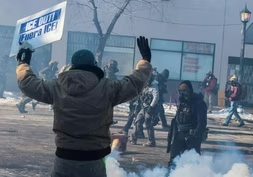
Still, tensions remain high in the Twin Cities, one demonstration boiled over last night, with people vandalizing the hotel where they believed ICE agents were staying.
The state's Department of Public Safety said officials were encircling the group for arrests when federal agents showed up unannounced and deployed chemical irritants, all this as friends and colleagues mourn and remember Alex Pretti.
Dimitri Drekonja is an infectious disease physician who worked with Pretti both in clinical and research settings.
DR.
DIMITRI DREKONJA, Colleague of Alex Pretti: He was just a really fun guy, did his work hard, made sure that he was covering everything that he could do and also trying to see what else he could do that would free up space for other people to do their jobs.
He was just a helpful, friendly, engaging guy.
So, to hear him described as a domestic terrorist is -- it boggles the mind and it is contrary to everything that I have known for eight years.
FRED DE SAM LAZARO: And while Pretti's final moments are splashed across the front pages, Dr.
Drekonja points to other photos as a truer reflection of who he was.
DR.
DIMITRI DREKONJA: The image of him holding his mountain bike, the image of him smiling in his official portrait, you will notice that every one of those images that is out there, he has a smile.
And that is the person that he was.
And that's how I hope people remember him.
FRED DE SAM LAZARO: For the PBS "News Hour," I'm Fred de Sam Lazaro in Minneapolis.
AMNA NAWAZ: And we should note we asked officials from Border Patrol, ICE and the White House to join us for an interview, but they declined our requests.
Meanwhile, the crackdown in Minnesota and the deadly shootings of two U.S.
citizens are raising questions about the tactics used by federal immigration agents.
To discuss that, I'm joined by former Customs and Border Protection Commissioner Gil Kerlikowske.
He also served as the chief of local police departments in multiple cities.
Gil, welcome back to the "News Hour."
Thanks for being with us.
GIL KERLIKOWSKE, Former Customs and Border Protection Commissioner: Sure.
AMNA NAWAZ: So you have seen a number of videos circulating online, some even frame-by-frame analyses by different news outlets.
I'm just curious, what stands out to you from what you have seen?
GIL KERLIKOWSKE: Well, the fact that they took him to the ground.
And he is resisting.
But you would think that, with the number of agents that they had, they would be able to get his hands behind his back and get him secured and get him handcuffed.
And it reminded you of kind of a football scrum, where they were all at different angles.
So I didn't see them doing a particularly good job of securing him and getting him in custody.
AMNA NAWAZ: Based on what you know about what happened before that interaction, what should have agents done in that case, in those circumstances?
GIL KERLIKOWSKE: Well, I think what they don't do and what they should be doing is that when they're confronted with somebody who is attempting to interfere or attempting to obstruct, they should tell that person we're arresting you.
This use of chemical munitions, just bringing out pepper spray, et cetera, just makes little sense.
Police officers deal with these things all the time and they make a physical arrest.
And that actually then deters some other people from getting involved or obstructing.
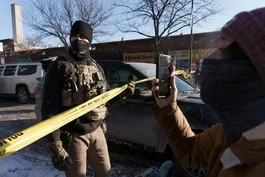
But, remember, this is a group of people, the Border Patrol in particular, who are completely untrained and unskilled for policing an urban environment.
AMNA NAWAZ: I want to ask you a little bit more about that training.
But can I just pick up on something you mentioned about attempting to interfere or attempting to obstruct, which is something we have heard from administration officials.
When you see the videos, is that what you see Alex Pretti doing?
Many people say they see him stepping in to help a woman who was knocked down.
Is that interference to you?
GIL KERLIKOWSKE: I see him stepping in where the agent has already knocked this woman down.
And I don't condone that.
I mean, that is totally wrong.
But as a person who's there to protest, observe, record, you want to not get involved.
Even the guidelines the protest groups give you say you should stay five or six or seven feet away.
Alex was in the heat of the moment and he didn't do that.
And I wish he had.
AMNA NAWAZ: You mentioned the training that these federal agents have before they go.
And I want to point out a slight distinction here.
When we talked about the shooting and killing of Renee Good, that was by an ICE agent.
This was -- it looks like it was a Border Patrol agent in the shooting and killing of Alex Pretti.
From what you know, are they trained to work in these kinds of environments, crowd control, urban policing?
GIL KERLIKOWSKE: Not at all.
Commander Bovino from the Border Patrol talked about how they have offices in some different cities like Buffalo.
I was the police commissioner in Buffalo for five years.
I never saw a Border Patrol agent in the city.
So they don't have that kind of experience and background and training to work in an environment that can actually become a bit hostile.
And city police officers know how to handle those things.
It's very obvious that ICE and the Border Patrol do not.
AMNA NAWAZ: The other thing we have heard from the administration officials is this idea that Alex Pretti was someone who was intent on harming federal agents.
They say he approached officers with a gun, intended to massacre law enforcement.
The DHS secretary said that officers were acting defensively in their actions.
I know there's a lot of video we haven't seen yet, but have you seen any evidence of those claims in the videos that are circulating now?
GIL KERLIKOWSKE: I did not see any of that.
The only thing I did see in his hand was a cell phone.
AMNA NAWAZ: So, to follow on that, we know that there's body camera footage from the federal agents that investigators are looking into, reportedly.
There's also the phone that Alex Pretti himself seemed to be recording on.
What do you think we can learn from those additional camera angles?
GIL KERLIKOWSKE: Well, body cameras have become very popular, and for a number of years.
And when I was at Customs and Border Protection, we experimented and the Border Patrol agents were keen to use them.
The problem was, at that time, the technology did not hold up well in the environment that they worked in.
But they said, look, this body camera will protect me more.
It will show that what I did is lawful and restrained.
And now the administration doesn't want to use body cameras.
AMNA NAWAZ: Can I ask big picture here?
Because you mentioned these are not agents who are trained in the environment in which they're currently operating.
Two American citizens have now been killed by those federal agents in Minnesota.
What do you think needs to happen so there's not a third citizen killed?
GIL KERLIKOWSKE: Well, one, the Border Patrol is clearly the wrong tool to be leading this effort, to be working in an urban environment.
And, frankly, the ICE section, the removal section, ERO, they were pretty good at being able to target people who were dangerous, target people with final orders of deportation and make those arrests.
This walking through Walmart and Home Depot lot makes little sense.
And all Iran really does is, one, cause chaos, but you've also pretty much eroded the trust that law enforcement has gained in the last five years after the murder of George Floyd.
AMNA NAWAZ: That is the former Customs and Border Protection Commissioner Gil Kerlikowske joining us tonight.
Thank you so much for your time.
GIL KERLIKOWSKE: Thank you.
GEOFF BENNETT: A federal judge in Minnesota heard arguments today on whether to expel ICE agents from the state and put an end to the Trump administration's sweeping immigration enforcement.
The hearing comes as state and the cities of Minneapolis and St.
Paul officials warn that ICE's actions have pushed them into crisis.
We're joined now by Mary McCord, executive director of the Institute for Constitutional Advocacy and Protection at Georgetown Law.
Mary, thank you for being with us.
MARY MCCORD, Former Justice Department Official: Sure.
My pleasure.
GEOFF BENNETT: At its heart, is this lawsuit, is this case really about immigration enforcement or is it fundamentally about the balance of power between states and the federal government?
MARY MCCORD: Well, the way that it's been pled by the state of Minnesota and the cities of Minneapolis and St.
Paul, it does bring to issue this idea of federalism and principles of states' rights and the federal government's rights.
And they have a number of other claims, but two of the key claims in their complaint and the key claims that were in their motion for preliminary injunction that was heard by the court today is that what the government is doing here with this entire surge in the way it's been implemented has violated the Constitution, the Fourth Amendment when it comes to some of the searches and seizures, the First Amendment when it comes to retaliation against protesters, racial profiling, aggressive conduct, all those things.
They're saying that this infringes on their 10th Amendment rights because states are reserved the police power.
And because of the surge and because of the pressure it's putting on the state and the cities and where it's occurring, that's impacting their ability to protect public safety, general health and welfare, all obligations of the state.
And they also argue it violates the notion of equal sovereignty between the states, because they argue that Minnesota is being targeted for political reasons, whereas other states that might even have more undocumented immigrants or the crisis of undocumented immigrants might be greater are not being targeted this way.
GEOFF BENNETT: And if the judge were to grant Minnesota's request for a halt or some restriction on ICE's operations, what would that look like in a real way?
MARY MCCORD: Well, that's a tough question to answer, because the complaint asks for a lot of relief.
At the heart, what Minnesota wants is for ICE to pull out of this surge, not necessarily every ICE agent to leave, but the surge to end.
And that's an extraordinary relief, because, of course, the federal government argues that, under principles of supremacy of federal law, a state can't force them to stop enforcing federal law and that a judge would not be able to do that either.
So it really does pit these interests.
And that relief would be pretty extraordinary.
There are lesser forms of relief, though, that the judge might be considering, because she's taking this under advisement, which are things like enjoining violations of Fourth Amendment by not racially profiling when they engage in stops, enjoining them from going into sensitive locations like hospitals and schools and day cares, things like that.
So there's a whole sort of variety of relief that she could grant if she agrees with the legal arguments that have been made.
GEOFF BENNETT: And on the flip side, if the court sides with the Justice Department and the Trump administration, what precedent might that set for states that challenge federal immigration enforcement and surges like the ones we've seen in Minneapolis?
MARY MCCORD: Yes, this case has been different than so many of the other cases that have been brought in places like Portland and in Illinois, Chicago, when it comes to how ICE agents are actually performing their duties.
A lot of those cases, like another case actually that's in Minnesota right now, the Tincher case, those have been brought on behalf of protesters or on behalf of people who have been stopped as suspected being here undocumented.
And those are making very specific other types of claims.
And this would have no impact on those lawsuits because the claims made by the state here are very different, these 10th Amendment claims.
The other claims are much more personal to the individuals who have been subject to unconstitutional treatment.
So I think that you would still see those types of lawsuits in Minnesota, like there is one ongoing, the Tincher case, or in other states, if we see the type of excessive force and overreach and unconstitutional practices that we are seeing by ICE in Minnesota and that we saw in Portland and that we saw in Chicago and in L.A.
GEOFF BENNETT: And, Mary, based on the arguments that you have heard and the legal issues at stake, are there any clues about how this judge might frame her decision?
MARY MCCORD: Yes, I was not able to listen to it today because I was working on other things, but I understand that she did ask pointed questions along the nature of what we have been talking about, about how to balance the interest of the federal government and the Supremacy Clause and the interests of the states and the powers reserved to them under the 10th Amendment.
And so she's going to think long and hard about, I think, the legal arguments here before she answers her ruling.
And I don't really want to speculate about that because that wouldn't be fair to the parties.
GEOFF BENNETT: Understood.
Mary McCord, our thanks to you, as always.
Let's look now at some of the political fallout from the immigration crackdown and fatal shooting in Minnesota.
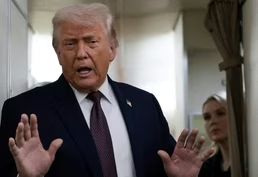
AMNA NAWAZ: At the White House today, Press Secretary Karoline Leavitt delivered a somewhat different message than administration officials did over the weekend.
Our own Liz Landers was in the Briefing Room and she joins us now from the White House.
So, Liz, when it comes to the shooting and killing of Alex Pretti, what did we hear from the White House today?
LIZ LANDERS: Yes, Amna, as you mentioned, a very different tone coming out of the White House, White House Press Secretary Karoline Leavitt this afternoon, when talking about the shooting that occurred over the weekend, especially when you compare that to what we heard from administration officials on Saturday and Sunday.
The White House press secretary today calling Alex Pretti's death a tragedy, saying that President Trump never wants to see Americans shot and killed in the streets.
And when she was asked if the president thought that the shooting was a mistake, this is what she had to say: KAROLINE LEAVITT, White House Press Secretary: Again, the president has said we have to review it and this investigation needs to continue.
And he's letting the facts and the investigation lead itself.
LIZ LANDERS: Those investigations are being conducted right now by the FBI and by Homeland Security themselves.
There's also an internal investigation that Customs and Border Patrol is also undertaking.
And, Amna, one of the main sort of differences that we heard today from Leavitt at the podium was specifically some of the comments that Kristi Noem and Deputy White House Chief of Staff Stephen Miller had made in the press and online over the weekend.
She was asked if the president thought that Pretti had committed a domestic act of terrorism or that he was an assassin.
Leavitt said: "I have not heard the president characterize Mr.
Pretti in that way."
AMNA NAWAZ: Liz, we also heard the president announced he's going to send his border czar, Tom Homan, to Minneapolis, and that Homan's going to report directly to him.
What do we know about what Homan will be doing on the ground there?
LIZ LANDERS: Right.
So, Tom Homan, the border czar, is on his way this evening to Minneapolis.
And we heard from the president in just the last few moments that he has connected on the phone with the Minneapolis mayor and with the governor of Minnesota, Tim Walz, talking about Homan's role on the ground there.
White House Press Secretary Karoline Leavitt said in today's briefing that he is there to coordinate with the state and local authorities to achieve this cooperation and she said to subdue the chaos on the streets of Minneapolis.
Governor Walz, though, was Pretti pointed still this afternoon in a Wall Street Journal op-ed that he had talking about the administration and saying that they are lying about Minnesota not coordinating with deporting some of these criminal illegal aliens who are here in the United States.
He said: "This assault on our communities is not necessary to enforce our immigration laws.
We don't have to choose between open borders and whatever the hell this is.
Mr.
Trump can and must end this unlawful, violent and chaotic campaign."
You're seeing from Minnesota officials, the Department of Corrections there saying and fact-checking 68 false claims that they say that the Department of Homeland Security is putting out there about them not cooperating with detaining people that they have found here in the United States who are here illegally that they have arrested -- Amna.
AMNA NAWAZ: All right, that's our Liz Landers reporting live from the White House tonight.
Liz, thank you.
GEOFF BENNETT: The Minneapolis shooting is also having direct consequences on Capitol Hill.
Democratic leaders say they're ready to block funding for the Department of Homeland Security and potentially other agencies.
Our congressional correspondent, Lisa Desjardins, joins us now.
Lisa, it's good to see you.
So what are you hearing from members of Congress and is it in any way different from how they have responded in the past?
LISA DESJARDINS: Let's start with Republicans.
Notably, it was different in that very few of them actually responded initially, despite Stephen Miller and others at the White House signaling aggressive messaging.
Instead, we have something almost from another time, neutrality from some and even some concern from other Republicans, like this from Texas Republican Mike McCaul.
He wrote: "I am troubled by the events that have unfolded.
I believe a thorough investigation is necessary, both to get to the bottom of these incidents, but also," he wrote, "to maintain Americans' confidence in our justice system."
Now, there are many Republicans who also criticize Democrats and say they're to blame for this kind of inciteful atmosphere and tension.
Of course, Democrats deny that.
But one example is important to me, the House Oversight chairman, James Comer.
He did say Democrats are to blame, but he also is not saying, ICE should double down.
He's saying instead maybe ICE should pull back.
Here's what he said on FOX Sunday.
REP.
JAMES COMER (R-KY): The situation's only going to get worse.
And I really think that there are so many cities in the United States that have issues with criminal illegals, that I think they would be -- they would be better received in other cities.
I hope that's something they're talking about doing right now, because Minneapolis isn't the only city.
LISA DESJARDINS: That reads to me as looking for a way out.
Most notably, there are Republicans who are calling for hearings now.
One, look at this letter from Senator Rand Paul of Kentucky, chair of the Senate Homeland Security Committee.
He's saying he wants a hearing in the next two weeks or so.
As for Democrats, I have spoken to so many.
They're as incensed and also focused, as I have seen them, especially on ICE.
They do not want any ICE funding to go through without changes.
And indeed that funding is up for a vote potentially this week.
Here's what Chuck Schumer, the Democratic leader, wrote on Twitter.
He said that Democrats will not provide the votes needed for that.
What's that mean?
Well, that funding is attached to a bunch of other agencies too.
So we could be in for a shutdown.
GEOFF BENNETT: And the shutdown would affect far more than DHS.
LISA DESJARDINS: Yes, let's take a look here.
These are the agencies that are part of this funding package.
These are some of the biggest agencies in government, defense, HHS, transportation housing, in all, about 70 percent of the funding that Congress controls.
Democrats want to pull out the HHS part of it and deal with that separately.
But my reporting is, Republicans so far are denying that.
They say Trump can have executive actions to curb ICE.
Well, you won't be surprised to hear that Democrats don't trust that.
They want a legislative fix here, and we really are heading toward a potential shutdown.
GEOFF BENNETT: And, separately, Lisa, amid all of this, there was a Democratic member of Congress who was assaulted this past weekend, and the assailant shouted racist remarks?
Tell us about that.
LISA DESJARDINS: We're talking about Florida Congressman Maxwell Frost.
He was at an event in Utah on Friday, and he announced he was punched in the face and that the assailant, he said, said: "Trump will deport you."
Someone has been arrested in this case.
GEOFF BENNETT: Lisa Desjardins, our thanks to you, as always.
LISA DESJARDINS: You're welcome.
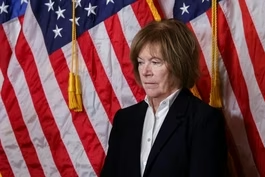
AMNA NAWAZ: Well, for another perspective now, we're joined by Democratic Senator Tina Smith of Minnesota.
Senator, welcome back to the "News Hour."
Thanks for joining us.
And let's just begin with a reaction to the latest news, this report that Governor Walz, President Trump had a good, productive call, in their own words, that Greg Bovino, some agents are going to be leaving Minnesota imminently and that Tom Homan is on his way in.
What, if anything, do you think that changes on the ground?
SEN.
TINA SMITH (D-MN): Well, it's so interesting.
Clearly, there is an attempt by the White House and the president and the people around him to de-escalate the situation.
It's a dramatic turn of events from just this weekend, when the attorney general sent a letter to the governor saying that the only way to end this attack on Minnesota was if the governor were to, among other things, turn over our voter rolls.
So I think what has changed is the tragic killing of Alex Pretti and the pressure that the White House is feeling from Americans and certainly from their allies in the Republican Party who are saying, this just cannot stand.
It's interesting, because, earlier today, I was out in the neighborhoods talking to people, and it's still very, very tense.
I had to hold up visiting one mutual aid spot because an ICE raid was happening right there.
And so there is still complete fear and anxiety on the streets tonight as ICE agents' roving vans continue to terrify people in my community.
AMNA NAWAZ: And we know, as a result of all this, you and other Democrats, as Lisa was reporting, are saying you will oppose a funding package for DHS.
So give us your latest take.
Is this fight worth a partial government shutdown to you?
SEN.
TINA SMITH: I think we are very, very firm, as Democrats in the Senate, that we cannot just stand by while this federal police force in Minnesota and places elsewhere in the country, but particularly in Minnesota, where they are shooting and killing United States citizens, people who are peacefully demonstrating and exercising their constitutional rights.
So we are quite firm about this.
And the only sensible thing to do is for the leader, the Republican leader, to understand that he needs to break aside the -- break apart the five bills that I think many Democrats would support and allow us to deal with the challenges at Homeland Security and put some meaningful restraint on this lawless behavior of this agency.
That's the path forward.
And I have to say, Amna, I have had some conversations with some of my Republican colleagues over the last day or so.
I can't say that they're all on board, but I have heard a lot of concern from them about what's happening here.
And that gives me some hope that we can find a good path forward.
AMNA NAWAZ: So could you get a little more specific for us?
What does a meaningful restraint look like here?
I mean, the question is, what's the ask?
Because the last time Democrats pushed for those enhanced health care subsidies, and that led to the longest government shutdown in history, you still didn't get the subsidies, right?
So what leads you to believe that you will get what you want if you push for another shutdown now?
SEN.
TINA SMITH: Well, let's start from the idea that these federal agents who are part of ICE and customs and border control should not be allowed to just randomly detain and arrest U.S.
citizens.
Let's start from the fact that they should not be allowed to barge into, breakdown the doors of people's homes and cart them off with no warrant.
These are just fundamental, commonsense kinds of protections, the same kinds of rules that local law enforcement have to follow in every single city in this country.
So it's hard for me to believe that, at the end of the day, Republicans in the Senate would shut down the government because they would refuse to put those kinds of commonsense guardrails on this agency that has clearly run amok in Minnesota and in other places around the country.
AMNA NAWAZ: And in your conversations with your Republican colleagues, are they saying they'd be willing to support those kinds of measures?
You mentioned sort of a shift you have seen after the death of Alex Pretti.
Is that something they would support?
SEN.
TINA SMITH: Well, I mean, I can't predict what they will do.
And, certainly, far be it for me.
But I will tell you that it's -- there's sort of this coalition of the horrified that has developed around what's been happening here in Minnesota.
And it includes law enforcement, who see (AUDIO GAP) doing is so deeply damaging to their own credibility in their communities.
It is people who care about Second Amendment rights, the outrage that I have heard from Minnesota gun owners who've said, wait a minute, this man was carrying, lawfully carrying, a firearm as a Second Amendment right, and you're saying that he could be killed for that?
The level of rejection of this behavior of ICE is growing, not diminishing.
And I think Republicans in Congress are hearing that as well, and that is leading them to look for a way forward that can put an end to this.
AMNA NAWAZ: That is Democratic Senator Tina Smith of Minnesota joining us tonight.
Senator Smith, thank you for your time.
Really appreciate it.
SEN.
TINA SMITH: Thank you.
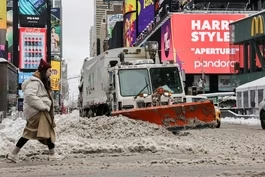
We begin the day's other headlines with the massive winter storm that blanketed much of the country with snow, sleet and ice.
At least 28 deaths were reported, including from hypothermia and sledding accidents.
Millions of Americans now face bitter temperatures for days and widespread power outages in some states that may last well into the week.
John Yang has our report.
JOHN YANG: From Tennessee to Texas to New Jersey, about half the United States population today shoveling, scraping and slogging their way through heavy snow.
DAVID WATTERS, Montvale, New Jersey, Resident: It's fun to see this amount of snow.
It's almost apocalyptic in a nice way.
I was expecting a lot, but I didn't think it was going to live up to it, and it did more than that.
It's crazy.
JOHN YANG: The National Weather Service said at least 19 states got more than a foot of snow.
MAN: It's kind of scary.
JOHN YANG: The weekend mix of wind, sleet and freezing rain wreaked havoc on the power grid.
More than 800,000 customers, mostly in the South, lost electricity, and authorities warned that in some areas restoring it could take days.
MAN: It's really deep.
JOHN YANG: New York City schools were closed today.
Students logged on from home for remote learning, a modern snow day.
ZOHRAN MAMDANI (D), Mayor of New York City: Good morning, New York.
JOHN YANG: Mayor Zohran Mamdani said the city is braced for a cold week ahead.
ZOHRAN MAMDANI: While the worst is behind us, there is still more to be done as we clear the snow and restore our city.
Our top priority remains in assuring that every New Yorker can remain safe and warm throughout this prolonged cold period.
JOHN YANG: The mayor confirmed that, in New York, seven people died during the snowstorm.
And a swathe of states reported weather-related deaths.
Outside Boston, police say a woman died when a snowplow backed into her in a parking lot.
Massachusetts Governor Maura Healey: GOV.
MAURA HEALEY (D-MA): I have spoken with her husband.
It's devastating.
It is heartbreaking.
I know the matter is under investigation right now, but my heart goes out to the family.
JOHN YANG: Officials warn that roads are still icy and slick and urge drivers to proceed with caution.
For airline travelers, the weekend was brutal.
According to the Web site FlightAware, on Sunday, more than 11,000 flights were canceled, the most in a single day since the pandemic.
And, today, thousands more were grounded.
Even those who managed to get to their trains couldn't escape the blizzard.
This video shows snow whipping inside a Long Island railroad car.
But amid all the chaos, there was still time for some good old-fashioned fun.
In Washington, D.C., snowball flights broke out in parks.
In Austin, Texas, neighborhood streets turned into slopes.
A few daredevils dusted off their skis, from the amateurs to the professionals.
Three-time Olympic snowboard gold medalist Shaun White put on a show in New York's Central Park.
For the "PBS News Hour," I'm John Yang.
GEOFF BENNETT: Also today, airport officials in Maine say at least six people are presumed dead after a private business jet crashed during the weekend's snowstorm.
Officials say the Bombardier Challenger 600 crashed during takeoff at Bangor International Airport last night and caught fire.
No details about the victims have been released.
The airport, located about 200 miles north of Boston, was closed shortly after the crash.
Snow had started falling at the time of the crash, but other planes were taking off safely.
Turning now to the Middle East, Israeli officials say they have recovered the last hostage remains in Gaza, a major step towards the next bays of Israel's cease-fire with Hamas.
(SINGING) GEOFF BENNETT: Israeli soldiers sang the country's national anthem as they stood around the body of 24-year-old police officer Ran Gvili.
He was killed during the October 7 Hamas-led attack and his body was among the first to be taken into Gaza.
Speaking to lawmakers, Israeli Prime Minister Benjamin Netanyahu called it an incredible achievement.
BENJAMIN NETANYAHU, Israeli Prime Minister: I thank the entire people of Israel for their prayers and encouragement.
We completed this mission, as I promised, and we will also complete the other tasks we have set.
GEOFF BENNETT: With all of the hostages returned, the next phase is expected to include the reopening of Gaza's border with Egypt.
That would allow Palestinians to move freely in and out of Gaza and ease the flow of aid into the territory.
That second phase also involves more complicated issues like disarming Hamas, something the group has refused to do.
China's top military ranks are in turmoil after news that its most senior general is being investigated for what's being called suspected serious violations of discipline and law.
General Zhang Youxia was second only to President Xi Jinping in the chain of military command.
His removal is the latest in a near-total purge of China's powerful central military commission, with only one of its six members still in place.
Global security experts warn that the full impact of the changes are unknown, but they could have major implications for the region and especially Beijing's approach to Taiwan.
A number of congressional Democrats are heading to a detention center in Dilley, Texas, this week.
They're planning to meet with the 5-year-old Ecuadorian boy and his father who were taken by ice agents in Minnesota last week.
The detention of preschooler Liam Conejo Ramos has become a focal point of the Trump administration's immigration crackdown.
The visit comes after the Associated Press captured aerial images of detainees protesting at the South Texas family residential center this past weekend.
They held signs saying "Liberty for the Kids" in Spanish.
Connecticut Senator Chris Murphy tried to visit the site last week, but said he was -- quote -- "illegally blocked."
The Treasury Department is canceling its contracts with Booz Allen Hamilton after a massive tax leak that revealed details about its wealthy clients, including President Trump.
Former IRS contractor Charles Edward Littlejohn was sentenced to five years in prison in 2024 for leaking tax information to The New York Times and ProPublica.
The Treasury Department said today the leak affected roughly 406,000 people.
Secretary Scott Bessent says the firm failed to protect sensitive data.
Booz Allen Hamilton has more than 30 contracts with the Treasury Department totaling around $21 million.
President Trump says he's raising tariffs on many goods from South Korea In a social media post this afternoon, Mr.
Trump said South Korea's legislature is not living up to its deal with the United States.
As such, he's increasing South Korean tariffs on autos, lumber, pharma and all other reciprocal tariffs from 15 percent to 25 percent.
It's not clear when the hikes would take effect.
The two sides agreed to a framework agreement last year, but South Korea's National Assembly has yet to approve the deal.
Meantime, on Wall Street today, stocks posted decent gains to start the week.
The Dow Jones industrial average added more than 300 points on the day.
The Nasdaq rose about 100 points.
The S&P 500 has now recovered from its losses last week.
And one of the driving forces behind the eradication of smallpox, Dr.
William Foege, has died.
As a young medical missionary in Nigeria, Foege developed what's called a ring containment strategy that helped health officials combat the disease.
He later went on to lead the CDC in the 1970s and 80s, where he helped guide the nation's early response to the AIDS epidemic.
Standing 6'7'', Foege was a towering figure in his field in more ways than one, receiving the Medal of Freedom in 2012, the nation's highest civilian honor.
William Foege died over the weekend at his home in Atlanta.
He was 89 years old.
Still to come on the "News Hour": Tamara Keith and Amy Walter break down the latest political headlines; and the "News Hour"s "Settle In" podcast provides advice for keeping a sense of purpose during an onslaught of news.
GEOFF BENNETT: It is shaping up to be a consequential week in the nation's capital, as cracks emerge inside the Republican Party over the Trump administration's handling of its immigration crackdown in Minnesota and beyond.
For analysis, we're joined tonight by our Politics Monday team.
That's Amy Walter of The Cook Political Report With Amy Walter and Tamara Keith of NPR.
It's good to see you both.
AMY WALTER, The Cook Political Report: Hello.
GEOFF BENNETT: So, Amy, for all of the talk about this defiant Trump White House, the White House is not immune to sustained public pressure.
What does the latest polling show about how the American public broadly views its immigration approach?
AMY WALTER: Yes, it's really interesting, Geoff.
At the beginning of President Trump's term, approval rating of handling immigration was higher than his overall handling of the job that he was doing.
Now, as both of those have come down over the course of his presidency, still, for much of the year, immigration has been higher.
But -- and it's not just because of what we have seen in Minnesota.
We started to see this dip really going back earlier than this, where opinions about how Trump's handling immigration are now basically matching his overall approval rating.
What happened?
I think a lot of it is that the conversation about immigration is no longer about immigration.
It's no longer about the border.
It's not even about this conversation about what we and how we should be handling the things that we normally talk about, like path to citizenship or DACA.
Instead, what we're talking about are very specifically the way that agents whose job it is to apprehend these folks, the ICE agents, are treating communities and, in the case of Minnesota, these two individuals who were shot by these agents.
GEOFF BENNETT: And, Tam, you heard Senator Smith describe this as a coalition of the horrified, Democrats and Republicans who take issue with the way that the Trump administration is executing its immigration priorities here.
I mean, could this be one of the moments where voters who backed Trump on immigration begin to recoil from the methods, even if they still support the end goal?
TAMARA KEITH, National Public Radio: I think that we are starting to see that.
NPR had a focus group that we sat in on conducted by Engagious.
And there -- they were talking specifically to people who voted for President Biden and then voted for President Trump in 2024.
And about a third of them raised their hands and said they thought that ICE was going too far.
These were Trump voters who said that ICE was going too far.
And I think that the surest sign that the politics on this are not the best is President Trump himself.
The fact that he is trying to distance himself from what happened in Minnesota, the fact that he and his chief spokesperson are distancing him from the statements of Kristi Noem, the homeland security secretary, and Stephen Miller, his deputy chief of staff, the fact that they are putting some separation there is an indication of a real shift and an indication that President Trump realizes this may not be a political winner.
And I have previously said here that the Trump administration has one speed, and it is to fight.
Well, they just suddenly discovered a different gear.
They're in reverse.
They are looking for an exit strategy from the really heightened rhetoric that -- and just really heightened situation on the ground in Minnesota.
AMY WALTER: Yes.
GEOFF BENNETT: And, Amy, one of the Republican candidates for governor dropped out of the race this morning, Chris Madel.
He wrote AN op-ed saying that ICE has gone too far.
He accused national Republicans of pursuing retribution against the state's leaders.
If even GOP candidates are worried about how the administration's enforcement strategy is landing, what does that say to you?
AMY WALTER: Yes.
I mean, the fact that you also had a lot of Republicans across the country take to social media over the weekend to say, again, the opposite of what the secretary of homeland security was saying, the opposite of what some of the folks of the administration were saying, they came out really and said, don't like what we're seeing here, this is a tragedy and that they're saying we need to have some more oversight here.
That, for Republicans, is a big push, to say we're going to have oversight over an executive branch, executive authority, executive branch.
But how far this goes -- right, we always wonder how far will this go?
And that's why Lisa on here a few minutes ago made a really good -- helped us really understand what comes next, but trying to figure out what that line is between what Republicans are willing to do in terms of a funding bill, what kinds of oversight they're willing to provide and whether or not Democrats will believe that that is good enough.
When I was talking to a Democratic strategist earlier today, the frustration among Democrats is as telling as some of these rifts among Republicans.
So making a deal isn't just about getting Republicans on board.
It's getting Democrats to trust and to want to agree with a compromise on the Republican side.
GEOFF BENNETT: And, Tam, what's the risk for Democrats here if there is one for confronting these tactics head on, given past political losses on crime and immigration?
AMY WALTER: Right.
TAMARA KEITH: Yes.
So the issue that Democrats have had is that Republicans have been able to own immigration.
They have won many a midterm with a Democratic president by campaigning on immigration, talking about the border.
But as Amy mentioned before, this is different.
This is Americans in American cities being killed by immigration agents.
So if Democrats are able to keep it focused on that and not talk about open borders or eliminate ICE, which had been something that they had campaigned on before and then that was thrown in their faces, there is a careful balance here.
But the fact that these videos exist, the fact that people, like, everyone is seeing these videos really makes this a visceral issue for a lot of voters.
GEOFF BENNETT: How do you see it, Amy?
AMY WALTER: Yes, I absolutely agree with that.
And that's why, again, you look at this New York Times poll that came out last week, this -- again, before what happened this weekend -- I'm sorry - - it came out last week.
Do you support Trump's deportation of immigrants living here illegally?
Fifty percent of Americans say, yes, they do.
But then you ask the question, do you think - - do you approve of how ICE is handling its job?
Only 36 percent approve of it.
So the issue isn't that people are saying, we should not be deporting people who are here illegally.
What they are disagreeing with is the way that ICE is handling it.
And that, again, if we had a Congress that was working together, that is the sweet spot there.
Fix the problem with the enforcement.
That's where the crux of the matter sits.
GEOFF BENNETT: Amy Walter and Tamara Keith, our thanks to you, as always.
TAMARA KEITH: You're welcome.
AMY WALTER: You're welcome.
AMNA NAWAZ: We turn now to our PBS News podcast "Settle In."
In the latest episode, we explore what's caused a loss of trust in institutions, what the Trump administration has revealed about the way power works in this country, and how to find hope during the onslaught of difficult daily news.
GEOFF BENNETT: I recently spoke about all of this with the University of North Carolina Professor and New York Times columnist Tressie McMillan Cottom.
Here's an excerpt.
How much of our political dysfunction is actually an attention problem?
And how much has the media economy reshaped what kinds of stories and people get rewarded?
TRESSIE MCMILLAN COTTOM, The New York Times: Yes, I think there is something to the fact that obviously our attention has been monetized in a way that is really antithetical to how human curiosity has worked for millennia.
But I do think we overstate that fact, because it kind of sounds like, when you start talking about so many things are competing for our attention, and so we just can't capture people long enough to tell them what matters, right, and to move them politically, I think it's a bit of a cop-out, right?
It is true that it is hard to compete with TikTok and it is difficult to compete with memes.
And it is absolutely true that the media ecosystem now rewards the production of cheap, emotion-driven content over meaningful information and news.
But it is also the case that that is not naturally occurring.
That too was a political choice.
It is a political choice not to regulate technology companies.
It was a political choice.
I would point out that both the Democrats and the Republicans have had an opportunity to do and have failed to do so.
No one has shown a political appetite, real, strong political appetite for regulating technology companies, because at the root of that is what I would argue is the real problem, which is extreme wealth inequality and the extent to which money has infiltrated the -- our systems of governance and certainly campaign financing.
And so we have been willing to cede our attention in the name of money, but that was a political choice.
And now we find ourselves reckoning with the fact that attention cannot be captured long enough to tell people the truth, the objective truth, about what is happening to them.
But that is, again, a lesson about what happens when one side has more power than the other.
I don't think that is a foregone conclusion, however.
It is absolutely a political choice to say that our media ecosystem needs to have a civic core to it, right?
It is not a foregone conclusion that we all need to just accept artificial intelligence is here and we need to turn over our privacy and our citizenship rights to it.
Those are choices, right?
And I think that, when we focus too much on whether or not people spend too much time on TikTok, it lets a lot of political actors off the hook.
GEOFF BENNETT: Amid this sense of exhaustion, what does renewal look like, when it's not that people are apathetic?
It's just that people are tired.
They're worn out.
TRESSIE MCMILLAN COTTOM: Yes, there is a lot of exhaustion.
I would argue, though, that much in the way that we sort of have misconstrued the idea of taking care of ourselves and taking care of each other, as, you know, self-care, solve your problems with a bubble bath, we kind of have that problem writ large with politics, right, that if you are exhausted and overwhelmed by the onslaught of negative news, that you sort of need to retreat, right, and you need to withdraw.
When, in fact, everything from research to history to art will tell you it's the exact opposite, that sometimes we aren't exhausted because we are aware of too much.
We are exhausted because we are doing too little.
The antidote, I think, to political exhaustion, the type that we are talking about is that we are getting so much passive information and we have so few opportunities to act.
We are tired then not from doing too much, but from doing too little.
People who feel agentic aren't as tired.
They are not as easily overwhelmed.
So, if you are exhausted by the onslaught of bad news, go to a protest.
If you are exhausted by social policy that is demonizing children, start teaching children how to read.
The more time you spend doing something, whatever it is possible for you to do in your space in the world, the less exhausted you are by the onslaught of information that really wins when it can convince you that the only thing you can do is watch what is happening to you.
GEOFF BENNETT: And you can find that full conversation and all episodes of "Settle In" from PBS News on our YouTube page and wherever you get your podcasts.
AMNA NAWAZ: And that is the "News Hour" for tonight.
I'm Amna Nawaz.
GEOFF BENNETT: And I'm Geoff Bennett.
For all of us here at the "News Hour," thanks for spending part of your evening with us.
Border Patrol 'untrained' for urban areas, ex-CBP head says
Video has Closed Captions
Clip: 1/26/2026 | 6m 14s | Border Patrol 'untrained and unskilled' for policing in urban areas, ex-CBP head says (6m 14s)
Democrats vow to block DHS funding after Minnesota shooting
Video has Closed Captions
Clip: 1/26/2026 | 3m 6s | Democrats vow to block Homeland Security funding after Minnesota shooting (3m 6s)
Judge hears Minnesota's arguments for ending ICE surge
Video has Closed Captions
Clip: 1/26/2026 | 5m 16s | Federal judge hears Minnesota's arguments for ending ICE surge (5m 16s)
Sadness, anger grip Twin Cities after latest killing
Video has Closed Captions
Clip: 1/26/2026 | 7m | Sadness, anger and exhaustion grip Twin Cities after latest killing by federal agents (7m)
Sen. Smith calls for 'meaningful restraint' of agents
Video has Closed Captions
Clip: 1/26/2026 | 5m 33s | Minnesota Sen. Tina Smith calls for 'meaningful restraint' of 'lawless' federal agents (5m 33s)

Tamara Keith and Amy Walter on Trump losing support
Video has Closed Captions
Clip: 1/26/2026 | 7m 39s | Tamara Keith and Amy Walter on Trump losing support over his immigration crackdown (7m 39s)
Thousands without power in aftermath of massive winter storm
Video has Closed Captions
Clip: 1/26/2026 | 3m 10s | Hundreds of thousands without power in aftermath of massive winter storm (3m 10s)
Tressie McMillan Cottom joins Geoff Bennett on ‘Settle In’
Video has Closed Captions
Clip: 1/26/2026 | 5m 13s | Tressie McMillan Cottom joins Geoff Bennett for our ‘Settle In’ podcast (5m 13s)
White House shifts response to Minn. shooting after outrage
Video has Closed Captions
Clip: 1/26/2026 | 3m 18s | White House shifts response to Minneapolis shooting after bipartisan outrage (3m 18s)
Providing Support for PBS.org
Learn Moreabout PBS online sponsorship
- News and Public Affairs

FRONTLINE is investigative journalism that questions, explains and changes our world.

- News and Public Affairs

Amanpour and Company features conversations with leaders and decision makers.












Support for PBS provided by:
Major corporate funding for the PBS News Hour is provided by BDO, BNSF, Consumer Cellular, American Cruise Lines, and Raymond James. Funding for the PBS NewsHour Weekend is provided by...