Capitol Journal
July 10, 2026
Season 21 Episode 81 | 56m 39sVideo has Closed Captions
New Alabama State House remains on schedule, under budget as move-in date approaches
New Alabama State House remains on schedule, under budget as move-in date approaches
Problems playing video? | Closed Captioning Feedback
Problems playing video? | Closed Captioning Feedback
Capitol Journal is a local public television program presented by APT
Capitol Journal
July 10, 2026
Season 21 Episode 81 | 56m 39sVideo has Closed Captions
New Alabama State House remains on schedule, under budget as move-in date approaches
Problems playing video? | Closed Captioning Feedback
Where to Watch Capitol Journal
Capitol Journal is available to stream on pbs.org and the PBS app.
Providing Support for PBS.org
Learn Moreabout PBS online sponsorshipThis week on Capital Journal, Big news for the Gulf Coast.
As the state is finally set to move forward with construction of the I-10 mobile River bridge.
Alex Angle has that story.
More developments on the Tommy Tuberville residency issue as a Montgomery judge makes a key ruling.
The state's two flagship universities are joining forces to oppose legislation moving in Congress.
We'll explain the details.
A major capital cit hospital is saved from closure, at least for now.
Randi Scott will tell us more.
More progress on the highly anticipated new state House for the next legislativ session, just six months away.
Jeff Sanders has that story.
And joining us in studio this week, state Senator Chri Elliott of Baldwin County talks about that new bridge deal and what it will mean for the Gulf Coast.
And acclaimed actress and director Doctor Tianna Stewart shares her latest film project and discusses her efforts to grow the film industry in Alabama.
That's all next on Capital Journal.
From AP Studios in downtown Montgomery.
I'm Todd Stacey.
Welcome to Capitol Journal.
Lots of news this week.
And we'll start with the major breakthrough with the long awaited mobile River Bridge and Byway project on Interstate ten.
After more than a decade of delays and setbacks, state officials this wee announced that the River bridge part of that project is read to start construction this year.
It's going to be much more expensive than originally thought, and that means the bridge will have tolls.
But the state has a plan to help make those tolls manageable for local commuters.
Alex Angle reports on this major breakthrough and breaks down what's changing with the bridge project.
Construction on a new six lane cable state and Mobile River bridge is expected to begin later this year, pending approval of a federal loan.
The first phase will cost about $3.2 billion.
But that price tag does not include the Bay project, which will be constructed at a later date.
Alabama leaders, including the state's delegation, announced the new plan on Thursday.
This is transformative for the entire coasta state region and for the United States of America.
When you look at the people and the products that move right there on this corridor, when you look at our national security interest that we are building right there off the coast, this was a no brainer.
Funding for the new bridge and re striping of the Bay way to six lanes will come from federal grants, loans, bonds and state investment.
The first phas will also involve improvements to roads around Mobile and Baldwin counties.
The river bridge is expected to be completed by 2031.
Big projects take time for a reason, and building a new bridge and relieving congestion along I-10 over the mobile River will be the biggest infrastructure project of its kind in Alabama history.
The project, aimed at easing I-10 congestion, has been plagued by steep costs and multiple delays.
State officials say the two step plan, the easing of regulations and new financing options have made progress on the bridge possible.
We know that we've had a number of wins, bu we also still had some setbacks that we had to overcome in order to be able to move forward with this.
President Trump and and Secretary Duffy have come to the table and said we want to help you figure out how to make this a reality.
Controversy over toll prices has scuttled progress on the bridg in Bay way project in the past.
Under the revised plan, no tolls will be charged until the new bridge is complete.
But the new proposed toll prices have rise for an unlimited monthly pass.
Drivers will pay $60 per month with an all go pass.
Drivers will pay $3 per trip, and for drivers with a multi-state pass, a triple cost $7.70.
Other routes, including the Causeway and Wallac Tunnel, will remain toll free.
This bridge will make it easier for people to get to work, get home, or visit our great beaches along the Gulf of America.
And the construction will generate countless jobs and support economic growth all across the state.
The Alabama Departmen of Transportation says the state will continue to seek out federal funding opportunities to bring the project to fruition.
Reporting in Washington Alex Engle, Capital Journal.
Thank you Alex.
Well, they might be rivals on the playing field, but the University of Alabama and Auburn University are staunch allies in the fight ove the future of college athletics.
The two schools on Monda announced their joint opposition to the Protect College Sports Act, arguing that the legislation would lead to more litigation and more disorder, not less.
The bill, which is now moving in the US Senate, would do three basic things.
It would set a national framework for student athlete compensation.
It would limit transfers and it would restrict coaches from switching jobs during the season.
It would also create limited anti-trust protections for the NCAA.
But Auburn and Alabama say the bill has key flaws that would not address the true problem.
In a joint statement, the top leaders from the universities said that they can appreciate that Congress is trying to address the significant challenges related to name, image and likeness and money and the transfer portal, but that is written.
The bill would undermine enforcement efforts and open the floodgates even wider to moneyed interests in college sports.
The statement said, quote, the bill is presented as a wa to stabilize college athletics, but it would actually perpetuate that instability.
And, quote, like I said, the bill is through committee in the Senate and ready for the floor.
But it would require 60 votes to bring it up.
US Senator Tommy Tuberville agrees with the two schools and said he wants to see the bill amended.
Speaking of Tuberville, the coach turned senato turned candidate for governor.
Got some good news this week.
A judge on Thursday dismissed a lawsuit claiming that he does not meet the constitutional requirement to be Alabama's next governor.
Montgomery Circuit Court Judge Brooke Reed did not rule on the merits of the case, but rather that the court does not have the jurisdiction to hear the case.
The lawsuit was brought by two voters claimin that Tuberville has not resided in Alabama for the last seven years, meaning he would be constitutionally ineligibl to hold the office of governor.
But the judge ruled that state law doesn't allow for the challenging of eligibility of candidates, but rather officers of the government.
In other words, only after someone is elected and takes office can legal challenges to their eligibility be taken up in court.
The top reveals on a beach house in Santa Rosa, Florida, where the senator has frequently traveled to.
When returning back from Washington, which was the basis for the challenge.
But the tower rules homestea tax exemption is on their home in Auburn and has been since 2018.
Tuberville attorney Joe SB said, quote, the court's decision follows the Alabama Constitution and the law that has been in effect for generations and generations.
Hopefully, the court's decision brings an end to all litigation.
The decision on our next governor should not be made up, but to not be made up to any court, but rather the people of Alabama.
Jordan.
To fix this, Tuberville is chief of staff and campaign chairman, celebrated the win, saying, quote, coach is now five and zero against these ridiculous challenges and we are confident he will win the championship with the people of Alabama in November.
Well, Alabama's senior senato was one of several dignitaries.
He's at Fort Rucker this week to cut the ribbon on a new facility to house and support more than 300 Army aviators on the post.
The new PFC, Garfield M Lang Hord training complex will replace the old barracks that was riddled with mold, gas leaks and other hazards.
The $41.2 million to buil the facility was secured by U.S.
Senator Katie Britt.
Three new one.
Was also in Dothan this week, offering the keynote speech to the Dothan Chamber of Commerce.
She talked about the Wiregrass emergence as a leader in the health care field, and said she's working in the Senate to find ways to support rural health care.
We are so proud of the wor that she's done here in Dothan, particularly when it comes to the health care industry and the way it services all of the Wiregrass and really this entire region.
We want to make sure, though, that rural health care not only survives, but what happens is, as it's sustainable for future generations.
Very proud to help lead the effort and the working families tax cut last year and to for the creation of the rural transformation fund that we spent $50 billion.
So Alabama's portion of that was $203 million.
That was delivered directly to Alabama to help with rural health care needs.
Now, obviously, it is up to state and local leaders and how they spend that, but it's my hope that they do it in a way that is truly transformative for generations to come.
In addition to that funding, we have taken a look at like, how can we make sure, for instance, the maternal mortality rate of Alabama is unfortunately one of the highest in the nation.
We know that it disproportionately affects black women.
We know that since 2011, we have had rural hospitals closed in this state at a record that we do not want to see.
So the Rural Obstetrics Act is something that I am pushing in the United States Senate.
That's to help give tools to those in rural communities in the event of an emergency.
And there is a woman that is, that is ready to give birth, but unfortunately is too fa away from a birthing facility.
So we're working on both those tools that education and those resources trying to to try to figure out, you know, how we can make sure people have what they need to say, stay safe and to bring life into this world.
We're taking an all of the above approach, but I'm excited about the 203 million that's been now delivered to the state of Alabama, where they'll take a look at how we transform our rural health care system.
So it's sustainable an successful.
For years to come.
Well, it's not a rural hospital, but an urban one that has been on the brink of closure in recent months.
But this week, Jackson Hospital announced that it had reached a verbal agreement with Blu Cross and Blue Shield of Alabama on a renegotiated reimbursement rates that will help the hospital remain open.
Randy Scott has more.
It's an unthinkable scenario.
The state's capital city losing one of its hospitals to financial problems.
But it's a true statemen which came down to a deadline.
Well, the Jackson hospital would have to close for the first time in my ten years of being on the county commission, that everybody has come together in Montgomery, like much of Alabama, still needs long term sustainable health care solutions.
It's been about two weeks, and as you can see, Jackson Hospital is open.
That's the first big hurdle.
Hospital officials, Blue Cross Blue Shield officials, city officials, county officials, even some state officials wanted to overcome.
Now, the next big task makin sure this facility stays open.
Doug Singleton, chairman of the Montgomery County Commission, is one perso who's been in the meeting room who had discussions to solve this problem.
We're taking place as of last Thursday afternoon.
Blue Cross, Blue Shield and Jackson Healthcare had come to a agreement in principle that would enable the hospital to continue to stay open and continue to continu to provide health care for here in Montgomery County.
The Montgomery City Council's Tuesday meeting featured a Jackson Hospital update from Montgomery Mayor Steven Reed.
An important development we're grateful that Jackson Hospital and Blue Cross Blue Shield, recent new agreement that keeps the hospital fully in network, and ensures Montgomery residents and those throughout central Alabama will maintain uninterrupted access to essential care.
They finally came together and they both worked very hard, from day one, both wanted the hospital to remain open.
I haven't really met anybody.
Don't want that, doesn't want the hospital to remain open and be successful.
But they came together.
They worked it out.
They found a path where they both could not be happy and neither sides happy.
And if you have a deal where nobody's happy, that's probably a pretty good deal.
Jackson Hospital President and CEO John Quinlivan said in a statement that their focus remains to ensure access to local health care by, quote, ensuring any path forward is financially sustainable, unquote.
I couldn't be happier for th 1800 Jackson Hospital employees, but not only that, the over 70,000 that rely on Jackso Hospital for their health care.
Nearly 100,000 people rely on Jackson for doctors and prescribe options and medications.
Both Reed and Singleto point out this is a giant step forward, but there are still details to work out.
The conversations about this matter will most likely continue.
What we're willing to sacrifice, what politics we're willing to put aside, and what policies we're willing to implement to make sure that regardless of what zip code you end up, regardless of what your aim it may be that you have access to the type of healthcare that you need.
The Montgomery County Commission approved the signing of a letter of support as a nonbinding letter of support basically says that in the future, we will continue to do everything we possibly can to help Jackson Hospital and health care in Montgomery County in Montgomery.
Randy Scott, Capital Journal.
Thank you.
Randy.
This week in the state House lawmakers on the contract review committee gathered for their monthly review of various state contracts.
It's usually a pretty uneventful meeting, but this week, one state lawmaker took issue with a contract sought by the Alabama Department of Corrections.
Department says it needs to contract with the Butler Snow law firm to help recoup funds from the company.
Yes care, a health care provider that the state hired to serve as prisons that is now going through bankruptcy.
State Representative Chris England said he warned the department not to do business with yes care, and is holding up the contract and calling on the attorney General's office to investigate the company.
If we have cannot hold a contractor who basically we gave $1 billion to accountable, to pay employees, pay vendors to make sure deploys are taken care of.
Can you imagine what we're doing to incarcerated folks?
I mean, it seems like, as I've said before, like if there's like a checklist of failure, 80 doc hits every singl one of them every single time.
And at this point now we've got employees who worked without pay.
To take care of our inmates while we fronted money to a company that had already been bankrupt before, was headed toward bankruptcy now.
And basically they lied to us, defrauded us and then ran off with the money.
I don't know who enters into a handshake verbal agreement with somebody who' desperately searching for money and telling them what to do with it.
Snakes bite, you know, and this particular company robbed us without a gun.
Without a mask.
So just like I said, up there and just like you heard representativ Tom, Department of Corrections say a company made false material misrepresentations to a state agency to get money based upon promises that they made, to do things that they ultimately did not do, and they filed bankruptcy.
To me, that sounds like fraud.
And we have a criminal statute for that.
And yes, care should be prosecuted.
Well, meetings in that old state House are becoming more rare these days as the legislature prepares to move across the street to the new statehouse.
Construction on the nearly $400 million project remains on schedule, and officials say it's also under budget.
And while much of the work is now happening out of public view, legislative leaders sa the building is quickly moving from a construction site to a functioning workplace.
As Capital Journal's Jef Sanders reports, the countdown for the new statehouse is on.
For nearly three years cranes, concrete and steel have dominated the skyline behind Alabama's current statehouse.
As the new statehouse has taken shape.
It's an active beehive or an anthill, whichever one you want to call it, it's active.
Pat Harris serves as secretary of the Senate.
While you can see a lot of progress from the street, Harris says the project has reached an important milestone inside the buildings.
Major systems are now comin online, allowing crews to focus on the work needed before lawmakers and staff move in.
AC is out of the building, the elevators are working in the building.
So, it's it's easy to move from floor to floor.
The front elevators are working.
The new statehouse will feature modern committee rooms, legislative offices, and public meeting spaces.
But some of the most visible finishes will have a connection to the past.
Workers are salvaging materials from the current state house and giving them a second life in the new building.
We are taking marble from this building, taking it off the walls, cleaning it really well, and then are incorporated in a number of the areas in the new state House and in the first floor.
When you come in the building, there's there will be marble there.
There's marble around the entrances to the chambers, on the reception areas, to the legislative offices.
So we are repurposing as much as that moment as we can.
Another milestone may be even more impressive, despite the size and scope of the project.
Harris says construction remains under budget.
Something not often associated with large government building projects.
But I can't brag on RSA, Jesko Rayburn and the legislative group of the, Austin Life from the director of LSA Legislative Services, John Treadwell, the clerk of the House and this office working to end the as well as working with architects.
We're not trying to do this all by committee, but decisions are being made.
You got a lot of experience, both in construction and in the way the building will operate when it's up.
And everybody working together and that's what makes it work.
The next major deadline arrives this fall.
Legislative staff are expected to begin moving into the building months before lawmakers return to Montgomery for the 2027 organizational session.
We will start moving staff in, late October.
Those members that are elected to the legislature to take office immediately, they don't wait till January, so they take office immediately.
So we have to be prepared for them to start moving in.
Once staff and lawmakers make the move.
The current state House is expected to be demolished in phases, making way for a public greenspace that will eventually connect the new statehouse complex to the Capitol grounds.
We have to balanc the legislature being in session and deconstructing this building all together.
There's certain days that they can't be working over here while we're working over there so all that has to be balanced, but it's not a hurdle that we have not either talked about or preparing for or ready to handle.
For Capitol Journal, I'm Jeff Sanders reporting.
Thank you Jeff.
Can't wait to be in the new state House.
We'll take a quick break and be back with tonight's guests.
Alabama Public Television is your place for quality educational services.
Free professional development for educators and childcare providers with access to free, curriculum aligned videos, lesson plans and instructional resources with PBS Learning Media and all the PBS kids programs, parents know and trust.
Learn something new every da with Alabama Public Television.
Visit us at AP tv.org/education to learn more.
Welcome back to Capitol Journal.
Joining me next is state senator Chris Elliott from Baldwin County.
Senator thanks for coming on the show.
Thanks for having me.
Big news out of Baldwin County and the coast this week.
We reported earlier on the mobile River bridge.
Not going to do the Bay way yet, but getting a big go ahead from the Trump administration and the state of Alabama.
I mean, just huge news considering how far this project has come.
What's been the reaction from down South?
So quite honestly, it's been mixed, right?
There's still folks that are concerned about the toll and understandably so.
But there are a lot of folks that have seen this project really just languis for years and years and years.
And so there's a lot of almos relief that it is moving again.
And that it actually looks like it's going to, going to come to fruition.
Or as you point out at least a portion of it will.
Right.
And remind us of what why this is needed.
Is it gridlock?
Is it interstate commerce?
What?
Why do we need to replace the tunnel?
So it really is all of the above, right?
So it is a lot of interstate commerce.
Baldwin County sees just shy of 9 million visitors a year.
Just just in tourists.
And so a lot of that traffic doesn't come necessarily just from the north, but comes from our, our, our Western, neighbors.
And so we nee to be able to accommodate that.
And then you have of course, the commuter traffic that goes between Baldwin County and kind of the central business district in mobile.
That's decreased over the last 15, 20 years as more people work for home or as Baldwin grows and has its own, you know, its own independent business client.
Climate.
But but at the same time, the traffic on, on the I-10, Bay way and into the tunnel is, is horrendous at any given moment.
And then the design of the tunnel itself, the geometry of it, and coming out of the tunnel causes its own problems that hopefully the bridg structure will help alleviate.
Right.
We talked about that history.
I wanted to talk about that because you've been involved with this not just as a state senator, but back when you were on the county commission.
Yeah.
And so, you know, it's been quite a saga.
This this thing.
Take us back to those days where there wer just so many stumbling blocks, so many obstacles that that that derailed this project.
Time and time again, take us back to what were some of those stumbling blocks, back then?
Well, the stumbling blocks really were the federal regulations and what the federal government was going to make the state of Alabama do on this project, and whether that was, replacing the existing byway and elevating it, or some of the other, add ons that they wanted onto the bridge itself, that just continued to drive the price up.
And so we've seen the projected price of this entire project double and then quadruple, in large part because of what the federal government was saying that the state of Alabama needed to do in order to get their their assent, their blessing.
And so the the real story here, and I think what you saw in the op ed that Senator Brett and Senator Tuberville wrote was that the Trump administration has been very helpful, as you might expect, in really reducing some of those requirements so that the project was we were able to phase the project, but also a lot of those requirements that that the, previous administrations had on the project, kind o we were able to navigate around.
And so it makes the project viable again, because you don't have to jum through as many of those hoops and because they're permitting this to be phased.
So those requirements increase the cost really, significantly.
And that's where the tunne conversation came from.
Right.
Because, you know, those who aren't super, you know, involved down there may just remember the whole conversation because it it was kind of a sticker shock was like 6 or $7 is going to be the total.
I mean, that's that's pretty hefty.
And so you can understand, whil local opposition grew to that.
Sure.
And especially for my constituents who are traveling back and forth daily, when you start adding those types of six, you know, plus dollars each way daily.
It was it was just not workable.
And so I'm glad that that we were able to hit the reset button.
The Metropolitan Planning Organization, which I used to chair, hit the reset button on that and said, no, we're not going to do that and we're going to try to rethink this.
And I think again, th the addition of this monthly fee and the Al pass, which is that transponder that will have a discounte significantly discounted amount.
And and an and then the reduction in scope.
Right.
I've been talking about d scope in this project for 6 or 7 years now in order to get to get it to where we can afford it.
And then the Trump administration both allowing us to to change the scope within the year and phase.
This project really makes the difference to where it's actually if you can call it affordable, it's it's somewher within the realm of possibility.
Well, now nobody likes a toll.
But this thing doesn't get built without a toll, right?
Do you think?
Because it's it's produce especially for those commuters.
Pretty significantly.
Do you think the public at large will be accepting of that?
Understandin that it's gotta call something?
I think so, and I think especially especially as you look at the difference between what my constituents, the folk that have the algo, transponder for that amount versu what our out-of-state neighbors that don't either have the transponder, don't have the monthly pass or paying.
They're they're paying a whole lot more for it.
And so when we talk about interstate commerce, they're helping pay for that.
When we talk about the the 9 million visitors to the beach, they're helping pay for that infrastructure that they're using.
And so while there is certainly a burden on on the commuters, it's significantly less.
And it is disproportionately and appropriately so put on on the folks that are out of state that are using this.
And another big change, that seems to me a really I don't know if actual change is no tolls on the non interstate ports.
Right.
You have the highway down there, the causeway.
But the original pla was to toll that to to I guess keep it to wher everybody just uses that road.
And, and I remember public reaction to that being just furious like come on.
It was visceral.
And you'r right that they were concerned.
And if you look at the statistical modeling about toll avoidance, right, I' not going to pay this high toll.
So I'm going to go around it.
Well, the natural thing you know, for the toll modelers to do will say, well, we have to toll that stuff to, to keep them from doing that.
That was just a nonstarter.
And those are my my constituents.
And my folks were used to using those local roads used to using causeway I use the causeway all the time.
And so we wanted to maintain that as a toll free route.
You have the option, to get on on the bridge.
You have the option to go faster and and go across the bridge.
But you don't have to.
There is a toll free route an will remain a toll free route.
Yeah I think it's a big a big factor.
Well, look, they're saying that construction could begin this year.
That's a big deal.
They're saying that construction could be complete on the bridge, not the Ba way, by 2031, which we say 2031.
That's a different decade.
Maybe you think that' a long way away, but really not.
I mean, if you think back to 2021, that wasn't very it seems like yesterday.
So it'll be here before we know it.
And I'm curious what you think the difference this project will make, understanding that it's not the Bay way, but they're going to restrict that to make it six lanes.
What kind of what difference will it make to mobile?
To mobile and county?
To your commuters.
What?
Economically.
Socially?
What will be the benefits?
Well look again interstate traffic is is important.
And moving it efficiently i important for the whole region.
And so that that is benefit number one.
But the interplay between th economy and mobile and Baldwin County has frankly has struggled in in recent years.
And that's not a good thing for our region.
I mean, we have a ton of folks who work in Austal and Airbus who work at the central business district, you know, downtown, in from the Eastern Shore area.
And so hopefully this will facilitate more of that.
And then, of course, our visitors, you know, any time that it's difficult to get somewhere and get to the beach, that's problematic for our tourists.
And so I think that continues to allow those folks to come spend their money in Baldwin County which keeps our economy strong.
Yeah.
Okay.
So you can have a six lane maybe one day, a six lane from mobile, all the way to that fully beach express that run through your neck of the woods.
That's interesting.
Well, speaking of that, speaking of the beach, we are sitting right i the middle of peak beach season.
That was a huge part of the economy.
I was down there the other day for a conference and got to, I guess, the way the road works now, you use the new bridge to go south and the old bridge to come north.
How's that working out?
That, the two bridge model?
Yeah.
So it's it's working reasonably well.
There are there are certainly some, some commercial interests that do not like, the one way on and one way off, and that's not unusual.
Tod, we're going to continu to have to look at how to expand capacity on and off that island for the foreseeable future.
We'll need another bridge, and honestly, we'll need another bridge after that.
Our market share continues to grow.
The amount of tourist spendin in our area continues to grow.
There are over $5.5 billion worth of taxable sales last year in just south Baldwin County.
That's in Carney.
Wow.
It is huge business.
And so we need to continue to provide a way for folks to have a pleasurable experience when they come to our area and when they leave our area.
So they will keep coming and keep spending.
It is huge business.
It is as big or bigger than any of these industrial projects we love to talk about on a regular basis, but this continues nonstop.
If you look at the amount of visitors in Baldwin County plus our permanent population, right at any given day, Baldwin County has more than one, 1 million people in it on any given day.
And so our infrastructure need to be able to accommodate that.
And so this helps.
There is more that needs to be done.
And there will be more after that.
Well, when you say commercial interest, I just remembered that you obviously have the wharf right there that's been aroun for more than ten years.
Right?
Or 20 years.
You also have tha new Margaritaville development.
So you can you even get to that if you're not traveling north?
No.
And that's somethin that we really need to address.
So the the new bridge, if you will, in my opinion, was built largely to persuade, if you will, the toll company that owned and operated the other build to or bridge to to to sell it to the state.
And they did that.
And so it was, it was designed to really show them that they were going to have a decreased revenue amount, and they were going to have to do something.
And so they sold that bridge, but there's still four lanes that go straight to that two lane bridge.
It would still make sense in my opinion, to to add another span there so that you could have two way traffic ther and then perhaps two way traffic on the new bridge as well.
I'm guessing the six lanes.
Yeah, I'm guessing the Margaritaville folks probably would have chosen that spot to land on north of the canal if they knew all that was going well.
And you will remember, that was a blighted area that was invested in heavily.
And then to have this kind o one way and one way out, scheme kind of forced on them at the end is not probably not very well received, but there are opportunities to fix that.
And I feel comfortable that we can look at that in the in the near future.
So you think it' been a good beach season so far?
Oh, it's been a great beach season so far.
And I'm so proud of of Orange Beach and Gulf Shores and then the county in general and the sheriff there and what they've done to enhance beach safety.
I mean, we've we have had, unfortunately, some drowning deaths, but but not nearly what we used to have.
And so we have great partnerships between Alea, using their assets, and their, their helicopter, and then the lifeguards in Orange Beach and Gulf Shore that deploy on that helicopter and are usually in the air on big weekends and, and big holidays so that they oftentimes can get to a swimmer in distress in a matter of minutes with a lifeguard that deployed out of the side of the helicopter and is fresh and ready to swim and rescue them, as opposed to one that had to get there an then swim out through the surf.
And so I'm just glad to see all of those municipalities in the state working together to solve that problem for Alabama's beaches.
And and so we continue to grow.
The airport in Gulf Shores is doing amazing things.
Another big grant from the state to help folks come there.
I expect, you know, we had this conversation at the end of the quadrennial, and, and we're seeing an increase in 100,000 employments a year, to over 350,000 employments, that you're the people that are flying to the beach in Gulf Shores instead of driving, which means what?
They don't use our infrastructure.
And so and it increases market share.
We see 40% of those folks that are flying there have never been to Gul Shores or Orange Beach before.
And so we're increasing market share as well.
It's it's it's on fire.
It's going great.
And all of these infrastructure projects will help continu to boost that economic growth.
Yeah.
Well, I'll let you get back south.
Senator, thanks again for your time.
Thanks for having me.
We'll be right back.
Why did the father of the Bill of right initially oppose writing them?
James Madison proposed the first 17 amendments, ten of which became the Bill of rights.
They include the freedom of press, assembly, speech, religion, petition, and to bear arms.
It prohibits unfair trial excessive bail, and unreasonable search and seizure.
During the country's founding, the founders believed in numerous inalienable rights, and Madison worried that writing a list could limit the rights of the people.
After all, the Constitution doesn't have the power to take away those rights.
So why write them down?
But his fellow delegate wouldn't ratify the Constitution without it.
So he created the nint and 10th amendments, which state that the Constitution can't deny or disparage rights of the people.
And any powers not listed are reserved to the States or to the people.
Few.
Nice save.
Madison.
You're watching Alabama Public Television.
And you.
Alabama Public Television is your place for quality educational services.
Free professional development for educators and childcare providers.
Access to free curriculum line videos, lesson plans and instructional resources with PBS Learning Medi and all the PBS kids programs.
Parents know and trust.
Learn something new every da with Alabama Public Television.
Visit us at AP tv.org/education to learn more.
You can watch past episodes of Capital Journal online anytime at Alabama Public Television's website.
App tv.org.
Click on the online video tab on the main page.
You can also connect with Capital Journal and link to past episodes o Capital Journal's Facebook page.
Welcome back to Capital Journal.
This week, the Alabama Capitol hosted a special ceremony on the South Lawn where the state's replica of the Liberty Bell sets.
July 8th marked the 250t anniversary of the first public reading of the Declaration of Independence.
The Alabama Department of Archives and History organized another public reading of the declaration from a diverse group of participants.
Check it out.
This afternoon, we join communities across the nation in commemorating Jul the 8th, 1776, the first public reading of the Declaration of Independence.
Marking the birth of a nation grounded in the enduring ideals of liberty, equality and self-government.
As Alabama continues its yearlong commemoration of America's 250th anniversary, may this observance reaffirm the resolve of thos who declared our independence, and I will share a duty to preserve the freedoms they secured for generations to come.
At this hour on this date, Americans in all 56 states and territorie and on seven continents around the globe are gathered to hear aloud the words of the Declaration of Independence.
On the 250th anniversary of the very first public reading of the text in Philadelphia.
Today we will engage th declaration in the same manner it was experience by brand new Americans in 1776.
And what a moment that was in 2026, we have a perspectiv afforded by 250 years of history for understanding what the declaration came to mean in this nation and around the world.
We know how that first chapter ended in many intervening chapters since.
But on July 8th, 1776, at that first reading, the moment brought great opportunity and great danger to a people setting out on an uncharted path.
The ending was hardly foreordained, and the nation's prospects would become bleak indeed, before success became evident in the wake of a wonderfully celebratory 250th weekend.
It is fitting that today we refocus our minds on the words of the first of our national charters of freedom.
And what better occasion than a reading of the declaration to unveil Alabama's newly restored Liberty Bell, a perpetual symbol here on the lawn of the Capitol, to remind citizens and stat employees and elected officials of the importance of the founding principles to the actions we take on a daily basis.
Menthol world t me to be a part of this program I've told people o many occasions is that, one day I'm in the treasurer's office and I get a phone call from, Steve Murray, and he said, boozer.
We've just discovered a letter that's in the archives about the Liberty Bell that's outside your window.
And it said, it's a it's a, a letter about a savings bond program to raise money for, for the state, for the country after World War two.
And, Oh, by the way, the person who wrote the letter to the state is a fellow by the name of young J. Boozer.
And he says, I gotta believ that's real, relative of yours.
I said, that's my father.
When I heard that, was obviously thrilled about it, I never I've been looking out that window since 2011 at the bell and watching fourth graders play with it and gather around it.
It's a great gathering point, and it means a lot to a lot of people.
And to think that my father was, responsible for doing all the work that raised all the money to get it her and have it displayed out here.
Now, the special part was I said, oh, we are going to have it refurbished.
And I said, that sounds great.
And if I can help out in any way, let me know.
And he said, well, you can.
We did some things that I helped out with, but the thing that he gave me that I will never forget is the opportunity to talk abou the real Liberty Bell Alabamas Liberty Bell and how we got it and how my family was involved with it.
That's our show for this week.
Thanks for watching.
And thank you to al who tuned in for our special 4th of July program from American Village in Montevallo.
So many have written to offer their feedback on the event which was just a tremendous success.
If you missed it, the whole three hour broadcas is available on our website, apt tv.org for our Capital Journal team.
I'm Todd Stacy.
We'll see you next time.
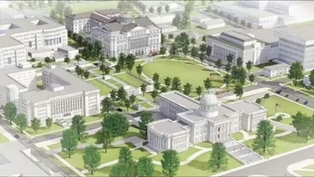
New Alabama State House remains on schedule, under budget as move-in date approaches
Clip: S21 Ep81 | 3m 13s | New Alabama State House remains on schedule, under budget as move-in date approaches (3m 13s)
Providing Support for PBS.org
Learn Moreabout PBS online sponsorship New Episode
- News and Public Affairs

Top journalists deliver compelling original analysis of the hour's headlines.
 New Episode
- News and Public Affairs

Today's top journalists discuss Washington's current political events and public affairs.

 New Episode
 New Episode
 New Episode
 New Episode


 New Episode
 New Episode

Support for PBS provided by:
Capitol Journal is a local public television program presented by APT