Capitol Journal
July 31, 2026
Season 21 Episode 84 | 56m 39sVideo has Closed Captions
State School Superintendent Dr. Eric Mackey Alabama Emergency Management Director Jeff Smitherman
State School Superintendent Dr. Eric Mackey Alabama Emergency Management Director Jeff Smitherman
Problems playing video? | Closed Captioning Feedback
Problems playing video? | Closed Captioning Feedback
Capitol Journal is a local public television program presented by APT
Capitol Journal
July 31, 2026
Season 21 Episode 84 | 56m 39sVideo has Closed Captions
State School Superintendent Dr. Eric Mackey Alabama Emergency Management Director Jeff Smitherman
Problems playing video? | Closed Captioning Feedback
Where to Watch Capitol Journal
Capitol Journal is available to stream on pbs.org and the PBS app.
Providing Support for PBS.org
Learn Moreabout PBS online sponsorshipFrom the Alabama Public Televisio Studios in downtown Montgomery.
I'm Randy Scott.
Welcome to Capitol Journal.
Todd Stacy has the day off.
Later, we'll chat with state school superintendent Doctor Eric McKee.
And afterwards, Alabama EMA Director Jeff Smitherman will join us.
But first, families searching for answers.
Former inmate describing dangerous conditions.
And lawmakers promising more scrutiny.
Those were the themes Wednesday as Alabama's joint Prison Oversight Committee heard emotional testimon about the state's prison system.
Capital Journal's Jeff Sanders reports.
So former inmates and family members of current inmates pleaded for answers as lawmakers heard emotional testimon about Alabama's prison system.
Before the hearing began Chairman Senator Clyde Chambliss urged speakers not to identify inmates by name over concerns about retaliation.
That is, for their safety, for your safety.
And please just refrain from announcing names and I. S numbers or anything like that.
Among those addressing lawmakers was Kim Baker.
She Sasser, a 58 year old brother who had a mental disability, died while housed in an Alabama prison mental health unit.
Baker says what she saw when she identified his body still haunts her.
He was wrapped in bubble wrap and covered with a sheet up to his neck, without any belong in sync with him.
His face had been beaten a top and head was cracked open, and a dried u blood in his nose, a blood stain under his nose and dried face still on his scalp.
And for someone attempted at cleaning, the baker says her family still doesn't know exactly what happened.
Another speaker, Collee Howell, told lawmakers inmates who report abuse or misconduct often pay a price for speaking up when an inmate reports wrongdoing.
The officers will announce it publicly and all the dorms, the yard, everywhere.
That gets retaliation to the inmates.
It weaponizes the staff.
Representative Chris Englund says stories like those are exactly why lawmakers continue to hold public hearings.
He says families deserve answers and the state still has more work to do.
So I never want you to get the impression that you're coming here for no reason.
You have changed things.
This these meetings, once a year.
They have changed things.
You've informed us and made us more empathetic and sympathetic to what's going on.
And we've created thing in order to make things better.
It's a big shift.
It turns slow but I think we're tired of it.
Lawmakers also heard from Rachel Riddle, chief examiner with the Departmen of Examiners of Public Accounts.
She says an independent revie of the Department of Corrections has expanded beyond a single prison, and is now examinin how the entire agency operates.
Riddle also says that investigators have run into issues obtaining some department records.
I've never had a state agency not give me documents, even confidential ones.
And so this is new territory for me.
With that being said, we really, really hope to come to a resolution.
We are working with D.O.T.
to try to do that and not have to g the route of issuing a subpoena.
Riddle says her office expects to release its first findings by October.
Lawmakers hope that review will help determine whether broader changes are needed throughout Alabama's prison system today.
Reporting from the statehouse in Montgomery.
I'm Jeff Sanders for Capitol Journal.
Does The Alabama Democratic Party has spent years dealing with internal divisions over its leadership and direction.
While the Republican Party have expanded their supermajority in Montgomery, now, Senate Minority Leader Bobby Singleton says he wants to help chart a new course.
The Greensboro Democrat announced he's challenging current Alabama Democratic Party chairman Randy Kelly, saying he wants to unify the party, better support Democratic candidate and focus on winning elections.
Party member will choose their next chairman during the state Democrat Executive Committee meeting on August 8th in Montgomery.
You know, as a sitting member of the Senate, I've been around for 25 years, and I just never really felt supported by the party.
As I sit here, we've fought battles all the way from D-I to reapportionment.
You know, things that I thought that hurt our people with with seeing budget cuts.
We've seen public schools get cut from money.
And all of those thing that Democrats say they're for are of Medicare.
Expansion has not happened in this state.
Hospitals are closing down all of those things that Democrats support, but we just never got that support from the party.
And I believe in this that if I can't get someone else to get the job done, I don't mind stepping up and doing the job myself.
I can't criticize someone else for something that I'm not willing to do.
So that's what drove me t step up and want to be the party chair is to make sure that we can do what we need to do.
I want to be a new and fresh voice.
I don't come here from one side of the other.
I know that there's some splits in the party.
I don't come from one side of the other.
I come to be a to unify and try to make this party move forward.
I want to win in November.
And that's what I come to do, is to win.
Congressman Shamari figures landed in Alabam this week to talk to citizens.
Figures was on hand for the Montgomery Chamber of Commerce breakfast to discuss items from the nation's capital.
One of those topics, a bill placing sanctions on Russia.
I haven't read the exact bill.
Not familiar with the exact sanctions, but obviously there are, diplomatic means of pressure that we need to be pressuring on Russia.
They're engaged in, acts of hostility against Ukraine, against an American ally, and something that we need to be doing everything that we can, to, bring to a close as soon as possible.
Congressman figures also spoke of the latest with the capital city's Jackson Hospital.
He reiterated to the audience the importance of making sure this facility stayed open for the people living in central Alabama.
Jackson Hospital is a vital core piece of this community.
It's a vital piec of the future of this community, and one that we have t make sure that we're preserving.
We convened a meeting when we heard that Jackson may be closing of the city, the county, the state, the hospital, the ownership group and the management group and BlueCross BlueShield to talk about, ways to a viable financial future for Jackson Hospital.
Coming out of that meeting, we've been able to make some progress.
But we're hoping to get this deal finalized and get all the signatures on paper so we can move forward with Jackson in a stable manner.
Bipartisan senators advanced a sweeping Russia sanctions bill this week in a tribute to the late colleague Lindsey Graham.
Senator Katie Britt is helping lead that push.
But other Republican priorities have not gained traction this week as intraparty fighting stalls the Save American ad and a budget plan.
Alex Angle has the details for us in Washington.
Hours after senators pai their respects to the late South Carolina Senator Lindsey Graham, they voted to advance his signature bill, one that will enact sanctions on Russia and tariffs on th major purchasers of Russian oil.
We have an opportunity to advance this legislation at a critical juncture in the war, where Russia is the weakest that it has been since the start of the war more than four years ago.
This legislation will give the president the tool and the economic firepower that he needs to sanction individuals who fund Russian war.
Senator Katie Britt is a key Republican sponsor of the sanctions bill.
She and Tommy Tuberville voted to advance the measure Tuesday night after a meeting with the Ukrainian president.
The vote was 8612.
We heard from President Zelensky in this room as the United States Senate and some members of Congress.
And then we walked out there and did something.
We showed the world that we stand for strength.
We stand for peace, and we stand with Ukraine.
But hurdles remain for the sanctions legislation, which is expecte to face opposition in the House.
Also this week, Senate Republicans have clashed over enacting some of President Donald Trump's legislative priorities.
The Save America Act and the $95 billion budget framework that would fund the Iran war.
Farm aid in that election bill have stalled in the Senate.
Senate Majority Leader John Thune warned that Republicans don't have 50 votes to advance those efforts right now.
The discussion we had was a fulsome one.
And we'll continue to listen to our colleagues to figure out what the path forward is.
But that isn't stopping staunch conservatives.
Tuberville is calling to cancel the Senate's August recess to pass the Save America Act, despite its slim chance of passage.
We don't need to go on recess.
Let's get something done.
Americans didn't send us up to D.C.
to take these long vacations.
They sent us up here to preserve the greatest country on earth, and it is in trouble.
And that' what I'll keep fighting to do.
This Senate is scheduled to leave for a five week recess starting at the end of next week.
Reporting in Washington Alex Engle, Capitol Journal.
Over 700 members of the state's banking industry came together at point clear for the Alabama Banker Association's annual conference.
They're interacting with state and federal regulators, discussing the latest issues impacting the industry and how to help protect Alabamians and their money from scams.
The management of our bikes, the presidents and CEOs, the C-suite people very, very important that they maintain as much of the latest information that they can possibly maintain on how to best run a bank.
Banking is highly regulated, as are a lot of industries.
And so we partner with the FDIC, which is the Federal Deposit Insurance Corporation, as well as the Alabama Banking Department, to put this conference on every year.
So the purpose of it is, is to bring, in our case this year, 734 people down to this meeting to talk about the the importance of governance in banking.
And so we are thankful to be able to be here with our regulatory agencies, the FDIC, the Federal Reserve, the Alabama Biking Department to, be in front of our bankers and our bank directors to to really bring up the latest trends.
We talk about the economy.
We talk about changing regulation out of Washington, out of Montgomery.
That impacts banks.
One of the things that I'm proud is stop with this conference is it is the largest of its kind in the nation, according to the Federal Deposit Insuranc Corporation out of Washington.
We have held that spot for a lot of years.
And to me, that speaks very highly of the commitment of boards and management of banks across Alabama to make sure we get it right.
So having 734 people here is not something that we take for granted.
We take it really seriously.
And I'm really proud of our banks, the opportunities we get to learn.
You know, we we come her as a group understanding that we we may be comfortable from day to day, but comfort is short lived.
And there's always an opportunity for u to be exposed to something new, to think differently about something or to our to have somethin brought to the top of our mind that that we need to address.
And I think those things come together at a conference like this.
Banks in the United States are unique in the world.
We are Main Street banks.
We'r all involved in our communities.
And the governor established the Alabama Growth Alliance, and I'm very fortunate to be a part of that.
And it brings all of the economic developmen agencies together in the state, with the public private partnership, to try to build the community the whole state, all together, all at the same time.
We're clearly focused on about seven different segments of the economy, and you can really see the work that the governor has put together and the success Alabama i having in economic development now.
Coming up at the Eric McKee State School superintendent.
And we'll also be joined by Jeff Smitherman, the director of the Alabama EMA, to stay with us.
Did you know that mobile played a crucial role in the American Revolution?
Located in the British colony of West Florida, losing control of this port later helped the Spanish take Pensacol and with it, the colony itself.
West Florida was an unofficia 14th colony, but remained loyal to Britain.
Fort Charlotte in Mobile was British stronghold in the area, but this was an attractive spot for France and its ally Spain due to mobile Bay and its proximity to New Orleans.
In January 1780, Bernard de Galvez, governor of Spanish Louisiana, sailed for mobile to attack the fort commanded by British Captain Elias Dunford.
The British were undermanne and ill equipped for the siege that took place over the coming weeks, as the Spanish army advanced during effort ordered his men to burn mobile.
The Spanish artillery breached the walls and the British surrendered.
The army retreated to Pensacola, leaving mobile controlled by Spain.
You've hear the adage blink and you miss it.
Well, that's what a lot of people are using to describe summer.
It seems like just yesterda it was the end of May and kids were getting out for school.
Now it's time to start a new school year.
Joining me to talk about that and other things education, is that the Eric McKee State Superintendent of Education, Doctor Mackey, so good to see you.
So glad to be here.
You know, I had just, this last week passed by one of those big billboards that MPs just put up here i Montgomery, and it said 16 days until school starts.
And I noticed it's been counting down every day.
So, yeah, I'm also blanking and the summer's gone.
Seriously, we were jus everyone getting out for school talking about what they were going to do.
Talking about what programs are going on for the summer.
And here we are in a mere daze.
We're about to start again.
Well, time flies when you're having fun.
It's been a good summer.
We've had a lot of good summer school programs this year going on.
We've had thousands of student back in doing special programs, whether they're reading or math programs or are just kind of summer fun programs.
But, you know, as I drive by schools, I'm seeing band practice.
I'm seeing, sports, football teams out there.
I know that inside.
I've also got volleyball teams practicing already.
And so I thin students are ready to get back.
We all kind of missed the summer and kind of begrudge the end of summer, but it's same time.
It means cool weather's coming those Friday night, so be fun for everybody.
And so we'll be now.
You mentioned reports about other programs going on to help students inside the classroom, which kind of leads into how the school last school year ended with some reports about some improving test scores throughout the state.
Math reading.
It ended on a good note, did it not?
Yeah it did.
We feel really good abou our test scores from last year.
We did have mixed results in places.
So first of all, third grade reading about where we were the year before about 88% of our third graders scoring on grade level, so means 12% below a lot of those 12% were in summer school this year or, or otherwise, where we're in some process where they might still be promoted for what the legislative act calls a good, good cause exemption.
But we also want to track all those students as they go into fourth grade.
Then, you know, right after school got out, we started getting math scores in and other, English language arts scores and side scores this year.
So it's a big win for us.
We went to a new science test this year.
Not not a big change, but an updated, more difficult test because we had changed the standards.
And so when you change the standards, you have to update the test.
And we saw pretty significant growth.
Now that's not easy to compare though to the last year because it is a new test.
It's based on new standards, new cut scores.
So we really want to try to kind of track that as we go forward.
But but you know, I'm really proud of our new scienc standards and the new materials we were able to get in the last couple of years.
I, I think they're a big improvement over what we had.
And so I think we're going to continue to see, growth i science standards, eighth grade.
You know, we're very excite about our eighth grade scores, because eighth grade has kind of struggled for a long time.
We've struggled on the eighth grade Naep, the National Assessment, as have most of the states.
Well, not most every state has struggle in eighth grade now, even those like Alabama, they've seen real growth in fourth grade have continued to struggle in eighth grade.
But this yea we saw some really good growth across the board in math and reading, language arts and in science in eighth grade.
So I hope that means that the, the work that we're doin and putting some resources into middle schools is really helping to push that narrative.
But at the same time, there's always more work to be done, because when the programs started a few years ago, this was the adage of saying, we're going to see what's going to happe with positive.
These programs.
Give it time.
Yeah.
So, you know, all of our real resources have been put into elementary schools, and particularly in early elementary scho.
So we focused on reading, in kindergarten, first and second grade, trying to get students on grade level.
By the end of third.
We focused on mathematics through fifth grade because it' just it's a different subject.
And, and you start getting more difficult math in and introduced in fourth and fifth grade.
So we focused up through fifth grade.
But again, real focus has been on early numeracy.
And that develops reall in first, second, third grade.
How the students really understand the, the principle of numeracy, just like they understand the principles of literacy.
What you want, though, is for that to transfer to deeper learning.
So as students prepare to get ready to take algebra in eighth or ninth grade, our students are really working to focus on deeper readin and expanding their vocabulary.
Learning more words, bigger words, reading faster.
You know, you got to have those foundational skills.
So we focused on the foundation.
I think, what we realized you know, and we knew all along.
But now we're getting to that point is we have to mature our programs and really go into intermediate middle schools.
And and hopefully these test scores are the first beacon that we are getting there.
But there will be mor to do to invest in intermediate, intermediate and middle schools in the years to come.
So is it safe to say, doctor McKee, that science, math, English are somewhat the pillars of support for education moving forward?
Oh yeah.
Yeah, absolutely.
You know, we're we so obviously ratings number one reading is foundational for everyone.
Early math and numeracy is foundational.
But you want to take that into, deeper math, deeper science learning.
So, you know, I was a science teacher.
I love science.
But but I've always said you can you can teach any student science.
They have three things curiosity, ability to read, read, read the textbook.
And they can do math.
If they can do those things, they can learn science.
If they can't do those things, you're going to struggle in science.
And we know that, the 2030s, which we're we're now more than halfway through this decade.
So the 2030s, 40s, 50s and beyond, Alabama's economy is going to be more and more based on, modern manufacturing date manufacturing and, and real technology of, based around information in the information economy.
So we've got to prepare students for those kinds of jobs.
And those jobs are coming to Alabama.
They're coming to our major cities like, you know, Tuscaloosa, Birmingham, Huntsville, mobile, Auburn, they're growing in all of these regions, whether it's rocket science or it's, it's how to develop the newest best automobiles of the future, to submarines and ships down the coast.
So, but all of these, all of these projects, these manufacturing places are really high tech.
They're computers, they're robotics.
They they need students who can think and who can also use a machine, use a, you know, interact with a machine like a robot to build the very best.
So our students are going to be ready because we're going to have them prepared.
And that means a strong foundation.
But it means building on that foundation to also make sure they have the right skills.
As they go into these trades.
Well, again, we are about to start a new school year.
Anything on your mind that you're looking forward to tackling?
Not missing football.
Tackling.
Yeah.
Blocking and tackling.
You know, I think, we're really this year going to, be transitioning.
Obviously, we'll have a new governor and new legislatur coming in in about six months.
And we look forward to working with them.
We're already working with leadership about what the priority is for the for the next year, in the nex four years, really going to be, so one of those last week, I was able to join Speaker Ledbetter up in his area, to talk about the launch of our new, career pathways, program, a way to to innovate, to modernize our career tech centers so tha they're the best in the world.
The legislature's already invested a quarter billion dollars.
All of that has to be matched at least dollar for dollar by the locals.
So that's a half $1 billion in investment.
And it's actually going to be more than that, because I can tell you that a lot of the locals are putting in $4 to the state's $1.
So I think when it's all said and done will be, you know, certainly between a half billion, $1 billion in investment i upgrading our facilities.
Why?
Because we want our students to have the very best, the very best opportunities.
And as the speakers pointed out multiple times, we want we want them to have those opportunities everywhere in the state, not just in the places that have deep resources, but every community, is preparing its students for the jobs of the future.
So I'm very excited about that.
I know that he is really committed, t to carrying that program around and to think about more things we can do, to be innovative and creative in that field in the new quadrennial.
So we're working on that.
You know, I'm really excited about where I think we're going to go with basic literacy and numeracy, where, we'll have new Naep scores out in January.
I then.
Yes, unfortunately, that' the one thing I cannot predict.
People usually don't pay attention to the score except the day they're released.
But we actually took the night test this past January.
It takes the federal government, usually about 12 months, 11 to somewhere from 11 to 13 or 14 months to put the scores together and release them.
So we think they'll be out next January.
They've told us it could be as late as March or April before they're ready, but but probably in January.
And so that'll give us a look back.
Now.
That'll tell us where really where we were back in 24, 25.
So you know they may go up.
I'm certainly hope that we'l have confidence that over time we're starting on the right trajectory.
We've got a great results.
But we'll have to see where that goes.
I think that'll be, you know, you know, teach us some things about what we've been doing and help us adjust as we going forward.
You know, I'm excited about, artificial intelligence and where we're going with that.
We've we've talked a lot about that.
We that's going to be a part of the future.
I know a lot of people are afraid of it, and with good reason.
They may be afraid of it, but it is here to stay.
I mean, if you, if you turn on your TV and decid you want to watch some Netflix and you're trying to decide what to watch next, the artificial intelligence has already partially made that decision for you because it's going to it's going to push to the top of your screen a lot of choices for you, and you still get to make the choice but it's going to push choices to the top for you based on your past choices, and also based on wha other people in your demographic choose to do.
So they're already these things are behind us.
What we need to know and what all of our students say to know is how it works, how to use it ethically, and how to safeguard yoursel against the dangers and biases that might be built into it.
So we're we're working on that now.
I'm glad you mentioned ethically, because that has to be a big part of it because this is everywhere now.
Yeah.
As you said, from whether or not you're making coffee in the morning or are you going to the store or someone's doing a shopping for you, air is everywhere, so you hav to get an understanding of it.
And students are that front line.
Okay.
To understand artificial intelligence, A is built into everything we do.
Look, if you say, well, I'm just going completely, you know, I' going to not have a cell phone.
I'm not a not have a computer.
I'm just going to live totally off the grid if you have electricity.
I was into that because, again, all of these systems are interactive.
They're they're nationwide.
They're global systems.
And so they're using really good technology to build in the best efficiency.
What we want to do is make sure that our students know how to use it, that they know how to use it ethically, that they know how to, to look at bias and understand what bia might be built into the system, that I kno how to take multiple resources and share those against one another so that they get the best answer possible.
And, you know, it's not been with AI, I realized.
But this is the kind of stuff we've been doing for a long time.
Back when you and I were in school, teachers were telling us, when you go to the librar and you do research, you know, we used to writ our research down on cards and we'd take all those note cards.
But every teacher told you, don't take the first book you pick up, don't take just one resource.
You had to have multiple resources.
And it's good to get resources where the authors don't agree with each other.
So you can compare against each other.
And and then you look at the sites for those resources.
Well, now we're doing that online.
But our students have to be the best in the world at it.
We don't want any students anywhere in the world to be better at, making these comparisons and learning how to ethically use it.
And then Alabama students, we want to be the best at everything.
I'm glad you said to look at different sources, because that definitely rings a bell, because it helps you to be better by saying what this person may sounds agreeable to you.
This person may not, but it gives you a broader visio of what you're trying to reach.
So if you just go in and you ask Google a question and you get, now, you know, unfortunately, I really don't like it, but you get that, summary at the top, which gives you maybe two paragraphs on the subject.
You should never accept that is truth.
One.
That is, that is produced by a search engine based on lots of different people who are searching the same thing as you.
It probably has bias, almost certainly always has some bias built into it.
It may pull the right facts and it may not pull the right facts.
So you should definitely go beyond that unless you're looking up something, very, very minimal.
Like, what was Mickey Mantle's middle name?
Then you should you should not pay attention to that.
That, you know, summary at the top.
Like it's only good for really basic, nearly useless information.
But you go deeper.
You can, obviously do high quality research using internet resources and, and again, look, every job in the futur is going to have some component of technology and artificial intelligence probably built into it.
And that's going to be everything from agriculture.
We have tractors no being driven remotely by GPUs.
To obviously manufacturing, communication, TV.
The world that you're in, the world that I'm in in education, they're all going to interact with these new technologies.
And so our students have t they have to be good at using it and understanding how to use it.
And ethics is number one.
They have to understand how to ethically, make decisions and use these technologies for the good of mankind.
And that's the only way we win and keep this great republic moving forward.
Speaking of using technologies, there's another concern of yours I want to ask yo about real quickly screen time.
Yes, because a lot of this i based on how much time you spend in front of a a laptop o a computer or your cell phone.
In many cases, to ge the information that you need, there should be some understanding about what is good screen time and what may not be good screen time.
That's exactly right.
Yeah, yeah.
So the governors appointed a commission.
I'm very prou to be a part of that commission.
I mean, we're going to start meeting on August 17th to talk about some recommendations around screen time.
As you probably know, this last year the governor championed, some real strong screen time limits for four and five year olds, which we were glad to be a part of.
And we'll be implementing those in the upcoming school year, not this school year, but the next one that that committee is working right now to say what the specifics will be.
Representative Gina Ross had, did a great job, great leadership in pushing forwar on another bill that would have, created a commission around some, you know, done some things around screen time for the rest of K-12.
It didn't pass in the last days.
You know, a lot a lot of bills died in the last days of the legislative session.
And it was one that didn't there were a lot of questions still out there.
And so I think that, you know, as she and I've had follow up conversations, she wants to bring that back.
The governor's very interested in it.
And so I think this commissio will bring some recommendations that then the legislature can consider next year.
I would tell you this, you know, the final bill that the Senate looked at with some amendments, we thought was very good last year.
So I think we do have a starting place.
We're not starting from scratch.
We have a really good, bill that we can start with.
And I think what we'll see is, more, you know, more limitations.
The earlier, we are in school, the younger a child is, there's no question that students should not be spending a lot of time on screens.
But the key is what is the screen time for?
So students should be on screen.
Some screens are the way in the future.
I mean, you know, you go drive in a car now there's going to be a screen in that car.
So students need to be able t use them in the appropriate way.
And if I could give a quick example, when I was teaching science, when the first iPads came out, I was extremely excited.
And I'm still excited about this technology because, you know, I taught, DNA structure to ninth graders, an it's really hard to understand.
It's hard for adults to understand.
But we we just had a plain sheet of paper in a textbook trying to show the double helix and how it how it works.
And, and that is done with the three day drawing.
When the iPad first came out, I remember the first thing I sa on an iPad was a double helix.
That you could rotate 360 degrees and see all the sides, and you really could better understand what the structure looked like, and you could manipulate tha structure using the touchscreen.
So that is an appropriate use of technology and screens in the classroom that we never want to get away from.
Like there are going to be, activities that can be better taught using a screen than a piece of paper.
But does that mean a screen is better for everything?
Absolutely not.
If I'm going to assign you, to read Huck Finn, then you probably need a paper back copy of Huck Finn where you can you can carry it around.
You can read it.
You can hold it in your hand.
You can mark in it.
Because we know that kinesthetic learning is very important, and that's, that's a part of the brain development and human development.
And so, unfortunately, I think in many cases schools may have gone overboard.
Not all of them, but many of them.
And I like where we're goin to put everything on the screen.
Everything's going to be digital.
Probably not a good idea.
And I don't want to preempt the commission, but, you know, I certainl will be speaking up about that.
I think there are some activities that ought to be paper and pencil there, some activities that ought to be on a screen.
We need to be very careful that we help teachers make good decisions about which one is which.
Well, doctor McKee, we will be watching.
And as we started off this conversation by saying the countdown is on, the countdown is on that.
Eric McKee.
Thank you sir.
Thank you.
Okay.
With you.
And we we'll see what happens next.
We'll be right back.
Alabama Public Television is your place for quality educational services.
Free professional development for educators and childcare providers.
Access to free curriculum line videos, lesson plans and instructional resources with PBS Learning Medi and all the PBS kids programs.
Parents know and trust.
Learn something new every da with Alabama Public Television.
Visit us at AP tv.org/education to learn more.
Did you know that over 700 revolutionar soldiers are buried in Alabama?
Even though Alabama wouldn't become a state until 36 years after the end of the American Revolution?
More than 1000 veterans lived some portion of their postwar life in Alabama, while some soldiers arrived in the state before its inclusion into the Union.
Many rush to Alabam during the height of a migration called Alabama Fever.
Alabama veterans were often young and of low rank during the war.
Still, many came from all walks of life.
Some notable Alabamians who moved south after the war were future governors William Wyatt Bibb and Thomas Bibb, whose father had served as a captain in the revolutionary Army.
Among the revolutionar veterans were three black men, Frederick Gowan and Jim Capers, as well as women Mary Witherspoon Conyers and Elizabeth Duckett Casey.
Over 90% of Alabama based veterans were born in one of the 13 Colonies before American independence.
You're watching Alabama Public Television.
And you.
Here in Alabama.
We are in the heart of summer, and a lot of people watch the weather on a constant basis.
Morning, noon and night because weather is a big thing to talk about here, especially with people wanting to go to the beach, vacation, or even work in it.
Joining me now is another person who watches the weather.
The director of the Alabama Emergency Management Agency, Jess Smith.
Mr.
Smitherman, good to see you.
So yeah, weather is a big thing nowadays around the country, not just Alabama.
Tell me a little bit about your agency in terms of watching the weather.
What does that mean for citizens throughout the state?
Yeah.
So while we face many hazards to include, the nuclear power plants that we have in the state, and we actually even have the threat of hurricane above, earthquake.
But the most important thing is the weather, the weather impacts.
And specifically because we're in the tropical storm season.
So we watch that we really keep an eye on those, tropical systems as they develop and, and become a threat to the state.
So that's probably the biggest weather phenomena that we track and keep up with.
And and that's a 24 ove seven operation we do out of the out of the headquarters.
And it's really it it ties into the mission.
We we lead, guide and assis our emergency manager partners in, planning, responding to and recovering from critical incidents.
And, you know, with the idea of promoting, community safety and, making a more resilient Alabama.
Now, when you say your emergency management partners, you're talking about, sir.
So that could be the county emergency managers, the the local jurisdiction, the elected officials, other state agencies.
Really, it's more the counties and the other state agencies as we work together to, to respond to any critical incident.
But particularly we've got a fairly well-developed plan of support for the tropical systems, because you mentioned earlier how things can affect Alabama coming from the coast for the tropics, all the way up to North Alabama, Huntsville and above.
This state has a unique, I guess, perception of being a state that experiences everything.
Yeah.
Excellent point.
So I have that in my presentations when I give to others, who may not be familiar as I go across the nation presenting what Alabama does.
And one of the things i we do face every natural hazard but one.
And that being a volcano.
But I was just up at the U.S.
Geological Survey Service, this week up at the University of Alabama.
And I was about to ask them, hey, can you help m find if there's a volcano here so we can claim every natural hazard?
But but, it, it really is a diverse state, and the meteorologists have a really tough time with the winter weather because we're in a transition zone.
When that winter weather comes down and we never know, for sure whether it's going to start as a liquid and then turn to a solid, like for rain to ice, or if it's going to start out as snow or say.
So it really challenges our Alabama Department of Transportation on ho they're going to treat the roads they need to pre-treat and to get washed away, or because then they can't treat it.
So it really is a really challenge.
And and we work with multiple, weather partners, bear and weather.
We've got a bunch of mesonet systems at South Alabama and, different ones up in Huntsville and, and weather itself that work with us on, working those call and working together as partners to really track tha and do the best we can to help, keep those main, road networks open Let me talk about one season that we are in an we alluded to a little earlier hurricane season.
Now of course people think of hurricanes.
They think of the Gulf.
They think along the coast.
Hurricanes can actually travel inland and cover again this entire state.
Correct, sir.
That's right.
You you know, just recent history with Hurricane Helene just shows just how far inland, and devastatin those tropical systems can be.
And we've had, in recent history here in Alabama, following hurricane Sally, we had Hurricane Zeta that came in, and I think it made landfall in Louisiana, but it came in, into the state from the west.
And it's and, some of our communities experienced some high wind event that they had not experienced in decades, which caused som really some significant impacts to the power, debris from the trees and all.
And the trees fall on the power lines, taking them down.
So it made a huge impact on the state because of the angl and speed at which it came in.
So it's pretty far inland up, up around the, central west central part of the state where it entered.
So not and not the normal typica path of, from the coastal area with Mobil and Baldwin County.
It was really significantly north than there.
So yeah, it could be the entire state' threatened by a tropical system.
And again, the coastal areas, coastal cities, coastal counties, a big problem.
They have to deal with flooding, water coming i and doing a lot of damage, that of course everyone's looking out for the wind, but it's also the water.
Exactly.
And that's, just recently, inland flooding past storm surge as the number one killer from these tropical systems.
And it's not wind.
And so it's, we really put out a strong messaging campaign.
Don't get tied into just wha the category of the of the storm is because it's rating wind speed.
It's not.
It's not necessarily rating.
What's the most likely kill or of that of that system.
So we've had some tropical storm that that killed a lot of people because they maybe underestimated the potential.
But it is this inland flooding from these tropical systems that are killing the most people.
And I guess it's time to plug, you know, Governor Ivey, lobby the legislature this last year to fund a statewide notification system.
So we now have a way of alerting those inland, if we've got an impending flooding situation, we can get that, that message out that didn't exist.
Prior to this year.
And, and there has to open up the door of being able to communicate with the governor and with lawmakers here in the state who are curious as to what ma be going on in their districts.
I can remember, during th tornado outbreak back in 2011, during the legislative session, many lawmakers were watching as that stor was ripping through Tuscaloosa and people were asking, what's going on?
Who do we need to contact?
And I know they were saying, we need to get in contact with the Emergency Management Agency to find out what's going on.
So that has to be also another, notch on your belt, if you will.
Things that you have to do.
Yes.
There's that.
And we've, really, we've taken advantage the last couple of years of really increasing our technology and our ability to, to communicate.
We've got, levels of redundancy at our agency now that just really it's never existed before.
And, and I would put it up against anyone in the nation.
How many different, ways of connectivity we have coming into that building.
So if we lose one or or 3 different ways of access to to the internet, we have a force to be able to do that.
Some of it's Starlink, some of it, some of the most, most affect of, fiber optic that's run through the, through the state and nation So we're really proud of that.
And we accomplished that with our, renovation we took advantage of while we were out of the building and shut down.
We we were able to do a lot of that.
And so it's going to increase our bill to help keep everyone informed.
With that, we increased our, what I would call our common operational picture, if you will.
What's so that everybody can see where everybody else is at, what they're doing and what's going on.
So we've really put a lot of effort into that.
And it's a lot of that's been help from the governor and the legislature.
Let's change gears for just a second to talk about that, because I wanted to talk about some of the new additions that you have added to your agency in terms of your fight to help keep people safe during storms and other emergencies.
Yeah.
So one of the key, piece of equipment that we actually, worked with the legislature and the governor to get was a mobile command vehicle.
We did not have the capability to go into an incident site operate unless we took some space from the local jurisdictio that we were there to support.
Well, that was tha became a drag on their services.
If, if we did that.
So, you know we never would want to do that.
So we were able to get a mobile command.
So now I can put my team forward at the incident site.
And they can provide near real time information, to not only to, to me, but to anyone else who's connected into our, into our network, which, which we open up to any anyone, any legislator or any of the, other state agencies can see exactly everything.
I see because weather can be unpredictable.
Let's just say it what it is.
It could be unpredictable.
It could look beautiful outside.
And all of a sudden you hear clap of thunder overhead.
Where did that come from?
You had to be ready to stay ready?
Yeah.
And it's impacts.
You just never know.
It can take one smal thing, can have a major impact.
A lightning strike on a particular electrical substation could take out a whole communities, energy and power for for days.
And at this, with the temperatures and the humidity that we're experiencing right now, you know, that's that coul that could mean death to some.
So we really, have to plan against that because just one simple lightning strike could have that significant impact on the community.
So you just never know when that's going to occur.
You know, one thing about hurricanes, it gives you a little bit of tim to usually to plan and prepare, and you kind of pretty much know where where they're going to hit.
And you're able to, to better pla against those projected impacts.
Some systems don't give us the spring storms that come through like the April 2011, very devastating.
I mean, we were talkin some somewhere around 60 tornado tornadoes, 250, 260 deaths.
That's that's huge.
And, unfortunately, Alabama is 24th in population.
We're ninth in, major disaster declaration by the president, but we're number one in tornado deaths, you know, and Alabama likes to be number one in things, but that's not one that I don't think we like to be number one.
And we got to do something to be better, than that is better prepared.
Better prepared and and information to people to, to know where to go, to get information and have redundant wa of receiving that information.
Not just their cell phone not just their broadcast media.
Both of those are great.
But do they have a NOAA weather radi that they can program and get?
Because it can be stay on and receive signal even when most of the other locations lose power.
So just do they have that redundant way and are they watching the right people sometimes?
There's a lot of people that may think they know weather on and they're on social media, and there's nothing wrong with that.
Maybe be in that first initial.
But but ask the question, hey, is that right?
Let me go chec with a respected meteorologist.
So what is the broadcast media saying?
What is, Alabam Weather Network or or whoever?
What are they saying?
Someone that that knows the state knows the area, knows the area you're in and can give you honest, reliable, information.
For that You can make your preparations.
Speaking of knowing the area that you in, correct m if I'm wrong, but you probably your agency probably doe a lot of work with other states.
Whether or not that is is SC southeast or across the country, because I'm quite sure people are watching what is happening across this country to see what system could be moving into here, what system may be leaving here, going to their area.
So just in my short tenur here as director, we have sent, my staff and some of the local, first responders or support, to North Carolina, South Carolina, Georgia, Florida, Tennessee, Kentucky, Texas.
We did not go to the Mississippi.
They we just didn't g to the Mississippi recent storm.
But we've also done Colorado.
I mean, so we we there is a mutual aid agreement amongst all the states.
It's called Emergency Management Assistance Compact.
And we were much more active in that, system than we've ever been before.
And I think, it goes to say that, especially the states here in the southeast, they're very experienced, not just Alabama.
The others are as well.
And with that experience, you share that.
And that mutual aid compact allows for that.
And, I think the states do more for each other.
And, you know, mayb we don't advertise that as much, but I think if the federal government would listen, they would find out that the states do a pretty good job of supporting each other every once in a while.
The states may need some particular help from the federal government.
Alabama, luckily, has not had to call in tha that federal support that often.
But they're there for us if we need it.
And that's nice to know because, again, we're all in this together in terms of staying safe from some violent weather.
And it's not always the hurricanes.
Of course we can talk abou tornadoes as well too, because, the quote you had earlier about Alabama leading the country in tornado deaths did not know that.
And it's really kind of not even close.
Wow.
It's it's, I'm glad to get the number.
We're number one by a good bit.
We've got a lot of work.
It'll take years for somebody.
El parcels, I don't.
And God forbid, I don't want anybody to to pass us.
But, it's not something to be proud of.
And it's something that we've.
The biggest thing we can do is just get information out to people that's going to have the biggest impact.
Like, just being able to get the warnings when they're coming into you area in the middle of the night, because for some reason the storms always seem to hit us in the middle of the night and people aren't paying attention, as closely, maybe.
So.
You know, there's a lot of things like tha that contribute to that number.
But, we've got to figure out how to help peopl not become one of that statistic and lead the countr in notifying people and helping to understand how these systems can affect you.
That's right.
And and, you know, we put a lot of our time and effort into that.
And it's just hopefully, you know, you just it's one of those things you never know.
If your efforts pay off because you don't you just don't know if they do.
But we know it's the right thing to do because we kind of know, you know, we were with, a sociologist from the University of Alabama said, hey, how can we work our messaging to get the maximum impact?
What what are th what do the people need to hear?
When do they need to hear it and how do they need to hear it?
And once we figure that out and it differs from, a tropical system versus, a high wind event like in the spring tornadoes, it' just how they want to hear it.
You all, it's just different.
And we have to we have to take that into account, into our, timeline and how we send the messages out and when and how we do the proclamation in the state of emergencies that we recommend to the governor and whatnot.
It's all part of that entire messaging effort.
Now, something else, too, tha a lot of people have been paying close attention to the heat.
It has been very very hot really for months now.
And it's dangerously hot, here in Alabama and again across the country again.
Your agency also pays attention to this as well, too because that heat can be fatal.
That's right.
One of the one of the biggest things I think I could say on that is and it goes for all disasters, is neighbors check in on neighbors, especially the elderly or what we would say special needs someone that has particular needs.
Like they live on oxygen and require power and the power goes out there, you know, it puts their life in danger.
So so we work to say, hey, neighbor, help.
But just just be neighborly.
Check on your neighbor, see if they're okay.
Maybe if they, aren' running their air conditioning because they can't afford to pay their bills, maybe invite them over to your house for an event just to get them.
Let them cool off for a little while, maybe have dinner, just watch a movie together, do something to get them out of the heat.
Maybe anything you can do just.
But again, neighbor check in on neighbor.
Especially after an incident after tornado, after hurricane.
But most people who are rescued or, recovered after a storm, it's initial person is their neighbor that's helping them.
We've talked to a lot of law enforcement officers and officials, and they had this saying, tell me if this is appropriate for what your agency does.
If you see something, say something.
Absolutely.
So I have a military background and what it came from that was every soldier has sensor.
So we apply that in the emergency management as well.
A key example is I had the opportunity to go to see Walmart's world, emergency operations center that they use worldwide, and they said they even have examples of where, like state emergency operations centers will reach out to Walmart and say, hey, you got anythin on a particular road or whatever or what your driver's seeing?
So there's so many, avenues to get the information.
It's not everything's a sensor.
Especially if you've got a system built to take that information in.
So, so we do we have, a business EOC that we run virtually and, and it allow these private sector to come in and have conversations with each other.
The Walmart can ask the power company, hey, when is power going to be on in this area?
So they know when to have their employees to report, to work.
And they start saying, hey, we're going to have power on Wednesday, so come in on Tuesday, let's start getting it ready so that they can make plans.
And what's key that it's not about Walmart, it's not about Alabama Power.
But at that point is when the when the, residents in tha area can get back to normalcy, that's what it's all about, is when they can go and be normal again, nothing.
Nothing helps recovery better than, the individuals being able to get back to normal.
Is there anything else citizens can do to help with your agency in times of need like that?
Because I'm quite sure, as we said, you know, that awareness factor is key.
Well, it's easy to say for the to take the steps individually to be prepared.
And there's they can they can, come to our agency's website and find out what makes a good ki to, to have and to be ready and, and ask them to kind of, as best you can, be self-sufficient for that 72 hours that it takes us to kind of really get out there and get them market and make sure we got a good sense of what's needed where, so probably the biggest thing that they could do is second, I would say get to know your local emergency management agency.
There's representation in all 67 counties.
And then some of the cities and towns have that as well.
Get, get to know get to know the volunteer organizations in the area, so that you can call them if you have a need, but also if you're interested in supporting your neighbors in that way, to to join and help in with those volunteer organizations, because I'm sure they'd appreciate the extra assistance in a time of need.
And as you said, right now is probably a good time to get those go kits ready because we are in, again, the hardest.
It is, you know, we had that, Tropical Storm Bertha that just, skimmed off the coastline.
And, luckily we we only had, minor impacts to the state, but, the next that we jus don't know, it just takes one.
That's what we always say.
It just takes one.
I think it was hurricane Andrew was the only major hurricane that year, but, it's, it's well known.
The impacts it.
I mean, it wiped out a town in Florida that just really never recovered.
So, it just takes one.
That just takes one.
So, citizens, please stay aware of the weather.
And please listen to the Emergency Management Agency in case they put out some warnings.
And your local, media meteorologist as well.
Absolutely.
Director Smitherman thank you so much for your time.
My pleasure.
Yeah, we appreciate it.
And we hope to have you back on again to to talk about some other things, to keep people abreast of what's going on with your agency.
Yeah.
Thank you.
I'd be pleased to.
Thank you sir, and we'll be right back.
The Carver Theater was erected in 1935 on the corner of fourth Avenue North and 17th Street North in Birmingham.
The Carver was one of several theaters in the Fourth Avenue area offering first round movies to African-Americans.
Today called the Carver Theater for the Performing Arts.
The space has been the hom of the Alabama Jazz Hall of Fame since 1993, and it serves as a museum and performance venue.
You can watch past episodes of Capital Journal online anytime at Alabama Public Television's website.
App tv.org.
Click on the online video tab on the main page.
You can also connect with Capital Journal and link to past episodes on Capital Journal's Facebook page.
And that would do it for this edition of Capital Journal.
Thank you for joining us.
Jeff Sander will be in the chair next week.
We look forward to seeing you then.
For Marvel this year Alabama Public Television, thank you for watching and be safe.
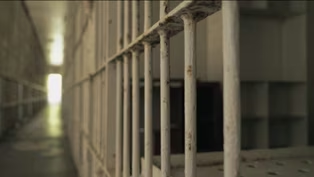
Families allege abuse, retaliation as Alabama prison audit expands
Clip: S21 Ep84 | 3m 15s | Families allege abuse, retaliation as Alabama prison audit expands (3m 15s)
Providing Support for PBS.org
Learn Moreabout PBS online sponsorship New Episode
- News and Public Affairs

Top journalists deliver compelling original analysis of the hour's headlines.
 New Episode
- News and Public Affairs

Today's top journalists discuss Washington's current political events and public affairs.

 New Episode
 New Episode
 New Episode
 New Episode


 New Episode
 New Episode

Support for PBS provided by:
Capitol Journal is a local public television program presented by APT