Capitol Journal
June 26, 2026
Season 21 Episode 80 | 56m 40sVideo has Closed Captions
June 26, 2026
June 26, 2026
Problems playing video? | Closed Captioning Feedback
Problems playing video? | Closed Captioning Feedback
Capitol Journal is a local public television program presented by APT
Capitol Journal
June 26, 2026
Season 21 Episode 80 | 56m 40sVideo has Closed Captions
June 26, 2026
Problems playing video? | Closed Captioning Feedback
Where to Watch Capitol Journal
Capitol Journal is available to stream on pbs.org and the PBS app.
Providing Support for PBS.org
Learn Moreabout PBS online sponsorshipThis week on Capitol Journal, the state's new unemployment numbers are out.
We'll walk you through how the job market works.
A major Alabama hospital is on the brink of closure.
Randi Scott reports on what's at stake here in the capital city.
Market conditions are threatening the pulp and paper industry in Alabama.
One of our key economic sectors.
Jeff Sanders has that story.
Anothe tumultuous week in Washington.
Alex Angle brings us the latest on how Alabama's delegation has been involved.
With one week to go until 4th of July.
We'll invite you to join us for our special broadcast from Sweet Home 250 at American Village.
Joining us in studio this week, Steve Murray from the Alabama Department of Archives and History.
Promote some upcoming Independence Day events, including a special one at the state Capitol.
Deputy Secretary of Commerce Ed Castile is retiring after 33 years, leading Alabam industrial development training to reflect on his career and the evolution of industrial recruitment.
And Paige Hutto on the Alabama Chamber of Commerce promotes the upcoming national civics being, including the state competition coming up in a few weeks.
That's all next on Capitol Journal.
From AP Studios in downtown Montgomery.
I'm Todd Stacy.
Welcome to Capitol Journal.
The state's latest unemployment numbers are out, and they sho some positive signs for Alabama.
The overall unemployment rate for May was 3%, up slightly from April's rate of 2.8%.
That's not altogether bad news, though, as it shows that more people are actually looking for work and not remaining out of the workforce.
To that point, the state' percentage of prime age workers participating in the workforce is 79.6%.
That prime age rate includes worker between the ages of 25 and 54.
Basically, omitting those from ages 55 to 65.
And so that number has increased by just about a whole percentage point over the last year.
Another positive indicator is wage growth.
Average weekly wages have increased by $72 over the last year, to a record almost $1,700.
Department of Workforce Secretary Greg Reed says that means more money into the pockets of Alabama workers to support their families.
The closure of a major hospital in the capital city would be a big time problem, not just locally, but for the whole state.
But that could be happening within a week.
As Jackson Hospital says, it is on the brink of closing permanently after years of financial troubles.
Capital journal's Randy Scott has more on what's at stake and what might happen.
As well as poo management of Jackson Hospital.
Granted, they didn't have the best manager for the last ten years, no doubt about that.
Doctor Davi Thrasher is one of many people watching the situation unfold with Montgomery's Jackson Hospital.
The chairman of the state Health Longevity Commission says it's a fight to keep Jackson open in a day where other facilities have not been so lucky.
84% of Alabama rural hospitals are operating at a loss today.
27 hospitals in Alabama are in danger of closing in the next two years.
19 hospitals across Alabama ar an imminent danger of closing.
Today, we take away one third of our public health care and our other hospitals.
Baptist, Sout and East are already strained, so that puts a tremendou strain on the health care card.
The big reasons are financial.
Disagree.
It's the physician reimbursement.
Alabama is one of the lowest in the nation.
Hospital reimbursemen likewise, is one of the lowest in the nation where a poor state.
We've in poor county here in Montgomery.
The big question is, what's going to happen to Jackson Hospital?
State leaders, city leaders, county leaders, even some business people are working behind the scenes to make sure the doors of this facility stay open.
But if they're unsuccessful, then what?
What will happen to the patients who have to come here?
What happened to the people who work here?
What will happen to the city of Montgomery?
The city and the county both have stepped up and, helped fund the hospital to the tune of 25 million.
Between the two of us, we go a pledge for another 15 million.
The state has, obligated $40 million to help the hospital.
Montgomery County Commission Chairman Doug Singleton is one of those people in the middle of those talks.
He says they knew it would take many stakeholders to get this problem solved.
Also, investments from Atlanta businessman Rick Jackso have made a positive difference.
Everybody in Montgomery County will be affected.
And people say, well, you know, if Jackson closes, we just go to Baptist South or Baptist East.
Or if you've been to the emergency room lately, you've got a 4 or 5, six hour wait.
The work is coming down to the wire with discussions between Jackson Hospital and Blue Cross Blue Shield.
I still remain confident, that we're going to be able to come up with some type of solution again, that nobody's going like, nobody's going to be happy.
There's going to be no winners in this thing except the constituents of Montgomery, Alabama.
But all parties again, we're working diligently, and talking.
And that's a great thing.
We're all talk.
We all had the same goal.
We want to keep the hospital open in Montgomery.
Randy Scott, Capitol Journal.
Thank you.
Randy.
Another interesting wrinkle that a story we discovered this week in its dispute with Blue Cross Jackson Hospital last year filed suit asking the cour to force the insurance company to pay them more.
A judge this wee dismissed their latest motion, saying the financial the hospital's financial troubles are self-inflicted.
As part of that lawsuit.
The litigants agreed to what's called a waterfall distribution of litigation procedure, which basically means who gets paid and when.
If a settlement is reached.
According to that document the hospital and its operations would actually be last in line.
If a settlement is reached.
Funds would first g to pay the attorneys for Jackson Investment Group, the entity that bought the hospital through a debtor in possession deal.
Next would be investors for that group to get back any unpaid interest.
The hospital itself an its operations would come third, and even then it would only get 70% of what's left, as the agreement calls for 30% of what's remaining to go to a nonprofit of the investment groups choosing.
Again, we have asked Jackson Hospital repeatedl for a comment on this situation, but have yet to receive a response.
Forestry is on of Alabama's largest industries, with more than 23 million acres of timberland, supporting nearly 40,000 jobs and generating an estimated 36 billion for the state's economy each year.
But lawmakers say protecting the mills that turn those trees into paper and other products is becoming increasingly important.
Capital Journal's Jeff Sanders reports.
Alabama's forest helped drive one of the state's largest industries, but changing market and a shrinking number of pulp and paper mills have lawmakers looking for ways to keep the industry competitive.
That's why the legislature created the Study Commission on Alabama Forest Products Retention and Pulp and Paper Mill Stability.
Representative Marcus Paramour of Troy, helped sponsor the legislation creating the commission.
One plant, I think, close over in Georgia, which was right over the state lin from Dothan and Houston County.
But it affected thousand of people that lived in Houston County and Henry County who went to work there every day.
Like a lot of things in life it simply comes down to money.
Landowners who planted forests like this a couple of decades ago say i simply costs more to have crews come in and cut the trees down and take them away than any profits they'll earn.
They're probably a half a dozen counties in southeast Alabam that pump up wood has no value.
Commission member Russell Johnson, also a Pike County commissioner and co-owner of Coastal Plain Land and Timber, says the issue is not a shortage of timber.
It's a shortage of markets for lower value wood.
Alabama State Foreste Rick Oates told the commission there are still reasons, though, for optimism.
He says companies continue investing in many of the state's larger mills.
That gives us a little bit of hope that at least those those facilities are probably not on the chopping block anytime soon.
While commission members say they're encouraged by those investments, they also say Alabama can't afford to wait for the marke to solve the problem on its own.
And the things that the state can't work on.
My industry needs the state t push those with the state's way to D.C., to have added into some of the current conversations that are going to continue.
The study commission is expected to continu meeting over the coming months before making final recommendations to lawmakers for Capitol Journal.
I'm Jeff Sanders reporting.
Thank you Jeff.
Turning now to Washington, where President Donald Trump this week upended Republicans plans to tou a major housing reform victory by canceling a bill signing ceremony at the last minute.
It so happens that that housing bill, which did pass and still could become law, had lots of provisions from Alabama Senator Katie Britt.
But the president insists that a voter identification bill must pass first before anything else.
And that has halted Congress's work completely.
Alex Angle reports on th standstill and what comes next.
The stage was all set for President Donald Trump to sign a landmark bipartisan housing bill, but within an hour, it was dismantled.
And so was the Republicans agenda this week.
I said, I'm not signing the housing bill.
I want to see what happens, we said.
On Wednesday, Trump said he wouldn't sign the measure unless Congress takes up an election bill dubbed the Save America Act, that quickly fired up his most loyal allie like Senator Tommy Tuberville.
There is no excuse for us sitting on our hands and not getting this done.
President Trump has every right to be frustrated.
But Trump's move to derail a major affordability push in favor of a voter ID bill that doesn't have enough vote angered some other Republicans.
Still, Trump projected confidence after a closed doo meeting with Senate Republicans.
We're very proud of the party.
We like our leader.
We like everybody really in the room.
I don't like a few people, but that's okay.
On the House side, emboldened by Trump, hard line conservative called for the Senate to return to Washingto to vote on the Save America Act, and they chose to shut down the House floor to try and force the Senate to act.
The bottom line is the Senate is too lazy to do America's business right now.
And that's just plain wrong.
America deserves better.
That's why we stood up for this.
But Congressman Gary Palmer says that's not the right tactic.
I tend to think that that plays into the Democratic Party's hands that they say I do nothing.
Congres and a lot of people are starting to feel that way about us.
And there are some really important things that we could do.
Instead, he wants to se at least parts of the election bill included in a third reconcile package, which only requires a simple majorit to pass to make it reconcilable.
It has to have an impact on the budget.
That's not incidental.
So we need we need to pay for the photo IDs.
We need to pay for the birth certificates and for cleaning up the road vehicles.
And those just happened to be the three most important things that we could do.
But the House Freedom Caucus is wary of that approach.
After speaker Mike Johnson met with Trump on Thursday.
The president urged Republicans to drop their blockade next week.
Johnson says he is also now sent the housing bill to Trump's desk.
If the president doesn't take action within ten days, the bill could automatically become law.
Reporting in Washington Alex Engle, Capital Journal.
Thank you Alex.
Here in Alabama, the summertime means a lot of things.
Heat and humidity for sure.
Hopefully a trip to the lake or to the beach.
Maybe summer camp for kids.
But summer also means enjoying fresh, homegrown Alabama produce corn, okra, Lima bean and yes, those juicy tomatoes.
This week, the Alabama Department of Agriculture and Industries held the 23rd annual Tomato Sandwich Lunch.
Hundreds of farmers, politicians and community members attended a luncheon at the E Teague Arena here in Montgomery, getting their fill of the classic southern delicacy.
AD Commissioner Rick Pate called the event a phenomenon unto itself.
Something about a tomato sandwich that just in Alabama excels in goe with all those, hard eat right.
And this is right off Alabama grown farm.
Slocum, Baldwin County, Mo.
We'll kind of.
Yeah.
Everything here is donated.
The bread bowl, all Alabama companies.
Milo's.
I brought name and name, but yeah, it's just a celebration of Alabama grown food and Alabama summers.
I guess it always is how it normally is.
Last week of June.
What's on the menu?
Well, pretty simple.
It's corn tomato.
It's only mayonnaise.
I don't think there's a mustard.
Nothing to put on it.
Cause we got go to Blake.
Thank you.
Got bird's best cookies.
Got I would say bluebell ice cream.
So.
Yeah.
You.
You're late for.
Well and, you know, outside we have, we call it a pop up farmers market.
And right here, two hours ago, we allowed growers to show up here and sell their stuff.
But, you know, to be part of sweet grown Alabam just can't be grown in Alabama.
So, yeah, there's a celebration.
Doritos Omaha moon.
Man about eating healthier.
Eat local, fatty, highly processed food.
Yeah, that's what you get here.
Really good food.
That does look good here.
I couldn't make it this year by now.
You've heard us mention on air a few times about our big plans for the 4th of July.
We are terribly excited to be broadcasting live from the American Village in Montevallo for The Big Sweet Home 25 where freedom feels like home.
There will be reenactments and live performances, includin from The Blind Boys of Alabama, and it all caps of with an amazing fireworks show.
Of course, you can attend the event in person, but if you can't be there, tune in to Alabama Public Television starting at 630.
When my co-host Melanie Posey and I bring you Alabama's official celebration of 20 years of American independence.
Hope you'll join us.
We'll be right back with this week's guests.
Alabama Public Television is your place for quality educational services.
Free professional development for educators and childcare providers.
Access to free curriculum line videos, lesson plans and instructional resources with PBS Learning Medi and all the PBS kids programs.
Parents know and trust.
Learn something new every da with Alabama Public Television.
Visit us at AP tv.org/education to learn more.
Welcome back to Capitol Journal.
Joining me next is Steve Murray, director of the Alabama Department of Archives and History.
Steve thanks for coming on the show.
Good to be with you, Todd.
Absolutely.
Well, we're getting close to Independence Day.
That's a really exciting time to be the state's historian, I'm sure.
Absolutely.
Well, but you all have a really special event that actually is after Independence Day.
We've talked about it a little bit months ago, but I wanted to give you the chance to remind folks what's going on, because it's a really unique opportunity and something peopl may want to attend.
Absolutely.
So after all the great celebrations and food on July 4th weekend, on July 8th, that's th Wednesday of the following week.
We'r having a really special program on the South Lawn of the Capitol.
July 8th is actually the 250t anniversary of the first public reading of the Declaration of Independence.
So the Continental Congress has worked hard to create this really special statement about the purposes of the new United States, and the very first chance that the public had to hear what they were saying was on July 8th.
So 250 years after that, we're going to have a commemorative reading of the Declaration of Independence on the South Lawn of the Capitol.
And combin that with another really great program related to Alabama's replica Liberty Bell.
Right.
And so y'all have had this Liberty Bell.
Our replica, Alabama's replica that's been on the South Lawn for many years, 50 years now.
Y'all had it restored, right?
That's right.
We sent it to a, a bell fabricator in Charleston, South Carolina.
Did some really good TLC that it needed afte being sitting outside for years.
It's had lots of, good, good, attention and affection from the public, especially school kids tours and their tours of the Capitol.
And, just had some, wear and tear that needed to be addressed.
It's got a brand new, beautiful wooden yoke.
The frame's all been sandblasted and repainted, and the bell shined up.
So it's ready to serve for another 50 years over at the Capitol.
I love it.
It's a renewal.
Just as the 250th I'm taking as a renewal of our, you know, adherence to th found, the foundational ideals, that this country was, was founded on.
I think it's an opportunity for everybody.
Talk about July 8th, because I love this history of the declaration, because when you watch it in movies and things like that, it all seems very quick.
And we know that, you know, oh, Declaration of Independence and that was it.
Well, I mean, the vote wa actually on the second it was.
Yeah.
So, you know, coming in to 1776, we had all these, the actual outbreak of war in 75, the year before the events in Massachusetts, and in 76 th there were some of the members of the Continental Congress who were ready to proceed with declaring independence.
Ben Franklin among those John Adams, George Washington, the commander of the Continenta Army, were trying to encourage this step forward, important step forward in declaring independence from Great Britain.
There were some there were some folks in the Congress who were not entirely sure about that yet.
And, there were quite a few events that unfolded between the fall of 75 and early 76 that gave them the momentum that they were looking for.
And, on a resolution that came from Virginia Light Horse, Harry Lee, who made the motion that the actually declare independence.
That motion was tabled for about a month while they built the case for it, like often happens in legislative bodies, it takes some time to get the support behind it that they need.
By July 2nd, they were ready to have that vote and were able to do so.
And then, as we all know, Thomas Jefferson became the principal author of the Continental Congress, a statement to the public.
This is what we've done and why.
That's really what was the purpose of the Declaration of Independence.
And that text was approved on July 4th.
So, so two very important dates for us, the decisio to move forward on the second.
We're actually going to approve the statement on July 4th.
Yeah.
And I've read that, you know, his, historical books about that because it was almost like a, a communication document.
The vote had already happened.
So we had already actually because John Adams wrote about that, about history will remember July the 2nd.
That's right.
That didn't work out.
But because they that was when the action actually happened.
But they had to tell people because.
Right.
They had all the windows closed out, the door closed.
No.
Like the press was there.
They were committing treason.
Right.
So so they had to they had to communicate what they were doing with the world, the king, but also their constituents, their countrymen.
And I think that's reall interesting historical context.
It is, so the very important thing that follows that once they approve the language, then they need to communicate that to the public and get it out.
So that happens first on July 8th.
So that's why we've chosen this date for our event.
Colonel John Nixon, who was a member of the Pennsylvania militia, gathered a crowd outside what we now call Independence Hall in Philadelphia.
And he read the full Declaration of Independence.
So it's the public's first opportunity to hear the word and to hear the justifications that the Continental Congres had offered for for independence soon after that.
It's going to sprea all over the new United States.
It's, broadsides are printed and circulated.
It's going to star appearing in news, newspapers.
Congress instructed that copies be sent out.
And very often, the local sheriff would receive those copies and then assemble the public on the steps of the local courthouse, and the declaration would be read aloud there.
Those kinds of events I think, were really important to this emerging civic culture that existed at the time.
That may seem a little bit foreign to us, but bringing people together and allowing them to actually hear the words, and so it's a nice way to get back to the heart of the anniversary, I think, to invite the public to come and hear the words read aloud, and to spend some time reflecting o the purposes of the declaration and how it's, how th how the position of the Congress is actuall being articulated at the time.
So tell me about this event.
What can we expect on July the 8th there on the South Lawn of the Capitol?
Yeah, we've got a great cross-section of Alabamians.
We're going to be there.
We're not going to ask one person to read the whole document like John Nixon did in 76.
There's a lot of grievances a lot of the king's grievances.
Yeah.
But we've got some some great folks lined up to come, be part of that program as a nod to the significance of, militiamen actually reading the document for the first time, we've got Adjutant General Pritchett from the Alabama National Guard is going to lead us off.
We appreciate his participation.
Then we've got other, legislator, Senator Greg Albritton.
We've got an associate justice from the Supreme Court.
Kelly Wise is going to read.
It's all going to be closed out by, Sheriff Cunningham here in Montgomery County.
Again, as a nod to that history of local sheriff being so involved back in 1776.
That's terrific.
So when does it start?
When can people I guess I can go online and see information.
Yeah, it's easy to remember.
5 p.m.
on Wednesday, July 8th, we're going to be right there on the South Lawn of the Capitol where the Avenue of Flags is.
That's where the Liberty Bell has been sitting since 1975.
We'll have a tent provide a little shade on the hot July afternoon.
We're going to have good weather where we are.
We're confident.
But, 5 p.m.
then during the will transition directly from the reading of the declaration to the unveiling of the bell.
And there's a really interesting personal connection and state government to this.
Okay.
Many of your viewers very familiar with State Treasurer Young Boozer.
When we were doing research about the bell, as we were having it prepared to go off to be restored, found a letter from a US Treasury Department official in Birmingham from 1950 who was involved in the bell coming to Alabama.
And this was this came to the state as part of a Treasury Department campaign to promote the purchase of Liberty of Independence savings bonds in 1950, and that the federal official who was involved was named Young Boozer.
What I thought there's you know, there aren't I don't know if any other young business outside that family nickname.
So, sure enough, this is our state treasurer's father, who was a young World War Two veteran who was involved in this effort way back in 1950.
So Treasurer Boozer is going to speak, talk about the history of that program and be involved in unveiling the bill.
That's so cool And his office is right there.
He he looks out his window and sees it for years has see all these schoolkids out taken, taking their class pictures with the bill.
That's great.
Will certainly be there on the eighth.
Let's back up to the the third and fourth because we're really looking forwar to up there at American Village.
We're going to be broadcastin on the fourth, from 630 to 930.
There's actually two days of events up there, including on the third, maybe some more.
Historically substantive events that you're participating in.
What are you going to what's your message going to be in terms of, communicating about what independence is all about?
Yeah.
So our friends at American Village have put together a great program.
I'll mention just Google, America 250 Alabama.
You'll find a website with the schedule for those two days in advance on that.
On the third, they've invited a great lineup of speakers talking about many different aspects of American history.
I'll be there talking about the declaration.
A couple of my colleagues, Courtne Pinkard, will be talking about, genealogy and how to get started on studying your own family's history in American history.
And then, Jenna Abbott, one of our museum curators, will be there talking about the bill.
And, history of it and this whole process of doing research and having it restored and ready for the public to enjoy it.
Well, absolutely.
We'll look forward to that.
I mentioned at the top, it's go to be exciting as a historian, all the focus on history right now.
And that's I mean, w welcome it, but talk about that.
How can we take advantage of it, of this opportunity when the whole country and much of the worl out of the World Cups here, is, is paying attention, focusing on our founding, our history, how can we take advantage of that?
And maybe, you know, make sure it continues in the future?
Yeah.
I hope, you know, things like these declaration readings which are happening, you know, in many place around the state, in the country in particular, ar an opportunity to think about, not just maybe to move beyond our assumptions about 1776 and to kind of look a little bit more closely at what the founders were saying, this beautiful articulation that served not only our own country, but freedom, freedom loving people of all over the world for 250 years have used that document as a model for what, a a just and free society can look like.
Have we always lived up t the aspirations that Jefferson and others articulated?
Well, clearly not, but but, it serves as our as our lamp.
Right?
It's it's our guide for the bes of what we can be as a people.
And I think it continues to have real meaning for us if we pause and take the time to to think about it and be willin to, look to the promise that it that it extends to us, as well as to explore how some bad decisions along the way meant that we didn't always live up to that that promise it is.
The United States did not com about in 1776 as a fully formed representation of the best of, representative democracy.
You know, it was a we'v always been a work in progress.
We remain a work in progress.
And I think that's what how history can service is by helping us to look back and with a realistic view that we've we've never really been all that we want to be, but we're a people who have made a commitment to do our best to try to get there.
And that's what we want to try to continu to do in our second 250 years.
Absolutely, very well said.
And it does take a commitmen by us, you know, by the people.
And I'm encouraged by this dedication and commitment to civics, civics education.
Next tim you're on we'll talk about that.
Look forward to it.
All right Steve, thanks a lot.
Thank you Todd.
We'll be right back.
You can watch past episodes of Capital Journal online anytime at Alabama Public Television's website.
App tv.org.
Click on the online video tab on the main page.
You can also connect with Capital Journal and link to past episodes o Capital Journal's Facebook page.
This July 4th, join Alabam Public Television for Sweet Home 250, a live celebration from here at American Village in the heart of Alabama.
It's once in a generation opportunity to honor our nation's founding, and we're doing it here, wher history comes to life every day.
The celebration starts at 630 with musi from the Blind Boys of Alabama, and ends with an incredibl fireworks display that Saturday, July 4th here on.
You're watching Alabama Public Television.
And you.
Welcome back to Capitol Journal.
Joining me next is Ed Castile, deputy secretary of commerce and director of I. RT.
Alabam industrial development training.
Ed, thanks for coming on the show.
Well, thanks for having me, Todd.
Appreciate it.
Well, of course I should have said retiring director.
Retiring deputy secretary.
It was announced the other day that you're stepping down after 33 years on the job.
So congratulations on your retirement.
That's that's quite a legacy.
Well thank you.
Appreciate it.
It's been quite a ride.
I want to get to some of that history in a minute.
But I also want to give you the chance to remind our audience about ADT, its role here in the state, especially with economic developmen and just training the workforce.
Okay.
Great.
Well ADT is just that a job training incentive program for the state.
It's been in existence since 1971.
There's been two full time directors.
There's been some interims myself 33.
And then the fellow before me, George Howard, was there 20, 21 years.
So it's it' got a long legacy of addressing and working new businesses as they move in and existing industries as they expand.
So, our job is to recruit screen and train the workforce and the incentive pieces at no cost to the company.
Our program is funded by, of course, the legislature, the governor and that's how we, that's how we d the job is through their help.
And of course, our return on investment is quite large.
When you start looking at, you know, the jobs we help bring in and, payroll and so forth of these folks who maybe haven't worked or if they have worked, they're moving into a higher level or a different kind of job, something like that, at a higher rate of pay.
So it's, it' that's economic development 101.
And we've been very much part of that for a long time.
So I'm trying to think of an example, I guess of the latest like big big example would be like Mazda, Toyota several years ago.
Yeah.
So so the state is at the table recruiting Mazda, Toyota.
I'm assuming that we're competing for other states.
So you're at that table saying what we can provide in terms of training the workforce.
It's eventually going to work at that at that facility.
Is that kind of that's basically right.
And and in addition to that recruit and find the most qualified or best qualified for each of the job because whether it's car making or airplane making or chemical making, or back office finance or, distribution, that kind of thing.
Warehousing, distribution, you know, all of them are a little different.
We've got five car plants, five OEMs in the state, and every one of them make cars a different way.
So each one of those i very specific to what they do.
And our claim to fame is to help them create the workforce that fits them specifically.
Well, yeah.
And I'm thinking about that.
Robotics park up there in Decatur.
I'm also thinking about I got the chance a long time ago to close a maritime facility down on the coast because all still had just come.
And now there' even more shipbuilding coming.
So it's not.
It's a, a very diverse range of industries that y'all have got to be prepared for.
How do you manage that challenge?
Understanding.
You know, different industries require a different kind of worker.
Absolutely.
Well, it's of course, w we don't have people that know how to do each of those very specifically.
So we rely on their subject matter experts now.
And our hard part of that is being able to listen to that customer and then develop and create a program around it to help them do just that.
Train them in the job, the specific things they need at all still or they need it.
Airbus or they need it.
MTM.
So, you know, we we help them create their progra is essentially what we're doing.
And, and then help, help administer it.
And a lot of times we reimburse them fo their trainers to do the work, you know, and, our part of it is, you know, there's many things that happen in a facility like safety and quality and, and, and basic skills that everybody needs to have in a manufacturing that we, you know we have plenty of people either on, on salary or part time that help us with that.
But a lot of times we need to use the company's training experts or their subject matter experts to help us do that job.
And and with the state's, part of the incentive there, the financial piece, we do a lot of reimbursement for that kind of thing to the company.
So essentially help them do their training.
And I guess the secret sauce is really just listening to the customer and and then doing what they need.
You mentioned economic incentives because that's always what's good.
What gets talked about whenever there's a big recruiting, when it's like, okay how much are we paying this time and all that?
But over the years the focus has really been and more about that.
But you mentioned, that in the workforce training, part of it being an incentive by itself.
Would you say that's just as important or right up there in terms of financial incentives, in terms of actually landing these companies like, like what they're looking for and getting them to a yes, well, whatever money's put into it, if you don't have the workers that can do the work, then you have nothing.
So it's very important and it's and and it's kind of the tip of the spear when it comes to it.
But then behind us you've got, of course, the two year college system.
You got the universities.
And in our state over the years, they have really, come to the challenge of helping get that group ready because we're not really creating the people, the skill piece.
We're taking them and then and say they're a welder.
Well, they're welder.
And from one of the schools someway, well, they whatever it is, they're trained on the weld, maybe radically differen than what all those requirements are likely is.
So we're going to take that piece and fill that void.
We're going to fill that hole with what the company actually needs and the skill set they bring, and then join those two.
And that's how we help them get what they need.
But, but you know, incentives.
And I'll go ahead and say this to me, it's important, especially as a taxpayer, but no incentives are offered without knowing exactly what our return on investment is going to be and how far out that is.
I mean, that's been going on now for years.
Several governors have have made sur that whatever commitment we make and whatever incentives put out there, whether it's core state incentives, but there's a lot of local stuff, there's a return, you know, the, the you look at that in a lot of ways.
Way back when Mercedes came, you know, oh my gosh, we've given away the state.
You know, we're never going to.
Oh yeah.
All the headlines.
End of the day.
How many times has that paid us back?
And billions and billions of dollars.
It's incalculable.
It is.
And you know, and you know, whichever side of the fence you're on, on that at the end of the day, creating jobs, having opportunities to advance and careers that have opportunities to to take, to go from one salary level to another, or maybe enter the workplace in jobs.
That was some training anybody really can do.
I mean, that's that's again that's economic development.
That's that's what it is.
And the workforce piece of that is, is to help the worker get to that level so we can reap those economic benefits.
And and all of it togethe is a really good strong package.
You know we're we're a very competitive state when it comes to this.
And we're we're extremely competitive in the South East certainly.
But I think where we're at today under Governor Ivey's leadership, and several of the especially late the last several governors, we've really come a long way in how we approach it.
You know, we don't go borrow money now like we used to to do incentives.
It the project creates the reimburse ment or creates the tax fund.
That's going to be, you know, set aside.
They create it wasn't there to start with.
Now it's there.
And so they get some of tha back and at some point then we, we do get the benefit of that tax dollar after tax period.
You know, just depend on the project and what it is.
In rural Alabama.
It's a little bit higher net for the company if they choose a county.
So, you know, the way it' set up today is very creative.
And Secretary McNair, current, Alabama Department of Commerce secretary, and previous to that, Canfield and and and there's a legacy of of these people who have been involved and governors who have employed them, and they've all been very creative.
And in the legislature there, the pardo lines go away during this piece.
I mean, they are very joined at the hip on economic development work.
And for me is, somebody involved.
It's it's very, comforting to see our leadership just approach it and, and approach it for the win, but also protect the taxpayer and the taxpayers funds.
Well you mentioned several governors.
I counted six since you've been in Alabama.
And that doesn't even count when you work in Tennessee.
Right?
So 33 years, six governors in Alabama, talk about and you already kind of spoke a little bit of this, but talk about how workforce training has evolved during that time.
I'm trying to think back in 1993, we didn't have cell phones.
You know, we didn't we didn't have hardly had an internet, right?
We didn't have a lo of the technology we have today.
So talk about how your job and your industry has evolved over the years and met these new technological, technological changes over 33 years.
Well, it it's a challenge.
There's no question.
And and every day it's a challenge.
However, you know we we again listen to the customer and watch the technology and look at commerce.
Today our project managers are divided into sectors.
We've got sector specialists that only work on automotive projects.
They're all into that.
I mean they they they know when when something in ten states away hiccups and thinks about moving somewhere.
We're listening to that, you know, or another country somewhere else in the world or it's defense missile defense or, that kind of shipbuilding and defense.
I mean, we have the bio, we have these sectors.
So they're focused on that.
So I think the the the key has been, you know, the work itself hasn't changed much, but the technology that we're working on to not only, train the workforce to do, but the, the tools we have to train the workforce to change.
So, you know, the, the, the only way you can survive it is just keep up with that.
And, and I'll just say one good reason for me to step away is there's a, deep bench at the outset of some young folks that know what the hell they're doing and some of this technology that I can assure you I'm going to struggle with.
So, you know, it's truly, I mean, I've, I can't take a lot of credit for that yet, other than I've hired some really good people and they're extraordinarily good at their job.
And I think you're going to see, you know, they just continue to go in, in a very positive direction and then look a what's going on again, with K-12 and a lot of the now a real focus on career tech.
And yeah, which is not just, you know, the typical trades or welding or machinin or something, you know, critical it is a lot is a very dynamic, plethora of stuff, you know, everything from health care to technology, including a lot of really good skilled programs.
And those skilled programs with all the technology have just gone crazy.
Just think about drafting, for example, you know, when I taught school in drafting, it was a T-Square and triangles.
And today it's all software.
I mean, all right.
So how did it.
Well, the school flex and grow and all of that.
And you know it's and and again tip of the spear, but you've got to have the whole village to do this.
I mean, we, we, we got a file on people somewhere.
They come out of the colleges.
Great.
They come out of career tech and really great.
If they come out of the universitie because, you know, jobs are it programs and companies have jobs at every level, not just assembly of a car, right?
I mean, there's H.R there safety.
There's management, administrative, there's marketing, I mean, all the things and, you know, just logistics, supply chain.
I mean, all these things that you have to have really good people for.
And many of those jobs require four year degrees and some don't, you know, and the bigger jobs or the bigger number of jobs are typically gonna be somebody at, a real if they're a really good high school, educated person, maybe add some two years to that.
That's a really strong, group of people.
And we have to have the majority of that number to, do the work.
Well, I trust that you're right, that there's a deep bench and we'll we'll look forward to meeting some of those folks over the years.
But there's no question that you've played a huge part of that, of of being that tip of the spear and of Alabama bein so competitive over your tenure.
So thank you for your work.
It has made a huge difference in Alabama.
And congratulations on your retirement.
I hope nobody deserves to put up their feet more than you.
I don't know about deserving, but thank you.
Absolutely.
Thank you sir.
Enjo it always.
We'll be right back.
Cheaha Mountain, often called Mount Cheaha, is the highest natural point in Alabama at 2407ft above sea level.
It is located in north centra Alabama and Georgia State Park, surrounded by the Talladega National Forest in the foothills of the Appalachian Mountains.
This dramatic landscape gets its name from the creek Indian name for the mountain char, meaning high place.
Welcome back to Capitol Journal.
Joining me next is Paige Hutto, presiden and CEO of the Alabama Chambers of Commerce.
Paige, thanks for coming o Capitol Journal.
Thanks, Todd.
Thanks for having me again.
Well, what we're talking about this time is the National Civics Bee at the spelling bee.
But the civics this is a really cool because I didn't actually know about this.
Tell us what is the National Civics Bee?
So the National Civics Be is an annual, nonpartisan event that was started by the of the U.S.
Chamber of Commerce Foundation, and they starte it just as an opportunity to get middle schoolers engaged in civics and to know that there are receiving the civics education and to kind of test their knowledge.
Yeah, I think that's terrific.
And especially, you know, we've been talking a lot lately about civics education.
I was up in Jacksonville State a few weeks ago, and they've gotten a grant to teach teachers more civics engagement and things like that.
And the two 50th here is a great reminde and a great opportunity there.
But talk about the chamber' involvement, both from the U.S.
Chamber of Commerce in the Alabama chambers here.
You know, how did you all get involved and why did you get involved?
So the US Chamber Foundatio started this several years ago as kind of a test in about 5 or 6 states.
And then about three years ago, they set a goal of rolling it out to all 50 states by America.
250.
So we got involved in 2024 as the state partner, and we have regional competitions that are hosted by local chambers.
And really, we got involved in the reason the U.S.
Chamber Foundation got involved is because we know that the most stable governments lead to stronger economies.
And also we need to have people civically engaged.
Voter turnout.
And just advocating in your local community understandin that your voice matters.
Amen.
And starting that at a young age, like we've got to raise this new generation to be not apathetic.
So starting at the middle school level, by the time they turn 18, they're going to have been involved, and hopefully voter turnout will increase, hopefully, more civic minded.
And chambers are built o civic minded individuals, right?
Our boards are made up of that.
And so we are focused on local economy, state and federal, obviously.
So it just seemed like a natural fit for us to get involved.
Absolutely.
It is a natural fit.
And, more power to you.
I totally agree.
And starting as early as possible and within a competitive the we all love to compete, right?
That's right, that's right.
So talk about the event itsel because you know a spelling bee.
Now that would give me anxiety right.
I can still remember the word that I was eliminated on in the fifth grade.
All right.
I think of a race that for life.
But now a civics bee.
I might be a little more competitive and, like, I might be more apt to to do something like that.
Yeah.
So talk about the event itself because the the state finals are coming up.
Yes.
State finals are coming up.
So it all starts with an essay.
And that gives students anxiety.
Probabl would give me anxiety as well.
But it's really a very simple four prompt essay writing about any subject or any challenge in your school or community, big or small.
And so it's really identifying that, challenge and then describing it.
Who can you partner with who's working in that space already identifying, local resources and then making an argument of why that, subjec or that challenge is important.
But what's really cool to me is the last part of that.
That fourth paragraph is then putting that back against a founding principle or a civic virtue that our country was founded on.
And so it makes them do a little research.
Why was this country founding founded?
What are our founding principles?
So that's the really cool part, that it's relating it all back to that, the founding of our country.
Well so the current state finalists or their essays about so their essays are across the gamut from animal welfare, littering, small business support, advocacy, just why being involved is important.
Couple of them are respect and civil discourse.
Just civics.
So, it's really amazing to read some of these essays of our, you know, seventh and eighth graders.
And the actual format of the competition still includes those essays all the way, if they to our state finalist, that will go to DC.
But then there's the, the quiz rounds at every level, which are really cool.
Okay So they're like on stage.
Yep.
And are asked in front of an audience.
Yes.
You know, various questions about, you know, government and civics, government, civics and everything.
And so, at the regional level, there are 20, 20 competitors.
Then from those, eac of those regions, we get three, that come to the state.
So we had a total of nine that could come to the state finals, eight or choosing to compete.
I think one had a pre-scheduled European vacation and I yeah, I get it, I get it that and so they will do two rounds of quiz questions which make me sometimes question if I remember what I do.
And then from those we'll get five finalists that will, present to a panel of judges their essays.
And then those judges determine who will move forward to the final to, do you see how about that And so when is this coming up?
It is July 16th.
It begins at 9:30 a.m., and this year we're hosting at the Montgomery Museum of Fine Arts and their auditorium.
Oh, terrific.
So folks can attend.
Absolutely.
We'd love to have a room full of folks there to support these kids.
That's great.
Well, more importantly maybe because I'd love to come.
I heard Jason is was hosting the.
He is.
He is.
Yeah.
You migh need to come keep him straight.
He's like a professional emcee.
He is.
But I'm thinking about next year.
Yeah, because you know what?
What age range are you looking for?
If I'm a parent out there or a student out there, considering, like, oh this sounds really interesting.
How did they get involved for the next year round?
So we will open or the U.S.
Chamber Foundation Foundation will open the online portal on September 7th this year.
And it will be open through February of 2027.
Okay.
And so it's really easy.
It's civics.us chamber foundation.org.
Just go there.
You can submit the essay.
Very simple very easy.
We encourage all of our educators, particularly those in the social studies arena.
Right.
To maybe make it a class assignment, but it's open to all six seventh and eighth graders, whether they are in public school, private school, homeschool faith based school, any student living in the state of Alabama can compete.
Is there a grade range?
Six through eighth, six through eight.
Okay.
Yes And you mentioned the website.
I went there and one one fun thing about it is you've got this like I wouldn't call it a sample quiz, but it's just a quiz on civics and government.
I'm not finished yet, so I think the questions get progressively harder.
The questions online do get progressively harder.
I've taken it a couple of times by now you'd think I would get all the answers right, but I can tell you it does not compare to the questions in the quiz rounds.
At the state level.
Last year's questions were, had me Godsmack.
They were just so.
And our students did so well.
So yeah, I encourage you to come.
And just the cool thing about it is, while the students are participating, they participate on a tablet as Jason reads the questions.
But the same question will be projected on a projector and the audience can participate.
Okay, so you can take the quiz that the students are taking while you're sitting in the audience.
Okay?
So they're they're submitting their answers on a tablet.
On a tablet.
Yes.
They're not having to recite in front of them.
Correct.
Because that would be pretty difficult.
Yes.
The quiz rounds, they do not have to recite, but because we're trying to get people, students ready to participate, in our local governments and all of that, they do have to speak, and talk about their essays.
If they make that final round in front of the judges.
Absolutely.
Well, as a former speech competition participant, I think that's important as well.
And I can also see you know, growing up, every school has spelling bees, right?
Right now, maybe not every student participates, but could you I mean, could you see like this becoming a thing for for high schools, middle schools and high schools to say, all right.
Yeah.
So we're going to have the spelling bee, but we're also going to have the civics that is our ultimate goal.
That'd be awesome.
Yeah, that'd be really cool.
Well, thank you for what you're doing here.
And I think it's terrific.
We're, 100% on board with civics education.
And maybe we'll come ou and watch and, get to interview the the winners.
That would be awesome.
All right, well, Paige, thanks again.
Thanks, Todd.
We'll be right back.
You can watch past episodes of Capital Journal online anytime at Alabama Public Television's website.
App tv.org.
Click on the online video tab on the main page.
You can also connect with Capital Journal and link to past episodes o Capital Journal's Facebook page.
Since 1997, Alabam Public Television has provided programs, services, and resources to childcare professionals, teachers and parents.
Visit AP tv.org/education to learn more.
That's our show for this week.
Thanks for watching again.
I hope you'll join us for our live 4th of July coverag from American Village next week.
But even if you can't, I hope you'll find the time and opportunity to celebrate Independence Day and reflect on the founding of this great country and the ideals it was founded upon.
Liberty.
Equality.
Unalienable rights.
It may have started with the Declaration of Independence but those ideals of our founding have been challenged, reaffirmed and rededicated.
Generatio after generation for 250 years.
For all the challenges this country has faced and there have been many.
We were able to rise an meet them and make it through.
Because we adhere to the ideals of our founding and did not abandon them.
And that's exactly how we wil overcome the challenges of today and the challenges of tomorrow.
God bless this great country.
We'll see you next time.
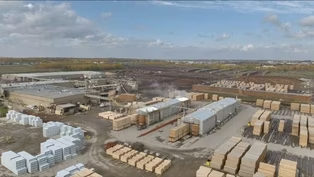
Lawmakers launch study commission to strengthen Alabama’s pulp and paper industry
Clip: S21 Ep80 | 2m 15s | Lawmakers launch study commission to strengthen Alabama’s pulp and paper industry. (2m 15s)
Providing Support for PBS.org
Learn Moreabout PBS online sponsorship New Episode
- News and Public Affairs

Top journalists deliver compelling original analysis of the hour's headlines.
 New Episode
- News and Public Affairs

FRONTLINE is investigative journalism that questions, explains and changes our world.



 New Episode

 New Episode


 New Episode
Support for PBS provided by:
Capitol Journal is a local public television program presented by APT