
November 27, 2026
11/27/2026 | 55m 54sVideo has Closed Captions
Theresa May; Angelique Kidjo; Michael Powell
Former British Prime Minister Theresa May sits down to talk about the latest in British and global politics. From the archives: Singer Angélique Kidjo joins Christiane in-studio. Michael Powell, staff writer for The Atlantic, discusses the impact that harm reduction policies for drug users have had in major cities across the country.
Problems playing video? | Closed Captioning Feedback
Problems playing video? | Closed Captioning Feedback
November 27, 2026
11/27/2026 | 55m 54sVideo has Closed Captions
Former British Prime Minister Theresa May sits down to talk about the latest in British and global politics. From the archives: Singer Angélique Kidjo joins Christiane in-studio. Michael Powell, staff writer for The Atlantic, discusses the impact that harm reduction policies for drug users have had in major cities across the country.
Problems playing video? | Closed Captioning Feedback
Where to Watch Amanpour and Company
Amanpour and Company is available to stream on pbs.org and the PBS app.
Watch Amanpour and Company on PBS
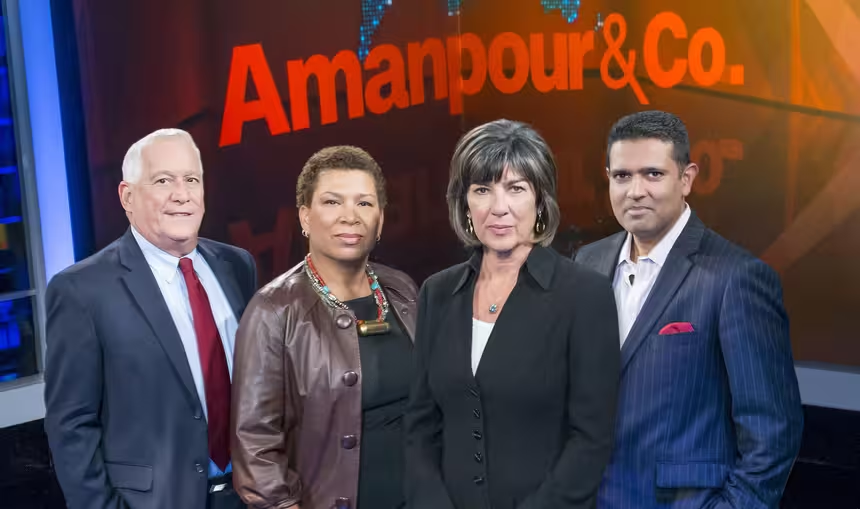
PBS and WNET, in collaboration with CNN, launched Amanpour and Company in September 2018. The series features wide-ranging, in-depth conversations with global thought leaders and cultural influencers on issues impacting the world each day, from politics, business, technology and arts, to science and sports.Providing Support for PBS.org
Learn Moreabout PBS online sponsorship(graphic whooshes) (thrilling music) - Hello, everyone, and welcome to "Amanpour & Company."
Here's what's coming up.
(sirens wailing) (dramatic music) - [Reporter] We were told that a nerve agent had been used.
- How did it get into the country and where is it now?
- [Reporter] Salisbury has taken a serious turn for the worst.
Now it's murder.
- [Christiane] A Russian attack on British soil.
A new CNN documentary examines the 2018 poisoning of Sergei Skripal.
And I speak with the former UK Prime Minister Theresa May about this real-life spy thriller.
Then- (Angelique singing in foreign language) - [Christiane] "Hope" on tour.
Renowned singer Angelique Kidjo from Benin, West Africa, performs her new album on stage in Europe.
We look back at our conversation about her passion for music, family, and social justice.
Plus, the cities that said yes to drugs.
"Atlantic" staff writer Michael Powell says how he thinks some harm reduction policies may have done more damage than good.
(thrilling music) (thrilling music continues) (gentle music) - [Announcer] "Amanpour & Company" is made possible by the Anderson Family Endowment; Jim Atwood and Leslie Williams; Candace King Weir; the Sylvia A. and Simon B. Poyta Programming Endowment to Fight Antisemitism; the Strauss Family Foundation; the Peter G. Peterson and Joan Ganz Cooney Fund; Charles Rosenblum; Monique Schoen Warshaw; Koo and Patricia Yuen, committed to bridging cultural differences in our communities; Barbara Hope Zuckerberg; and by contributions to your PBS station from viewers like you.
Thank you.
- Welcome to the program, everyone.
I'm Christiane Amanpour in London.
This summer, Britain got its seventh prime minister in just 10 years, with the Labour Party's former mayor of Manchester Andy Burnham taking over from Sir Kier Starmer.
It is just the latest chapter in a tumultuous decade since Brexit, which has upended trade, defense, and immigration.
My next guest, Theresa May, was catapulted into Downing Street by Brexit and tried negotiating a better deal with the European Union, something that proved so tricky that it cost her her job.
Another defining moment was the Salisbury poisonings, a failed assassination attempt right here in the UK on a former Russian military officer and double agent, again, in 2018, exposing the shadow conflict between Russia and the West long before the full-scale invasion of Ukraine.
Now, this is documented in a recent CNN film, "The Salisbury Poisonings: A Spy Next Door."
Here's a clip from the trailer.
- Immediately, this didn't look right.
They had very unusual symptoms.
Somebody said, "You're not gonna believe what I've just found out.
(dramatic music) Something has poisoned these people."
- Turns out that he was a Russian spy.
(suspenseful music) (thrilling music) - [Reporter] We were told that a nerve agent had been used.
- How did it get into the country and where was it now?
- [Reporter] Salisbury has taken a serious turn for the worst.
Now it's murder.
- There was enough poison in that bottle to kill 10,000 people.
There is no playbook for this.
(thrilling music) - Russia had been responsible for this.
(thrilling music) - I got into all of this with Theresa May when we sat down recently in Westminster, here in London, and we spoke just before Andy Burnham was confirmed as prime minister.
Prime Minister May, welcome to the program.
- Thank you.
- You have taken part, with other people, in this new documentary, which is airing on CNN, about the Skripal poisonings.
Obviously happened during your prime ministership.
Take us back to that moment when you heard about it and what went through your mind.
- When I first heard about it, it was presented to me as two people who'd been found on a park bench who were obviously ill, but at that stage it wasn't entirely clear what the problem was.
And there was a hope that actually this was something that was explicable, a drug issue or something like that, rather than being what it turned out to be, obviously the chemical weapon, the nerve agent.
So at that point in time, there's a sort of you hope for the best, but then you have to start thinking and preparing for the worst.
- And the worst was that, I think, one way or another, essentially it was an act of war by a hostile state on the United Kingdom.
- Yes.
I mean, the fact that initially there were sort of two people on a park bench, okay, well, this may be more than just something that will naturally be explicable.
And then, of course, you're told that Sergei Skripal had worked for Russian intelligence, and that makes you start to think there's potentially more to this than meets the eye.
And so you have to start thinking about what you need to put in place, what the order of things is.
I'm a great believer that you have to make sure you have the evidence before you start to make public statements about issues like this.
- I'm just gonna play now something actually really obvious.
It's the doctor at the hospital in Salisbury.
And Salisbury was essentially, it's not a tiny town, but it was a little town that not many people around the world knew about, and suddenly they were faced with this massive geopolitical crime and act of violence.
Here's what the doctor said.
- It suddenly began to dawn on me that something has poisoned these people at that moment.
Somebody came up to me and said, "Dr.
Cockroft, I've just Googled Sergei Skripal, and you're not gonna believe what I've just found out."
So I went and looked, and there it was.
(suspenseful music) He had a Wikipedia page.
(suspenseful music) Right, okay.
This is beginning to smell a bit fishy, this.
- Fishy could be a great British understatement.
You discover that it was Novichok.
Were you surprised that it was actually a journalist, Christo Grozev, a colleague, who discovered the identity of these two who had claimed that they were tourists coming to visit the famous church spire, cathedral spire in Salisbury, that he discovered who they were?
- Well, first of all, there was a lot that happened, obviously, before the names of the individuals who'd undertaken this were put forward.
And so there was that whole process of making sure that we were right that it was Novichok.
Obviously we have this very particular capability in the UK, at Porton Down, that we're able to look into that.
And then that, of course, later on, the fact that it was Novichok was confirmed by the OPCW, the organization that deals with chemical weapons.
- But the people- - Yes, but there were people... Obviously you've got UK intelligence, you've got UK police, you've got, and journalists who make it their business to be looking at these sorts of issues, so all coming together and identifying.
First of all, we had to identify that it was Russia that was behind it and then, of course, the individuals were identified.
- And then you were faced with a, it's not really a dilemma, but a national security perspective and prerogative that you couldn't let this stand if you knew that this was Russia and it went to the highest levels, i.e., Putin.
There was a Security Council meeting convened.
President Trump banged everybody into order and you were given the floor.
Were you satisfied with how your allies reacted to this?
And how did you see Sergei Lavrov react, the Russian ambassador, who was sitting quite close to you?
- Impassively, I think, is probably the best description.
I mean, in terms of the response from allies, what was critical was that we were able to bring about the largest ever expulsion of Russian intelligence officers across the world in history.
Over 25 countries came together with the United Kingdom, NATO as well, and expelled Russian intelligence officers.
Over 150 were expelled around the world.
And that gave a very clear signal to Russia: "First of all, we've been watching you and we knew where these people were, and we are disrupting your networks."
That was the first message that it gave.
And secondly, it gave a longer message: "We know where you are and we're watching."
And I think that was incredibly important.
And allies from around the world, the United States, member states from the European Union, which we were in at the time, Australia, Canada, came together and said, "This is not good enough.
Russia has used a chemical weapon, which is unlawful to use a chemical weapon, and they've used it on the streets of a British city."
The audacity of that, the recklessness of that was absolutely clear to me, and I think that came across to allies around the world.
- And it was extraordinary to me.
I mean, I didn't remember for the time, but the analysis said that that small amount could have killed 10,000 people.
It was very, very potent.
- And that was, sorry, but that was one of the issues that we had to deal with at the time, was not knowing where this agent had been used initially.
It was then discovered it was on the handle of the door of Sergei Skripal's house.
But, of course, the police and others had to look at all the places the Skripals had been to.
Those places had to be cleared, cleaned out to make sure there was no trace of that Novichok there.
And they were on a park bench.
Children could have come up, children could have found that vial.
No.
The potential damage is difficult to comprehend, in a sense.
And that's why I say this was so reckless from Russia.
And it was so important that we were able to take our time to find the evidence and to identify that this lay at the hands of the Russian state.
- So, obviously, they deny it, and Putin has not been humbled at all by any of this.
He's been outed in every which way by this, by your investigations, by the revelation of who the two agents were who brought this and committed this crime, subsequently doing the full-scale invasion of Ukraine and continuing these very reckless, bold... I mean, thumbing his nose is an understatement, but just not taking NATO, the United States, Europe seriously at all, it seems.
- Well, of course, we saw, following, some weeks after the attack in Salisbury, we saw Russian agents trying to take action against the organization for the prevention of use of chemical weapons, which was an organization where a vote was taken, where, overwhelmingly, the vote was in favor of the UK in relation to this attack that Russia had done.
So, yes, they carried on, in that sense.
And we saw that further invasion of Ukraine.
We've seen the Ukrainians fight back, Ukrainians clearly wanting to maintain their independence, their sovereignty, and the UK, United States, and other allies across Europe supporting Ukraine and continuing to support Ukraine, which is absolutely essential.
- Do you think, 'cause we've seen it all... We've seen President Trump go back and forth.
and maybe President Trump 2.0 is different than the President Trump you knew and worked alongside in his first administration when you were prime minister.
But the support for Ukraine from the United States and the support for NATO, all things that, you know, should be a bulwark against Putin's adventurism, seems to be very touch and go, very easy come, easy go from the US perspective right now.
- Well, the United States... I was the first world leader to visit President Trump in his first term.
And one of the reasons for doing that was to ensure that he would support NATO, and he did, and he came out supporting NATO.
But what he said at NATO was what the UK actually agreed with, which was that the countries sitting around that NATO table had to up their defense spending.
And, of course, what Putin achieved by his further invasion of Ukraine, which is something that he did not expect to achieve, was an increase in... The critical thing was Germany saying that they were going to increase their defense spending, which they had not done previously.
So if you think about, Putin's an opportunist.
I think he saw that the West was turning its eyes towards China more, he saw the withdrawal from Afghanistan and the chaotic nature of that withdrawal, and he saw an opportunity.
He thought the West was not united in defending its values.
And what he got as a result was a West that came together to defend their values, was a NATO that has been strengthened by Sweden and Finland joining it.
What he got was Germany increasing defense spending, was NATO commitments to increase defense spending around the table.
- Are you concerned?
How would you advise, if you were to advise, any current British prime minister?
The defense minister resigned over UK defense spending.
What does this next prime minister have to do?
And, well, we've just had a NATO summit and Trump is, again, complaining about lack of, you know, correct spending by NATO allies.
What actually does a UK prime minister have to do knowing that there's so much domestic that needs to be dealt with as well?
- Well, what the UK prime minister does have to do is to commit to the, which has been done, commit to the sum of spending on defense and security that NATO is requiring, but needs to set out a clear plan to achieve that.
Obviously there's been a lot of to-ing and fro-ing from this current Labour government about the Defense Investment Plan.
And as you say, the Secretary of State for Defense John Healey resigned because he didn't feel enough money was coming forward.
I have to say there is a simple way in which some money can be released in terms of UK government terms, which is by the UK government getting on top of welfare reform and ensuring that we are spending less on welfare.
And the Conservative opposition has said they will help the government.
They're willing to work with the government to do that.
- Since the financial crash, there's been no meaningful, you know, pay rises for people, their salaries have been stagnant.
There's a huge amount of dissatisfaction.
Where is Britain right now?
You've got Nigel Farage, the father of Brexit, essentially, who's had to resign because of an allegation of financial misdeeds.
Where do you see the political reality here right now?
- I think what is underlying the causes of concern that, obviously, people here in the UK have about the cost of living, about hope for the future is lack of economic growth.
And that is absolutely critical that the government gets economic growth going.
Unfortunately, the Labour government has taken a number of policy decisions which have been negative for economic growth rather than encouraging that growth.
But getting that growth is critical.
But actually it's critical in other countries as well because what we see across the European continent is that we have seen that economic growth being, in some cases, stuttering, in others there, but not at the sort of levels that you would hope to see in order to provide people with that hope for the future.
- What about the sort of... You can see what's happening, so Reform, Restore here, this is far right.
You've got Marine Le Pen who says she's going to actually campaign for president because she's been allowed to campaign despite her conviction for economic financial fraud.
She's the far right in France.
You've got a problem in Germany with AFD.
You're a Conservative, but you're a centrist Conservative.
What can conservative parties and more liberal parties, but who essentially hew a centrist line, do to deny the fringes, whether it's on the far, far left in France or the far, far right elsewhere?
- Voters are dissatisfied because they can't see a better future.
They can't see a better future for their children.
Every generation expects that actually their children will have a better future, a better life than they've had, and at the moment, people can't see that.
And it comes back to this question, I'm afraid, of economic growth, be it here in the UK, I think in France, in Germany.
These are the issues that politicians are having to grapple with.
And it's being able to give people an optimism for the future, a hope for the future, but actually delivering that on the ground.
It's when people are dissatisfied, they don't think the traditional mainstream parties have delivered for them, then they turn to the disruptive parties on the edges.
And so as a Conservative, I think the Conservative Party under Kemi Badenoch's leadership is absolutely right to be focusing on some of these issues of the economy because that is where we need to ensure that we can get the growth that will give people that hope.
- And do you think the disruptor, in this case, in this country, Reform, as polls show that it's doing better than the Conservatives, better than the Labour government, will it be, do you think it's gonna win the next election?
- No.
- Because?
- For a number of reasons.
First of all, actually, although they've been ahead in the polls, they have been falling back in the polls.
I think what we see now is people see, in looking at Reform and looking particularly, you mentioned Nigel Farage, I think they see that maybe he's more of a normal politician than they thought he was, that he's like everybody else, in their terms.
- [Christiane] Because he says it's him against the establishment.
He'll fight for the little people, so to speak.
- But he is a man of the establishment.
I mean, he's been in politics for several decades now.
And if you look at his background, he's a man of the establishment.
But the other thing is I think there is a sense that you've seen from parliamentary by-elections of people being willing to vote tactically to ensure that Reform do not get elected.
So at the next election, I think we will see quite a lot of tactical voting.
- There is a real issue, sort of an ungovernability.
It's not possible in the United Kingdom to, about to be welcoming a seventh prime minister in 10 years, and this is since Brexit.
Are you concerned that there is, we're in a moment of total distrust, total disruption, total inability to actually persuade people of, let's say, the things you've been talking about right now?
What is the antidote to this ungovernability?
- Well, I don't think the UK is ungovernable, but unfortunately members of parliament have decided that the answer, if there is a problem, if they're not seeing enough progress in terms of issues like economic growth and people's opportunities, and members of parliament see changing the leader, changing the prime minister as the answer.
Of course I would say to the Labour Party, "It's not..." I think Kier Starmer made a number of mistakes, a number of bad decisions, but actually it's about those policies that are being pursued that matters, not necessarily the person who is there at the head of the party and as prime minister.
So I would say to the Labour Party, "You've decided that you want... You've got rid of the prime minister who actually won you a big majority"- - Yeah, I mean, a historic majority.
- A historic majority.
"You're going for somebody else, but what you really need to look at is your policies."
- And finally, is this world, to your satisfaction as a former prime minister, is it in safe hands?
Do you think that, you know, with all the disruption, and there is a lot coming from the United States, I mean, unprecedented disruption, whether it's, you know, creating new wars in the Middle East, whether it's, you know, always disrupting NATO, whether it's trade, tariffs, whatever it might be, do you think democracy and the rules of the road, the post-World War II rules of the road and the international order can survive?
- Well, democracy can survive, certainly, but those of us who believe in it have to stand up and share those values and explain why we believe democracy is so important.
The world post the Second World War, we created these multilateral institutions which I would argue have helped to maintain peace, security, relative peace, security, and stability for us.
Those are breaking down and we need to think about whether we should reshape those for the future.
But I would say that those of us who believe in democracy, in the importance of people having the freedom to choose who is governing them, in the importance of the rule of law, importance of a free press, all of those issues that underpin our democracy, we need to be willing to go out and argue for those and show a new generation, because I do worry about the polls that show young people who don't see democracy as the way forward, we need to show that new generation why their freedoms matter and it's democracy that deliver those freedoms.
- Prime Minister Theresa May, thank you very much for being with us.
- Thank you.
- And now, 18 albums, five Grammys, and a star on the Hollywood Walk of Fame, Angelique Kidjo is arguably the most decorated African musician in history.
With a career spanning four decades, she's known for her incredible voice and for fusing West African styles with funk, jazz, and R&B.
Now Kidjo is on tour around Europe for her latest project "Hope," a 16-track album which is described as a much-needed antidote to despair in these troubled times.
(upbeat music) ♪ In the bando ♪ ♪ Urban, suburban, rural to village ♪ ♪ Woo, woo ♪ ♪ In the bando ♪ - Back in 2019, the renowned performer joined me in the New York studio and I asked her what drives her still to keep on creating.
- In a world where I think we are losing ground, a lot of things are happening, there's a lot of anger, and at the side of that anger, you have a lot of people doing wonderful stuff, but we focus more on the anger than the positive things.
And for me, music is about building bridges.
It's about bringing people together to our common shared humanity.
And that's why I'm like, "I'm devouring everything that comes my way and giving it back to the public."
And it has been a really roller-coaster journey that I'm taking, but I like that.
Keeps me young.
- I think that's amazing.
I mean, keeps you young, that's great.
You definitely look young.
We're about the same age.
You're out doing me.
- Okay.
(laughs) - But you're doing something that you hadn't necessarily done before.
You, as I said, doing some cover albums, cover songs.
One of the bands that's so well known to American and Western audiences, I guess, are the Talking Heads, erupted onto the scenes in the early '80s, I think.
And you did a cover last year, including a song that you said had inspired, you know, "Once in a Lifetime."
You did their album "Remain in Life."
Do you fancy just giving me some of your joy right now?
- Oh yeah.
- Go on then.
♪ Letting the days go by ♪ (Angelique mimics music) ♪ Letting the days go by ♪ (Angelique mimics music) ♪ Into the blue again ♪ (Angelique mimics music) ♪ Once in a lifetime ♪ - It's great, Angelique, it really is.
And when you sing, your whole face comes alight, and it does definitely impact on the audience.
But what was it about that song and that group?
When did you first hear them and how did they inspire you?
- I mean, I heard the song "Once in a Lifetime," actually, when I arrived in 1983, three months after I arrived.
I was trying to tag along with friends in my musical school.
And even though you speak a language and you share the same culture, pretty much, with people, it's always difficult to leave your home.
No one live in exile by choice and find it very fun.
And some of the musical friend that I was making at that time said, "Let's go raid my fridge.
My parents just filled up my fridge."
I'm like, "Free food?
Student?
I'm tagging along.
I'm going along."
- Raiding your friend's parents' fridge?
- Yeah.
- Here in the United States?
- [Angelique] No, in Paris.
- In Paris.
- I'm like, "Okay, let's go for it."
- So you came from the African nation of Benin?
- Benin, where we have- - A communist dictatorship.- - Dictatorship.
- Yeah.
- So for the 10, 12 years that followed their arrival, music was banned at radio- - Literally?
- Literally.
All music was banned.
Only thing you hear is (speaks in speaking in French) day in and day out in every different language.
- And just so that we understand, that's: "Ready for the revolution.
The fight continues."
- The fight continues.
- So they banned pop music or- - [Angelique] All of it.
- Why?
What was the reason?
- Well, it might make us think about freedom.
That's what music does.
If you see any dictatorship that comes in place, culture is the first thing that they crush because culture give people strength to stand up for their right.
When you decide to listen to a music in your room, it's not a summon from a government, it's your will, your free will to do that.
And what that music reveal from your life is something that is beyond.
- Do you know, that's really an incredible story because obviously we remember the counterculture here in the United States, the '60s, all the incredible music associated with that during the student uprisings, the protests against Vietnam, political protests.
But you're saying that you had that in your bedroom in Benin- - Absolutely.
- When you were growing up.
- Absolutely.
All the kind of music.
I mean, my father and mother... And I'm realizing, as I grow older, that what I've taken for granted and sometimes annoyed me because my mom and dad always used to tell us every morning, "A human being is not a matter of color.
If you come back and you fail, you say you're Black and..." I'm like, "Ah!
Come on, stop."
And I grew up and moved and it helped me actually accept people not thinking the same way I think, but allowing the conversation to going on.
We can disagree, but as long as we talk to each other, it's okay.
If we stop talking to each other, we go into war, we go into violence, and it's unnecessary.
We don't need to get there.
- You're talking about all of this from your own perspective as growing up in Africa under this terrible dictatorship and escaping it.
But now we are, here in 2019, in the United States or in Great Britain, where this kind of tribalization, this kind of political hatred is really just driving societies and cultures apart, the racism that we see here in the United States overtly.
Just talk to me a little bit about what you're noticing now, here in our world, in the free world today.
- I think it's a lot of ignorance, one, and it's a lot of frustration.
When we start talking about globalization, I always say this: "Globalization doesn't mean we all have to think the same and we all have to look the same," because we are unique.
Even though we belong to the same human family, we don't think the same way.
In the same family, brothers and sister, with the same education, don't have the same take on the situation they are facing.
So we are here now, and what I hear... And it started, like, way before.
I mean, it start 10, 15 years ago when people would come to me, young Africans and young from around the world, even in America here, telling me... I was doing a signing at BAM for my book and a couple of young kids come to me, white kids, I mean, we can say Black are mad here, we have reason to be mad here, telling me, We're gonna do a revolution.
We're gonna break everything, We're gonna destroy everything."
And I said, "Come again.
You come to my signing to tell me that?
So you don't know the person that I am.
I'm not for chaos, I'm for construction.
I can understand you guys are angry.
I can understand any reason you have to say this, but if you don't think about building the better society, you are the great loser because you are the young.
You're gonna be the one that pay the cost of the chaos you wanna create."
- So don't meet anger with anger, meet it with a constructive- - Conversation.
- Conversation.
Let's play, then, a little clip from Celia Cruz, the cover album that you've been doing.
(Angelique singing in foreign language) - So I hear you singing with me as we're playing that.
Come on.
Belt it out again.
(Angelique singing in foreign language) - So that's one of her most famous and popular songs- - Absolutely.
- [Christiane] And it, roughly translated, means life is a carnival.
- Yeah.
- And she's one of the greatest salsa stars.
So, what is it about her?
Why did you decide it?
How does she first come into your life?
- Well, for me, salsa has always been a huge music scene in Africa, everywhere.
There's no one artist today... Youssou N'Dour started with salsa, Salif Keita, all of them.
All of the guys, they started with salsa.
So for me growing- - And it's usually guys.
- It's only guys.
That's what I said.
Salsa is a male dominated form of art.
So for me, okay, as a girl, I'm like, "Okay, this music, you can't touch because it's only guys that plays it."
So come Celia, and I'm like, "What?
What up?"
She walk on state, she goes... (speaks in foreign language) I say, "Hey, guys, she's here to settle.
You're gonna learn something right now."
And her song "Quimbara" is a lesson of what a voice can be.
She used her voice as a percussive instrument, and no one, I say no one till today can sing like Celia.
It's amazing that we have the same kind of range because most of her song, I don't touch, I don't change the key of the song.
And from that point on, for me, it becomes clear, as a young girl, that success or failure has no gender.
And if you don't believe in yourself... We talking about women leadership.
What would that leadership be?
Are we always gonna be, when we put in front of choosing something where it's out of our realm, we're gonna go back and say, "Can I do this?"
I'm saying no.
I say no to every young girl and every woman out there.
You're offered a chance, an opportunity, take it.
Learn while you're doing it.
Don't think back twice.
That's what I learned from Celia.
- And just let's go back to when you were younger, when she first came into your consciousness.
I think you had a bet with one of your childhood friends that she would, in fact, emerge onto the stage.
Tell me about the homework bet.
- The thing is it's a... I saw the poster and I said to my friend, "There's a woman singing salsa coming to sing."
And they go, "Yeah, smarty pants, you always know everything.
A woman singing salsa?
Where do you come from?"
I'm like, "I'm just saying."
They say, "It's not gonna happen.
She's gonna be a backing singer."
I say, "You wanna take a bet?
And if it's a front-runner, you do my homework for six months in and out.
The math, I give it to you.
I hate that."
And then when she walk on stage, before she came in, they have 15 guys singing, and they're looking at me like, "So you see?
You gonna lose."
I say, "You talking to me?"
And I was there praying God, I said, "God, please let her come and be a front-runner."
And she came out and I'm like... - Six months free homework.
- Yes.
- Because Celia Cruz was the lead singer- - Absolutely.
- And that was the first you'd seen of that in Africa.
- Salsa female singer.
Absolutely.
The first, I mean, Afro Cuban, because what I love about Celia is that she never shied away of singing the song that came to Cuba with the slaves.
She always paid tribute to all those gods, those orishas.
And for me it's, I was like, "How come she knows all this?"
And it's great.
- Talk about that.
We're in the United States right now.
You've mentioned the origins, the slave music that she never, you know, hid and always used.
And you sing a lot about dark subjects as well, with the joyful tone that you have.
But, look, it is 400 years since 1619, since the first slaves were brought over here.
Reflect on that, but also on how you have really wanted to bring Afro music, the Afrobeat, into a wider world.
And you don't like the idea of world music, how it's called.
- I hate that.
- [Christiane] I mean, you won your Grammys, but in the World category.
What does that mean today?
- Well, it means that we haven't learned yet that every music that we do today comes from Africa.
We like it or not, that's just the simple fact and truth of it.
It is true.
Everywhere you turn, everywhere I turn as a musician, I've always found my continent in it, and especially my country.
Blues comes from the songs of the slave.
The blue note has been create by the Africans.
I mean, jazz has been create by African descendant.
So for me, music is just what we are, the mixture that we are from the beginning.
As a human being, we are mixed.
There's no such a thing as a purist.
And I don't understand white supremacists because supremacy has to be a higher level of morality, a higher standard in life.
It cannot be killing people, it cannot be hating people.
Because you're talking about supremacy and hate, it's, those things don't go together.
So for me, Africans that came here, the African American didn't migrate here like the Irish, like any other people, they have been forced to come here.
They have created the wealth of this country and they have created the wealth of Europe.
That's slavery.
Today, we don't wanna talk about it, we blame Africans for slavery.
Of course, it comes as a business proposal to the king and they thought it was gonna be a good thing, the lie that had been told to them.
They bought the lie and here we are today.
But to make a long story short, I think we ought to always think about the fact that the genesis of the crime committed for the rich country to comes is in the blood and sweat of African people.
And that model of slavery is also implemented in business, because we Africans are not free.
They say we have independence.
Which independence are you talking about?
The raw material we have in our country, we don't define the price of the raw material.
The price of oil is not decided by the leaders of Africa.
We have the wealth, but the wealth is in the hand of the Westerner still so far with, of course, the help of our leaders that just really facilitate the job for them.
So for me as a musician, what I say to people is, "We that come from that painful story, how do we create a different narrative?
How do we show the world that despite all the wrong that people have done to us, we are still human being and we are still willing to create bonds between us?"
We don't have the choice.
We cannot live without each other.
It does not matter what skin color you have, we have to live together.
And it's something that I learn every day, especially when as a UNICEF guru ambassador, we go to villages and you see all those kids suffering.
When you face a child soldier, when you face a teenager that had been raped constantly in a conflict and you have no words to touch them and you start singing and you see a smile, that's the power of music.
And it's something that makes me humble, makes me come to the core of it and say, "As a human being, what do I have to bring to the table?"
- So what keeps you optimistic?
- The strength and the resilience of the people around the world, white, black, yellow, red, because poverty is in this country too.
I think we need, really, to come to realize that if we are not each other's keepers, we lose everything.
There's no other life out there.
There's not another ecosystem as this one on this earth.
If we messed it up, rich, poor, yellow, black, whatever color you call yourself, whatever language you speak, Mother Nature don't know that and death don't know.
When your death come knocking, you can't tell death, "Hey, wait a minute.
I have to go count my billions."
You're gone.
- On that note, Angelique Kidjo, thank you so much for joining us.
- It's always the pleasure to be with you, Christiane.
- Anything optimistic you want to finish on?
- Always.
(Angelique singing in foreign language) Come on, live up.
- It's really good.
It's really good.
It makes us all wake up and feel happy and optimistic despite the serious issues that we have to deal with.
Angelique, thank you very much.
- You're welcome.
- And Angelique Kidjo is on tour now.
The number of drug overdose deaths in the United States has fallen sharply in recent years.
That is being linked in part to the adoption of harm reduction policies which prioritize the health and wellbeing of drug users rather than criminalizing them.
While effective in some American and Canadian cities, "Atlantic" staff writer Michael Powell says that it has adversely encouraged public drug use in other cities, and he shares his observations with Walter Isaacson.
- Thank you, Christiane.
And Michael Powell, welcome to the show.
- Thank you.
My pleasure.
- You have a very provocative piece in "The Atlantic."
It's called "The Cities That Said Yes to Drugs."
It's about the whole issue of harm reduction.
Explain to me what harm reduction is.
- Sure.
I mean, harm reduction was born of an inarguable, it seems to me, humanitarian impulse.
It began with drug users during the time of the AIDS epidemic, so that would be the late '80s and the early '90s.
And there was a great concern to keep them from, that is drug addicts, from sharing needles because that was obviously a very easy way to spread AIDS.
So they started needle exchanges where they would go around, that is activists, the like, and take dirty needles, give clean needles.
And there's absolutely no doubt that that kept a lot of people alive and gave you a chance to get them into drug treatment and the like.
Over time, that's metamorphosed into a much kind of grander project, which is to set up injection sites where people can legally take their drugs and inject heroin or meth or fentanyl.
And it's also led to a big push not to have any legal consequences for people, the whole notion of sort of meeting people where they are, that is to say if you're a drug addict, don't come in and try to convince them to go into treatment or that they should give up their drugs and their works, meet them where they are, and that it's kind of not our business, that is society at large, to tell them what they can and can't do.
- It seems if you allow this, there's a certain contempt for the working-class and middle-class people that have to deal with it.
And then they get stigmatized, I'll say, by objecting to having to walk through open-air drug markets.
Do you think part of this was an elite sort of condescension to the middle-class and working-class people who didn't like having this in their neighborhoods?
- Simply put, yes.
I mean, and that's actually what drew me to writing about this.
I had seen what had happened in another city I looked at, Burlington, Vermont, 'cause I go up.
My family is from up there, going back some generations.
And I had seen the transformation of a number of kind of working class-neighborhoods in Burlington to places where drug use was open, it was happening on porches and cemeteries and churches.
And, yes, I mean, I think that lost in the notion of meeting an addict where they are is: How about meeting a neighborhood or a city where it is?
- In your piece, it starts, I think, your piece, with Seattle, Little Saigon.
Tell me about what happened when it hits Seattle and what the reaction there has been.
- Seattle as a place, it's very, its politics are very left liberal.
It's not to blame... I mean, there are people of left liberal politics who are not happy with the current situation, but certainly the dominant ethos there was, again, this kind of mix of, excuse me, left politics and libertarian politics and the notion that you might, say, go to Little Saigon, where I counted 250 people using and dealing in a one-block area, and not just move people away, but frankly, you know, say, "Look, we could do one of two things.
We can arrest and jail you, which doesn't really serve any particular purpose, or you could sign up for drug treatment and we're gonna help you get into that."
And there's actually been a fair amount of success with that in some other cities.
That's not happened in Seattle.
So as a result, you have this terrible situation where you have, as I say, 250 people in one block.
I saw three women lying flat on the ground, I mean, breathing imperceptibly.
You know, fentanyl is an enormously dangerous drug.
I went around the corner, there's a beautiful new park that they had just opened up, really, for the Vietnamese community, and there were, I counted there about 25 users, and again, you know, not a kid in sight.
So it's a grim situation.
And I could play this... You know, we could sort of play this out geographically and go around Seattle.
There's probably 15, 20 places just as badly hit.
- Wait, personalize it for me about, you know, the people, middle-class, working-class people there.
There was a story about a woman on a bus with her six-year-old, that personalized for me.
Tell me that story.
- I saw her, this young woman, a mother, waiting for the bus, so I walked across the street from the park to talk with her.
And I asked her, you know, "What do you make of this first?"
She was one of the people I asked, "Well, do you ever use the park?"
And she looked at me like I had lost my mind.
And then she told me this same bus stop, some weeks earlier, she had had her six-year-old daughter with her.
They'd gotten on the bus and she smelled something.
I mean, she smelled fentanyl being smoked.
And she panicked, you know, and she looked around.
Her daughter has asthma, so she was gonna be sensitive to the smoking to begin with.
But fentanyl is an enormously dangerous drug, so being in an enclosed area with somebody with fentanyl terrified her.
She screamed at the person, you know, "What are you doing?"
and then she screamed at the bus driver to say, "Please stop the bus.
Let me get off," and she did.
And it left her terrified.
And when she called, then, the city to say, "Look, this is going on," they sent a, they have these teams, the community response teams, and this particular team went up and ended up handing out safe drug use, you know, safe drug use kits that give, like, tinfoil and a pipe and this sort of thing.
So, yeah, in a very real way, it keeps people locked in their homes.
- But in 2023, didn't Seattle start pushing back on some of this politically?
And what are they doing now?
And is that changing things?
- That's the strange thing with Seattle, is they seem to have this, you know, reaction, right, I mean, to this politically.
And they elected a very moderate Republican city attorney.
They had a, well, a woman who would be classified as safely liberal in most cities in America, but not in Seattle, as the head of the city council.
And they started to make, I think, some interesting progress.
And again, neither of them were, you know, classically what we think of as drug war, you know: lock people up, put them away.
I mean, no.
But they were saying that, "Look, we need to kind of combine carrot and stick here.
We need to start taking some efforts to reclaim streets and parks."
And they were making some real progress.
And in the last election, both of them were defeated by people who are strongly in favor of the harm reduction policies that Seattle had put in place before.
- So wait, why does the population... You're saying this really is hurting working-class people.
Why would the population say, "Hey, we don't wanna be too tough on people using drugs?"
(Michael laughs) - It's a great question and one I ask myself a lot.
And I think, you know, it's a complicated answer.
I mean, a lot of the polling there shows that people are concerned about crime, which often comes down to drugs and drug trade, and also prostitution, which is related to drugs and the drug trade.
At the same time, they're still a very quite wealthy city and the politics are very much kinda upper-middle-class politics and also, upper middle class and lefty.
So, you know, lefty can be also young college students, post-college.
And that group, to a certain extent, still very much kind of dominates the elections there.
So when you looked at, you know, where these reformers had been, where they had been, you know, strongest and stuff, that was in more working-class neighborhoods.
And, yeah, I mean... But having said that, I don't... You know, my answer is incomplete here because it's not just working-class people that suffer here.
I mean, there's been any number of parks where, for the longest time, Seattle's reaction, when you would get, say, a tent encampment of 30, 40, 50, and they had big encampments and they're all using drugs, and they're all dealing and using and stuff, was to close off the park, I mean, quite literally put up a fence around the park.
And so, okay, I guess, I mean, you've prevented them from camping there, but you've also prevented people from using the very beautiful parks in Seattle.
So it's a conundrum as I look there as to what's going on.
- If you were in Seattle and somebody walks up to you, they're homeless or they're living on the streets, drug addicted, and they say, "Okay, I want out.
I wanna something," what's the process?
How hard would it be?
Could they immediately get treatment and get a bed?
- That's a great question.
And, I mean, and, you know, the answer is probably mixed.
I mean, there certainly are, and I know the groups, in fact, several of the groups I talked with who work with these folks and who argue, these are nonprofits, strongly that there are ways to get them help, but that the city shows little or no interest in doing so.
Now, if they were really successful, if the city made a commitment, you know, "We're gonna move as many people as we can into treatment," sure, they could end up, I suppose, you know, in a place where they don't have enough treatment beds.
But right now, that isn't the problem there.
Right now, the problem is the resistance of the political culture to, if you will, kind of embrace the true nature of, you know, the disaster that they're facing on the streets.
- You cite more than 7,000 overdose deaths in Seattle from 2016 to 2025, yet West Virginia, with an even smaller population and no drug decriminalization, in other words, they don't follow these policies, they recorded nearly 10,000 overdose deaths.
What does that suggest to you?
- Well, it suggests to me, I mean, which has been true for decades now, alas, that in West Virginia, the levels of drug addiction and hopelessness are extraordinary.
They also have very high rates of suicides.
I mean, if you go to some of these towns, I mean, they're quite run down and the dealers are very easily seen.
I mean, I don't pretend to be an expert in West Virginia.
But I would say that, you know, it's hard to look at a place like Seattle, San Francisco, Burlington, these are pretty well-to-do places, and think, "Well, you know, do you really wanna, like, you know, compare yourself, say, 'Well, you know, maybe the worst-off place in America in terms of income and the like is a little bit worse than we are'?"
So I'm not... Yeah, I mean, Seattle is one of the five wealthiest cities in America, and so it's awfully hard to argue that, you know, it has no other choice than the one it's made.
- You know, I've walked around San Francisco a lot over many, many years.
And about five or six years ago, in particular, were open-air drug markets.
It felt dangerous.
And what have they done?
- The mayor there, Mayor Lurie is the new mayor, and he ran on a very explicit platform of reform.
Again, the guy is a liberal by any, you know, the measure of almost any city in America, but here he said, "You know, look, this is unacceptable.
We can't have..." I mean, they essentially had defacto injection zones where they would put up, you know, a kind of canvas around these areas where people would come in and use.
They would never arrest people.
We could rattle off a bunch, the Mission, the Tenderloin, a whole bunch of neighborhoods, where dealers and users were dominating, and that, he basically has said that, much like we were talking about right here, is unacceptable.
That's not an acceptable way for a, I mean, a working-class family, mother or father trying to raise kids, to have to come out, and I've seen it, you've no doubt seen it, and people are shooting up right there.
So he's made a real, you know, he's made a real effort- - So what did he do?
How does he make it work?
- Well, I mean, one is they've put a lot more emphasis on, you know, sweeping the tents out of, you know, the back alleys and that kind of stuff.
- But when you sweep the tents out and the encampments out, what happens?
- Well, then you have to combine it with a real effort to get people into treatment because you're not gonna, you know, you're not gonna... Well, there's, two things happen.
One is you have to get people into treatment, 'cause otherwise you just kind of cycle, right?
Number two is places like Seattle, places like San Francisco, places like Burlington become a place of, and this isn't to minimize the pain if you're addicted to drugs, but for drug tourism.
You know, you have, like, coming into... San Francisco became known as the place, if you're in Nevada or Northern California, you wanna score, you want the easiest possible life you could have as an addict, and again, that can be a pretty hideous life, but nonetheless, you'd go to San Francisco 'cause you're not gonna get arrested, you're not gonna get pushed.
The dealers are not... The police are not going after the dealers.
All of that has happened under Lurie.
I mean, I should say a reverse of all of that has happened under Lurie.
- Does that mean these people are just being moved into other cities?
- Well, I don't know.
You know, the question is... I mean, to some extent, I don't know.
I should admit what isn't known at this point.
But there are more people going into treatment, so that's an unambiguous good thing.
- One of the things, Donald Trump, when he signed an executive order about a year ago, said that most people who are street homeless, you know, people living on the streets, encampments, have drug issues and they should be put in drug treatment.
Is that right?
- You know, I think it is.
I mean, look, there's two things, particularly with street homelessness.
There's very high rates of mental and emotional illness, and there are very high rates of drug use.
So to the extent that you can get these folks into the system, right, I mean, into the system being, you know, in treatment.
With treatment, they're gonna start getting their, you know, whatever mental illness problems they might have addressed.
It's gonna be a net positive.
And that's a... It's interesting.
It strikes me that's a largely liberal vision (chuckles) of how you do this, right?
And somehow that's been flipped on its head and seen as a reactionary approach.
And that's, I think, what's been so puzzling looking at this.
- Michael Powell, thank you so much for joining us.
Appreciate it.
- Thanks very much.
Great talking with you, Walter.
- And that's it for our program tonight.
Thanks for watching, and goodbye from London.
(bright music)
 New Episode
- News and Public Affairs

Top journalists deliver compelling original analysis of the hour's headlines.
 New Episode
- News and Public Affairs

Today's top journalists discuss Washington's current political events and public affairs.

 New Episode
 New Episode
 New Episode
 New Episode




 New Episode

Support for PBS provided by: