Capitol Journal
October 9, 2026
Season 21 Episode 94 | 56m 40sVideo has Closed Captions
TBD
TBD
Problems playing video? | Closed Captioning Feedback
Problems playing video? | Closed Captioning Feedback
Capitol Journal is a local public television program presented by APT
Capitol Journal
October 9, 2026
Season 21 Episode 94 | 56m 40sVideo has Closed Captions
TBD
Problems playing video? | Closed Captioning Feedback
Where to Watch Capitol Journal
Capitol Journal is available to stream on pbs.org and the PBS app.
Providing Support for PBS.org
Learn Moreabout PBS online sponsorshipFrom AP Studios in downtown Montgomery, I'm Todd Stacey.
Welcome to Capital Journal.
We are on hurricane watch here in Alabama as we record this on Friday evening.
Hurricane Isaias is bearing down on the Gulf Coast with landfall expected near the Alabama, Florida line late tonight.
It was recently upgraded to a Category three storm with winds peaking at 120 miles per hour.
Governor Kay Ivey this week declared a state of emergency for 40 counties in Alabama.
Basically everywhere south of Shelby County, there's expected to be a storm surge on the coast and then severe winds and tornado threats all over the state.
Alabama Emergency Management director Jeff Smitherman is urging Alabamians to complete preparations and take this storm seriously.
It's impending, it's bearing down on us.
And I know people have done spent the last couple of days getting prepared.
Now's the time to make those final preparations and if you're again, like we talked about yesterday, if you're in that evacuation zone, you're running out of time.
You really need to move to a safer place and make your final preparations and preparedness.
And really, it's time now that when we start losing power, so charge your devices.
Make sure you've got that along with that redundant notification so that you can be alert to any impending emergency in your area.
News from the Alabam Supreme Court on the residency challenge to U.S.
Senator Tommy Tubervill eligibility to run for governor.
In a ruling today, the court upheld a lower court's ruling that said that the courts lacked jurisdiction over the residency challenge, leaving the matter to political parties.
The court did not rul on the merits of the case, but rather agreed with Montgomer Circuit Court Judge Brooke Reed that such a challenge can't be brought until someon is actually elected to office.
Alabama's Constitution requires those serving as governor and lieutenant governor to have been residents of the state for seven years prior to being elected.
Multiple challenge have contended that Tuberville does not meet that requirement because of his time spent at his family's vacation home in Florida.
Previous reporting has confirmed that Tuberville and his wife maintain their homestead tax exemption at their Auburn residence going back to 2018.
Tuberville, the Republican nominee, faces Democrat Doug Jones in the November 3rd general election.
And we're looking forwar to having both candidates here in studio for in-dept interviews in the coming weeks.
Also o the campaign front, the air war is heating up in Alabama' second Congressional District.
By air war, I mean the battle over the television airwaves.
An analysis from Ale Angle shows that Democratic ad spending to boost incumbent Congressman primary figures is about double that of Republican spending to support Republican challenger Rhett Marcus.
Alex breaks down the campaign advertising and the state of play in one of the most competitive races this cycle.
With less than four weeks until the election, political ads are flooding screens in Alabama's newly redrawn Second Congressional District.
Democratic Congressma Jamari figures an outside group supporting him have spent about $1.5 million on ads in the past two months, according to ad impact figures is set to face Republican state Representative Rhet Marcus on the ballot next month.
Since Marcus won the GOP nomination in August, about $840,000 has been spent on advertising to boost his campaign.
Alabama Republicans Reed District ad this year to give the GOP an edge in the new second District, stretching from Montgomery to the Wiregrass.
But the race isn't a slam dunk for Marcus.
This is a lean towards a Republican.
We're not going to say this is solidly there for Marcus, but, you know definitely representing figures has an uphill climb to go there.
That's because President Donald Trump would have won the district by 14 points in 2024.
So Benjamin GROSS, the director of Jacksonville State University's Center for Leadership in American Principles, says the election results coul depend on who turns out to vote next month.
Those national factors are definitely too little advantage of representing figures.
The question just is, are those going to be enough to motivate Democratic voters in District two to show up and to depress Republican voters enough so that he has a pathway to victory as both sides try to boost turnout in the race.
Campaigns are spending the mos on ads in the Montgomery area.
So far, the House Democrats campaign arm is the biggest spender on advertising in the race to boost figures.
While on the Republican side, a super PAC aligned with President Donald Trum is spending the most for Marcus.
This second District ad are touching on prominent issues on the campaign trail this year.
They include banning stoc trading by members of Congress.
Affordability and the one big, beautiful bill act.
The general election is November 3rd.
Reporting in washington, Alex Angle, capital Journal.
Thank you, Alex.
And we're looking forward to having both of those candidates in-studio for interviews next week.
So look forward to that.
We're continuing to follow Alabama's plans for more than $200 million in federal funding aimed to support rural health care.
When we last reported, lawmakers wanted answers about where the money would go.
Now, more grants have been announced, but questions remain about when that money wil actually reach rural hospitals.
Capital Journal's Geoff Sanders has this update.
Alabama has received $203 million of federal money to improve rural health care.
The Alabama Department of Economic and Community Affairs administers the money through the Rural Health Transformation Program.
A legislative advisory group is overseeing the rollout.
Its members are reviewing the awards and questioning how the money will reach rural communities.
Senator Donnie Chastain chairs that group.
He says announcing grants is only part of the process.
It's our job as legislators to make sure that these funds that are coming now from the federal government get to our rural hospitals.
You know, we talked today in the meeting about the awardees and then the sub recipients.
And, you know, right now, it's still not clear as to how that is going to roll out.
You know they haven't started dispersing any of the funding at this point.
The state announced $144 million in grants back in August.
On October 1st, Governor Kay Ivey announced nearly 55 million more.
The latest awards cover fiv additional parts of the program.
They also include more money for rural health and workforce projects.
Gina Abby is with BDO, the consulting firm helping Adak administer the program.
She says requests for those five areas far exceeded the available money.
We received 103 applications requesting a total of $70 million and we only had $24.2 million to award across those five.
So just like round one, there was robust interest in round two and we were oversubscribed a number of applications and the amount of funding requested against what we had to deliver.
Those five areas include cance care, maternal and fetal health and medical simulation trainin to focus on emergency services.
Adecco director Kenneth Boswell says the agency plans to make its applications more targeted.
You will see us being a more persuasion type.
We're going to tweak our applications from that perspective to make sure that we're I used the comparison of shooting with the shotgun and we're going to be shooting with the rifle this time.
The money comes from a $50 billion federal program that runs through 2030.
Funding is reviewed and awarded each year because the most important thin that we can do in this process is make sure that these funds get to where they need to go.
And we do this right because if we do it right, there's a chance that we can get more federal dollars next year.
And of course, we'll continue following where these federal dollars go and what they mean for Alabama's rural hospitals, which have faced growing financial struggles in recent years.
Reporting from Montgomery, I'm Jeff Sanders for Capital Journal.
Thank you, Jeff.
The high price for fuel continues to frustrate folks all over the state.
Last week Randi Scott reported on how gas and diesel prices were impacting small businesses.
This week, he took a look at the impact on the agriculture industry, which has already had a tough few years.
Agriculture affects everyone on a daily basis if you eat, if you put clothes on.
Agricultur is what provided that for you.
Wendy Yeager has worke on Bell Place Farm for 20 years.
They harvest items including cotton, peanuts and soybeans.
Now add one more item to that list Patience for conditions to get better for he and other farmers in the state.
Farming has become very challenging, not because of just the recent fuel prices.
Unfortunately, as farmers, we are price takers instead of price makers.
Higher diesel and fuel prices are really pinching farmers, not just with the usage of their farm equipment, but the cost of transporting their products.
We are in the heart of harvest season.
And just like this tractor that I'm standing here with, this i this is what I drive every day to do the work that I need to do here on the farm.
And so the price of fuel affects us every day.
It's not just the vehicles that we drive, but, you know, when you pull up to a fuel pump with one of these, you know, you'r pumping 150 gallons of fuel to, you know, to run for a day.
Diesel and high fuel costs aren't just regulated to the city and metropolitan areas of the state.
Here in Alabama's farmland, those people who live and wor here are paying double, double because they need supplies to do their jobs.
Working farms and also as consumers buying what they need to survive.
Many people, no matter where they stay, say one thing they could use some high price fuel relief at fertilizer, high fuel prices, because obviously the governo done two things to try to help with allowing you to read these fuel.
The president I think, stepped into that also.
So that's about a 50, I think the state portion of those $0.31 a gallon federal.
24.14 two gallons.
Yeah, that'll help.
Still, we still need to get that down.
Rick Pate is Alabama's commissioner of Agriculture and Industries.
He says finding help with high fuel prices facing farmers is a priority.
One possible idea is allowing more usage of red dye diesel fuel.
And it's just a way for the state troopers and police to they have the equipment to pull a sample of that diesel in a diesel engine tank and able to tell if it would non-tax fuel until you normally no drive it on a road, county road.
Governor Ivey has obviously, you know, given us a break with the ability to use that fuels in all of our vehicles beyond the tractors.
And, you know, honestly, that's great if you are driving a truck every day.
And when I say a truck, I'm speaking specifically for our SMA and freight haulers.
But for me, you know, I still get on this and that still a high cost to me, whether it's farm fuel or road fuel, perhaps Wendy Yeager says it best, whether it's farm fuel or road fuel, without the dollar doesn't really matter.
Cost just need to come down in Orville.
Randy Scott Capital-Journal.
Thank you, Randy.
Okay.
Coming up, I'll sit down with State Treasurer Young Boozer, who's running for reelection.
You'll remember we talked to the Democratic nominee, Rosalyn Houston, last week.
After that, we'll get into the rac for Alabama secretary of state with Democratic nominee Wayne Rogers and Republican nominee Caroline Dobson.
And then, a special treat to Alabama native competing on The Amazing Race.
Join u to talk about their experience.
You'll definitel want to stick around for that.
So stay with us.
How di the Liberty Bell get its crack?
There's a myth tha the bill told on July 4th, 1776, to declare national independence, and that's when it received its famous crack.
But historians say there's no evidence to support this claim.
The large crack in the bell today is actually the repair job.
Metal workers widened the crack to stop the spreading.
Originally called the statehouse bell.
The bell has been cracked and repaired multiple times, but has been silent for almost 180 years for fear of further damage.
After the revolution, the inscription on the bell that reads, Proclaim liberty throughout all the land and to all the inhabitants thereof became a rallying cry for abolitionists fighting to end slavery.
In the late 1800s.
The Liberty Bell toured the U.S.
on display, cementing its fame and name.
The bell would later remind post-Civil War America of when they fought together in the revolution.
Welcome back to Capital Journal.
Joining me next is Alabama state treasurer Young Boozer.
Mr.
Boozer thanks for coming on the show.
Thanks for inviting me.
It's good to be here again.
Well, of course, and I' sure you said Republican nominee to be treasurer once again.
So that's where we'll start.
And I ask all candidates this in this case, it's why do you want to continue being the state treasurer?
Well, because I love my job.
We've done some great things for the state of Alabama, and it's the most fun job I've ever had.
So and we have done some things we'll talk about here in a minute, how we've improved the Treasurer's office.
And so we just want to keep going.
Well, and if I'm not mistaken, you're the longest serving treasurer in the state's history because it was just that one term that you didn't serve even from 2010, right?
That's correct.
So I was elected in 2010, reelected in 2014, unopposed.
I was termed out.
John McMillan was elected.
He resigned and and the governor asked me to fill the rest of his term.
And so I fill that one in.
And because I was appointed, I could run again.
So I ran.
And 22 and I'm running in 26.
Well, you must like the job.
But serving that long, you know, begs the question, you know, is somebody is it time for somebody else to have a turn?
Oh, heavens, no.
Right.
I'm a fiscal conservative.
And what we have done is we have completely revamped the treasurer's office to make it more efficient.
For example, one of the things that we've done is to reduce the staff from 46 to 25.
Really?
So when I came into office in 11, it was 46 people.
Not only did we do that, but if you'll remember, 11 and 12 were tough years economically in the state of Alabama, and we were pro-rated twice.
I said had been in the private sector and I said, private sector doesn't work this way.
We cannot let this impact our operation.
So we figured out a wa to get out of the general fund.
We turned back $1.7 million, and if you multiply that by 15 years we saved the state $25 million from our operations.
And we have other other sources to fund our operation.
So and the other thing that goes along with that is that in 2011, I inherited Kay Ivey, his last budget.
My budget this fiscal year 27 is less than that budget was.
So in 15 years we have operated the state Treasurer's office cheaper, faster, better than it had been done before.
We'll talk about the role of State Treasurer.
You've you've equated it before on this show to basically being the state's banker.
That's right.
But that's only a part of it.
But let's just focu on the banker part of it first.
Taxes come in, we pull those funds they go into our bank accounts and we then invest those funds into other opportunities.
So we not only have bank accounts but we also have funds in money market accounts, commercial paper portfolios.
This mornin that balance is $12.3 billion.
Now, the interesting thing about that is when I was termed out in 2019 that balance was $3.6 billion.
So it's up about $10 billion over this time period.
And I think you mentioned that earlier about a lot of that was federal money.
Right.
That came in.
Now that federal mone has been going out and the last dollars will are expected to go out on December 31st.
But what's happened over this time period, it was tough times at the very beginning of my term.
But over the last couple of years, last five years, it's been excellent for the banker because the balances have gone u dramatically and interest rates have gone from 0 to during a portion of that time.
And right no the Fed funds rate is around 4%.
So I expect that we'll have significant balances going forward.
And at those rates, we can still produce significant income.
I was going to ask you about that because we're over, let's say, really ever since COVID.
So the last five years say you all have been able to invest, if you will, significant monies that were just coming into the state.
You know, they had two and three year outlooks in terms of when they had to be spent.
I think we're coming up on the last one.
We are at the end of this year.
So all this money is coming i and you're able to invest that.
So much of that, those returns are abl to be used for the general fund.
I mean, there were years that it was $200 million, $300 million.
That was just kind of unexpected for the general fund.
And so I guess what I'm getting around to is with the COVID money not being there anymore, are we going to continu to have those kind of returns?
What's going to happe once all this money goes away?
Okay.
Well one thing you haven't added in is that during this tim period, the state's done well.
So we've had surpluses over expenses.
Right, right, right.
So we have added to the amount of the 12 billion that I talked about earlier.
So not all of that's going away.
I think we'll have a significan amount of money going forward, and that would allow us to keep earning a significant amount of money now.
15 years I've been around here, the first ten years we were making about $20 million on the portfolio on an annual basis.
So for the first ten years, we made $200 million.
That sounds like a lot of money.
The last five years, we've made over $2 billion.
That's ten time the amount that we made before.
So we have been adding to tha balance as we have earned money.
Now, I know that the legislature has known that they would have to maybe slow down on some of the things that we're doing because they understand that this is going to change.
But I think we're still going to be in good shape going forward, because I also believe that interest rates are going to be higher longe and in a higher interest rate.
That's a bummer for the consumer.
But if you're an investor, if you're the bank, yeah, it's very good.
It's very good.
Yeah, no question about it.
Okay.
So that's the banking part of what we do.
I've got five divisions that are in part of the Treasurer's office.
Cash management isn't one of them.
We just talked about that.
They also do bond management.
So all the bond issue that the state of Alabama issues we manage most of the paying of principal and interest.
So that's a significant part of that operation.
The next group that we have is financial management, and that has to do with the Alabama Trust Fund back in 2012.
Also, in that first time I was here, I got together with Arthur, or he was unsatisfied with the kind of money that was being generated by the ATF that was going to the general fund.
So we got togethe and said, Let's change things.
And we changed them dramatically.
Constitutional Amendment 856 was passed, and it allowed me to restructure the entire program so that we brought the investments into the 21st century.
We have a very diversified portfolio and we also have a spending policy, which is really, you would think you should have had won all along, but we never had one.
And it would allow the legislature just dip in and take whatever they wanted to out of the piggybank.
Now what happens is, is that we have grown the portfolio from 2.5 billion to 4.5 billion.
That's an 80% increase from the beginning.
And over that time period, we have paid out to the general fund primarily, but also to Forever Wild and the CMT Counties and Municipal Trust.
$2.4 billion.
So it has been it's Alabama' most important financial asset and we treat it as a as a sovereign wealth fund.
And we've done a great job on that.
Another part of your office is the prepaid Alabama college tuition pack program.
Yes.
Which going back to the mid 2000s was a huge controversy.
It was running out of money.
And all this would bring us up to speed on where PAC is and where those families who were really wondering about their money are now.
Okay Thank you for bringing this up.
It was a big deal.
That was also the reason that ran the first time is that I had the idea as to how it could be solved.
It was insolvent.
And I came in there and said, okay, there's here's a formula for using the assets that we have in the cash flow that we're going to get over all these years.
We're going to do some calculations.
We had 44,000 accounts.
Today.
We have less than 3000.
And our goal was three thing make sure everybody gets paid, make sure that they get goo value, and that the last child gets tuition.
And a lot of people in government say, let's kick the can down the road.
Let's do something that's four years and somebody else will figure it out.
I don't do that.
I said, We're going to fix this thing for good.
And we have we have designed a solution that is going to take u all the way to the last student.
And it was going to be an over a 20 year solution to this program.
When will that be so?
So when the last student graduates, the program will end or something?
Yes.
Okay.
When will that be?
Well, it depends on the students, but it's scheduled for the last matriculation to be in 31.
So you might the payments might last all the way to 35 or so.
Interesting.
Yeah.
We're almost out of time, but I wanted to give you an opportunity to tell us about your website.
If people want to know more about your campaign, your platform, planks and everything.
What's your website?
Okay.
Website is a boozer for treasurer income.
It's available now, please.
A lot of the things we've talked about today will be on there and some other things.
I'd like to make two comments here at the end.
Well, three comments.
Thanks for having me on.
I appreciate that.
The other is Ben Franklin is one of my favorite people and he has a great slogan.
And the slogan is a quote, It is well done.
Is better than well said.
Everything that we do i the Treasurer's office is well done and has been well done.
The other quote I'm going to have is from Steve Flowers.
Steve Flowers said Young Boozer is the most qualified and accomplished treasurer in the history of the state.
I'll take that.
Okay, we'll put that in the endorsement section.
Okay, Good.
Mr.
Mitchell, thanks again.
Sure.
Great to be here and good luck on the campaign.
Thank you very much.
We'll be right back.
Alabama Public Television is your place for quality educational services.
Free professional development for educators and childcare providers.
Access to free curriculum, aligned videos, lesson plans and instructional resources with PBS, Learning Medi and all the PBS kids programs.
Parents Know and Trust.
Learn something new every da with Alabama Public Television.
Visit us at AP TV dot org Slash Education to learn more.
You're watching Alabama Public Television and welcome back to Capital Journal.
Joining me next is Wayne Rogers, Democratic nomine for Alabama secretary of state.
Mr.
Rogers, thanks for coming on the show.
Thanks.
Good to be here.
Absolutely.
Well, getting into campaign season here, we want to talk to all the candidates.
I was hoping that you would share with our audience some about your background and why it led you to run for secretary of state.
Absolutely happy to do that.
So I grew up in Thomasville, Alabama, a small town down in southwest Alabama with salutatoria on my high school class, 1980.
And I was the first person in my family to get a chance to go to college.
I got a scholarship to go to Stanford, came to Birmingham area and never left.
I've been there for 46 year now, living downtown Birmingham, but I raised three kids in Hoover, Alabama.
My wife of 40 years, Larry Rogers, and our three kids, and I got three grandkids.
So hey, man, the best thing I am as a pop up, that's for sure.
But I went to law school after going to Stanford undergrad as a music major.
Then I stayed there for three more years of law school, started practicing law in Alabama in 1988 and been practicing law.
I guess that's 38 years now.
Spent most of tha time as a litigator and appeared in court in circuit cour in 66 of Alabama's 67 counties.
So I taught if you ever need a lawyer, Lamar County, you better call me because I got to get that one more to have my whole set.
But I will not.
But so so I decided to retire from active practice law several years ago and got a call from the sheriff, the newly elected sheriff for Jefferson County, Mark Pettway.
Just a wonderful guy, great sheriff, and he's running for his third term up there now.
Right after he got elected, 2018, he called me up and offered me a job and I was like, man, what would I do there?
And he said, well, I want to help with running elections, which help with mental health issues, help with domestic violence issues and help with grants and things like that.
So I've been executive assistant sheriff that way for almost eight years now, and I've helped run elections in Jefferson County.
So I think that makes me sort of uniquely qualified to be secretary of state because the most important thing the secretary of state's office does is run elections.
Of course, they administe the Fair Campaign practices Act.
All the other candidates have to file reports with the secretary of state's office.
They also administe the voter registration system, you know, making sure that people get registere to vote, that the right people get to vote that our elections are secure.
And that's something I've actually been doing for the last almost eight years now.
And so I think that that qualifies me.
And also, I spent that whole time, 30 years as a litigator traveling the state, representing small businesses in Alabama.
And of course what the secretary of state does largely is businesses have to register with the secretary of state's office.
So I kno what small businesses are like.
My wife is a small business owner in Birmingham, and I understand the needs of those folks.
And I want to make sure we run a professional, very high quality office for them.
And then finally, course, the third big thing secretary of State doe is maintain the state's records, which means maintaining privacy for our citizens.
You know, people give a lot of information to the state dot and we want to make sure that that information is protected so it's not stolen by our data centers, not stolen by, you know, other people who might do evil things with it.
So the secretary of state's office is responsible largely for the security of your data once you turn it over to the state and is, in fact, the secretary, the official record keeper for the state.
So I think my background sort of qualifies me uniquely to be secretary of state, having primarily done so much in running elections in Jefferson County the last few years.
Yeah, well, and you're right, so much of the job is administrative, you know, like elections, businesses, like you said, the records.
And yet you know, in in recent history, secretaries of state have had kind of legislative agendas and things like that.
So anything on on that, Are there any initiatives that you would want to push as secretary of state if you were to win?
Oh, man, I'm so glad you asked that.
My initiative, the thing my entire campaign is based around is called the Alabama Voting Rights Act of 2027.
As everybody knows, th Kelly decision and the million two decisio have gutted much of the American Voting Rights Act that was passed by the 1965 Supreme Court has essentially said we don't need that act anymore.
Now, I personally don't believe that.
I think we do need a Voting Rights Act.
I think there's a lot of stuff that still needs to be fixed.
But my proposal for the Alabam Voting Rights Act has a number of a number of important things that I will push.
And the first and most important one is campaign finance reform for the state.
So a lot of a lot of your viewers may not know, Alabama is one of the few states where there are no restrictions on what people can giv to a campaign like we know right now, since I'm in this cycle, when I checked at the end of August, I had looked at the September reports yet hadn't really had time to quite do that because I've been campaigning pretty hard.
But looking a the end of August, there were 37 separate donations of six figures, $100,000 or more.
And I don't know about you, man, but I can just write somebody's check.
$400,000.
If I got $200,000, it's goin to something really important.
You're buying a house, a down payment, a house or, you know, things like that.
But but people out here, corporations, individuals, you know, fancy lawyers and big companies and, you know, Alabama Powe and Alpha and folks like that, giving people huge donations for their campaigns.
And it does make you wonder when a citizen comes before that individual who' been given these large donations as part of their campaign, will that citizen get the same kind of treatment that they should in front of an individua who just took such a huge gift from someone as to support their campaign?
So 14 of those donations have gon to one gubernatorial candidate.
On the Republican side, 14 separate donations of $100,000 or more to one candidate.
My proposal is we limit donations.
The number I came up with and a consulting with a lot of folks and talking through this people are involved i elections is $27,000 per cycle.
That would be $13,500 for the primary, 13,500 more.
If you win the primary and make it into the general, that would be the maximum amount that any individual corporation, union or PAC could give to one campaign during one cycle, kind of like the federal, except a lot higher up in federal.
Right now there's 10,500.
The $10,50 which you can give in federal.
I'm proposing 27000 hours because right now we have no limitation.
So would I like a lower limit than that?
Probably would.
But $27,000, what it comes from, that's what the averag Alabamian makes in six months.
And what I'm saying is nobody should be able to give any campaign more than six months wages of the average citizen of the state of Alabama.
So that's my primary thing that I would push is trying to put some campaign limits.
I also think we need to establish early voting.
A lot of our viewers may or may not know there's only three states that don't have early voting.
Now, Alabama has a wonderful la with regard to absentee voting problem is you got to have an excuse.
There's only eight excuses Those excuses are pretty broad.
Anybody over 6 can pretty much vote absentee.
And what we have been trying to tell people is go and vote absentee and do it absentee in person.
Here's the important thing about my proposal for early voting.
It wouldn't really cost the state anything.
We just keep that 42 day period.
Every clerk's office in the state has people hired and in the clerk's office, if you want to come in, vote absentee.
Now you can come 42 days before the election.
That voting has been going on since September 9th is the second longest period in the country for absentee voting.
What we should do is make absentee voting no excuse, absentee voting, as John Merril did during the 2020 COVID time.
John Merrill said, There's an emergency.
We should be able to have anybody come in and vote.
He didn't get the legislature's approval for that.
So we just declare there's a voting emergency right now.
We say, hey, let everybody com in and vote absentee right now.
Now, right now, there's eight excuses you can have if you'r going to be out of the county, if you're going to be working more than 10 hours, including travel time on Election Day.
But I think we should establish early voting Alabama, Mississippi and New Hampshire, where that would come from, are the only three states that don't allow early voting right now.
They're kind of old schoo up there, definitely old school.
They like coming into the town hall and voting together.
Another thing to to encourage the participation of our younger voters.
I'm not sayin we need to lower the voting age, but we do need to lower the registration age in this fashion right now.
Folks may not know you can register to vote in Alabama when you turn 17 and a half.
They can't vote to you turn 18.
When I first read your vote down in Thomasville and Clark County, you had to appear on a Tuesday night in front of the three ladies who comprised the the election commission or that sorry, their board of registrars.
You had to go on a Tuesday night twice a month down in the basement of the courthouse and grow feel you had to appear in front of them to register.
It's a lot easier now, thank goodness.
But what we ought to be doing is when a young person comes to get their first driver's license at age 16, they should be able to register to vote right then they don't get to vote till they turn 18, but they register at 16.
22 states already do thi and they have seen participation rates from young voters increase as much as 18% when those young voters vote in their first election.
So I think we need to lowe the registration age down to 16.
We also ought to be voting o Saturdays, voting on Tuesdays.
Kind of crazy, right?
And we've been doing it for 350 years because of the farmers in New England.
You know, the farmers in New England would come in for market day on Tuesday morning and then they gather up at noon on Market Day and they'd all vote.
And that's why we're still voting on Tuesday.
Well look, we're we're out of time.
Oh, gosh.
With all too much with all of your ideas and everything, is there a website where folks can g and learn more about your game?
Absolutely.
It's Wayne Rogers fo al secretary of state dot com.
You can find out a lot more about the Alabam Voting Rights Act of 2027 there.
I'm sorry I'm so long winded my no no I appreciate you coming on but that's why we say okay go to the website if you want to learn more.
Absolutely.
Find out a lot more about me there.
Len, thanks so much for coming on the show.
Good luck on the campaign trail.
Thanks a lot.
I appreciate it.
We'll be right back.
How did George Washington's farewell address reshape America?
Washington could have stayed in office indefinitely, but he chose to step down after only two terms.
After decades of public service.
Washington set a preceden for a peaceful transfer of power before returning home to Mount Vernon.
Many citizens worrie the country would be torn apart without his leadership.
So he directly addressed the nation in the Philadelphia newspaper.
He called for unity, a balanced budget, an informed public and more.
But he also warned against threats to democracy.
He believed Partizanship made a nation distracted and weak, creating a spirit of revenge as party power swung back and forth each election, allowing for an exploitation of party passions.
There would be an official two term limit until 1951, when the 22nd Amendment was ratified.
But Washington's farewell decision would shape American politics forever.
Welcome back to Capital Journal.
Joining me next is Carolyn Dobson, Republican nomine for Alabama secretary of state.
Carolyn, thanks for coming back to the show.
Yes.
Thank you so much for having me, Todd.
I appreciate it.
Absolutely.
Well we're getting to all candidates, and I'd like to for our audience to hear in your own words, why are you running for this?
Let me just ask you that very basic question.
Why are you running for secretary of state?
Or maybe more to the point, why do you want to be Alabama's secretary of state?
Well, you know you're hearing as you mentioned, you're hearing from all these and all these candidates.
It's election cycle.
But what we sometimes kind of take for granted is the process by which we get to choose these candidates and choose our elected officials.
There's really nothing more fundamental than election integrity.
We can have phenomenal candidates make the sacrifice, step up to run, and we can have an electorate that's engaged, that's watching this show, that's making informed decisions and actually getting out to vote.
But if we don't have secure elections, if we don't have integrity in our election process, then it's kind of all for nothing.
And we can't guarantee that our kids and grandkids grow up in the same Alabama, the same America that we did.
So, so truly, when you think about it, to to our freedoms, to our rights, there's nothing more fundamental than having election integrity.
And that's why I' running to ensure that Alabama's elections, our election process, is the most secure in the nation.
Mm hmm.
And that term, election integrity, you hear that a lot more lately.
Like, I mean, I guess you go back to 2000.
There were the Florid guys, hanging chads, all that.
But for the most part, you know, it's not been a thing until recently, till the last ten years.
And so really kind of o both sides, people doubting the outcomes of elections and casting doubts.
So how does the secretary of state from that top election official help ensure trust and maintain trust so that we do have after an election, say, you know, I'm okay with the results?
I can trust those results.
Right.
Right.
And that's like we're very fortunate her in Alabama to have had scrutiny about this issue of election integrity for the past several years.
So our legislature, I've got to give them a lot of credit.
And and the folks that have held the office of secretary of state of prioritizing election integrity here in Alabama.
When you go to vote, you have to show a photo ID to confirm that you're the person that's on the voter roll when you go to vote.
As a two years ago, absentee ballot harvesting is a felony, not just a slap on the wrist.
And that's in this state and in many others.
That has been a prevalent way of perpetuating voter fraud, especially at the local level.
And then also newly in this past legislative session, we are now going to have a mandatory mandatory across all 67 counties.
Post-electio audit, diagnostic, postmortem, if you will, of how the elections went.
What can we what can we do better?
Are we identifying fraud?
Is there some issue there?
And so we have some really good laws in place.
There's always more laws we can put in place to help further shore up our elections.
But what my main objective is, is to create an election integrity division within the office of Secretary of State, a group of dedicated professionals and experts who can work on objectively enforcing these good laws because we can have all the great laws on the books all day long.
And if there's no one tasked with enforcing them or working throug the post-election audit process, then they're really not worth the code books they're written in.
And so you loo at some other states, Florida, their secretary of state has an election crimes unit that was put in place about four years ago.
Louisiana, which was notorious for election fraud.
I mean, there are books written about it up long.
They have a six person election integrity team and they've really been abl to crack down on election fraud and ensure that the public ha a lot more trust in elections.
Because if you don't have trust in elections, you're certainly less likely to vote and you're also less likely to run.
You think about the typ of folks we want to run, people in the private sector, business leaders teachers, folks that can that can really contribute to their communities.
Why would they step away from their career?
Why would their family make the sacrifices it takes to run for office?
If you don't trust that, you aren't even going to have a fair process, a fair chance of getting elected.
So it's important for engagement.
It's important for participation, and also important for the people of Alabama to trust that their elected officials kno that their authority comes from.
That comes from us.
The people, the voters.
And so that's why it's truly fundamental to ensuring that we have opportunities in the state, that we have businesses wanting to invest.
And I'm from, as you know, from Monroe County, from Beatrice, Alabama a very, very rural upbringing.
And I think for too long we've ignored election fraud on a smaller scale.
If if election frau has influenced a municipal race or a county commission race I think sometimes that doesn't necessarily make the news, but it's important when you think about the average Alabamian.
They may never meet the governor, but they know their city council member, they know their school board member, and if they don't trust tha those folks got elected fairly through a secure election, then they're probably not going to going to trust statewide officers are not going to trust the federal government.
And that's not healthy fo a society that we need to grow.
We need we need private an public partnerships to function well and on a local level, that there's a couple of those matter a lot more.
Absolutely.
Absolutely.
In my home county, Monroe County, Frisco City, this past municipal cycle, back last August, there was there was absentee ballot harvesting and three people were arrested.
And but because of that law, because of of attention to detail on Frisco City doesn't have a whole lot of people in it.
But it matters to the people who live in Frisco City.
And I want to make sure that wherever you are in the state no matter whether you're casting a vote for president or for county commissioner, you can trust that that votes being counted.
You mentioned the legislature and a lot of laws have been passe over the last couple of years.
And I know a lot of the job of secretary of state is administrative work you're talking about with the elections, with the businesses and all that and just the record keeping.
But but is there but, you know, as a constitutional officer, you would have the right to have a legislative agenda or anything like that.
So are there ideas that you want to bring to the legislature to maybe change some of the laws to updat you talk about there's progress, but is there anything else that you want to do?
Yes.
With respect to the election integrity side, really forming this this election integrity division, looking at what some other states are doing on that front.
On the business services side, the secretary of state is head of all corporat filings and business services.
So there's a lot that I want to do to streamline those services, make those service more accessible and affordable to small business owners, especially small business owners in small towns and rural communities.
And so there's a lot of a lot of those objectives I can do in the office.
And some of them are as simple as making the website easier to navigate.
But some of the fee structure currently is set by the legislature.
So I want to work with the legislature to reduce some of those fees.
And then I also want to work with the legislature more broadly and evaluat our business code, our tax code.
How can we drive more busines incorporation here to Alabama?
Also want to work wit the next secretary of commerce when we are when we are pitching Alabama as a destination for a business headquarters or a corporate location, we also need to be making the pitch for that business to incorporate in Alabama.
We're at a moment where a lot of corporations nationwide that have been incorporated in blue states like Delaware and New York are rethinking that status because of the policies of those states.
In fact, Delaware has lost a last year, lost $3 billion from companies and corporations across the natio and incorporating from Delaware re incorporating in states that are more business, more pro-capitalist.
I can't think of a state that's more pro-business or more pro-capitalist in Alabama, but we need to be looking at how we can be innovative with our business code, make sure that our business environment is as favorable to busines incorporation here in the state.
I want to make Alabama the number one destination for business incorporation as well.
Interesting.
I did not know that about Delaware.
Well, look, we're almost out of time.
I want to give you a chance to offer our viewers your website so they can go find out more and just your your final pitch for voters a they go to the polls this fall.
Yes.
No, I'm so gratefu to have been raised in Alabama.
I'm thankfu to be raising my two daughters.
Bobbie and I are are just thrilled to be raisin our daughters here in Alabama.
But I want to make sure that my kids and your kids and grandkids have real opportunities.
And that's in this state.
And we can do that when we have elections.
We trust and we have a strong economy.
And so I also just want t thank each and every one who's watching for being engaged, being informed.
I want to thank the voters of Alabama for taking the time to share their concerns with me to to open their homes, their businesses, and visit with me.
And I want to continue that relationship because a as your next secretary of state, I really, truly want to serve the business owners and the voters of this state.
You can check out more about my web, about on my website, about my campaign Dobson for Alabama dot com or also social media Dobson for Al and of course I humbly as for your vote on November 3rd.
Okay.
Well thanks for coming i good luck on the campaign trail.
Thank you.
I appreciate it.
We'll be right back.
Tuscumbia native Helen Keller is popularly remembered as the deaf and blind child who learned sign language from her teacher and Sulliva at the Keller home, Ivy Green.
But during her adult life, she was a tireless activists on behalf of workers and women's rights.
A prolific author and an unofficial U.S.
ambassador to the world.
Her most famous publication is her bestselling 1903 autobiography, The Story of My Life.
Through her work with the American Foundation for the Blind, Keller advocated for broadened educational and employmen possibilities for blind people, and the State Departmen funded her international travel and advocacy of people with disabilities.
In 1964, President Lyndon Johnson awarded her the Congressional Medal of Freedom.
A bronze statue depicting a young Helen Kelle represents Alabama in the U.S.
Capitol, and she is featured on our State Quarter.
Time for some fun here on Capitol Journal.
If you've been watching The Amazing Race on CBS, you know that a north Alabama couple is competing on the hugely popular show Jacksonville State grad Daysha Wilks and Dalton Hamby.
Check out this clip.
I do see something.
I think it's on the back of the boys crap.
Oh, man.
I got you.
I got to go backwards.
Backwards.
Now, come on.
How about here's your paddle backwards.
Twist to twist.
We're gonna catch it on your right side.
Okay.
We're holding left lost.
I got it.
Let's go.
He grabbed that clue.
Almost the exact same time as they did.
Let's go back now.
Come on.
If we can get to the before they do, then hopefully we can get the fuel first.
Now we put it in overdrive.
You ready to go?
Let's go.
Let's go.
These people be not losing today.
Don't look over them.
You got it.
That's it.
Hey, babe.
No matter what.
I'm with you for life.
I love it.
So funny that so much online dating.
They're neck and neck with us.
Dig in, baby.
And give me all that.
My body is cooked.
Like I'm going to try it.
I know you're getting tired.
Can't say that I love you.
I love you, too.
We knew that.
This is it.
This is a race for who gets to stay in promises.
Oh, yeah.
Friend to race to your first pit stop.
Travel by taxi.
Dave Anderson, Botanica Garden Center Field near here.
Let's go.
Let's go.
And joining me next are Dalton Handy and Aisha Wilks.
Our newest Alabama reality show, Stars, y'all.
Welcome to Capital Journal.
Thank you so much for having us.
Now, I'm so sorry.
I don't want to correct you like we just started, bu it's actually Daysha handy now.
Okay.
Just got married last year.
Okay.
How about.
Congratulations.
Thank you so much.
That is awesome.
So.
Well, in preparing for this, I did read where y'all were engaged, but this must be a fairly recent development.
It is.
Last week.
Wow.
Well, we're so happy for you guys.
And I. Look, it's been so much fun watching y'all on the screen.
You know, all The Amazing Race.
It's a neat show.
Anyway, but I wanted to ask, what led y'all to apply?
I guess you've got to submit a tape, right?
Yeah.
We did a lot of traveling in 2024.
And her mo actually came up with the idea.
And whenever we were back at home and she said, Hey you guys should apply for this TV show called The Amazing Race Day, She actually knew about the show.
Yeah.
So I grew up watching The Amazing Race, so when my mom mentioned applying, I was like, Yeah, there's no shot of getting on a TV show, mom.
But we went ahead and we applied and we got on.
We actually have a 0.003% of getting on.
I was going to ask how many applications must they get?
So you.
Well, you got to want to stand out.
Right So what did you do to stand out?
We just set it up in a small town in Alabama.
Had the beautiful sunset behind us and we said, hi, please pick us.
We were just like ourselves.
And this.
And I gues they like their country accent.
Well, hey, that helps.
That will take you far in life.
I think the same thing.
Let's talk about y'all's background, both from small towns that y'all know y'all want to.
Jax.
They didn't meet at Jack State so we met through social media, Jack State.
We didn't know each other at the time, but we had mutual friends through social media, and I actually slid in her DMS, her Instagram, which means, you know, you send a phone or you send a message.
But I actually have a video of myself sliding in, says, This is your DMS.
Nice.
Nice.
Well, it worked.
Apparently it did.
It's like a little embarrassing being like, Yep, that's all it takes.
But yeah, no, we went on a first date and we just hit it off instantly.
Well, but you know, y'all's relationship is kind of part of your storyline, right?
Every team has a storyline and y'all's is very much y'all's relationship and everything, which is interesting.
We'll talk about what it's like to compete on that show.
You've got obviously different challenges.
You go through roadblocks and things like that.
I mean, it looks like physically demanding.
It looks like kind of mentally challenging.
Talk about what it's like.
It was one of the hardest things we've ever done.
Like, even for training, because, one, we had to keep it a secret.
And two, you are training everything for like from running to doing a puzzle to really working on our relationship with each other to because whenever you're racing, it' your partner against the world.
Yeah.
And I'm guessing a pretty good test of you couple communication challenge.
Definitely.
Yes.
Huge challenge.
Absolutely.
Well, how competitive does it get?
Because, you know, you're not always seeing the other racers, but then you'll run into each othe at some points and everything.
There's got to be that competitive, you know, juices flowing and things like that.
And I'm so competitive like, I like winning.
I hate losing.
Yeah.
So I'm so competitive.
So definitely just seeing everybody else trying to size up.
I say that we're, you know, small town Alabama people.
The people I'm sizing up is like two time gold medal athlete and Olympians.
And I'm like, I got this.
So the competition competition's pretty tough at the time.
Whenever you see everyone's faces and like their demeanor, you know, they want it.
So with us, you know, this is supposed to be a normal people season.
I mean, we're normal, but like everyone else, they're not that normal.
And it was this tough, wet season.
It's interesting how sometimes those advantages get evened out with different kind of mental challenges and things like that.
Well, I know you can't tell me how the season ends right?
We've got a ways to go.
I guess.
So.
When when will we know what happens?
So assuming that if you know, if we make it all the way through the season ends December 9th I think that'll be the finale.
Yeah.
But keep watching.
Yeah.
Keep watching.
Watching.
Oh, yeah.
Well, I was watching this week actually.
Yeah.
And it's a look for it to be around for 39 seasons.
There's a reaso why it's a really popular show.
Well, if y'all are in Montgomery this week, cause I know how Speaker Nathaniel Ledbetter brought y'all down.
Get to meet the governor and things like that.
That's pretty cool.
It's really cool.
We loved it.
It was awesome.
And we love our RV.
We love representing Alabama.
Alabama.
Alabama's our we brag about Alabama literally everywhere we go.
We've been going to different schools and telling kids that even though we've been going to all these countries, seeing all these places, we always sa that the best place is Alabama.
It's the best place on Earth.
And especially with the people you know, where Alabama's the best it's home is where we're always going to come back to.
As the song says, My homes in Alabama.
Yeah, that's right.
Well, that' why I wanted to have y'all on.
And thank you to the speaker's offic for arranging it because it is it's it's so great as an Alabama and to be represented so positively on the national level like that and to have y'all, you know, speaking so highly about it and representing us so well.
So thank you.
Good luck on the show, I suppose.
But, you know, congrats.
Very best wishes for all of your your happiness together.
That's that's awesome.
Hey we broke some news today.
Yeah, well, thanks again for coming on the show.
Thank you so much.
We'll be right back.
Alabama public television is your place for quality educational services, free professional development for educators and childcare providers, access to free curriculum, aligned videos, lesson plans and instructional resources with PBS, Learning Media and all the PBS Kids programs Parents Know and Trust.
Learn something new every da with Alabama Public Television.
Visit us at AP TV or Education to learn more.
You can watch past episodes of Capital Journal Online anytime at Alabama Public Television's website app, AP TV Dawg.
Click on the online video tab on the main page.
You can also connect with Capital Journal and link to past episodes.
Capitol Journal's Facebook page.
That's our show for this week.
Thanks for watching.
We're back next week at the same time right here on Alabama Public Television.
And remember, you can catch all of these candidate interviews online on our YouTube page or on our website.
Just go to Capita Journal dot org and you can find all the stories plus those candidate interviews for our Capital-Journal team.
I'm Todd Stacey.
We'll see you next time.
 New
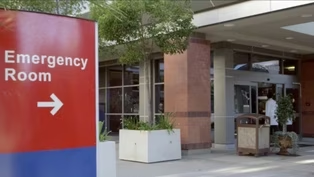
NewAlabama lawmakers prioritize getting federal funds to rural hospitals
Clip: S21 Ep94 | 2m 57s | Alabama lawmakers prioritize getting federal funds to rural hospitals (2m 57s)
Providing Support for PBS.org
Learn Moreabout PBS online sponsorship New Episode
- News and Public Affairs

Top journalists deliver compelling original analysis of the hour's headlines.

- News and Public Affairs

FRONTLINE is investigative journalism that questions, explains and changes our world.
 New Episode
 New Episode
 New Episode
 New Episode
 New Episode
 New Episode
 New Episode
 New Episode
Support for PBS provided by:
Capitol Journal is a local public television program presented by APT