Capitol Journal
September 18, 2026
Season 21 Episode 91 | 56m 39sVideo has Closed Captions
Lt. Governor candidates John Wahl & Phillip Ensler, plus Josh Vaughn of the Alabama Trucking Assoc.
Lt. Governor candidates John Wahl & Phillip Ensler, plus Josh Vaughn of the Alabama Trucking Association.
Problems playing video? | Closed Captioning Feedback
Problems playing video? | Closed Captioning Feedback
Capitol Journal is a local public television program presented by APT
Capitol Journal
September 18, 2026
Season 21 Episode 91 | 56m 39sVideo has Closed Captions
Lt. Governor candidates John Wahl & Phillip Ensler, plus Josh Vaughn of the Alabama Trucking Association.
Problems playing video? | Closed Captioning Feedback
Where to Watch Capitol Journal
Capitol Journal is available to stream on pbs.org and the PBS app.
Providing Support for PBS.org
Learn Moreabout PBS online sponsorshipFrom AP Studios in downtown Montgomery.
I'm Todd Stacy.
Welcome to Capitol Journal.
We've got a good show for you this week.
After the news, I'll be interviewing the candidates for lieutenant governor, Republican John Wall and Democrat Phillip Ensler.
And later in the show, I'll sit down with Josh Vaughn of the Alabama Trucking Association to talk about Truck Driver Appreciation Wee and show their new music video.
Hope you'll stick around for that.
We start our coverage in the nation's capital, where the Alabama congressional delegation had a big week.
From Russia sanctions to data centers.
Lawmakers scrambled to act on their priorities before hitting the campaign trail ahead of the midterms.
AP Washington correspondent Alex Engle breaks down this week in D.C.
and how Alabama's delegation was involved.
As the sun set Wednesday at the Capitol.
Bipartisan lawmakers including Senator Katie Britt, were giddy.
They were celebrating the House passage of a sweeping Russia sanctions bill, sending it to the president's desk.
We have an opportunity to give President Trump the tools to drag Putin to the table.
We know that Russia is on its heels, and this is, in my opinion, kind of that last layer that's needed to ultimatel bring peace there between Russia and Ukraine.
The bill, which would sanctio key parts of the Russian economy and impose tariffs on the largest purchasers of Russian oil, overwhelmingly passed the Senate last month.
This week, 58 House Democrats joined most Republicans, including Alabama's members, to support the sanctions legislation.
Congressman Shamar Fingers was one of the Democrats who supported it.
We consider both sides of it and went a little back and forth on it.
But at the end of the day, I felt that it was very important to stand with the people of Ukraine.
Russia has been overly aggressive in that region, and that is something that has fueled higher fuel costs in this, in this part of the country and around the world, for that matter, especially in district two.
Congresswoman Terri Sor joined a majority of her colleagues in opposing the bill.
They argue it would give to much tariff authority to Trump, invoking the legacy of the Tuskegee Airmen.
House Minority Leader Hakeem Jeffries explained his opposition during debate on a bill to rename an Alabama post office after the fighter pilots.
Why in the world would thi Congress or the people's House give this president unfettered authority to visit more tariffs on the world?
That will have an adverse economic impact on the American people.
Also this week, Alabama's entire House delegation voted for a bill to help cur data centers electricity cost.
It easily passed the House 417 to 3.
As lawmakers hit the campaign trail.
They were eager to say that they took some action on data centers as they faced growing pressure from voters to address the issue.
The bill is now in the hands of the Senate.
If you're concerned and you want to see some guardrails in some way, shape or form, you know, these are great.
First steps with regards to just how we're doing, AI and data centers in general.
Senate Democrats block the data center bill from passing vi unanimous consent on Thursday.
But the measure could be brought up again for another vote in the next two weeks.
Reporting in Washington Alex Engle, Capital Journal.
Thank you Alex.
And another major development from Washington breaking just today.
US Transportation Secretary Sea Duffy announced that the Trump administration has approved a loan of up to $2.52 billion to fund the mobile River bridge and Bay way project.
The state has been trying to find ways to pay for the long needed project that would be the largest single infrastructure project in the state's history.
Commuters and freight haulers have long been frustrated by the current design of Interstate ten throug mobile, particularly the Wallace Tunnel under the rive that is frequently gridlocked.
Alabama officials are expressing gratitude to the Trump administration for financing the project, which could break ground by the end of the year.
Governor Kay Ivey and U.S.
Senators Katie Britt and Tommy Tuberville called it a game changer for the state.
Well, Alabama's November general election is now less than seven weeks away.
After months of court challenges over voting maps and changes to the primary election calendar, Secretary of State Wes Allen says preparation for November remain on schedule.
Capital Journal's Jeff Sanders spoke one on one with Alle about what voters need to know.
Alabamians still have mor than a month until Election Day, but preparations are already underway.
Secretary of State Wes Allen says his office is working hand in hand with election officials across the state.
Yeah, busy.
I mean, it's always busy.
A lot of things that we've got to do and coordinate with, the local election officials who are responsible on the county level for running the elections.
A lot of people don't really realize that we've got 67 differen elections going on Election Day because they're all administrative at the county level.
There are some important election deadline you need to remember for voters.
October 19th is the deadline to register to vote absentee voting is already underway for those who qualify.
Applications sent by mai must reach the county absentee election manager by October 27th.
Completed ballots must arriv by noon November 3rd if mailed, or by close of busines November 2nd if hand-delivered.
And with so much in the news in recent years concerning election integrity, Allen points to paper ballots as a safeguar for checking election results.
Well, we passed a la when we first came into office.
We advocated for tha during our legislative package in 2023 to make sure tha Alabama always has paper ballots preprinted delivered to the precincts.
So that's very important.
They will always have the receipts.
You know, if there's ever any controversy we can go back and count, make sure that everything turned out correctly.
There is also a new state law this year that requires post-election audits in every county.
Probate judges will select one precinct in their county, one race, to perform an audit on, and the they will return those results to the Secretary of State's office.
The secretary of state will make that report available online and to the legislature.
Turnout was very low in August.
Special congressional primaries held after court battles over district line reshaped the election calendar.
Looking ahead to November, Allen says pas general elections should offer some perspective.
This is an off year election.
It's not a presidential election, so it's not going to be as high historicall as what we've seen in the past as what a presidential election year is.
So it's hard to predict.
But my encouragement to the people of this state is to do your homework, be involved.
Look at Alabama votes.gov.
Get the sample ballot for your county.
We've got all the counties up and look and do your research and then get out and go vote.
And Alabamians will have the final say so when they head to the polls on Tuesday, November 3rd.
Reporting from Montgomery.
I'm Jeff Sanders for Capitol Journal.
Thank you Jeff.
And speaking of the campaign, the Democratic nominees for governor and lieutenant governor were on the trail this week.
They made a stop at the state capitol to promote a new concept moving the lieutenant governor more firmly into the executive branch, similar to the vic president at the federal level.
Doug Jones and Phillip Ensle are already running as a team, and they say this concept would enhanc the role of lieutenant governor and make the position more useful.
There are appointment authorities of some other things that the lieutenant governor does, but the lieutenant governor, i my view, has always should be, a part of the executive branch of government.
A partner with the governor to help implement the administration's policies.
So we're going to propose when we get elected, we're going to propose an amendment that obviously wouldn't take effect until the 28 elections.
But to do just that to make sure that the governor can select a lieutenant governor to run as a ticket.
27 states already do that.
Alabama is one of only a few that have independent governor and lieutenant governor.
27 states treat the lieutenant governor and the governor's office as the president and the vice president.
And that only makes sense.
It only makes sense that you've got that the governor has someone that has been elected statewide with him or her, that can help implemen the new administration policy.
Look, there is a lot of talk about the lieutenant governor role not having a lot of formal powers, but the lieutenant governor can and should on day one, be ready to fight for the people of Alabama, ready to fight and advocate for legislation that's going to help improve people's lives.
I often get the question, well, what can the lieutenant governor do other than to sit there on the Senate?
Well there is so much that I can do because of the relationships I have, as Doug said, across the aisle.
And to be able to help carry out a vision, hel fight for the people of Alabama.
So I'm excited to be in the rol and to be in the role in a way that it's really going to make a difference.
And I'll talk with both lieutenant governor candidates about that concept later in the show.
63 years ago, dynamite planted by the Ku Klux Klan exploded through the 16th Street Baptist Church in Birmingham, killing four little girls as they prepared for Sunday services.
Hundreds filled the church this week to mark the anniversary, and they also celebrated th opening of a new visitor center that leaders say is aimed at educating people about one of the most horrific acts of violence of the civil rights movement.
Randy Scott was in Birmingham for the gathering in Birmingham, Alabama, one of the state's busiest cities, full of people and activity.
But it hasn't always been this way.
In the 1960s, i carried the nickname Birmingham due to the random explosions which targeted many homes and businesses of African Americans.
One such explosion happened here at the 16th Street Baptist Church.
Four little girls lost thei lives on September 15th, 1963.
And on this day in 2026, people are here to remember them.
This is part of our shared American history, and if we don't know our history, we're destined to repeat it.
Birmingham native Lisa McNair lost her older sister Denise, that day.
She says the bombing creates ripples in time, which affect society and inspires the need for change.
I am still upset about the rise of the hateful rhetoric and how people are cosigning that that's okay.
That's never okay.
And especially when we're in the Bible Belt where everybody's supposed to love Jesus.
We need to.
Those who claim to love Jesu need to stand up against that, no matter what their political bent is.
They need to fight that.
63 years ago, Birmingham, Alabama changed.
In fact, those her in Birmingham say 63 years ago, the world changed.
What?
A bomb went off at 16th Street Baptist Church, right across the street from where I'm standing, shattering the facility and taking the lives of four young women.
It also started a movement, movement to help make this city, the state, this country, the world, a better place.
Work that still goes on to this day.
Scores of people of all races and gender attend a church memorial service.
Once they ended, they walked a few steps down the sidewalk for a ribbon cutting.
This is the 16th Street Baptist Church, new education and visitors center openin to advance the mission of faith, remembrance and reconciliation, says Pastor Arthur Price.
Here, this new building that we're in, we'r not just opening up a building, we're opening up a new beginning.
We're on this journey where, when people come to Birmingham, when they come to the Civil Rights District, they're not just getting a history lesson, they're getting a, a challenge on what do I do wit the history that I've learned?
Doctor Terrence Brown is the executive director for the new center.
He says its completio is continuing the work to help make the world a better place by using education.
So understand a little bit of the history, understand and make a personal connection to that.
Number two and I just have to go back to it because I think it's essential.
Then connect.
Then how how do I play a role in making this world better?
And we can start small because sometimes the greatest effort starts with the smallest step.
Doctor Brown says by honoring those who lost their lives for the purpose of equality, and sharing that with others is how it can make a big difference.
A point Lisa McNair agrees with.
Anybody can come here.
If you breathe in, you're human being.
You can call, you can come, you can learn, you can share, you can invite.
That's what this is all about.
In Birmingham, Randy Scott, Capital Journal.
Thank you.
Randy.
The Alabama Joint Mental Health Task Force met at the state Hous this week to continue its deep dive into mental health resources in the state.
The group faces a November 1st deadline to submit its final repor and legislative recommendations.
We spoke with Mental Health Commissioner Kim Boswell about the state's ongoing system transformation and State Representative Ed Oliver on a new initiative targeting veterans suicide.
Here's what they had to say.
We have been in a major transformation over really the last nine years, and we've done so many successful programs crisis in our school based mental health programs.
The legislature and Governor Ivey, they've both investe tremendously in our department.
And so we're really just hopeful that we can continue that transformation.
There's a lot of work that still needs to be done.
We certainly haven't solved all of the problems, but we're really hopeful through this next, transition that will continue to have the opportunity to do that.
We can actually d one stop shopping for a veteran.
We can refer them.
You know, jobs are the most important thing.
You know, most veteran suicides, the, the person is either unemployed or underemployed.
So we decided that wa the first thing we would tackle.
After jobs, we look at education, and then referrals for health care both medical and mental health, education, assistance.
So the is sort of a holistic approach to how we treat veteran.
History is coming alive in northwest Alabama.
Officials gathered in Haleyville this week to launch the Byler Road Trail.
The Byler Road was the first ever road establishe by the legislature back in 1819.
It was built on an even older trail carved out by migrating bison and other animals thousands of years ago.
State leaders want to preserve this history in a way that helps future generations remember Alabama's story.
Just two days after Alabama became a state, on December 16th, 1819, Governor William Wyatt Bibb signed legislation authorizing the construction of the Byler Road, making it the first public road commissioned by the state of Alabama.
200 years ago, it was a gateway for people coming to settle in this area to work and build a future.
And today, it could be a gateway to people or for people who love history or appreciate our culture and who want to experience the beautiful scenery that God created right here in this part of Alabama.
We spend a lot of time in Montgomery, ladies and gentlemen, speaking about the future of Alabama, where to invest, how we grow our economy, how we strengthen rural communities, and how we create opportunities for the next generation.
But I believe, I believe part of that building in that future is making sur we don't lose things that made these communities what they were in the first place.
And the Bar Roa project is one of those things.
For more than 200 years, this road has been part of communities of Northwest and West Alabama.
Generations of families who have lived along it, businesses and churches grew up around it.
People have traveled to make their living and raising their families and building communities.
A lot has changed since then.
200 years ago.
But the importance of connecting communities has not.
We'll take a quick break and be back with this week's guests.
Stay with us.
Pratt City, Alabama native Osman Kelly Ingram was the first United States serviceman killed in World War One.
He died heroically when a German submarine attacked his ship, and he ran to release the ship's ammunition ahead of the torpedo strike.
Ingram was posthumously awarded the Medal of Honor.
The USS Osman Ingram was named for him, and West Park in Birmingham was renamed Kelly Ingram Park.
Welcome back to Capitol Journal.
Joining me next is John Wall.
Republican nominee for Alabama lieutenant governor.
Mr.
wall thanks for coming on the show.
Oh, it's good to be on the show.
How's the campaign trail?
Busy.
You know, it's it's, it is a Republican nominee.
You know, it's assumed tha you're going to win in Alabama.
But for me, this is it's not about just winning.
It's about actually going out, visiting with the people, hearing their concerns and talking with them about the issue that are affecting their lives.
Because at the end of the day, that's what a good, a good statesman should do.
They should get out there and talk with the electorate, and work for it, because that's that's what representative government is all about.
And so we've been all over the state, you know, and going to continue that until November 3rd.
And just make sure that we're listening to the people, the state and we're out there campaigning and talking to voters in every corner of Alabama.
Well, I ask this of all candidates, and that is a very simple question.
So I'm not the simple questions are the hardest.
And that is, why are you running?
Why do you want to be lieutenant governor?
Look, I think that's a fantastic question.
And it's something that everyone running for office should ask themselves before they get in.
And for me, it's about what I believe.
You know, I'm a I'm a small businessman, and I have a great life, back home in north Alabama.
And, have property right on the river.
Love it.
And and for me, this was about the my political journey, you know, running for state party chairman.
Right?
Getting elected.
It was about the fact that I want to.
I love the vision of our founding fathers.
I'm enthralled with the American dream, and, And I want to keep it alive for future generations.
I see a an onslaught, whether it's on the national level, the state level, our education system, just a lack of understanding of what made America special.
And I really believe America is special.
I believe Alabama is special.
And so I wanted to get involved in the political process, to be a part of that process and making sure that that my children and my grandchildren don' just have the same opportunities I did for the American Dream, but we actually gain ground, and they have the same opportunities that my grandparents or my parents had.
So it's about being engaged in the process and really fightin for the fundamental, you know, value I believe in, which is liberty.
It's freedom.
And the American dream.
Well, the lieutenant governor job specifically is an interesting one.
It's kind of been it's evolved over time.
In fact, they've kind of pared back a lot of the responsibilit over the last couple of decades.
So understanding that what is it about that role.
What do you want to do with that role.
Because in some ways it's what you make it right.
Like current Lieutenant Governor Ainsworth has bee it really involved the military, you know, and picked his issues.
What do you want to do with that role?
Understanding that as it stands right now, some of its actual authority is somewhat limited.
Well, first I want to compliment, you know, willing to work.
I think you did a fantastic job as lieutenant governor, and I'm blessed that I'm going to get to start where he, you know, where he left off, because I think he did bring a new focus to the lieutenant governor's office.
And I think that's that's incredible.
A lot of people also don't realize some of the role of the lieutenant governor's office.
And I always bring it under.
There' three kind of key basics to it.
The first is the legislative or the executive side.
Right.
You take over in case anything happens to the governor.
But that also means is chairing.
And, you know, as chairman of the Senate, you know, chairing the state Senate, you're kind of the bridge between the executive branch and the legislative branch.
And I think that's a very important role, especially with Senator Tuberville.
You know coming back from from the U.S.
Senate, back to the governorship.
I've got a very good relationship with him.
I worked with, worked to his campaign, when he was running for, running for Senate and the served on his transition team.
So we've got a very good relationship.
I think that's going to pay dividends, for the state of Alabama for economic opportunities.
So I'm looking forward to that that kind of being that bridge between the executive and legislative.
But I think a lot of peopl forget, you know, as lieutenant governor, you do still chair the state Senate.
You assign legislation Senate legislation to committee, which is a very important role, legislatively.
And then probably the third is probably the one that's overlooked the most.
And that is that the lieutenant governor, gets to appoint over 400 positions to 16 different boards and agencies.
And if you really want, you know, we we hear a lot about, you know, changin the focus of government, right.
Whether it' on the national level with those or on the state level, you know, making government more efficient, a more or a better service to the people.
Well, a lot of that doesn't doesn't come through our elected officials.
It comes through these boards and agencies.
Right.
When you're when you interface with government, you're not going to interface with the lieutenant governor's office very often, but you are going to interface with the boards and agencies that the lieutenant governor appoints.
So I'm going to take that appointment power very, very seriously.
You know, there's going to be a lot of interviews.
We're going to make sure that we put people in there whose focus is on service to the people, because, look, my focus as lieutenant governor is going to be taking taking government and trying to return it as much as possible, power control, less regulation and returnin that control back to the people, and back to the entrepreneurs who actually actually hire people and create jobs.
So my focus is going to be in that direction, especially in that appointment process.
Your opponent an and Doug Jones and Phil Spencer just this week, had this proposal that to alter the lieutenant governor's office, kind of bring it mor fully into the executive branch.
I mean, it's there in the Constitution as it is.
But to make it kind of a ticket, you know, obviously that won't happen this time.
What do you think about that out of it?
Because it's it's not really a Partizan thing.
I've heard senators talk about the same thing.
What is your view in terms o should the lieutenant governor's office change?
Should it be closer to the governor, or should it remain in the Senate?
What's what should we do?
Yeah.
Well, look, having just come through a very hard primary, there's obviously a temptation to say, yeah, let's, let's let's have it.
You know, run is a ticket, right?
At the same time, though, I think it provides the, the voters, the people of Alabama with the unique opportunity to to have a separat elected voice, in the, you know, constitutional position in state government.
So I'm very, always very leery to take away, the electorate's right to vote on, on a, on, on a position.
And I would, I would lean towards that direction.
And I think it's healthy that the public that, you know, i forces the lieutenant governor to get there and ask for their vote.
And I think that's a good thing.
I think that's a healthy part of the, you know, the the idea of representative government.
So I would encourage to leave it where it's at.
I think that's it's going to provide the best service for the people.
And at the end of the day, that' what government should be about.
And there have been many times when the, lieutenant governor and the governor aren't in the same party, you go back, I mean, it's it's been a while, but I remember in the Rowley administration, you know, Jim Folsom was lieutenant governor Democrat.
They actually got along really well.
But that's kind of an interesting dynamic.
It doesn't have to be the same.
And look, Steve Windham is a great example of that, right?
Like a lot of the that's when they started changing diminishing the powers came through that that time frame when you had a Democrat governor, a Democrat state House and Senate and a Republican lieutenant governor.
Right.
Yeah.
Interesting.
Look, let's ask let's talk about this issue of residency.
You've been challenged.
Your candidacy has been challenged over where you lived and when, stories been written, there's a lawsuit.
That's what.
That's what's going on.
So can you clear up for our audience?
Just when the timeline.
When did you live in Tennessee When did you vote in Tennessee?
Where and when did you come back?
And can you clear up the timelines?
And so that, because there is that seven year residency requirement.
Yes.
No.
And and look, I'm glad you bring it up.
This is something where people you know, talk to me about it.
And whenever they bring it up, whether it's the lawsuit, I, I welcome it, because we should we should be, you know, elected officials should b fully transparent to the people.
And I embrace this, this conversation because, I'm very confident in my in my meeting, the residence standards, for the, for the Constitution.
And look I'm going to make a few things, you know, you know, very clear here.
One is I never voted in Tennessee.
Okay?
Like, I had a second residence in Tennessee.
I've always been very open about that, very honest about that.
Nothing in the Constitutio or in or in federal or state law says you can't, you know, many people.
It's a very common understanding that, you know, some people own property in multiple states.
And you have multiple legal residents.
That's not unusual There's nothing wrong with it.
And I think what people ignore in this question is the fundamental requirement found in the Constitution.
So section 11 of the Constitution clearly says you have to be a resident of the state of Alabama for the last seven year preceding the election.
Right.
I have been did I have a second residence in Tennessee?
Yes.
But I never abandoned my residence in Alabama, so that's going to be the key.
The burden of proof is not.
Did you have a residence out of state?
The burden of proof is did you keep one in Alabama?
Right.
And, no one has.
You know, the lawsuit doesn't allege that at this point.
No one ca because I have truth on my side.
So I'm very confident.
So you say you didn't vote, but you did register, right?
Yes.
And see that kind of to some people that implie more than secondary residency.
Yeah.
No.
Look, I can see that.
And I think, you know, when looking at that through a legal context, there's a couple things you look at.
You look at one, the definition, you know, the requirement in the Constitution is it is a domicile.
Is it residency?
And I always point to section 118 of the Constitution.
The immediatel following section where it talks about it, requires any constitutional officer except the lieutenant governor to reside in Montgomery.
So look at our constitutional office.
We have 3 or 4 constitutional officers right now who take that residency requirement to be getting a an apartment or getting a second house.
They don't move over all their stuff.
They maintain two residence and that has complied and then been accepted.
For section 118 and you can't have a double standard and require something different for section 117.
So you're not worried about this lawsuit?
No, no.
Look, we've already had our first hearing.
I like the requested relief in the lawsuit was tha I'd be removed from the ballot when the lawsuit was filed.
We were already a week and a half past that deadline in state law.
So this is like this is law here.
This is the Democrat trying to make me look like I'm, you know, trying to trying to be abl to bring it up in a court case, and using it with the public on a legal standard.
I'm incredibly confident we're going to win that legal argument.
And and we're going to move forward.
We're going to take it directly to the voters of Alabama because they you know, what's going on.
You mentioned earlier in the interview about, you know, being the Republican nominee.
It's a good plac to be historically, in the last couple of decades in Alabama, huge advantage in a very conservative state.
And yet we're at this interesting point where th president's popularity is down.
There's a lot of headwinds nationally for Republicans.
I mean, look at al these battlegrounds out there.
I mean, Alabama is still very much a Republican state.
But, you know, that being the case of voter enthusiasm is down.
If turnout is down, are you worried at al about these national headwinds impacting even a race in Alabama?
I mean, look, I don't think we're going to lose statewid any Republican seat statewide.
It's jus we have such a strong majority.
But look, I think this election cycle is a wake up call for Republicans.
I am not a career politician, and I don't want to be.
I've ran on the fact that, look, I'm a farm boy from fro Limestone County, you know, and, I'm running because I see the problems with government.
I see the problems with, you know within the political system and I want to be an agent of change, you know, and I want to do it, you know I want to do it the right way.
I want to be able to work with everyone respectfully.
But the people of this country are looking for a change.
They're looking for something different.
It's why they elected Donald Trump.
And, you know, especially the pocketbook, you know, voters across the state, they're hurting, you know, it's they're struggling to put food on the table.
You know, our senior citizens are struggling to pay for medical bills.
And I think that's at the end of the day, that's what that's what's driving this, is voters looking for someone who's going to go to Washington or go to Montgomery and fight for them, and that's my commitment.
And I look, it doesn't matter whether you're a Republican, whether you're a Democrat or whether you're independent.
We should all want the same things for the people of our state.
We should want it to be more successful.
We should want them to have safe communities, and we should want to have a brighter future for their children.
And that's my outloo when I'm out there campaigning.
That's wha that's what I'm telling voters.
Look, I want Democrat votes.
I want independent votes.
I want obviously Republican votes.
But for me, this is about fighting for the people of the state, not backing down, not surrendering and making sur they have a lieutenant governor who's going to fight for them every single day.
Okay.
Well, look, if voters want to find more information about what you just talking about, their website.
Absolutely.
So we we encourage them to come chec out, sign up for a newsletter.
You know, stay involved.
It is vote John wall.com okay.
We'll put that up on the screen.
Well thanks for taking the time to come.
Sit down and good luck on the campaign trail.
Thank you sir.
It' been been a pleasure to be here.
We'll be right back.
Alabama Public Television is your place for quality educational services.
Free professional development for educators and childcare providers with access to free, curriculum aligned videos, lesson plans and instructional resources with PBS Learning Media and all the PBS kids programs, parents know and trust.
Learn something new every da with Alabama Public Television.
Visit us at AP tv.org/education to learn more.
You're watching Alabama Public Television.
And you.
Welcome back to Capitol Journal.
Joining me next is Stat Representative Phillip Ensler, the Democratic nominee for lieutenant governor.
Representative thanks for coming on the show.
Great to be here.
Absolutely.
Well, you've been pretty busy on the campaign trail, I see.
I have, yep, I've been to 51 counties.
16 more to go and about 25,000 miles on the car.
But it's been a lot of fun and great to get out there.
Life as a statewide candidate.
It's a little differen than running in your district, I imagine.
Oh, yeah.
I mean, when I ran in my district, I can get from point A to point B in 15 minutes, and now, you know, multiple hours.
But but it's been great.
I'm loving getting out there and meeting people in every part of the state.
Yeah.
Well, look, I ask all this of all candidates, I want to put it to you.
Make your case.
Why do you want to be th lieutenant governor of Alabama?
Yeah.
I have a strong track record of getting things done in the legislature and some tough things.
Things that we've talked a lot about protecting children from Glocks, which is, that law has helped law enforcement, worked, to pass both law dealing with inhumane conditions for dogs.
Have secured funding for mental health programs.
So I've done things that benefit people not just in my district, but the entire state.
I know how to get things done.
Working with Democrats and Republicans and being a lieutenant governor is a chance to keep advocating, keep fighting for things that are going to mak a difference in people's lives.
Well you mentioned those those bills.
I mean, getting those passed as a Democrat in the minority for the supermajority.
That is significant.
You know, something to consider.
Yeah.
And look, I've drawn on my background as a public school teacher, certainly as a lawyer, but a lot of working at the statehouse is about relationships.
And I'm proud to be a curren member of the Democratic caucus, but have great relationships with the speaker, with the Senate presiden pro tem, with the budget chairs.
And anybody can talk about wanting to do things when they get in office.
I've done it.
I have cut taxes, I have secured funding for conflict resolution programs, and those are the things I want to continue to try to do as lieutenant governor.
Well, look, we aired earlier the press conference, you and and, Doug Jones about changing the role of the lieutenant governor, which would, I guess, be a constitutional amendment.
But there's nothing specifi right now.
But walk me through, you know, eve though there's nothing on paper, what you would see if you all got your way and the voters approved it, how that role would change.
Sure And let me preface it with this.
It that proposed changes and th vision rehab has nothing to do with the current lieutenant governor.
I think Lieutenant Governor Ainsworth has done some really great thing that I would want to continue, chairing the Military Stability Commission and focusing on veterans, focusing on small businesses.
He has had a very hands on active role.
Hopefull we can reach his goal of having, the interstate, expanded because I know that that nine hour drive from the beach all the way up to Guntersville has been tough.
So you're just thinking conceptual and conceptual?
Yeah.
The like the president, vice president, the lieutenant governo can be a more cabinet level role where the lieutenant governor has a policy portfolio, where the lieutenant governor is dispatched to to work on certain initiatives and programs.
So I would want to be in a position because of my background in the legislature, where I'm very involved, trying to get enough votes in the Senate, working on implementing initiatives throughout the state but also acting as a top advisor to the governor, being involve in those day to day decisions.
So you can do some of that informally.
Doug and I have a great working relationship and have talked about what that partnership could look like.
Of course, to Ryan as a truly joint take it.
That's something that would require a constitutional amendment and would be up to the voters of Alabama.
But we want to make sure that the lieutenant governor is that the taxpayer are getting as much as they deserve out of it, and that somebody who is really there to to work with the governor, work in the executive level role, as we see in a lot of other states.
Would it still preside ove the Senate as Senate President?
It would still preside over the Senate.
You know, and we haven't gotte into all the specifics of that, but generally, there would be a much more executive level branch role, because I'm thinking with the vice president, also president of the Senate, but rarely presides onl if there's a tie break needed.
And so usually it's just kind of the Senate doing their own thing.
And there's been more talk about that, you know, rules changes and things like that.
So I'm curious.
But, you know, the other side of that is whether it's this job or the auditor job that we have talked about, you know, voters tend to get a little I don't know, they tend not to like things being taken away from them in terms of being able to elect their leaders.
Does that concern you at all of championing this understanding that voters kind of like to elect their people?
Sure.
No.
Great.
Great question.
Everywhere I go, people ask me, what is the lieutenant governor do?
And when I describe the current limitations, they say that doesn't really make sense.
They want a lieutenant.
What they do care most about is that it's going to be a lieutenant governor who fights for them, who's going to fight to put more money in their pockets.
A lieutenant governor who is really a advocate and champion for them.
So whether that is remain as it is or is a joint venture with the governor, I think they just want to kno that the lieutenant governor is is there for the and going to speak up for them.
Well, as you mentioned even if that was to take place, it wouldn't be in this term.
So if elected, what do you want to do with the current role?
What do you want?
I mean, understanding the the limitations, right.
The for the last two decades, the legislature has been, you know, limiting the role.
What do you want to use the current role of lieutenant governor to accomplish?
You.
You mentioned a couple of things already.
Yeah.
So the the lieutenant governor presides, of course, over the Senate, but also then has, over 400 appointments to boards and commissions and having peopl that are qualified that that are in there to really help do the work to that doesn't always get, you know, attention.
It's not always in the news, but those boards and commissions serve a really important function in our state.
So I would take that very seriously, that duty.
Like I said, the Military Stability Commission, and the rol it has with our military bases and with veterans is something that I would really focus on.
But the lieutenant governor, because of my relationships already in the legislatur and especially up in the Senate, of course, with Minority Leader Singleton, but with Senate President Pro Tem Garland Gardner, you know, we work very closely on both law, which goes into effect October 1st.
So on day one, I would be able to go in there and work with both of them to figure out where there's common ground, where they're shared, things we care about.
I know I can't introduce legislation, but I can work really hard on both sides of the aisle to get the votes that are needed fo things like Medicaid expansion.
And I know that word gets, you know, some people don't like that.
At the end of the day, our hospitals are suffering.
Rural hospitals are closing, things like a lottery.
Overwhelmingly, Alabama voters want to vote on that.
They want it.
It was one vote short in the Senate two years ago.
So I would really work to get legislation introduced by members and get the votes to get it through.
Well, let's just say you were elected and then yet it was Tuberville elected.
You know, as a Republican, as governor, would you be concerned at all about because again, if you were running as a ticket it wouldn't matter.
But there's been that that has happened plenty of times in the past.
We've had a lieutenant governor of one part and a governor of another party.
Any concern there about being able to work with a Republican governor?
Of course I hope, and I'm praying and doing everything I ca for it to be me and Doug Jones.
But I am someone I get along with almost everyone, and work really well.
Democrat, Republican, urban, rural.
I have those relationships.
There is a lot that I don't agree with Senator Tom Revell on.
And we would have strong disagreements, but I always work to find common ground if there is something that we agree on.
You know, I'm not someone that's, that's in there to to try to, to block things and, and just fight to be adversarial.
I'm there to say, hey, where, where can we work together?
Where can we do things that are going to benefit the people of Alabama?
Well, being the Democratic nominee in this Republican state, puts you at a bit of a disability uphill battle, we'll call it.
Y'all have talked a lot about that.
You and Jones have talked a lot about that acknowledging it and everything.
What needs to happen, what needs to happen in terms of understanding its historically over the last 20 or so years, been a Republican state.
How do you get over that hump in terms of, overcoming that buil in sort of Republican advantage and, and, and get elected as the Democratic nominee?
Yeah.
And I acknowledge it.
It is an uphill battle, but it is doable.
And for a few reasons.
One, I'm as I said, getting out there and listening to people and meeting them where they are, that makes a huge difference.
And when people meet me one on one, when we talk about the issues I hear every day from people that say that they are Republicans, people that have voted for Trump, but they appreciate that I'm willing to listen and stand with the when it comes to data centers.
They're willing, to support me because they know that I am somebody that is reasonable.
So meeting people where they are is one way to do it.
And then focusing on the issues that matter.
Data centers is huge.
People are concerned about their power bills.
They're concerned about now gas prices.
So talking to them about the thing that Republicans haven't done, and the things that we are proposing as Democrats that we can do, that resonates.
But then also, you know, energizing people by by letting them know, you know, I'm not going to be bought and bossed around.
I'm not somebody who is beholden to anyone, but them.
And they want to know that they're someon who's going to fight for them.
And that message resonates with Democrats, Republicans and independents.
Well, you mentioned data centers.
And you're right.
This has turned into the biggest issue, kind of unexpectedly, what needs to happen because it the last year earlier this year, last session, the legislature did pass some data center related kind of things.
You know, reining in incentives and things like that.
But maybe it wasn't the whole hog package, and it really wasn't the issue that it has become.
Now, in your view, what needs to happen, what what legislative action needs to take place to address the data center issue?
Yeah.
So we need a few things.
One, the fact that local officials are signing nondisclosure agreements where they're then withholding information from their constituents is is crazy that that just violates every basic notion of what a public official should be.
So having a state ban on NDAs where those local officials, you know, are not signing agreements, where they're going to them keep thing private from their constituents, you know, that deal more with the transparency part, but also then having a review process to look at what is the potential impact on the noise in the area, what is the impact on wildlife or people's water or electricity, and then having a proces in place where if a data center, if it is built, if it then ends up leading to noise pollution, or we see on an annual basis that the water in the area is starting to be polluted, that there then mechanisms to to shut down that data center or correct those issues.
Right now, you know, a data center company can make all sorts of promises, but once they're in there, there's not a whole lot to hold them accountable.
So doing things that in the long ru are going to protect residents, I think is something that I hear everywher I go from people that they want.
Yeah, I fully expect that to be an issue in the legislative session.
Well, look, we're out of time, but I wanted to give you an opportunity.
If people want to learn more about your campaign, you've got a website they can go to.
Yep.
Phillip ensler.com, have a detailed policy portfolio.
And look, it's been an honor serving in the legislature, in the House.
I certainly hop for everyone's vote and support and to be up in the Senate as lieutenant governor and continuin to serve our state.
All right.
Well, good luck on the campaign trail.
Thank you.
Tom, we'll be right back.
The quilters of G spend are world renowned for their traditional quilt designs.
The inhabitant of the small Alabama River town are mostly descendant of enslaved African Americans.
Gee's bend has demonstrate a persistent cultural wealth in the vibrant style of its quilts.
Quilt making has a long history in Alabama, and there are no finer examples of this art form, and the motifs and craftsmanship of the quilts of G spanned.
Welcome back to Capital Journal.
This week is Truck Driver Appreciation Week, and the Alabama Trucking Associatio has another special music video to mark the occasion.
Here's a clip.
Open roads running through my mind.
Just sitting still.
Never satisfied.
Through the southern hills.
To the western sky.
As.
If nothing were open.
Roads running in my mind.
All sun shining bright.
Passing the loves on a starry night.
Trouble sleeping.
When I'm in.
The driver's.
I never feel quite so alive.
I can fly when I give my love.
I use I when I give up.
I get by when I give eyes.
I get a flower I in my eyes.
And joining me next is Josh Vaughn of the Alabama Trucking Association.
Josh thanks for coming on the show.
Thanks for having me on.
Pretty cool.
Music video.
Y'all had the other one last year.
We did?
Yeah This is become a yearly thing.
It's really neat.
Yeah.
You know, you're right.
This is our second year to do it.
It's been a really fun project to, to undertake a good way to show, you know, our appreciation to truck drivers and sort of a unique, creative medium that that, that they're maybe not used to seeing or hearing as much.
Last year we, we had our, our house band, the heroes of the highway that, that, worked with a featured artist and sweet t trio and kind of had more of a country inspired, song this year.
Just the heroes of the highway.
Really more of a, 2000 grunge rock kind of sound going, Pearl jam in there?
Yeah, yeah, yeah, I think it really connects well with with the drivers on the road.
And it was it was a fun project.
We filmed, in Bessemer, Alabama.
When truck when, when stop.
CDL helped, you know facilitate the, the space there.
And we had a great time.
What's really neat, talk abou truck driver appreciation week.
This is a you know, not just in Alabama, but nationally set aside time to really, thank them, and maybe recogniz what is a pretty difficult job.
Sure.
Well, you know, truck drivers are.
I mean, I should say the trucking industr is the backbone of our economy.
Truck drivers are the backbone of that industry.
There are you know, 37,000 truck drivers in the state of Alabama.
There's 131,000, people in the trucking industry in Alabama, 1 in 13 jobs.
3.5 million truck drivers across the country.
You know, if it wasn't for these drivers, the things that we enjoy every day are our, you know, our groceries.
You know, being available, our, all of our Amazon packages being delivered to our houses, just pretty much everything that we kind of take for granted.
You know, the vast majority of that arrives on a truck.
And so, you know, taking one week out of every year just to say thank you to those people that oftentimes, you know, we drive by on interstate and don't give a second thought to or if we do give a thought to is, get out of my way so I can get to where I'm going faster.
So having it, having a chance to, you know, sit back, say thank you from the companies that emplo them, but also just hopefully, as a state and our citizens, to, think a little bit about, you know, the sacrifices that those people make.
The time away from their families.
The long hours, the hard conditions, you know, that they, we just we it's nice to say thank you for those things, because it's not that they expect it necessarily, but they certainly appreciate it.
Well, you know, it strikes me that it's kind of a difficult time right now for the trucking industry.
And I mean it was reported this week Diesel's above $6 a gallon.
And that's just crazy talk about how the industry is dealing with that.
And maybe like how does that trickle down.
Because we see we hear all the time.
Well that's going to make prices bigger.
But it has to also affect companies and drivers.
Well, there's no doubt the you know, the higher prices in diesel, they're tough on, on the trucking industry.
They're specifically tough fo some of the smaller companies.
And, you know, individual owner operators.
But truckers are a resilient bunch.
You know, I've heard some things about, oh, the truckers might going, they're not going to go on strike.
They're going to they're going to deliver the goods, that we all need.
And, so, so there's no fear of that.
But but certainly, you know, those, those higher prices, they're felt immediately by those trucking companies, eventually those, those prices make their way, like all things do, down to the consumer.
They get trickled down to consumer.
And so, you know, as, as we look at, at the, at this issue, one that we don't necessarily control as it's a global supply chain problem.
We would encourage, you know, policymakers and decision makers, to, to think about long term solutions, not not knee jerk reactions.
You know, the things that can really help a consumer, at the endpoint and not, not, you know, create more fluctuation, with, with the prices that we already have.
Yeah.
I think we can all agree on that.
Other bits of advocacy, y'all.
And we had Mark in here, I guess during the session talking about it, about and this is not just Alabama.
It's a nationwide effort to essentially get bad actors off the road to those who have maybe game the system, gotten a CDL somehow, maybe in a lean, more lenient state or something like that.
I know there's bee some progress on that because, you know you don't want those bad actors.
It kind of taints the whole industry.
And, good drivers don't want to hear about it.
So talk about that effort here in the state and also nationally.
Yeah, I'm glad you mentione that that the good drivers on.
I mean that's that's really who's leading the charge at this effort more than anything is us hearing from our drivers, from our companies who have been saying, guys, we need support and removing some of these bad actors.
Now, obviously Mark and 50, 49 other state trucking, executives took the reins on that on that, request, and developed a plan called Trucking Resurgence.
The fight for fairness and safety in trucking.
That that plan is available to view at, Trucking resurgence.com.
It's a seven point plan.
It addresses a number of different issues where these bad actors have entered the industry.
It it, makes recommendations, most of those at the federal level because that's obviously where, we'r regulated at the federal level.
But there are some state level issues there that that we've already, addressed, last session and could possibly address, some additional, issues this, this upcoming session.
The English language proficiency, legislations that that the governor Ivey signed, I believe in March and will go into effect the 1st of October.
So, you know, obviously it is a critical, issue in our industry, one that that, the entire industry wants to see resolved so that we can lift u our people and, and, you know, the ones that are doing it the right way.
Sure.
One, it's it's got to be tough, though, because, like I said, there could be a more lenient state out there without the language.
Required cuts and things like that.
And yet, if they're crossing state lines and things like that, so is I understand.
Is that why it's important to partner with Alea and to make sure that the law enforcement has the tools that they need to to actually do the job of getting a bad actor off the road.
And Alea has bee a great partner in this effort.
They, you know they worked with us on the bill that we passed the last session.
But to your point that's why I really, you know, a lot of these issues are federal federal issues.
So, yes, we can strengthen some of the laws, here in Alabama, like, we we have done giving them more tools, to, you know, go after those people that they that they do pull over that are doing things the wrong way.
But ultimately, yes, it is more of a federal pus because to your point, you know, a truck coming from California drives through Alabama.
You know, so we're no controlling where in California if they got a non domiciled CDL or they, you know, got their, their CDL from, from an on, a qualified CDL school.
So, you know, control the things that you can in the state and, and, and, and, you know, find ways to improve our enforcement abilities, and then work on the federal level to, to try to strengthen some of those things.
That's been our plan.
You mentioned the legislative session.
It'll be here before we know it.
One issue I'm curious is if it comes up and we'll see.
I mean, it's going to be a whole new ball game, new governor, a lot of the new lawmakers, is tort reform.
Y'all were part of a group that started to push, I guess it was last year.
On the issue of tort reform.
I mean, I don't think I'm not even sur if legislation was introduced, but it's people have been talking about it.
Sure.
Trucker Trucking Association Realtors, some of the business community saying, hey, we've gotten to a place where the lawsuits are being abused.
Do you think that's going to.
Is that effort, going to produce something that we might see in the legislative session?
Well, I'm optimistic that it will.
I mean, you know, that' one of the things that we hear.
One of the issues tha and what we just addressed with the bad actors are the two things that we hear from the most, from our from our members, which, you know, ar predominantly small businesses.
And so as it relates to, to tort reform and frivolous lawsuits, I mean, one, one accident can can put a family business, you know, out of business.
And so, you know, outside of of just, the constant settlement game and, and the rise of their insurance costs.
I mean, it's it's an issue tha obviously affects our industry.
We all know that.
We see the billboards that that specifically target trucking companies and, you know paint truckers in a bad light.
But really, this it's an issue that, affects the business community as a whole.
It's one that, you know, as you mentioned earlier, we've we've we've seen support from a lot of different, industries, in tackling, and we're really encouraged by the, the development of Alabamians for legal reform.
I think that, we, you know, they just, implemented a new executive director for that organization, Harrison Proctor, who, I think is going to be going to do a great job, has already done a great job.
And and we're really excited about some of the things that they're going to bring t the table in this next session.
I don't know what all those are specifically right now.
But he is not sitting back and, and, and, you know, just listening.
He's he's gathering data.
He's he's talking to lawmakers.
And so, you know, we'll see what happens.
Yeah.
It's going to be an interesting session.
Everybody I think, is trying to anticipate what comes nex and how we're going to respond.
It's going to be in a brand new building too.
So we're going to have to figure out where the bathrooms are.
Josh, thanks so much for your time.
And thanks for coming to celebrate.
Truck Driver Appreciation Week.
Yep.
Thanks, dad.
Appreciate it.
We'll be right back.
Since 1997, Alabam Public Television has provided programs, services, and resources to childcare professionals, teachers and parents.
Visit AP tv.org/education to learn more.
You can watch past episodes of Capital Journal online anytime at Alabama Public Television's website.
App tv.org.
Click on the online video tab on the main page.
You can also connect with Capital Journal and link to past episodes o Capital Journal's Facebook page.
That's our show for this week.
Thanks for watching.
But stick around, because coming up right.
Next is our special spotlight on Education episode three, Back to School edition.
You won't want to miss that for our Capital Journal team.
I'm Todd Stacy.
We'll see you next time.
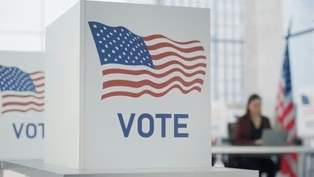
Alabama Secretary of State Says Elections are Ready to Go
Clip: S21 Ep91 | 2m 40s | Alabama Secretary of State Says Elections are Ready to Go (2m 40s)
Providing Support for PBS.org
Learn Moreabout PBS online sponsorship New Episode
- News and Public Affairs

Top journalists deliver compelling original analysis of the hour's headlines.
 New Episode
- News and Public Affairs

Today's top journalists discuss Washington's current political events and public affairs.

 New Episode
 New Episode
 New Episode
 New Episode


 New Episode
 New Episode

Support for PBS provided by:
Capitol Journal is a local public television program presented by APT