Capitol Journal
September 4, 2026
Season 21 Episode 89 | 56m 39sVideo has Closed Captions
TBD
TBD
Problems playing video? | Closed Captioning Feedback
Problems playing video? | Closed Captioning Feedback
Capitol Journal is a local public television program presented by APT
Capitol Journal
September 4, 2026
Season 21 Episode 89 | 56m 39sVideo has Closed Captions
TBD
Problems playing video? | Closed Captioning Feedback
Where to Watch Capitol Journal
Capitol Journal is available to stream on pbs.org and the PBS app.
Providing Support for PBS.org
Learn Moreabout PBS online sponsorshipThis week on Capital Journal, we are now fully into campaign season, with less than two months to go before the November election.
The trail is heating up with some of the first salvos in the governor's race coming this week.
Plus, we are starting to interview each candidate for statewide office this week, beginning with the candidates running for Commissioner of Agriculture and Industry.
Rising health car costs are starting to get real for the state budgets, to the tune of hundreds of millions of dollars.
Randy Scott has that story.
And state leaders are getting closer to answers on how to spend more than 200 million meant to support rural health care.
Jeff Sanders reports on that.
And joining us in studio this week is state Representative Chris England.
Hey, sharp, critic of Alabama's prison system.
Talk about some of those latest issues.
All that and more is next on Capitol Journal.
From AP Studios in downtown Montgomery.
I'm Todd Stacey.
Welcome to Capital Journal.
We begin our coverage this week looking at the rising cost of health care and how it continues to impact state budgets.
The panels overseeing publi employees health insurance plans meet this week to figure out how to deal with those increased costs and how much to ask of the legislature.
We'll start with the Public Education Employees Health Insuranc Program, or peer, which provides coverage to teacher and other education employees.
Capitol journal' Randy Scott was at that meeting and has this story.
Alabama is taking steps to keep employees under the P Hill program covered with insurance, but there will be changes to payments.
This P board meeting is looking into this notion.
And as a result of these projections and, our work with our actuaries, the remaining projections for other, plant, plan products, we're going to be asking for $1,226 per active per member.
Diane Scott CFO for the Retirement Systems of Alabama and forms a packed committee room.
Due to rising costs for healt care and other items nationally.
And here in Alabama members of Pip can see payment increases from 2027 to 2028.
Based upon these projections, we're asking as a result of the 1229 per active a grand total of $1.531 billion, which that's an increase of $222 million over 2020.
Seven.
Scott says with the unstable financial climate, it's good to get in a solid position in case a crisis comes in.
Pay here will require funding of $1,226 per active Vermont.
Should the legislature fund the additional amounts needed and no changes made to the pay hit plan will use it.
An estimated 104,056 active members, and this equates to a request of funding from the legislatur of approximately $1,000,000,531 million which is an increase in funding of approximately $220 million from fiscal 27.
Other board members say it reflects an effort to get ready for possible stiff times in the future.
But with inflationary costs, of health care increasing, that' creating a significant headwind.
Couple that with tightening state budgets, which, you know, I just want to poin out to the board, and go forward is, I think, anticipate and prepare and think ahead for the reality that I think exists, which is tightening budgets on the ETF side and a very, very challenging budget next year.
On the general fund side.
That I think could, quite frankly, make the potential agency reductions in the cost.
It comes down to a vote to approve the increase.
So we have a motion on this is Gibson.
We have a second by Mr.
Davidson.
Is there any discussion?
Seeing none.
All in favor signify by saying I, I yeah I have there'll be some things on the website that have that show the calculations.
But until they say that in writing or feel it in their pocketbook, honestly, they're just not going to see the impact of that in Montgomery.
Randy Scott, Capital Journal, thank you, Randy, and let's just take a look at the numbers from this week's meeting.
The board will ask for $220 million from the legislature to addres those rising health care costs.
They got 1.3 billion for this fiscal year, and say 1.5 billion is needed to fund next year.
Should lawmakers approve tha request in next to your session, it would raise the employer contribution rate or what the state pays by $178 to $1226 per employee.
There would be no premium increases for education employees.
But also meeting this week was the State Employee Insurance Board, which oversees health plans fo non education state employees.
The program is set to lose about $40 million this fiscal year, again to the rising cost of health care.
To help cover those costs, the board is recommending a $20 a month premium increase for state employees.
The last time state employee had a premium increase was 2015.
Alabama has awarded nearly $150 million for projects aimed at transforming health care in rural communities, but members of the legislative group overseeing that fund want to know exactly where the money is going, and whether it is reaching the hospitals and patients with the greatest needs.
Capital Journal's Jeff Sanders reports.
Members of the Alabama Rural Health Transformation Advisory Grou met at the state House to review the first round of grants awarded through the state's Rural Health Transformation Program.
Alabama awarded 138 grants totaling $144 million.
Republican Senato Donny Chastain of Geneva chairs the advisory group.
How does that money get to these rural counties, to the officers, to the hospitals, especially, you know, show us how that gets there.
It has to be transformative and sustainable.
The Alabama Department of Economic and Community Affairs received more than 390 applications, requesting more than $600 million, more than four times the amount awarded.
A Deca director Kennet Boswell says the level of demand made the selection process highly competitive.
There was no way to fund every application.
Some application simply did not score high enough and could certainly benefit from technical assistance that we're offering all applicants.
The grants include projects serving all 67 counties, but the 138 awards went to 82 institutions, with some receiving more than one.
Democratic Senator Bobby Singleton of Greensboro says lawmakers plan to scrutiniz how the recipients were chosen.
I just want to make sure that we are getting it out to help fulfill the need, and not just somebody who may not need the money and jus because they have an operation.
Grant recipients will report their progress every 30 days.
And a Deca is developing a map showin where the money is being spent.
Jenna Abbe is a principal with BDO.
That's the consulting firm helping a Deca administer the program.
Round two initiatives were published in mid-July.
All of those applications, we received 103 applications requesting over $70 million, compared to the $24 million budgete for those round two initiatives.
So rubric based scoring is underway now so that a Deca ca select awardees for round two.
State officials expect to announce the second round of grants in October.
Advisory group members say they will continue monitoring the project to determine whether the funding produces lasting improvements in rural health.
From the Statehouse in Montgomery.
I'm Jeff Sanders for Capitol Journal.
Thank you Jeff.
As I mentioned at the top, w are fully into campaign season with the November election just 60 days away.
Democratic nominee for governor Doug Jones launched perhaps the first majo salvo of his campaign this week.
He held a press conference in Birmingham challenging Republican nominee Tommy Tuberville to sell his investments tied to artificial intelligence and data centers.
This data center controversy has emerged as an early dividing line here in this campaign.
Jones has called for a one year moratorium on any new data center to give state and local leaders time to work to work out new policies.
Tuberville has said data centers should be able to locate her as long as they pay full taxes, cover the total cost of energy, and replace what they take.
But Jones went a step further this week, suggesting that Tuberville investments constitute a conflict of interest.
Oxford Dat Center controversy has erupted because people are realizing that it's the perfect example of why they distrust Alabama elected officials, why they believe that Alabama's government does not listen or pay attention to them.
It's true of data centers i Bessemer and in Lawrence County, but also of solar farms in north Baldwin County, or carbon capture facilities in Crenshaw County.
The way this has been handled in Alabama up to now is just the opposite of democracy.
Too many of these deals have been cut in secret through shell companies.
Small handful of multimillionaires ar trying to buy state government when they need it.
And as usual, the power company seems to be behind it all, pulling the strings.
And the sitting United States senator who wants to be your nex governor is personally invest in Alabama.
Do not have to accept tha Alabama can build data centers, but we can do it right with appropriate guardrails.
And Alabama can do it without a governor who trades the stock of these companies.
He regulates and calls your questions and your concerns about your communities.
Nothing but bullcrap.
I'm running for governor, folks, because I believe the people of this stat deserve a government that works for them and with them.
A government where everyone has a voice and a seat at the table.
A governmen that is not driven by the stock portfolio of the man sitting behind a big desk in the big office in the stat capital, with all the flags in.
And here is the response from the Tuberville campaign, which said Jones was, quote, grasping for attention.
They said, quote, we expect these desperate attacks from Doug.
But like so much of what he says, they are just empty.
Like many Americans, coach has a broker who manages his investments and makes day to day decisions about when and what to buy or sell.
Coach is not making those day to day trading decisions.
This has been answered and reported on for years.
Doug Jones can walk all he wants, can talk all he wants, but Alabama deserves more than a DC politician telling people what he wants.
A one more torium as a campaign line.
So what's Doug's actual pla that came from Jordan to Texas?
Tower rules chief of staff and campaign chairman.
And now let's take a quic look on where those candidates for governor stand in the money race.
Campaign finance reports for the month of August were posted this week, giving us insight into how muc they are raising and spending.
Tuberville brought in $829,000 raised.
He also spent $573,000 and goes into September with 9.51 million cash on hand.
Jones raised $803,000 in August, and actually claimed an additional $300,000 in non itemized cash contribution, which would put him at 1.2 million raised in total.
His campaign also spent $253,000 and goes into Septembe with $2.53 million cash on hand.
Well, Alex Angle is off this week, but we do have a quick update from Washington.
An Alabama native has been appointed acting Secretary of the Army North port nativ Adam Till was named by President Donald Trump to be acting secretary of the army after the sudden departure of previous Army Secretary Dan Driscoll.
Tell is a civilian leader in the US Army Corps of Engineers, but he spent more than 20 year working for Republican senators as well as in the white House.
During Trump's first term.
He actually served as the president's chief liaison to the Senate.
Tell us.
Appointment was met with high praise from both U.S.
Senator Tommy Tuberville and U.S.
Senator Katie Brett, and in a few weeks, a special Washington guest will make an appearance here in Alabama.
Amy Walter, editor in chief of the Cook Political Report with Amy Walter, is slated to keynote the 2026 Paka speaker series.
Paka, of course, stands for the Public Affairs Research Council of Alabama, the nonprofi and non-ideological think tank based in Birmingham.
Amy Walter is an award winning political analyst known for her accurate election predictions.
I've subscribed to the Cook Political Report for years to keep up with how House and Senate races are looking.
Amy is a highly respected journalist and I'm really looking forward to this event.
If you'd like to find out how to attend, just go to Parker's website.
That's PRC alabama.org.
Okay, we'll take a quick break and be right back with tonight's guests.
How did the Seven Years War lead to the American Revolution?
The Seven Years War, known as the French and Indian War in North America actually lasted for nine years and is ofte considered the First World War.
The conflict was over land claims and trade.
One of the bloodiest wars of the 1700s, it spread to Europe, Asia and Africa, with Britain and the colonies fighting France and native tribes for land in North America.
While the British won in the end, the global war was expensive.
After years of fighting, the British Empire was in massive debt and believed the American colonies should help cover the bill.
That's how the Seven Years War led to the taxing of the American colonies, colonial opposition, and ultimately the American Revolution.
Few individual in the history of American sport have possessed greater athletic ability than Bessemer, Alabama native Vincent Bo Jackson.
Auburn University second Heisman Trophy winner.
A three time all SEC and two time All-American selection, Jackson is the only running back in Auburn history to rush for more than 4000 yards in a career.
In 1986, both the NFL' Tampa Bay Buccaneers and MLB's Kansas City Royals drafted Jackson, decidin not to play for the Buccaneers because they didn' want him to also play baseball.
Jackson signe his first professional contract with the Royals.
The next year, the Los Angeles Raiders drafted Jackson with the understanding that he would also be allowe to play baseball, making Jackson one of the few athletes to succeed in both professional footbal and baseball at the same time.
In March 2013, ESPN Sports Science named Jackson the greatest athlete of all time.
He was inducted into the Alabama Sports Hall of Fame in 1996, and the College Football Hall of Fame in 1998.
Welcome back to Capitol Journal.
Joining me now is state representativ Chris England from Tuscaloosa.
Mr.
England thanks for coming on the show.
Thanks for having me here.
Yeah.
Well, lots to talk about.
Yeah.
Y'all had a contract review meeting this week.
Not a lot of controversy coming out of that, for a change, but I wanted to go back to a previous contract that you've had a lot to say about.
And that is the.
Yes care contract.
The Department of Corrections.
Billion dollar contract for health care.
Right.
For inmate health care?
Yeah, obviously, we reported guest care went bankrupt.
It's a big controversy.
They apparently owe the state money, but it's a longer story than that.
So I was hoping that you could, you know, kind of take a soup to nuts.
How did this contract get awarded?
Because you you kind of question it from the beginning.
I sort of wore my t shirt.
The prosecutor s care t shirt.
Because, I mean, that's essentially where all the, like, the the where this falls.
Yes.
Here used to be crazy.
Right?
And horizon was a failing, bankrupt company all over the they were collapsing all over the country.
And Alabama did what Alabama does and lined up to hire this company.
But they changed their name, changed their board, and they started calling themselves yes, care.
Before the contract review meeting, they had an RFP where they bid it out.
Just so happens that the attorney that is defending us in cour right now, Bill Lunsford, was on yes CARES board when they, submitted a proposa to get the health care contract.
And I mean, let's be honest, who knows better how to deal with or put it, put a bid together or a proposal for health care services for Alabama than the person who's defending us in court.
Obvious conflict of interest.
Once it was discovered they redid the bidding process, but of course by that time fix already in, they get it.
Now keep in mind they were already struck off running from creditors an bankruptcy all over the country.
It's just that they did the old Texas two step change their board, changed their names, and now here we are.
Is this care?
And I said back then they sai it's right now it's just care.
Soon it'll be maybe care, but eventually it's going to be no care.
And essentially halfway throug the contract, they go bankrupt.
And not just with the state of Alabama, but there are there are companies all over the country that they just didn't pay in local Alabama businesses that Burzynski Services, pharmaceutical companies and whatnot.
They owe them millions of dollars to.
The Department of Correction was aware of this early in 2025, and instead of doing whatever was necessary to get the company replaced with an emergency contract, they forced contractors to continue to work with a company that they knew was not going to pay them.
So eventually they get to the point where they're so bad off that they can't make payroll.
So they go running to the state, to the Department of Corrections, and they say, hey, can you front us the next payment so we can make payroll?
Well, they made the payrol for April 24th, but they didn't on May 8th.
And they then ran and file bankruptcy and told the bankruptcy court they didn't have the money that we had just given them.
When the Department of Corrections said, where's the money?
They said, well, we had to spend it on other things, so they defrauded the state.
But I mean, you know, the leopard's going to eat your face if you decide to do busines with a morally and financially bankrupt company, you should anticipate at some point they're going to go bankrupt and they're going to do it in the worst way possible.
Well, okay.
So that brings me to two follow up questions.
And that is is there a way for the state to get that money back?
Well, just as Dave, you know, turn their back on the state of Alabama and many other states, by the way, they also did the same thing to the employees, too.
So the only way we're going to be able to get the money is to go through bankruptcy.
That's expensive.
That's lawyer fees and everything.
But also in order for the employees to get their money, they've also got to go through bankruptcy, too.
There are many people who worked without pay to take care of prisoners without a paycheck.
And in my opinion, and I've said this and I'll say it here, the state of Alabama should make those folks home because you didn't have to be, you know, had better predict the future to know that a company is morally and financially bankrupt, as horizon was.
And yes, care is was eventually going to leave us holding the bag.
So you're saying the stat does have some responsibility?
Oh, yeah.
That'd be like a board of adjustment type thing or I mean, is that, well, right now I think we should compensate those employees and then pursu the entire amount in bankruptcy.
And, you know, jus as in typical Alabama fashion, the same lawyer, Bill Lunsford, who served on yes CARES board and got us in this mess, he works for Butler Snow.
Do you know who the state of Alabama hired to pursue this bankruptcy?
Butler.
Snow.
I mean, there's, I can' get any more Alabama than that.
Well, yo you mentioned prosecuting.
Yes.
You have the t shirt, bu you've been saying it for weeks.
I guess you're calling o the attorney general to do that.
Has there been any response from their office?
I think I think doing that.
I think there's been an investigation initiated and I think they're going through, you know, whatever is necessary to figure out if there's criminal charges there or not.
But at the very least, I would like to say that Alabama has learned its lesson.
But if you're looking at how much it's going to cost us to build this current prison and how much it's going to cost us to build this next prison, and how we're not any more accountable or transparent than we were the day the Department of Justice walked here and said, Alabama, your prison systems or your prison syste is unconstitutionally abusive.
No changes have been made and all we continue to do is just throw more money in it.
So my anticipation is, it'll probably get a lot worse before it gets better.
Well, but in terms of prosecution, it's not just about yes care.
Obviously.
You know, justice will be justice.
And yeah, we'll see.
But it would be about deterrin the next company from doing it.
Right?
Right.
Making sur that they're held accountable.
And everybody sees that.
So that this another situation would be a lot less likely to arise.
But I think it does repeat itself.
But also but to that end, though, I want to make sure that when you g and you look at prosecutors here and see what they did to the state of Alabama, don't forget to actually look at the entire, you know, menu of chaos, despair and destruction that is led by the Department of Corrections.
And, you know, I don't want to move on without making this point.
It's $850 million in our general fund budget right now.
Right.
And by next year and the yea after, with the federal courts taking essentially us conceding control of our our prison to the federal court, we're soon going to surpass $1 billion in our general fund budget paying for prisons.
And if everybody's telling you that crime isn't as bad as you think it is, and it' going down all over the country, then what?
Why is it costing us astronomically more money to incarcerate people in Alabama?
And I can tell you, it's quite frankly, it's incompetence and corruption.
Incompetence and corruption is expensive.
And we are going to get to the point where we're going to pay justice, much money incarcerating people in Alabama as we are keeping them healthy and Medicaid.
Well, you mentioned the new prisons because you got Elmore that should be online in a couple of months.
Right.
And that, you know, that's been a big, big deal.
The Escambia project took its first steps in terms of bond.
I mean, isn't it part of you talk about the Department of Justice in our in our, our prison system.
Part of it is building better facilities, right?
Because we've got some 60 year old, some older than that.
Just part of i is the danger of the facility.
Right.
And so it isn't that it doesn't have to be a part of the puzzle.
Sure.
But it but it's not the only part in the Department of Justice and everything that they've told us since they stepped foo in the state House back in 2020, they said that this i a bigger issue than facilities.
And, you know, we're not going to be able to build our way out of this problem.
If you if you've got people like Roderick Gadson, who's a correctional officer working for the Department of Corrections right now, who killed a man who beat a man to death and got promoted for it.
Keeping somebody like that employed is the quintessential definition of deliberate indifference, because he infects the entire body, it makes corruption and abuse rewarded in this system.
So do you think that if a person who's incarcerated in Alabama, right, and they're incarcerated in that new building, do you think they car about where that beating occurs?
Do you think they care about where, they're concerned about overdoses or being assaulted by another inmate because there's nobody there to supervise these folks.
Do you think they care where that happens?
And I'm also sayin that the department of Justice isn't going to care that we're just going to build a new building and just fill it full of old leadership and old problems.
So it's going to tak a actual qualitative assessment of our entire Department of Corrections, which has to begin with wiping out everybody that's over there in charge right now and starting over to actually to begin to transform the Department of Corrections as we know it now.
Well, and we've got to move on.
But it's interesting that both nominees for governor have talked pretty critically about, the Department of Corrections, which is, you know, that's just significant.
Well, it it's a bipartisa kind of I tell you, you have to if you're considering tha we just lost the brags lawsuit for how we torture and abuse mentally ill prisoners.
And then we've got a lawsuit by the Department of Justice against our entire Department of Corrections.
That's $1 billion problem at least.
So I think that every voter out there, if you're talking about data centers, if you're talking about ballot cameras, you should also ask every candidate, what is your what are you goin to do about the billion dollar prison problem that we have in the state of Alabama?
Aside from just conceding control of our Department of Corrections to the federal court system, I will plan on asking them just that.
We've only got a little bit of time, but I wanted to get to this question.
There's been a big sea chang at the Alabama Democratic Party or, you know, used to be chairman.
When when was that term too, 2022 and ended in 2022.
Right.
So you get it.
And there's always been this divide these dividing lines in the Democratic Party, kind of the old guard versus the new guard to, you know, that's one way to put it.
But Senator Singleton gets elected big.
I mean, wasn't even close, right?
He, overwhelmingly won.
Talk about how that happened, because it seems to me there was a lo that went on behind the scenes.
We're trying to get senior Senator Singleton on to hear from him directly, but he's a busy man.
Yeah, I know it's hard to get it.
We want you on Senator.
Yeah.
Talk about how that happened, how that developed.
Because it can't be easy to to go against the old guard like that.
Well, it's, it's basicall a whole bunch of people who were who desperately wanted change, wanted something different.
And, you know when I was chair of the party, it was removing it from years of neglect and I spent and we spent the folks that we worked that worked with me spent, you know, a lion's share of our time trying to rebuild infrastructure.
So whoever came in after would not have to worr about the building of the party.
Not necessarily.
It's now recruiting candidates and getting out there fundraising and becoming a viable party.
Right.
So what I think you saw in that roo and what Senator Singleton was elected, it's just people who were absolutely desperate for new leadership, charismatic leadership, and somebody that can inspire confidence that the ticket that we have now, which is a fantastic ticket, can actually be successful.
Oh yeah, you have to have the grassroots.
You have to have a functioning party, especially if the national folk are going to want to come down and help.
They need they need that infrastructure too.
Well, speaking of that, how does I mean?
Look, there seems to be some momentu from the primary in the spring.
You know, voter turnout and whatnot.
But it's still going to b an uphill battle for a statewide Democra to win in Alabama in this state.
So how does that happen?
Is this change, partly going to do that?
Can they build on the momentum?
Well, how does Doug Jones how does the rest of the ticket get over that hump?
I think to be honest with you, I think it's the quality of the ticket it's quality of the candidates.
And I think what you're seeing is the more Senator Tuberville talks the better it is for Democrats.
Whether we're talking about Social Security being a scam or you're stupid for not wanting a data center 20s from your house.
The Democratic ticket is responsive to the needs and sentiment of the people, whereas others are just taking their votes for granted.
So what you see is, Doug and Phillip and the entire ticket creatin genuine and authentic relations with voters, which is going to decrease our turnout while the messaging from th other side will depress theirs.
And I don't want it to be lost on anyone.
When Doug ran for Senate just a couple of years ago, he got over 900 somewhat thousand votes.
That's enough to win any gubernatorial election that we've had over the last.
However many years.
So the voters are there now.
It's just a matter of activating those voters with a message that works.
And I think that we're doing that right now, I'm sure.
Well, it's campaign season.
We're getting into it here on Capitol.
General representative, thanks again for your time.
Oh, yeah.
Thank you.
All right.
We'll be right back.
Before there was a presiden of the United States or a U.S.
Congress.
How did America wage war against Britain?
At first, the colonies had a provisional government representing the American colonists and their resistance against British rule.
Calle the Second Continental Congress when it convened in Philadelphia in 1775, fighting had already begun at the Battles of Lexington and Concord.
The Congress managed the war effort and met continuously throughout the Revolution.
This Congress also signe the Declaration of Independence and drafted the Article of Confederation, which created a new form of government for the United States.
Once the Articles of Confederation were ratified in 1781, the Confederation Congress governed the nation until March 4th, 1789, which was the da it officially transferred power to the new constitutional government.
From 1820 to 1826, Cahaba was the first capital of the state of Alabama.
The capital city was located at the convergence of the Alabama and Cahaba Rivers.
Because Governor William Wyatt Bibb had arranged for a free gift of land for that purpose from the federal government.
An ancient India earthwork was found on the site, so the governor reused it as a dramatic centerpiece for the town plan.
The sale of Lots and Cahaba built the state treasury for the new state and paid for the first state house.
Soon, the frontier capital had two newspapers numerous businesses, a theater, and nearly a thousand inhabitants.
Despite the loss of the capital to Tuscaloosa in 1826 as a county seat grew into one of the wealthiest communities in the nation and did not become a ghost tow until well after the Civil War.
Cahaba was added to the National Register of Historic Places in 1973.
Today it is known as the Old Harbor Archeological Park.
You're watching Alabama Public Television.
And you.
Welcome back to Capitol Journal.
Next, I'm pleased to be joined by the Democratic nominee for agriculture Commissioner, Ron Sparks.
Mr.
sparks thanks for coming on the show.
Thank you, Todd.
Appreciate the invitation.
Absolutely.
Well, we're here in the campaign season.
We want to get to every candidate.
So I appreciate you making the time.
You're running to become again the state's commissioner of agriculture and industries.
Can you remind, obviously, tha you've got that on your resume?
Can you remind our audienc of your background in politics?
Well, I first got elected i 1977 as a county commissioner.
I've been around politics most all of my life, but very good fortune.
I was the Democrat nominee for governor in 2010, and, came up a little short in that race, but ended up working with Doctor Bailey, doing some things for the state of Alabama that I'm very proud of.
And then I was elected to two terms as commissioner of agriculture for the state of Alabama.
You know, your term out there.
So, you had to move on.
That's right.
Well, why are you running again?
I gues that's the basic question to ask all candidates is why are you running?
Maybe the better way to ask it is, why do you want to become a commissioner again?
Well, number one realized responsibility at the Department of Energy.
Probably one of the best things that I've ever done.
I enjoyed being the Commissioner of agriculture but looking at what's happened at the department really concerns me.
Number one, they've got rid of all the, legal inspectors.
The inspectors, at the department.
They don't have the inspectors for the gas pumps that we had when I was there.
They don't have law enforcement there anymore.
So those are the kind of things that's the consumer protectio agency for the state of Alabama.
And I just don't think the department is where it needs to be today.
So I want to go back.
I want to get it right about, protect the people of Alabama and protect the food, do the things tha the department's supposed to do.
Those gas pumps, I mean, yeah, that's.
I think what maybe everybody understands about.
Because.
Because we see those stickers.
Right.
And that's and that's suppose to give you confidence for okay, this, well, I'm not going to get gas full of water here.
So you're saying those and that's the problem.
Read the sticker when you go to the pump your gas, it says the owner of this facility is responsibl for the accuracy of this pump.
What?
To me, that's the fox guarding the henhouse.
That wasn't the way it was when I was ad commissioner.
We had inspectors that would go out, pull a gallon of gas, check the octane levels, making sure the pumps were calibrated correctly, and we put the sticker on there with our phone number.
My name.
If you have a problem, you call us.
That's not the way it is now, and I want to get it back the way it ought to be.
Is that a funding issue you think?
Well, I don't know.
I can' imagine why they would do that.
Because I think that's extremely important.
You know, I know what we found when I was there.
We found water and gas.
We found pumps that wasn't calibrated.
We found 93 octane.
It wasn't 93 octane.
The people of Alabam deserve to get a gallon again.
If I pay for a gallon of gas, they deserve to get a gallon of gas.
And I want to go back and make sure that happens.
I feel like I could work with the legislature to try to make that happen.
Interesting.
Well, okay, that's a that could be a big issue on the campaign trail.
That leads me to talk about what other issues are you already bringing up?
Do you plan on bringing up as you're campaigning to retake that office?
Well, let me be real honest, Todd.
We don't do enough for farmers.
Farmers are struggling.
They're probably struggling now as much as they've ever struggled.
As I travel across Alabama, I hear it every day.
I want to do some things, like the state of Tennessee, the enhancement program that they've put in in Tennessee, they've had a hundred thousand projects.
They put $300 millio back in the pockets of farmers in Tennessee.
I want to try to emulate that program.
I've been talking to my forme commissioner buddy in Tennessee.
I want to do an incentive program for the young farmers in Alabama to help them rebuild their cattle herds in Alabama.
Our cattle herds are down.
So I'm looking at Kentucky.
I'm talking to Kentucky.
Now, I don't have to reinvent the wheel.
I've got friends.
I was president of the National association, Department of Agriculture.
So I still have friends across the country that I can depend on to help us with these kind of programs.
I'll also want to take the 1.5% sales tax off of agriculture equipment.
When you go buy a combine today, it could be 6 or $700,000, taking 1.5 cents off of that.
We could put $40 million a yea back in the pockets of farmers.
And I know you're going to ask me the question, where do you get the money?
Well, let me tell you this.
If everybody's going to tal about the lottery program, then I need a little of that mone to help my farmers in Alabama.
So you're saying and I, I wasn't aware there was this sales tax on 1.5%.
Okay, so you take that off and you're thinking that's $40 million that we could put back in the pockets of farmers right now.
Number one, the farm and the people who sell that equipment are not doing a very good job because they can't sell it, because farmers are having to try to hang on to the old equipment that they've got.
But there will be a point in time that they're going to have to upgrade their equipment.
So let's do everything we can to help them.
That's interesting.
Well, you're right abou producers having it hard lately.
I would just say the last several years, we've we've been reminded of that recently with beef and this issue going on with, beef imports and everything, which I know you'll want to talk about.
But again, that's an example of like, ho a lot of this stuff is federal, a lot of the tariffs that impact, the, fertilizer and things like that.
A lot of the markets, a lot of that's federal.
So how would the state you as a state commissioner, impact those and help people understanding that?
Well, that's a very good question.
A lot of it is federal.
But let me tell you, I took on the federal government when I was commissioner before, I stopped foreign seafood from coming into Alabama when it had chemicals in it that was contaminated.
That's my concern now, is other countries being able to use chemicals that we can't use in this country.
I was very aggressive with food safety.
Very aggressive.
And I'll be aggressive again to make sure there's the food supply that comes in here.
I had the ability to work with Congress.
I've worked on two farm bills.
I was elected president of the National Association.
I think I have the ability to work with the federal government and try to make some things happen.
But I can tell you, when I was commissioner of agriculture, we had about 45,000 farm in Alabama since I've been gone.
Not necessarily because I've been gone, but we don't.
We have about 35,000.
We've lost about 10,000 farmers in the past few years.
We don't need to lose any more farmers in Alabama.
We need to do everything we can't.
We don't do enough for agriculture in Alabama.
They're the largest industry.
For every dollar that we can help a farmer, that's $6 of economic impact that we do for the state of Alabama.
So I feel like I have a plan.
I feel like I'm might qualify.
Actions are pretty solid, and I feel like that I can go back and change that department back the way it needs to be.
Well, thi is going to be a big election.
Everything from the governor right on down to every seat in the legislature.
We big across the country this midterm election.
This is a conservative state.
You've experienced that.
You know, Republicans just have an advantage numerically.
Looking back at history, maybe this election will be different.
Who knows?
But understanding that history, how do you go about, convincing?
Because you probably do nee some Republicans to crossover.
Absolutely.
So how do you get elected as a Democrat, understanding that it's a pretty Republican state?
Well, first of all, Todd, I never made a decision that the Department of Agriculture, based on whether I was a Democrat or Republican, that jus I never done that, I never will.
Second thing is, you got to remember, I got elected when Governor Riley got elected two times.
So I've been elected when Republicans got I led the ticket as a Democrat.
I fill out my record.
I think people are going to look down and say, you know, we understand what Ron did.
I work with the legislature.
I asked people all the time, tell me what I did that you didn't like.
We had one of the best department of agriculture in the country, and you do have to have people across party lines to to elect you, regardless of which way.
And I feel pretty confident that the people of Alabama are looking a the qualifications in this race.
It's pretty obvious.
I've got 12 years experience a the Department of Agriculture.
It's pretty obvious we built one of the best departments in the country.
So I think the people are looking at this race pretty close.
Okay.
We'll look, we want to always share more information about candidates, allow you give a website or, let let me let let me just read it real quick.
It's info at spark 2020 26.com sparks 2020 6.com.
So you can go there and learn more about your candidacy and all that.
Yeah, well, Mr.
Sparks, again, I appreciate you coming on the show and sharing this with our viewer and good luck in the campaign.
Well, I appreciate the opportunity.
Todd, I mean, if we don' have these opportunities, then how do we get our message out?
But thank you very muc for allowing me to be on today.
Absolutely Thanks for your time.
Thank you.
We'll be right back.
As the longtime coach of the University of Alabama Crimson Tide coach Paul Bryant led the team to si national championships, 24 bowl games, 13 conference titles, and three undefeated seasons.
He is widely considered the greatest college football coach of all time.
Hello, I'm John Krol, defensive end on the 1973 National championship team that went 11 and zero.
Regular season.
In his 25 years at Alabama, Coach Bryant's teams compiled 232 wins, 46 losses, and participated in 24 consecutive bowl games.
He was nationa coach of the year three times.
His players received 67 All-American honors, and numerous top players went on to distinguished NFL careers.
Coach Wright remains an integral part of the Alabama football tradition.
He established a scholarship fund for the children of former players to attend the university.
And to this day, tide fan wear houndstooth in his memory.
Welcome back to Capital Journal.
Joining me next is Cory Hill, Republican nominee for agriculture commissioner of Alabama.
Mr.
Hill thanks for coming on the show.
Good to be here.
Talk.
Well, before we get started, I was hoping that you could inform our audience about your background and what led you to this being a candidate.
Right.
So we we farm in Marshall County.
We have a five house braider pull it operation.
We have about 120 mama cows.
My family also operate a grocery store there in town.
So we have the fourth generation back on our farm.
Currently, our kids are back with three children.
They're back on the farm with us after college.
So, that's what we do.
So you're a producer and a seller?
That's right.
In the grocery business.
That's interesting.
That's an interesting perspective.
And a lot of, you know, a lot of people don't know what their commissioner does, but food safety is a lot of what they do.
AG department's basically a consumer protection agency.
And so food safety is a really big part of that.
And so we certainly understand that in the grocery business, we understand you have food recall all the time and store and food properly and labeling properly and those kind of things.
So I feel like I'm well equipped to be that AG commissioner.
Well, that brings me to my next question.
This is something I ask all candidates.
This is why are you running?
Or actually, more importantly, why do you want to be the Commissioner of Agriculture and Industries?
Well, there was no firework, yo know, lightning strike moment.
It kind of built up over time.
And what I love doing more than anything that I do for a living is farming.
You know, I love it on the farm.
So as people know, because of it's no secret farmers are struggling right now.
They're getting hit by regulations.
They're getting hit b commodity prices, input prices.
It's just a tough time to be a farmer.
And so, you know, we have it.
We've had some good ag commissioners, but we haven't had an ad commissioner.
That's a production ag guy that might he's living farming in a long time.
I like Albert McDonald was the last one in the late 80s.
So I thought who better to serve the farmers and speak for them than a farmer?
So I'm excited about the opportunity for a farmer to be able to go down and sit in that chair in Montgomery and be a voice for farmers in Alabama.
We've got to get our farmers in Alabama more profitable, and we've got to keep them in business so they can, so they can stay in business.
And we keep owning Alabama and us growing food.
So this campaign is really just kind of getting started.
You know, it's almost Labor Day when it really kind of gets going.
But November will be here before you know it.
What are some of the issues?
I mean, you kind of already started talking about it.
What are some of the issues that you want to, not just campaign on but govern on if you get elected.
So I thin one thing we've already started working on and some legislation we're going to work hard to, you know, everything we do i funded through the legislature.
So we got to we got to work through them and convince them and be their friend.
But work on legislation.
Now, I've got a couple sponsors that'll have us give us opportunity to buy more Alabama grown products and put it in the schools in Alabama and even some jails and hospitals even, you know, if we're if we're using Alabama taxpayer money and it's my money and your money, we should be buying Alabam grown products to feed Alabama children and Alabama schools.
But yeah, that should be our first opportunity.
And we're going to work hard on that.
That's a big that's a bi challenge and a big a big ask.
I've got a of our staff when we get there.
And then Real Crimes Task Force, I kind of talked about that a couple of years ago.
And a couple spots out in rural Alabama, and that really caught fire.
I didn't realize how big a dea that was to some of these guys.
Where I live is not really rural anymore.
We're in Marshall County, so.
But these rural folk really live out in the country, are struggling now.
Our sheriffs and a police department.
Guys, I do a great job.
I'm not discounting that.
But, you know, they're over way of law enforcement now is overwhelmed.
So back when, the ag department had this program, there was about ten guys.
They ran the Rural Crime Task Force, and they recovered about $10 millio worth of merchandise every year.
I was going to ask you, what kind of crimes are you talking about?
You know, you think about cattle, the wild, wild West, cattle rustling.
But if somebody just.
If somebody stole your four Wheeler side by side or a cow trailer or whatever, you know, a lot of these guys are weekend farmers.
They might go check on their cows or go mother high or go just g out in the country on weekends.
Or they they might get out there on their phone.
There's been going for 2 o 3 days and they didn't know it.
But these these rural crimes guys, they just they focused on rural crimes.
And it might be, somebody stole your cows and they go to the sale barn and kind of watch and saying, get your cows back.
They solve a lot of crimes.
They're really good at what they did.
The day before that program closed, they recovered $1.2 million worth of property in Clay County.
And that night, the next day, that program wa shut down as planned, of course.
But, I'm not a big program government kind of guy, but that's somethin I think the ag department could, could utilize and and do you know, you could do animal cruelty calls, you could do even pay.
It's not a big deal.
Last few years is taking care of our animals, our pets.
You could you could run those cows, but animal cruelty is part of that as well.
But they often is the big thing, you know, nobody wants to be stolen from you feel violated.
And it would help probably potentially lower insurance rates as well.
Or not or not allow them to go up at least.
You mentioned food safet in your background as a grocer.
Talk about that.
Where are we?
Because, I guess maybe I'm noticing more.
We had the whole salad issue and all that.
So what would you say the state of play is, and how do we need to improve on that?
Well, I think a lo of as you know, as we all know, labor is not as good as you used to be.
I mean, people are not they're not they don't care, I guess, as much as they once did about job, the job they do.
So I think people are letting things slide.
And every aspect of the job.
So one thing we ca do is we can buy Alabama stuff.
And, you know, there's a lot of hydroponic lettuce places in Alabama.
We talk about the salads.
But one way we catch those food requirement and like there's a lot of them, bag departmen actually goes in grocery stores and we'll buy groceries, sample those and take them back to the lab in Montgomery.
Analyze those and make sure that a 12 ounce box of cereal is really 12oz, or that cheerio.
The ingredient label on the side of the box is actually what's in that cheerio.
So you find food recall sometimes that way accidentally.
And, we just got to stay on top of that and make sure we're keeping the food so we have the safest food supply in the in the world, in this country.
And we'll keep on, you know, making that to be the case.
And in that process, we'll push for people to buy Alabama products.
And Sweet Girl in Alabama, I'm sure your listeners have heard of that is a great resource.
You can click on that.
Like the latest issue.
There's a lot of places in Alabama that you can buy local lettuce.
It's grown year round.
So you can click on that sweet grown alabama.org.
At the top of the tab is fine, sweet grown.
Click on that and you can search by product by zip code.
It's amazing the the technology is there.
Let's talk about this base issue because it's and it's I mean Senato Britt was talking about it.
Yes.
Last week.
It's just a big deal where a lot of producers here in Alabama and across the country are really disappointed in the president for allowing this importatio of, of beef to kind of undercut, you know, I understand what he's trying to do in terms of lowering prices but it does harm our producers.
So as an example, the federal issue that maybe you don't have a direct say in, but what how can you how can the AG commissioner, how can the state of Alabama react and respond to federal issues like that to help our producers West?
We have no saying that.
Like you said, we respect what they're trying to do is lower prices for the consumer.
It goes back to buying Alabama stuff.
I mean there's a whole database there where you can buy local beef, and we've got a push push our consumers and educate them that that is out there.
But as far as Alabam telling them they can't import barn beef, we're starting to can't do that.
It's frustrating when that those things happen because we need to be supporting Alabama, our U.S.
producer now, my own producers.
But, you know, as a retailer, people come in our store and they don't necessarily complain about high beef.
They just complain about high prices.
And the reason the demand is high and we're trying to lower prices.
Demand is high because we haven't hit that point as a society where we say, oh, I'm not paying that for beef.
There's still willing to pa because beef is a good product.
It's good, nutritious product.
And evidently for most consumers, it hasn't reached the point where they're not going to buy it because the mind is so great.
Well, do you feel like that and other kind of federal issues, like you're the Republican nominee, that's a good place to be in the state of Alabama because it's a very conservative state.
You know, Republicans tend to get a look and say a lot, but there is some backlash going on, not just nationwide but here in Alabama.
Are you concerned that the national bran and the national, you know, mood might affect your chances just because you're, you know, on the Republican ticket?
That has been a concern from time to time.
We're just, you know, we're just working hard and getting our message out and meeting people.
But it does it does concern us that people are looking at the national level.
And if people think about this and and you know, this as good as anybody, you look at our federal Congress, how how they bicker all the time.
And you look at our state legislature here they are Republicans, Democrat, how well they get along.
It's true.
So Alabama does do a good job of getting along.
And so I think people can look at that maybe and you know, don't look at me.
Don't vote for m just because I'm the Republican.
That's great if that's your choice.
But look deeper into that.
Tell your friends and family, hey, this guy, he's a farmer.
He understands what farmers are going through who understands what they need.
He also sells groceries.
He also processes food and beef.
He knows the safety aspect of it.
You know, this guy might b qualified to be your activist.
That's kind of the message I'm trying to get out to.
People can can make a good choice and vote for me for our commissioner.
Well, speaking of you have a websit we can share with our audience.
They can learn.
Go deeper than this two minute interview on all the issues Cory Hill for alabama.com Cory Hill for alabama.com.
Simple, easy to find.
Google us.
And you know we'd love to love to meet people love to answer questions and and love to get our message out.
Absolutely.
We'll encourage our viewers to go there.
Thank you so much for your time and good luck on the campaign trail.
Thanks, Todd.
I appreciate it.
All right.
We'll be right back.
Ralph Shug Jordan coached the Auburn Tigers for 24 seasons, from 1951 through 1975, with 176 win coached during ladies alma mater to more wins than any other head football coach in Auburn's rich football history.
He's remember the College Football Hall of Fame.
The 1950s were probabl his best decade with the Tigers, winning the national championship in 1957.
I'm Thomas Garcia, wide receiver on Coach Jordans 1972 football team, nicknamed The Amazing.
A major underdo entering the season, we finished with a ten one record, number five in the country, including the infamous Punt Bama punt Iron Bowl victory.
Coach always said that his 197 team was one of his favorites.
Coach Jordan remains one of the most highly respected personalities in the history of Auburn University.
Not only because of his success as a head football coach, but also because of his tireless devotion to the Auburn community.
Alabama Public Television is your place for quality educational services.
Free professional development for educators and childcare providers.
Access to free curriculum line videos, lesson plans and instructional resources with PBS Learning Medi and all the PBS kids programs.
Parents know and trust.
Learn something new every da with Alabama Public Television.
Visit us at AP tv.org/education to learn more.
You can watch past episodes of Capital Journal online anytime at Alabama Public Television's website.
App tv.org.
Click on the online video tab on the main page.
You can also connect with Capital Journal and link to past episodes o Capital Journal's Facebook page.
That's our show for this week.
Thanks for watching.
We'll be back next week at the same time, right here on Alabama Public Televisio from our Capital Journal team.
Thanks again for watching and have a great Labor Day.
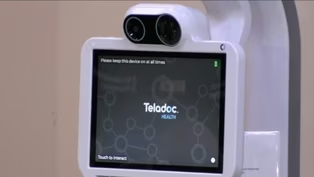
Alabama lawmakers seek details on how rural health grants will reach communities
Clip: S21 Ep89 | 2m 35s | Alabama lawmakers seek details on how rural health grants will reach communities (2m 35s)
Providing Support for PBS.org
Learn Moreabout PBS online sponsorship New Episode
- News and Public Affairs

Top journalists deliver compelling original analysis of the hour's headlines.
 New Episode
- News and Public Affairs

Today's top journalists discuss Washington's current political events and public affairs.
 New Episode
 New Episode
 New Episode
 New Episode


 New Episode
 New Episode

Support for PBS provided by:
Capitol Journal is a local public television program presented by APT