
What Is NITA? Here's What to Know About the New Transit Authority
Clip: 9/9/2026 | 3m 44sVideo has Closed Captions
The Northern Illinois Transit Authority board will meet Sept. 10, 2026.
The Northern Illinois Transit Authority is a new regional body overseeing CTA, Metra and Pace. It was created after years of debate over the future of Chicago-area transit, a debate exacerbated by a drop in passenger revenue during and after the COVID-19 pandemic.
Problems playing video? | Closed Captioning Feedback
Problems playing video? | Closed Captioning Feedback
Chicago Tonight is a local public television program presented by WTTW
WTTW video streaming support provided by members and sponsors.
What Is NITA? Here's What to Know About the New Transit Authority
Clip: 9/9/2026 | 3m 44sVideo has Closed Captions
The Northern Illinois Transit Authority is a new regional body overseeing CTA, Metra and Pace. It was created after years of debate over the future of Chicago-area transit, a debate exacerbated by a drop in passenger revenue during and after the COVID-19 pandemic.
Problems playing video? | Closed Captioning Feedback
Where to Watch Chicago Tonight
Chicago Tonight is available to stream on pbs.org and the PBS app.

WTTW News Explains
In this Emmy Award-winning series, WTTW News tackles your questions — big and small — about life in the Chicago area. Our video animations guide you through local government, city history, public utilities and everything in between.Providing Support for PBS.org
Learn Moreabout PBS online sponsorship>> new era for Chicago area Public Transit.
Tomorrow marks the first meeting of the new northern Illinois Transit Authority Board.
Nida was created last fall when the Illinois General Assembly passed a major transit funding package to keep CTA, Metra and pace from going over a fiscal cliff along with an overhaul of how public transportation in the region is governed.
Our Nic Blumberg joins us now to explain what changes riders will see.
And Nick, remind us how we got here.
What brand is that Bill, you mentioned that state lawmakers passed last fall.
It came after years and years of debate over how best to manage Chicago area transit.
>> And of course, that debate was really exacerbated by the drop in passengers and therefore passenger revenue during and after the COVID-19 pandemic.
So federal COVID relief money was running out.
Lawmakers managed to pass a measure to infuse a billion and a half dollars in additional public funding into the system each year.
And that will also created needed to replace the regional transportation authority.
You know, critics said the RTA didn't do enough to coordinate CTA, Metra and pace really create a seamless system for riders.
Some advocates wanted all 3 of the transit system's rolled into one.
This doesn't go quite as far but Meta has significantly more oversight authority and the 3 transit operators there now more so in charge of just moving buses and trains day today.
So what are some of the big changes that riders will see?
And when will there are a few key areas in a series of rolling deadlines that are built and to make sure that progress stays on track to pun intended.
one of the big ones is creating a universal fair system has until July of next year to put a procurement process for that system in place.
And then it's supposed to be up and running by February of 2030.
There's also public safety need a has a law enforcement task force.
Its report is due in March 2027 and then no later than June 2029, that task force has to be disbanded and they're going to be a transition to some kind of crime prevention program that uses sworn law enforcement officers.
Now on the non-law enforcement side, there's a new transit ambassador program scheduled to launch in July of next year.
Those are customer-facing employees aimed at improving riders experience is helping them with any issues they might encounter.
There's also a big focus on truly regional service planning.
So essentially, you know, making sure a metro train doesn't pull into a station right as a CTA pace buses pulling away.
There's a transition report on everything from service coordination to capital planning.
You name and that report.
That's due next July.
And then CTA, Metra and Pace have to submit coordinated service plans to meet up by April of 2028 for board approval by year's end and that new service schedule will go into effect in 2029.
Lots of work ahead.
media is overseeing the transit system who's overseeing need a good question.
As we mentioned, tomorrow is the first meeting of need is newly installed board of directors.
The governor, the mayor, Chicago and the Cook County Board president each get to name 5 directors.
The Collier County executives that's came Lake McHenry to page.
Will they get one pick each that it was something of a bone of contention when the bill was being negotiated with a lot of suburban officials arguing that the debt will be stacked in Chicago's favor and its supporters say they are committed to a truly regional approach, an equitable approach.
And Chicago transit advocates also point out that the vast majority of rights do occur on the CTA.
So a lot of the need to board appointees.
They'll also serve as directors for CTA, Metra and pace.
They'll still be having will be keeping their own boards.
So as you said, there is lots to keep track of.
But
 New
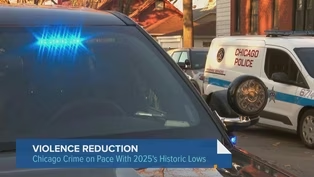
NewPublic Safety Concerns Remain as CPD Reports Lower Violent Crime Rates
Video has Closed Captions
Chicago police reported the lowest number of homicides in June, July and August since 1965. (16m 55s)
Providing Support for PBS.org
Learn Moreabout PBS online sponsorship New Episode
- News and Public Affairs

Top journalists deliver compelling original analysis of the hour's headlines.
 New Episode
- News and Public Affairs

Today's top journalists discuss Washington's current political events and public affairs.
 New Episode


 New Episode
 New Episode
 New Episode

 New Episode
 New Episode
Support for PBS provided by:
Chicago Tonight is a local public television program presented by WTTW
WTTW video streaming support provided by members and sponsors.