Docs on Call
Keeping Kids Healthy Through the School Year
9/20/2026 | 27m 4sVideo has Closed Captions
Pediatrician Dr. Aaron Traeger shares practical ways to keep kids healthy in school.
Pediatrician Dr. Aaron Traeger offers practical guidance for keeping children healthy and ready to learn throughout the school year. He joins Mark Welp to discuss sleep, screen time, school anxiety, nutritious meals, afterschool activities, common illnesses and when parents should call their child’s doctor.
Problems playing video? | Closed Captioning Feedback
Problems playing video? | Closed Captioning Feedback
Docs on Call is a local public television program presented by WTVP
Docs on Call
Keeping Kids Healthy Through the School Year
9/20/2026 | 27m 4sVideo has Closed Captions
Pediatrician Dr. Aaron Traeger offers practical guidance for keeping children healthy and ready to learn throughout the school year. He joins Mark Welp to discuss sleep, screen time, school anxiety, nutritious meals, afterschool activities, common illnesses and when parents should call their child’s doctor.
Problems playing video? | Closed Captioning Feedback
Where to Watch Docs on Call
Docs on Call is available to stream on pbs.org and the PBS app.
Providing Support for PBS.org
Learn Moreabout PBS online sponsorship(playful music) (inspiring music) - The school year is in full swing.
Tonight, we focus on how your kids and you can survive homework, sports, and afterschool activities.
(uplifting music) (uplifting music continues) Good evening, and thanks for joining us for WTVP's "Docs On Call."
I'm Mark Welp.
We're about a month into the school year now, and while the first day excitement has settled, new challenges can start to pop up, from keeping kids healthy to helping them stay focused and energized.
Joining us today to share how families can keep that back to school momentum going strong all year is Dr.
Aaron Traeger, a pediatrician with Carle Health at the Carle BroMenn Outpatient Center in Bloomington.
Doctor, thanks for coming on.
I assume this is your busy time of year.
- Yeah, it's actually quite refreshing.
Being a pediatrician kind of has its rhythms to the year, and it's that slow buildup to school starting, ending in just very, very busy.
School starts.
We're kind of in a quiet phase right now while we're waiting for everyone to get a little sick.
But once that starts happening, it's gonna get a lot more exciting going through respiratory season, but it's great as a rhythm of pediatrician feels really good right now.
- In a little bit, we'll talk about how we can hopefully prevent some kids from getting those illnesses, but it seems like they're inevitable at some point.
- [Aaron] Mm-hmm, certainly.
- First, let's talk a little bit about our kids and their healthy minds.
And one question that comes up a lot with parents is, how much sleep should my child get?
Can you kind of take us through, start maybe kindergarten age and go all the way up through high school?
What do you think?
- Yeah, you're right.
And it's cool because sleep is one of those things that as your child ages, it does change.
The kindergartner who comes home from school and is totally gassed, and they're tired and ready to go to bed is very different than that middle schooler who is pushing you to try and stay up later and later.
But yeah, but generally, preschool age kids, three to five, so definitely want to try and aim for somewhere between like 10 and 13 hours of sleep a night.
The school agers, the kids that are middle school, elementary school, again, if you can get to that 9 to 12 hour mark.
And then for teens, yeah, you get to high school, get into later middle school and stuff like that.
A little bit less sleep, but still just as essential.
We really want them to be aiming for 8 to 10 hours of sleep a night.
- So that eight hours we hear about is kind of the magic number, at least eight hours, I guess?
- Yeah, it really is.
And one thing that I think a lot of people are surprised by is that if you look at how much your kid's actually sleeping, they're probably needing more.
And especially when you start looking at just the stress of now that we're in the school year, how it really is, you're like, "Man, you're starting to get a little tired.
You're starting to have these different things that are happening.
And I wonder if it's sleep is off or thrown off a little bit."
So getting back to the basics, getting back to the routine that we tried to start at the beginning of the school year would be a good thing to focus on.
- So for kids seem to be sleeping a lot, it's not necessarily something we should worry about as parents?
- Well, for the most part.
Yeah, you know your kids, and that's the thing that's really important.
But as the school year started, a lot of families are really intentional about trying to get some kind of a rhythm.
They're saying, okay, this is the year, this is the year that we're gonna do our best and we're gonna get to bed on time, and we're gonna have a regular wake up routine.
So then you have those things that have started at the beginning of the year and you're going strong, but well, now we're a month in and things may have slipped, and now the kids are getting a little more sleepy after school or a little more crabby in the morning, a little harder to wake up.
So we kind of need to start to audit the process and go, "Hey, where are we leaking?
Are we staying up a little bit later than we should have been?
Or those mornings are just kind of dragging, do we need to start looking for it?"
But yeah, you're right.
Families know, you know your child, you know your kid, and trying to catch up on sleep is great.
Something feels different, if something doesn't feel right, got to talk to us.
But yeah, for the most part, more sleep, more sleep.
- And another thing we always hear about is screen time.
Our kids now seem to have watches and iPads and phones and all that stuff.
So, and it's hard to like get them away from the kids.
- Yeah, it really is.
- Especially when it comes to sleep time, and we've heard that screens are not good when you're trying to fall asleep.
Tell us a little bit more about that.
- Oh, that's so perfect that you bring this up because when it comes to sleeping, if there's a couple behaviors that you can really focus on as a family, as a family, okay, we're talking parents here too, is you do not need a screen in your room.
Okay?
We have this rule in our house, and I'll tell you, we're incredibly popular with our three children, that they are not allowed to have screens in their rooms.
That means no tablets, no phones, we don't have TVs in there.
They have to put them outside the room and plug them in and charge them outside.
The pushback is from the high school kid, "Well, I need it for my alarm."
No, they make alarm clocks for that.
They really do.
They're old fashioned, and they're wonderful.
But setting that boundary to say, "No, this isn't gonna be in your room."
Because what you're doing is you're establishing a space that you say, "This space is dedicated for sleeping, and this space is where your mind is gonna get the most rest that you need."
So yeah, get away.
And because what's happening is, it's actually kind of cool, that light, even with the filters and different things like that, that light is triggering the area of your brain to say, "It's time to wake up."
Okay?
So yeah, we want to kind of squash that.
The other thing is, remember this thing that's in your brain is being triggered to say, "It's time to wake up by getting that extra light from your screen."
Another rule that we have that's really great, we think, is we don't do screens before school starts.
Okay?
You do not need to wake up and get on a screen.
You don't need to play video games.
You don't need to do those things.
Because what we find is, is that when these kids are waking up and they get on the screen, sure, they can do the routine, whatever, but if they get on that screen, you're training your brain more and more to wake up earlier and earlier.
And these kids wake up kind of like hooked on it.
Like you're saying, you're trying to wrestle it away from them.
They wake up earlier and earlier because they're trying to get more screen time in throughout the day.
So we just say, "Nope, blanket statement.
We just don't do that."
And so the kids don't need it.
So it makes wake up a lot easier.
- I'm gonna throw this question kind of out of left field, but the governor just signed a bill that says no cell phones in schools.
Do you think that's good?
- Oh, I think it's wonderful.
And we've been asking for it for such a long time.
There was a really interesting book, and it was called "The Anxious Generation."
And one of the big recommendations from that book, and this is an evidence-based kind of a process that they went through, is to say that really kids don't need phones in school and that those types of things, along with early social media exposure, things like that, are making children be more anxious.
So to say that we can't have phones in schools, I think is great, okay?
I really, really do.
Since we're talking about kids in school and being on phones, I'm curious.
Actually, I don't want to throw you under the bus and ask what you guys do, but how does your family handle cell phones?
What age do you guys think it's appropriate for your kid to start getting a cell phone?
- Personally, and I've been told this by friends and family members, hold off as long as you can.
My daughter's 12, and we just got her an Apple Watch, but mostly so we can keep track of where she is.
She can use it to text and do some other stuff, but no talking, obviously.
So that's kind of where we're at.
As the years go by, we're being slowly worn down.
And there's a lot of peer pressure too, because I would say more than half of her friends already have a phone.
- They do.
You're right.
And okay, so number one, massively approve of that.
That's a great plan that you guys have done.
That's how we are too.
We don't get cell phones until they get into high school.
But my kids are active in sports.
They're active in ballet.
They have a social life that is way more impressive than mine, right?
So the peer pressure all the time is, well, so-and-so has a phone.
And what we have to say is, that's okay.
Our family doesn't do that.
There are ways to keep track of your kids, including the adults that are around them.
When you're in middle school, you're not just out running around.
There's parents, there's coaches, there are people there that if we need to get a hold of you or they need to get ahold of us, that's there.
So for us as a family to say, "Hey, we're not gonna do cell phones until your high school," I think is a great plan.
And then also, this rule saying that we're not gonna have cell phones in schools, I think is a really great plan.
And what's cool about this is, is that the teachers, I think, have been, my teacher friends and our kids' teachers have been fighting this for a while saying, "It's getting out of hand," right?
And then for them to be able to have the administration come in and say, "We don't think the kids should have cell phones."
There's those families, that peer pressure is there from a lot of families saying, "Well, my child needs this, or my kid needs to be connected to their social media for something like that."
Those are the pushback that they're getting.
But for the government to step in and say, "Hey, we think this is a great public health initiative that we want to do to make sure that we're protecting our kids," I think it's a great plan, so.
- Someday our kids will thank us, maybe.
- Someday, yes, that is right.
We will see.
- Keep telling myself that.
Let's talk, you mentioned being anxious a little bit earlier.
Let's talk kind of about back to school jitters, and those jitters can continue well after school has started, whether it's a younger child who maybe has separation anxiety or an older child who is having peer pressure issues, let's just say.
How can parents help their kids be more comfortable with going to school?
- Yeah, no, really cool.
Cool question because we're weeks into school now, and it's a very different conversation leading up to the weeks when school is starting.
You know your kids, you know your kid.
And if your kid is the one that is a little more worried about this, talking it up, getting them ready for something new, "Hey, we're gonna meet our teacher.
Hey, we're gonna be back with our friends."
Those types of things really pay off for those kids that need that.
For some kids, they just need to be dropped off and just go, and that's okay too.
But now that we're a couple weeks into school, if kids are starting to do things where they're starting to feel like the mornings are getting rough, we're still complaining of those bellyaches, we're still complaining of some of these headaches, or we're still seeming to be avoiding things more, then it is time to start really asking some serious questions of your teachers.
And I think that people forget that, is that they can reach out to the teachers.
These guys love it when parents are involved to be able to say, "Hey, what are you seeing?"
And the teacher can come back, and they might reassure you and say, "Yeah, 30 seconds into school, man, your guy is nuts.
It's wonderful.
They're having a great time."
Or they can say, "Hey, I'm noticing something too, and then we should start talking about it."
So in our communities, we have great resources to help with mental health types of concerns, including reaching out to your physician about this, because there are some things that we can do that can make a big difference.
But the really important thing that I think that we need to focus on is that remember, you know your child best.
And if something doesn't feel right, trust your instinct and reach out for help because there are people that want to help.
- Let's talk about those mornings when we're trying to get the kids ready and out of bed and bathed and especially fed.
Let's talk about breakfast, and is that as important as we've always been told?
- Yeah, you're right.
So you've heard that breakfast is the most important meal of the day.
That's probably not true.
That's probably not a thing that you have to have breakfast or especially that it's not the most important meal of the day.
But practically, yeah, we want your kids to be fueled well for school.
Okay?
So that means having a nice, diverse breakfast that includes lots of protein and things like that.
So yeah, every family does this differently, and you have to do what's best for your family.
If my kids were, if my family was trying to make sausage and eggs and pancakes and crazy things like that for breakfast every morning, it would be a lot of strain on our family dynamics.
So we can't do that, right?
So we do rely on some of these prepackaged things, or what we're doing is we're trying to prep the night before for those things.
Those are really good, but if you're gonna focus on something, focus on protein.
Protein is your friend, okay?
Those things that are really higher in the carbs and the sugars and stuff like that, your body's gonna burn through them, and then a couple hours later, you are going to feel a little bit of that blood sugar kind of a drop, and it's gonna make you feel a little bit crummy.
Really fascinating is that a paper came out just a month ago that was looking at having breakfast, what it does to your, looking at your weight overall.
Probably skipping breakfast isn't the best way to lose weight, or having breakfast probably doesn't contribute to it very much.
So there really wasn't a lot of change in weight in those things.
But for the people that did not have breakfast, they were consuming less calories during the day, but a much larger meal later on in the afternoon.
And that's not necessarily good or bad, but then they looked at the group that did have breakfast, and they saw that their blood sugar remained much more evenly distributed, much more even throughout the day.
So you can imagine that these, these little guys, these little kids that sometimes don't have a lot of reserves there, they are more likely to not have those ups and downs, that feeling of like your body is craving something again by having a breakfast.
So yeah, so a very big fan, do what works for your family, do what works for your kid, focus on protein, like that really is a thing, and try and pick a nice, healthy meal.
- Should you have that same philosophy for lunch then?
- Yeah, so lunch is interesting because the school lunches, while there's guidelines that the school has to follow, they're gonna put food in front of your kid, and it may not be what they eat.
They can bargain and they can do different things with other folks.
We hope that they're choosing healthy things, and that's a behavior hopefully carrying over from what you're doing back at home.
But sometimes it's easier for you to make your own, you make your kid's lunch and send it with them.
That way you're sure that they're at least being offered the things that are important to you and your family.
Again, we'd like you to focus on protein and veggies and stuff like that too.
But there's always that snack food that's in there for all the time and stuff like that.
And that's what they look forward to, but you hope they're eating the rest of those things as well.
- Yeah, I don't know what school cafeterias are like these days, but I know when I was in high school, I wasn't eating Brussels sprouts for lunch.
- [Aaron] Yeah, you certainly weren't.
- You pick out anything you want no matter how unhealthy it is, and you just eat it.
- When you were a kid, did you have those square pizzas?
- Oh yeah, yeah, yeah.
- Oh, man.
- I'll take two of those with extra grease, please.
- Yes, yeah, because trading those for the less healthy options, trading for people.
Yeah, it's just a thing.
- And I guess portion controls too, something that parents ought to be teaching their kids.
- Certainly, yes.
- Let's talk a little bit about some other habits besides getting the sleep and good food.
What other kind of habits should kids be doing to make sure they're getting through the day and they're optimizing their energy?
- So yeah, so being active, that really is an important part of it.
During the school day, a lot of places, they don't have recess, they don't have a whole lot of time around, especially in like the elementary school ages to actually get out and interact and be physical with folks.
So really trying to build activity into your daily routine is really, really essential.
So whatever that afternoon routine looks like, whether it's, you know, we come home and we have a snack, and we do our homework right away, and then we go play, or vice versa, whatever works best for you guys is the best thing, but including activity is a very important part of that.
And since we already talked about screens a little bit, if we're limiting screen time, if we're really following the new guidelines from the American Academy of Pediatrics that came out in 2026, where we really want to have less than two hours of screen time for older kids a day, then the rest of that time should be filled with going outside, playing, trying to be with friends in the real world.
So building into some type of activity every day is pretty important, whether that's organized sports or it's just get outside, go find the kid down the street and go have a good time.
- When it comes to gym class or recess for the younger kids, do you think just whatever their school does, they're getting enough physical activity at school?
- Probably not.
Yeah, it's great for them to have something like that, but more really is more.
Okay.
We really want them to have more of those activities throughout the day.
- Sure.
So when we talk about afterschool activities as the kids get older, they're playing sports, they've got clubs, things like that.
And of course, most of us encourage our kids to do that.
It's great stuff, but how do you determine when maybe it's too much for the kids to handle?
- Yeah.
Well, part of it's what the kids can handle, and it's also what the parents and the family can handle.
- Amen.
- I'll tell you what, if you're really running around and driving around all over the place all the time, and it's becoming a burden for your family, it's not worth it.
It's really not.
We have to do what works best for the family.
Now for the kids themselves, again, you know your kids, right?
And some people need that extra activity.
They really do have to burn off that energy to be successful throughout the daytime.
There are other kids that they need that physical activity, or they need the sports, or they need ballet, or whatever it is that they're doing because it helps organize their day.
There's so many middle schoolers and high schoolers that if they didn't have that, "Oh, I have football practice at this time or I have basketball practice, and if I don't have that, then I would just do my homework whenever."
No, it's like, "I have to get my stuff done so that I can participate in sports."
It organizes their day, so they may need those things, right?
But every kid is different, and you have to kind of fill it out.
But if your kid isn't enjoying it, you're gonna know, right?
Or they're gonna say things that make you feel like they're not enjoying it.
Then having that discussion with them to say, "Are you having a great time?
You don't have to do this," right?
And back off.
The other thing is too, is that if they're getting edgy or difficult or we're falling behind in our schoolwork, it sounds like it's time to maybe back off.
Okay, maybe this musical isn't the right thing to do right now because I'll tell you what, we need to focus back on school and family or those types of things.
- Let's talk about parents because to raise a good kid, I think the parent has to be energized and healthy and everything else.
So what can parents do to kind of keep their sanity during these times and keep themselves healthy so they can focus more on their kids?
- The first question you asked about was sleeping for kids, and you're right.
We don't focus enough on that as parents, on how much sleeping are you guys getting?
Is your phone really in your room?
Are you on your phone right before you fall asleep?
Are you being physically active yourself?
Are you eating a nutritious meal?
I mean, parents are really cool.
We, all of us parents, are really cool because we want our kids to do better than, or have better than we did, right?
And we'll sacrifice for ourselves there.
We'll sacrifice our own health, our own sanity to get our kids to the different events that they're doing.
And really what we should be doing is just looking at as a whole unit.
The family should be active, the family should be eating well, the family should be doing things to protect our mental health.
So yeah, so all of those same types of tricks apply to us as well.
- Let's talk about cold and flu season.
We talk about our schools being big Petri dishes.
And it seems like it's kind of inevitable that kids are gonna get sick, but what are some things that parents can have their kids do to try and protect themselves from all these germs?
- Well, you know, the bubble thing, they don't make bubbles big enough.
No, I'm just, I can't do that, right?
But true story, you know, hand washing, hand hygiene is such an important part of this.
Washing your hands before we're having meals, washing our hands after we're being in certain environments around people in close quarters, because so many of the things that we have, infections we get are from, you know, they're spread by touch.
They're not necessarily spread by breathing.
Now, the one thing that we do kind of say a little bit different is, is that a lot of things that are spread by breathing are associated with, you know, lots of coughing and especially fevers.
So if your child is sick, we really do want them to stay home.
Okay?
They're not gonna do good at school if they're feeling crummy, or they're not gonna do good at sports if they're feeling crummy.
So stay home, get better, right?
And you're not gonna spread this stuff around as much.
But hand hygiene and staying home when you're sick are two very, very essential parts of this.
- Yeah, some schools have those guidelines.
If your child has a fever of a certain number, don't come back for a day.
So should parents... what kind of guidelines should they look at, or is it not a one size fits all type thing?
- Well, yeah, it is hard.
If you're over a 101 as a temperature, then yeah, you shouldn't be at school.
And really, I'd even argue that if your kid's acting ill enough that you feel like you have to ask like, "Hey, should they go to school?"
Then again, you know your kid.
Some kids, they're kind of a slower start, rougher in the morning, and if you want to get them out the door, we're gonna be okay.
But if they have a fever, if you're checking their temp, it's probably a good idea to stay home.
- Let's talk about something that's a little bit controversial with some people, and that's vaccinations.
Our schools require certain things, and there are some parents out there that don't want their kids to get vaccinated for whatever reason.
What are your thoughts on vaccinations?
- Well, this is such an incredibly complex topic, and unfortunately it is becoming a lot more politically and emotionally fueled recently.
But what I tell folks daily is that these things are safe and they're effective.
And if I had any doubts about this, if I had doubts about these things, we wouldn't be vaccinating my own children against those things, right?
From a public health point of view, the policies and the procedures in place that we've had talking about vaccines have protected so many people and saved the lives of so many people and children in this country and worldwide because of the things that we've done.
These things are, they are supported by science that has been shown with a very, very long record of not only being effective, but also very safe as well.
At the same time, I completely appreciate when people say, "Hey, look, I'm concerned about this.
I'm worried.
I want to ask questions."
We welcome those questions all the time, and your physician would love to help answer those questions for you and your family because your child is probably one of the most important things, if not the most important thing that's ever happened to you.
And it's hard when you're hearing people talking and saying, "I'm worried about this," or, "I think that this is happening," and then to worry that that's not gonna happen to yourself.
So again, talk with your doctor.
It's a much bigger conversation than just what you're gonna find on the internet or on Instagram.
It really is, is find the people that you trust, and those are the people that you're bringing to your child too when they're sick so that you can have a conversation and say, "Hey, let's talk about this."
I know every physician or nurse practitioner, PA, people that I know, they welcome these conversations when you can come to them and say, "Hey, I'm concerned.
Let's talk about it."
And they'll spend the time with you to take care of this.
- One thing that some parents get confused about, myself included, when their child does get sick and starts showing symptoms is, "Is this something I should really be concerned about and go to the hospital?
Should I go to urgent care?
Should I go to my pediatrician?"
Do you have some general guidelines parents can follow in terms of what they should do when they think their children is getting sick?
- Yeah.
So a really important thing for doctors and advanced practice providers is that we really do believe in the medical home.
We've had a relationship with us for hopefully for a very long time, okay?
It's so cool.
We just finished school physical season, a little side here.
We just finished school physical season a month ago, and there are kids that I have seen that have held them as babies and now they're sending them off to college, right?
So to be with them that entire time is so important, and we cherish it so much.
So I really do hope that when those guys are sick, that the first people they call are my partners and myself.
That's a really important part of why we go into this.
So yeah, if you have questions, reach out to your doctor, right?
If you need to use an urgent care or things like that, I think that that's okay too.
Now, if you're concerned, if you're ill, that's what the ER is for, right?
But your first call hopefully is to the people you've been trusting this entire time with your child's life.
- Absolutely.
As a doctor, real quick before we run out of time, how have you seen illnesses in kids evolve over the years?
Has it been kind of steady, you know, common cold, things like that?
Or are kids getting any sicker than they were 10, 15 years ago?
- Yeah, it's actually really cool.
I'm an old man now.
So back in the old days when I was working at St.
Louis Children's Hospital, that was during the whole swine flu thing, right?
So we had this novel influenza, and we had some really sick children there, right?
And then it kind of faded.
And then there's something new that pops in, and then there's some... So the kind of the rhythm is, is that these things do kind of come and go.
You probably remember a couple years ago, we had strep throat that was really, really, really bad, and lots of kids got very ill from those types of things, right?
So always new challenges, always new things that are popping up, but are kids getting more sick than they were before?
I would actually point to the historical data in our country showing that because of the programs like immunizations, that we are not seeing children, you know, as ill as they have been in the past, and we're protecting them from terribly scary things.
So we wash our hands, and we hopefully, you know, people aren't gonna get as sick, and things get better.
- Good to know.
Dr.
Aaron Traeger is a pediatrician with Carle Health at Carle BroMenn Outpatient Center in Bloomington.
Doctor, thanks for coming on.
Great talking to you.
- Great, thank you so much.
- All right.
And you can watch this show again and share it with your family and friends.
Just go to wtvp.org.
You can find out about future show topics on our Facebook and Instagram pages.
And as always, we want to know your questions and topic suggestions.
You can message me on social media or leave a comment.
Thanks for watching and take care of yourself and your family.
(inspiring music) (bright music)
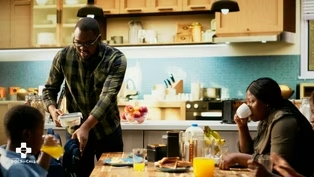
Building a Better Breakfast for Kids
Video has Closed Captions
Dr. Aaron Traeger explains how a protein-rich breakfast can fuel kids for the school day. (2m 13s)
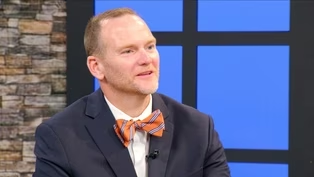
Preview: Keeping Kids Healthy Through the School Year
Preview: Keeping Kids Healthy Through the School Year (30s)

When Afterschool Activities Become Too Much
Video has Closed Captions
Learn how to recognize when sports, clubs and other activities are becoming too much. (1m 42s)
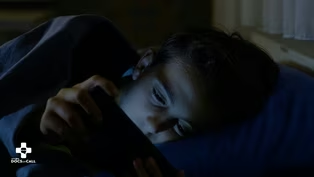
Why Screens Should Stay Out of Kids’ Bedrooms
Video has Closed Captions
Dr. Aaron Traeger explains how screens in bedrooms can interfere with children’s sleep. (1m 32s)
Providing Support for PBS.org
Learn Moreabout PBS online sponsorship New Episode
- Science and Nature

Explore scientific discoveries on television's most acclaimed science documentary series.






 New Season



 New Season

Support for PBS provided by:
Docs on Call is a local public television program presented by WTVP