
Stone Age Masterpiece
Season 53 Episode 11 | 53m 42sVideo has Audio Description
Step into the stunning cave that’s reshaping our understanding of prehistoric art.
Take an exclusive journey into a spectacular cave, hidden for millennia. Discover well-preserved Stone Age art of lions and mammoths, and see how scientists are unlocking the secrets of these masterpieces of early human creativity.
See all videos with Audio DescriptionADProblems playing video? | Closed Captioning Feedback
Problems playing video? | Closed Captioning Feedback
National Corporate funding for NOVA is provided by Carlisle Companies. Major funding for NOVA is provided by the NOVA Science Trust and PBS viewers.
Support provided by:


Stone Age Masterpiece
Season 53 Episode 11 | 53m 42sVideo has Audio Description
Take an exclusive journey into a spectacular cave, hidden for millennia. Discover well-preserved Stone Age art of lions and mammoths, and see how scientists are unlocking the secrets of these masterpieces of early human creativity.
See all videos with Audio DescriptionADProblems playing video? | Closed Captioning Feedback
Where to Watch NOVA
NOVA is available to stream on pbs.org and the PBS app.
Buy Now
NOVA Labs
NOVA Labs is a free digital platform that engages teens and lifelong learners in games and interactives that foster authentic scientific exploration. Participants take part in real-world investigations by visualizing, analyzing, and playing with the same data that scientists use.Providing Support for PBS.org
Learn Moreabout PBS online sponsorship♪ ♪ NARRATOR: Hidden in the gorges of Southern France lies one of the most stunning decorated caves ever discovered.
♪ ♪ GILLES TOSELLO (translated): It's the most beautiful cave in the world.
It ticks every single box.
(translated): The Sistine Chapel of Paleolithic art.
(thunder crashes) NARRATOR: A natural wonder visited by animals for thousands of years.
(bear snuffling) Until eventually, people arrived, some of them covering its walls with drawings of exceptional beauty.
Since its rediscovery in 1994, only a limited number of scientists have been granted access.
♪ ♪ STÉPHANE JAILLET (translated): When you see such a sparkling and well-preserved cave, you feel like the first person in it.
CATHERINE FERRIER (translated): It was an amazing opportunity, an unforgettable moment that I'll cherish forever.
(translated): I never imagined I would take part in such an adventure.
NARRATOR: Now scientists are returning to the cave to search for new clues... (speaking French) (translated): Those are blown dots.
NARRATOR: ...about the people who came here and what moved them to create these haunting images.
It totally changed my way of thinking.
♪ ♪ NARRATOR: "Stone Age Masterpiece," right now, on "NOVA."
♪ ♪ ♪ ♪ (birds chirping) NARRATOR: In Southern France, nestled between mountains to the east and west, lie the Gorges of the Ardèche, riddled with around 1,500 limestone caves.
Among them one remarkable site.
Since its rediscovery in 1994, its location has remained a carefully guarded secret.
But it is there, somewhere, 650 feet high, accessible only by a narrow wooden footbridge.
The cave is closely monitored by surveillance cameras and secured by a biometric fingerprint identification system.
Here, a steel door, 15 inches thick and airtight, protects the treasure from the elements.
The French government controls access to this heavily secured archaeological site.
The general public is not allowed inside.
This is the Chauvet Cave.
Its walls are decorated with some of the oldest and best-preserved Stone Age art in the world.
So fragile that even breathing on the paintings could damage them.
Now, for the first time, France is allowing a film crew to bring half a ton of specialized equipment into the cave to photograph the site in precise detail, creating a valuable archive for people to study and learn from in the years to come.
♪ ♪ The images will preserve the discoveries made by three intrepid cave explorers when they were first investigating the caves of the Ardèche in December 1994.
ÉLIETTE BRUNEL (speaking French): BRUNEL and JEAN-MARIE CHAUVET: CHAUVET: NARRATOR: During that time, Éliette Brunel, Christian Hillaire, and Jean-Marie Chauvet followed a flow of air coming through cracks in the rock, which indicated a cavity behind the wall.
♪ ♪ Éliette squeezed through a tiny passage, followed closely by the others.
What they saw astonished them.
CHAUVET: Ooh!
(echoes) NARRATOR: They'd just entered an extremely large open space.
Suddenly, Éliette said, "They were here."
♪ ♪ On the walls were clear signs of the Stone Age people who roamed the area tens of thousands of years ago.
The explorers had found one of the most beautiful decorated caves in the world.
The next day, they contacted Bernard Gély, the researcher in charge of the decorated caves of the Ardèche.
GÉLY (translated): The first time I heard of the Chauvet Cave was on the phone.
Éliette, whom I call Lily, and Jean-Marie Chauvet called me to say they'd made an important discovery.
I could really sense the emotion in their voices.
♪ ♪ NARRATOR: They named the cave after Jean-Marie Chauvet, because he had been the first to insist on exploring it.
(translated): A few days later, its authentication was organized with the ministry's official specialist, Jean Clottes.
(men talking softly in French) (exclaiming and chuckling) CLOTTES (speaking French): GÉLY (translated): We were very professional.
The whole point of this process is to verify its authenticity.
That's the first objective.
And we were convinced just 30 to 60 feet in!
CLOTTES (speaking French): GÉLY: (conversation continues in French) CLOTTES: GÉLY (translated): It was obviously very emotional.
I think we all cried at one point, or at least shed a few tears.
We were all truly fascinated, there's no other way to put it.
CLOTTES (speaking French): ♪ ♪ NARRATOR: Three months after this discovery, the first dating results come in, and they are astounding.
(speaking French): NARRATOR: Multiple radiocarbon dates obtained from charcoal indicate that the drawings are over 37,000 years old, almost twice as old as those in Lascaux, another French cave, making Chauvet one of the oldest among the hundreds of decorated prehistoric caves so far discovered around the world.
♪ ♪ Then, in 1998, the first research expedition begins.
Carole Fritz, who is named director of the scientific team in 2018, is part of that mission.
FRITZ (translated): The team put together by Jean Clottes was the first interdisciplinary team, meaning he hired people from different fields to work together.
(translated): Some of the people on the team were geoscientists.
Others were climatologists.
Some were specialized in chronological dating.
And of course, there were archaeologists and prehistorians, including specialists in cave art.
(translated): That was the great strength of the Chauvet team, and it was unheard of in France and in Europe.
NARRATOR: The team consists of 15 scientists.
After setting up a staging area, they finally head inside.
The original Stone Age opening had been sealed by a rock fall more than 20,000 years ago, forcing the researchers to squeeze through a safe, reinforced passageway.
But even inside the larger cave, their freedom of movement is limited, as their very presence poses a threat to the art.
(speaking French) FERRIER (translated): We can't work in Chauvet like on other sites, so, as we say, we work in a non-harmful way, meaning that we can't go everywhere and can't go near some of the elements we want to study.
MAN (speaking French): NARRATOR: Still, the opportunity to be even this close is precious.
They work together with the same goal: to uncover the complete history of the cave, all the way back to its geological origin.
To a time when the Gorges of the Ardèche didn't exist.
(Jaillet speaking French) (translated): 120 million years ago, the landscape was obviously totally different from the one we know today.
It looked more like a lagoon or a seashore, with a giant coral reef.
(speaking French) (translated): It was sort of like the Great Barrier Reef in Australia.
Layers and layers of limestone accumulated there over millions of years.
NARRATOR: Over time, as billions of marine organisms decomposed, they formed a layer of sediment at the bottom of the lagoon.
This layer became an underwater mountain range of limestone 1,000 feet high.
Eventually, tectonic forces deep in the Earth pushed the rock upward.
JAILLET (translated): Once the limestone massif formed under water, it rose under the effect of tectonic forces.
This is how mountains rise.
(speaking French) ♪ ♪ (translated): Everything rose that way.
So the limestone which was under water therefore appeared above water level.
♪ ♪ NARRATOR: Water rushed down through the rocky plateau, carving out the bed of what is now the Ardèche River.
But another tectonic shift brought more changes.
JAILLET (translated): A peculiar event occurred about six million years ago, as the Strait of Gibraltar closed.
♪ ♪ The closure of the strait caused the Mediterranean to evaporate.
The sea level lowered by 6,000 to 10,000 feet.
(speaking French) (translated): As the Mediterranean dried up, all the rivers that flowed towards it plunged straight into it.
♪ ♪ NARRATOR: As the rivers flowed down into the sea, they shaped the landscape.
In the Ardèche, they carved a deep canyon.
600,000 years later, the Strait of Gibraltar opened up again.
The Atlantic Ocean flowed back and flooded the valleys, forming the landscape that surrounds Chauvet Cave.
JAILLET (translated): The Gorges of the Ardèche are an exceptional geomorphological element.
It's a gorge, a canyon.
It's as if a 19-mile-long and thousand-foot-deep saw had cut through the limestone massif.
(thunder crashes) ♪ ♪ NARRATOR: Over millions of years, rain lashed the Gorges.
The slightly acidic water reacted with the calcium in the limestone cliffs, eroding them.
It seeped through fractures in the rock, drop after drop, widening the cracks, creating a network of tunnels, galleries, and underground rivers-- what geologists call a karst.
♪ ♪ This process slowly carved the region's caves, including Chauvet.
Until finally, around two million years ago, the water retreated.
JAILLET (translated): This underground space then underwent other transformations: some blocks fell, concretions grew, calcites formed, and erosion increased the volume of the chambers.
The original space was totally disrupted by different phenomena.
NARRATOR: The size of the Chauvet Cave is truly impressive.
91,000 square feet, divided into about 20 chambers and galleries, some almost 60 feet high.
Geological surveys suggest the original cave entrance was monumental.
Around 30 feet high and 50 feet wide, it was likely similar to the opening of this nearby cave, an inviting refuge that overlooked the landscape.
But who were those first people to explore this place?
Researchers began looking for clues, especially on the floor of the cave, where bones lay scattered.
♪ ♪ (translated): I like comparing this to forensic science.
Of course, there's no crime involved here, but we need to find all the elements which could indicate some sort of human or animal behavior.
Every single trace.
♪ ♪ NARRATOR: But of the more than 4,000 bones recovered, there were no human remains.
So what kinds of animals did they belong to?
And why so many?
Paleontologist Philippe Fosse has been part of the scientific mission since 2000.
FOSSE (translated): A large variety of species have been identified, such as ibex, wolves, horses, leopards, wildcats, foxes.
Since no evidence of flint being used on the bones was found, these animals were not remains of game brought into the cave by humans.
These are therefore paleontological vestiges, evidence of the cave's natural occupation.
NARRATOR: Over thousands of years, animals moved in and out of the mouth of the cave.
And many died there.
But as scientists probed deeper, they saw a change.
The farther in they went, the fewer the species of animal remains, until only one was left.
♪ ♪ (bear growling) The cave bear.
(bear growling) This now-extinct species made its home here for thousands of years.
FOSSE (translated): Cave bears were extremely robust animals.
They were as big as today's largest brown bears, such as North American grizzlies or Kodiak bears.
(bear breathing) These bears could weigh 900 to 1,100 pounds and stand about 3.9 to 4.3 feet at the withers.
So this species was very different and much stronger than the European brown bears we know today.
(bear moaning and growling) NARRATOR: When the bears arrived in Chauvet Cave 48,000 years ago, only the first few yards of the entrance were illuminated by daylight.
But bear remains have been found almost 700 feet deep into the cave.
So how was this giant able to navigate in complete darkness?
(Fosse speaking French) (translated): These bears moved along by keeping close to the walls.
They managed to adapt to the darkness.
This explains why the bottom of the walls are abraded and the limestone is smooth and shiny.
So even though these bears were totally blind in the darkness of these caves, they managed to occupy even the deepest chambers and galleries.
NARRATOR: But what drew the bears here in the first place?
(Fosse speaking French) (translated): These clay banks are covered with cave bear tracks.
These were routes which led to this area riddled with small hollows.
These were in fact bear wallows, in which they hibernated.
NARRATOR: It's thought these bears could survive more than six months without eating.
(bear growls) And this cave was so deep, it provided great protection from predators.
(bear breathing softly) For thousands of years, bears were the dominant visitors to the cave-- until about 37,000 years ago, when everything changed.
(people talking softly in background) A new creature entered the cave: one that was daring and driven by curiosity.
Homo sapiens.
And in Chauvet Cave, they left their mark.
(wind howling) (Gély speaking French) (translated): The main people are those who came to do the drawings.
The Aurignacians, to name them, left Africa and gradually spread across the planet.
They arrived in France about 35,000 years ago, maybe even before.
(speaking French) (translated): They are our direct ancestors.
They physically looked like us.
They were the same size, and their body was more or less the same shape.
The only thing we know for sure is that there weren't many of them.
They traveled in small groups, perhaps like families.
NARRATOR: These dark-skinned humans roamed Europe's plains and valleys.
They moved according to the seasons.
When they reached the Gorges of the Ardèche, it might have seemed like paradise, with its hundreds of shelters, flowing water, and abundant wildlife.
But of the hundreds of caves in the area, why did they choose to create such elaborate artworks in Chauvet?
JAILLET (translated): Geographically speaking, the Chauvet Cave is located upstream from the Gorges of the Ardèche.
It features a prominent landscape element which is extremely important: a natural arch called the Pont d'Arc.
♪ ♪ NARRATOR: The Pont d'Arc formed around 120,000 years ago, long before the first Homo sapiens arrived.
It is a landmark in the Gorges.
(translated): When they entered the Gorges and reached the Pont d'Arc, they could see the entrance of the cave.
I think that's what attracted the people in the first place.
They must have noticed this peculiar feature, this entrance, which was probably clearly visible from below.
♪ ♪ NARRATOR: The cave was visible from afar.
A few hundred yards from the Pont d'Arc, a ledge, a natural path carved into the cliff, guided these people toward the entrance.
♪ ♪ Evidence suggests that the Aurignacians did not live in the depths of the caves, which were cold, dark, and damp.
♪ ♪ However, they likely took shelter in them and made fires in the entrances, gathering around them to warm up, to cook their food, and probably to tell each other stories.
These fires also protected them from wild animals.
♪ ♪ Equipped with torches, these humans could venture into the dark and mysterious depths of Chauvet Cave.
♪ ♪ FRITZ (translated): When they first entered a cave, they had no idea what they were going to find in it.
I am convinced that they explored the place before drawing in it.
(Ferrier speaking French) (translated): The underground world is not made for us.
Our species isn't equipped to move around in it.
But some animals are, like bats, bears, or invertebrates.
If we don't have a source of light to help us, like a torch, we cannot explore the underground world.
(continues in French) (branches breaking) NARRATOR: Catherine Ferrier and Jean-Claude Leblanc were part of the Chauvet research team until 2024.
They've recreated a torch, the tool that allowed Stone Age people to move around in total darkness.
(Leblanc speaking French) (translated): When Aurignacians went inside the cave, they didn't go in with only one torch.
They had to take several, to last the time they estimated they would spend inside the cave.
FERRIER (translated): Remains of torches from the Upper Paleolithic were found inside.
The parts that were found were the ends of the torches.
Based on these archaeological elements, we know that the torches we made are quite similar to theirs.
♪ ♪ NARRATOR: Since this experiment cannot be conducted in Chauvet, the two scientists use an ancient limestone quarry with similar characteristics.
LEBLANC (translated): Now, this is a typical exploration torch, isn't it?
FERRIER (translated): Yeah.
A one-pound torch will produce about 40 minutes of light, which is quite a lot.
So with two torches, that's 40 minutes times two.
Since they are quite lightweight, they can easily be carried around to explore the underground safely.
When we walk fast, it brings some air.
LEBLANC (translated): Yeah, it brings oxygen, uh-huh, yeah.
I'm going to wipe it.
We can see that it leaves charcoal marks on the rock.
We call these torch wipes.
The charcoal falls to the ground and it renews the flame.
NARRATOR: The two scientists found dozens of traces of torch wipes in Chauvet.
♪ ♪ Like the Stone Age explorers, each member of the scientific team experienced their own first journey into the cave.
(translated): When I entered the Chauvet Cave for the first time, I was very intimidated.
Before going in, you equip yourself with lamps and go down a 33-foot-high ladder.
Once you're in, you wonder where you are.
Then, behind the draperies of calcite which cover up the walls, you can distinguish red marks.
So, yes, it's very intimidating.
NARRATOR: The first paintings are in the entrance chamber, named after Éliette Brunel, one of the discoverers.
Geometric signs and drawings on the smooth areas of the walls.
The predominant color here is red.
These paintings were the first discovered and raised many questions.
Like how were they made, and why?
(Tosello speaking French) (translated): When we visit the cave, we get the impression that there are many red figures or symbols in the first part, and fewer and fewer as we go deeper into it.
♪ ♪ Don't get fooled by this, because this is actually a color.
NARRATOR: Since they joined the research team in 1998, Carole Fritz and cave art specialist and artist Gilles Tosello have analyzed the artistic techniques of the humans who decorated the cave.
TOSELLO (translated): The reds come from hematite.
Hematite is what we commonly call red ocher.
It needs to be grinded for hours to be turned into powder.
It also requires binders.
Nevertheless, it can easily be found in the bed of the Ardèche and in the Gorges everywhere.
NARRATOR: The Stone Age artists used that red to draw symbols and animals and to leave handprints.
Sometimes, they put the red ocher in their mouths and blew it onto the rock.
TOSELLO (translated): Those are blown dots.
We can see that the color is denser here.
(clears throat) That's the point of impact, and there are the spatters all around.
(speaking French) (translated): It's as if they'd used an airbrush on the wall.
It's the same technique for the hands.
♪ ♪ ♪ ♪ NARRATOR: Deeper into the cave, the color and style of the paintings change.
♪ ♪ TOSELLO (translated): This change of color is pretty significant.
And it comes with a change of theme.
There are more figurative shapes of animals.
(speaking French) (translated): So it's quite different.
♪ ♪ NARRATOR: After a narrow passage and another room comes a roughly circular space 100 feet across.
This is the Hillaire Chamber, named after another discoverer.
The predominant color here is black and the artwork is more elaborate and varied.
♪ ♪ Right at the entrance is a 20-foot mural that was created not by applying color, but by removing the soft, dark outer layer of clay, revealing the bright white rock below.
FRITZ (translated): Sometimes we feel that they've just left, like they're just right behind us.
We turn around and we check if they're there, but no, they aren't.
NARRATOR: They drew horses, mammoths, and ibexes, often in one stroke, using a finger or a stick.
One figure stands out.
It's an owl, the oldest known depiction of the animal in cave art.
♪ ♪ On the other side of the chamber is a 36-foot-long monumental painting.
It's one of the most important works found in the cave.
This masterpiece is the Panel of the Horses.
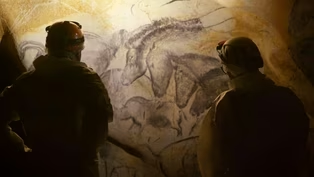
Here are lions, reindeer, deer, aurochs, woolly rhinoceroses, and mammoths drawn in charcoal.
It seems to have been carefully planned, making it one of the earliest major compositions in the history of art.
FRITZ (translated): To me, this structure is absolutely amazing.
(laughs): And I really love horses, so, yes.
That work is really special to me.
♪ ♪ NARRATOR: Gilles Tosello has mastered the cave artists' strokes.
TOSELLO (translated): These curves made with charcoal are extremely well done, with a lot of technique and skill.
(speaking French) (translated): And very often, they were made in one or perhaps a few strokes.
So it didn't take a long time to do them.
♪ ♪ NARRATOR: In 2012, the French government began construction of a monumental replica of the cave, known as Chauvet 2.
Tosello took on the job of recreating two of the largest murals using all the techniques of the original artists.
♪ ♪ (translated): You start by scraping off the clay.
Then, you can draw with charcoal.
Since there's no more clay, the wall is white.
(speaking French) (translated): That way, you can draw it in black and it will stand out nicely on the white background.
They had obviously noticed and understood that.
But they also used the clay on the wall to add details to their work.
For example here-- there's clay on the lion's head.
That means the artist didn't get rid of all of it.
So they didn't clean all the walls every time.
That's why I believe it's part of their artistic approach.
What seemed at first like a constraint became a source of inspiration.
They experimented with it.
NARRATOR: The scientific survey revealed over 1,000 works of art, many of them depicting prehistoric animals.
(animals lowing, growling) (snorting softly) FRITZ (translated): The animals drawn in the Chauvet Cave are characteristic of the Paleolithic wildlife.
The three main animals found there are big cats, rhinoceroses, and mammoths.
There are no hunting scenes.
No humans are depicted killing animals.
There are no scenes of everyday life and no landscapes, either.
NARRATOR: Over 430 individual animals of 14 different species appear on the walls-- many more than the handful of human figures depicted in the cave.
FRITZ (translated): In the Paleolithic era, when people stepped out of their tents, they probably encountered animals more often than other humans.
(animals lowing) (Fosse speaking French) (translated): Paleolithic artists had a lot of knowledge on the animals that they painted.
(speaking French) (translated): So obviously, 40,000 years ago, these artists rendered a lot of information on their behavior and, more generally, on the world they lived in.
♪ ♪ NARRATOR: These animal depictions provided paleontologists with crucial information about the appearance and behavior of many prehistoric species, sometimes overturning older preconceptions.
Before the discovery of Chauvet, cave lions were only known by their fossils and other rare prehistoric art, where the sex of the animals was unclear.
FOSSE (translated): The drawings in Chauvet confirmed that male lions did not have manes.
NARRATOR: The Chauvet paintings hold a treasure trove of information for scientists today, but what did they mean to the people who made them?
(talking in background) Catherine Ferrier and Jean-Claude Leblanc spotted dark marks on the walls-- traces of large fires.
These marks intrigued the two researchers.
Why were such large fires lit there?
Were they simply dispelling the darkness?
Or did they have a deeper purpose?
(Ferrier speaking French) (translated): The marks we found on the walls indicate that very big fires were lit there.
But what kind of fires were they?
What type of fire produces marks of this color and splits the rock that way?
We understood right away that these were not the usual types of fire found on prehistoric sites.
(speaking French) (translated): We realized that those were the traces of blazes that burned the Chauvet Cave.
This discovery really unsettled us.
We had never seen anything like it in other caves.
What were these fires?
What on earth were they playing at in this cave?
It's really extraordinary.
NARRATOR: Looking for answers, the researchers recreated these fires in a quarry outfitted with temperature sensors.
LEBLANC (translated): We are in a quarry which is the same size as the Megaloceros Gallery.
Our goal here is to recreate a fire the way the Aurignacians would have lit it.
To do so, we have a thermocouple tree made of tiny probes.
You can see them here.
Cables connect these thermocouples to a data acquisition module on the outside, allowing continuous temperature monitoring.
(Ferrier speaking French) (translated): Through this experiment, we wanted to show what the Aurignacians were able to do when they made such big fires.
We especially wanted to see if it was possible for them to stay near these fires and to feed them.
(insects chirping) (insects chirping) FABIEN SALMON (translated): This is a digital model of the result of the experiment.
This is the quarry where the fires were lit.
We notice that there are two separate layers: one cold layer on the bottom part and a hot layer on the top.
It is possible to stay in the cold layer by crouching.
However, no one can stay standing, because the temperature rises to several hundred degrees in the top part.
FERRIER (translated): So these fires were not meant for people to stay near them.
They weren't the typical domestic fires, around which they used to gather to warm up and to do activities of everyday life.
The fires next to which they would eat, shape flints, make different objects for everyday life.
That's not what they did with these fires.
So it obviously made us wonder what their purpose was.
♪ ♪ NARRATOR: This question has intrigued researchers for years.
Were these giant fires made to illuminate the artistic creations?
Were they used for rites or ceremonies?
(Ferrier speaking French) (translated): These decorated caves had strong symbolic value.
Did these fires add to the symbolic value of these sites?
And how?
Perhaps the light and the smoke produced by these fires were used to highlight the reliefs and the volume of the cavities when viewed from a distance.
(speaking French) FRITZ (translated): We must view this cave like a theater stage.
Different stories are told as we progress through it, from one wall to the next and one chamber to the next.
That is the Chauvet Cave.
NARRATOR: One of the most mysterious features in the cave is an isolated chamber with no modern walkways to explore it.
This image was created by digitally scanning the hard-to-access room, allowing researchers to study its contents-- including the skull of a cave bear, found resting on a limestone block in the center of the chamber.
It looks like it was placed there intentionally.
But why?
This question has fascinated scientists for decades.
TOSELLO (translated): The Skull Chamber is quite particular, because it has a theatrical feel to it, with its clay benches on the sides.
It could have been named the Theater or Amphitheater Chamber.
The bear is part of this symbolic world.
(Fosse speaking French) (translated): The skull on this block is the only evidence we have in all of the caves we've discovered in Europe that Upper Paleolithic humans had some sort of respect for these bears.
These humans knew they were entering the bears' home.
What we have here in the Chauvet Cave are walls decorated and painted in the exact same place where the bears came to hibernate.
♪ ♪ NARRATOR: We can't know exactly what this space meant to the humans here, but we do know that both bears and humans ventured deeper into the cave.
The most remote chamber, more than 650 feet from the entrance, contains the greatest evidence of bear activity.
This is also where the men and women of Chauvet painted another masterpiece.
♪ ♪ FRITZ (translated): You go down another level and you arrive in the End Chamber.
That is where the magic happens.
You're attracted by what's at the far end of it.
Even if you can't really see very well, you can make out black shapes on the walls.
(Tosello speaking French) (translated): The climax happens at the far end.
I'll use a musical metaphor by saying that it's a symphony which starts moderato and ends allegro.
FRITZ (translated): You can never get used to seeing that.
You always feel something.
You're drawn to it.
At least, I'm drawn to these images.
I can spend hours looking at them.
To me, it's like looking at a painting by Raphael or Leonardo da Vinci.
It's exactly the same to me.
♪ ♪ NARRATOR: Over 32 feet long, the Great Lion Panel reveals the artists' creativity and technical mastery.
♪ ♪ Prehistorian Marc Azéma was on the scientific team for 16 years and studied this spectacular mural.
He has his own interpretation of the work, experiencing it here in total immersion on a big screen.
AZÉMA (translated): Every time I entered this chamber, I was overwhelmed with emotions.
I really felt that the Aurignacian artists were trying to tell us a story.
♪ ♪ The compositions in the End Chamber are clearly staged.
Charcoal was found on the ground.
This means that fires were lit to highlight the graphic stories which were told.
But what is exceptional here is the presence of animals represented with many legs or several heads.
This was probably a way for them to break down the animal's movement into several images.
This is an extremely modern process.
One could almost say that cinema originated in Chauvet.
This first scene shows a cave lion doing something particular which refers to its life cycle.
Inside, there's a female lion.
We can see her rubbing her head with her two ears back against the male's flank.
(lion roaring softly) ♪ ♪ Then we walk past rhinoceroses and other animals of those times.
And we come across more cave lions.
This is the famous Lion Panel, which depicts a horde of about 15 lions chasing bison, who are depicted running with their heads forward.
(lions growling) What's interesting here is that these cave lions are rushing.
We can clearly see their progression thanks to the animation of the heads and legs, which are stretched forward.
Their mouths are half-open and then warp as if they were roaring.
(lions growling) After the general scene depicted in the Lion Panel, we get the impression that the artists try to focus on a more dramatic moment.
(lions growling) We can clearly see two aggressive lions with their ears back and their mouths half-opened as if they were roaring.
It's a very violent scene, with this small, isolated bison shown on top trying to push them away with its foreleg.
The dramatic emphasis made here is like a closeup in an animal documentary taking place before our eyes.
(lions growling) NARRATOR: This animal scene ends in violence.
The cave lions slaughter the bison, and the attack unfolds across the wall.
AZÉMA (translated): Here, we can see a big cave lion with a bison.
So, a predator and its prey.
♪ ♪ The lion seems to be pulling the bison's horn, probably to suffocate it, as we can see nowadays, when African lions attack buffaloes.
This killing marks the end of the hunting scene.
The cave lion plays a major part in this great composition.
This is emphasized by the presence of that animal on the pendant facing the large panel.
The lion is drawn with its prey and a vulva, which symbolizes birth and creation.
So, there's a predator and its prey, and we see the animal eat, which depicts survival.
This is perhaps the symbol of the cycle of life.
♪ ♪ NARRATOR: This vulva is the most obvious female representation in the cave.
TOSELLO (translated): The presence of this woman shows that those aren't lions which are depicted here, but are in fact humans, for the humans are the hunters.
They are the ones who kill, because they have no other choice.
They need to kill to survive.
So in a way, the scene in the End Chamber describes an eternal cycle of life by associating death and birth.
♪ ♪ NARRATOR: The works in Chauvet seem to invite the observer to read between the lines, to search for symbols and meanings that reveal their authors' vision of the world.
FRITZ (translated): A story is told in Chauvet.
We think that is what we call a myth.
Every society needs myths.
There are no societies of nomad hunter-gatherers without myths, especially origin myths.
Everyone needs to know where they're from.
(Tosello speaking French) (translated): These societies have passed on those myths.
I believe that in the Chauvet Cave, we've been given firsthand access to this spiritual world.
♪ ♪ NARRATOR: Even if their exact meaning has been lost over the millennia, the discovery of these paintings has revolutionized our understanding of Stone Age humans.
(Tosello speaking French) (translated): Before that, we believed that realistic shapes in cave paintings were more likely recent and that less realistic ones were probably more ancient.
But the works of art found in Chauvet caused what scientists call a paradigm shift.
This means that we came across information that was so new and groundbreaking that the whole system had to be reconsidered.
(translated): This shattered the theories on the evolution of drawing.
(speaking French) (translated): We used to consider that art was in its infancy with the Aurignacians.
And then, as humans evolved, they managed to draw better and better.
But this was no longer true.
♪ ♪ NARRATOR: The cave art in Chauvet is one of the earliest known expressions of human creativity.
This sanctuary has been listed as a UNESCO World Heritage Site since 2014 and is recognized as a global treasure.
Chauvet is much more than a milestone in art history: it is one of its foundations.
TOSELLO (translated): When people ask us if there are still things to discover in Chauvet, the answer is, "Yes, of course."
I am one of those who believe the Chauvet Cave should be used as a sort of research school.
♪ ♪ ♪ ♪ NARRATOR: Chauvet opens a window on the past, linking us to those who came before and left their mark, a vision of their world.
GÉLY (translated): It's the dawn of time.
It's another world.
And yet, it's us.
♪ ♪ ♪ ♪ ♪ ♪ ♪ ♪
Video has Closed Captions
Preview: S53 Ep11 | 30s | Step into the stunning cave that’s reshaping our understanding of prehistoric art. (30s)
Providing Support for PBS.org
Learn Moreabout PBS online sponsorship

- Science and Nature

Follow lions, leopards and cheetahs day and night In Botswana’s wild Okavango Delta.

 New Episode
 New Episode







Support for PBS provided by:
National Corporate funding for NOVA is provided by Carlisle Companies. Major funding for NOVA is provided by the NOVA Science Trust and PBS viewers.