
Brantley Farms Soybean Harvest
Clip: 4/27/2026 | 5m 53sVideo has Closed Captions
Discover how an Arkansas farm family is using technology to keep prices down for consumers.
Discover how an Arkansas farm family is using technology to keep prices down for consumers.
Problems playing video? | Closed Captioning Feedback
Problems playing video? | Closed Captioning Feedback
America's Heartland is presented by your local public television station.
Funding for America’s Heartland is provided by US Soy, Sustainable Agriculture Research and Education, Rural Development Partners, and a Specialty Crop Grant from the California Department of Food and Agriculture.
Brantley Farms Soybean Harvest
Clip: 4/27/2026 | 5m 53sVideo has Closed Captions
Discover how an Arkansas farm family is using technology to keep prices down for consumers.
Problems playing video? | Closed Captioning Feedback
How to Watch America's Heartland
America's Heartland is available to stream on pbs.org and the free PBS App, available on iPhone, Apple TV, Android TV, Android smartphones, Amazon Fire TV, Amazon Fire Tablet, Roku, Samsung Smart TV, and Vizio.
Providing Support for PBS.org
Learn Moreabout PBS online sponsorshipThe great success of American agriculture reflects not only the hard work being done by the country's farmers and ranchers, but also their ability to utilize new technology to improve the methods of production and crop yields.
This makes it possible to produce food, fuel and fiber for consumers in the U.S.
and around the world.
But let's go back to that hard work for a moment.
Autumn is harvest time for the majority of American farmers and a time when entire families pull together.
For one family in Arkansas, that means non-stop action until the crop is in.
♪♪ >> Look in any direction on this central Arkansas farm and it's soybeans as far as the eye can see.
>> From sun up to sundown, huge combines comb these fields, cutting the beans from the ground.
Let's give you a view that you may never have seen before - inside the giant equipment hauling in this harvest of one of the most versatile crops in the world.
♪♪ >> Quarterbacking this soybean harvest team is Dow Brantley.
Dow and his dad are partners at Brantley Farms.
It's a big operation, growing more than 9000 acres of crops each year.
>> Dow we really came at the perfect time, harvest in full swing and here you see the soybean in the process of drying.
These are almost there and these are ready to go.
What did it take to get this plant to this level?
>> You, you know, it's a lot of hard work, and this year because of the situation, the drought, a lot of irrigation to make this crop, to make these beans.
Uh, on, on top of that we're working very hard to keep the weeds out of it and insects as well.
We're around 7 days a week to harvest.
>> So it's not just plant and pick?
>> No, no, no.
I wish it were that easy, but no there is a lot to see about these crops to get the high yields that we want to achieve.
>> Once harvested, the Brantley's beans are crushed and turned into oil or meal.
More than half of the soybeans produced in Arkansas are shipped down the Mississippi River, and exported worldwide through the Port of New Orleans.
Dow's career path took him off the farm for a time acquiring technology skills he was able to apply to the family business on his return.
Today, those computer programs, equipment enhancements and crop monitoring systems have improved yields.
>> Dow brought skills that we've really needed.
Uh, we had opportunity, we had, uh, land we could produce, we've been doing it.
Could we take it and move it forward.
Yeah we could with technology, with knowledge.
>> "Moving forward" meant more than doubling the four thousand acres his dad was then planting.
Today, the Brantleys raise soybeans, rice, corn and cotton - on land that stretches their farm more than 20 miles.
♪♪ (Crop Duster) >> The Brantley's crop duster took us high in the sky to overlook their expansive operation.
Technology plays a key role here even to managing the aerial spraying on the Brantley's cotton crop.
>> Computerized applications target specific rows - reducing the amount of chemicals needed.
Dow says it's all a matter of being efficient and effective.
>> Anywhere from guidance on the tractor or combine to computer programs in our office to help us keep up with input costs.
Who sprayed what field?
Things of that nature.
>> Juggling harvest time on this September day means going from one crop to another.
Their cotton is picked and rolled into these modules and sent straight to the mill, their grains, stored in a state of the art silo system.
Dow and his dad can oversee all their harvesting from the fields or from their home office with computers and GPS monitoring.
Dow says technology like this is expensive, but pays off in lower costs for consumers.
>> It allows us to keep an affordable, food and fiber supply here in the US.
Ah, keep those prices low.
Ah, our job is to produce at the lowest cost that we can and we do.
>> But make no mistake, what really holds this farm together is family.
A bond between father and son rooted in the land they love.
>> Well it's a noble, I've been in the farming thing and the family farm, that's very precious to me.
>> I enjoy every minute of it.
Working with family members.
And I hope he continues to be here for a long time.
So, we're both having fun together.
Um, we truly are.
We're blessed to have some good land.
We're blessed to some very good employees and without them we wouldn't be where we are today.
♪♪ >> You'll understand why soybeans are called the "miracle bean" when I tell you that soybeans are used in animal feed, hundreds of food and household products, ink, plastics, wood adhesives and candles.
More soybeans are grown in the U.S.
than anywhere else in the world.
And one more fun fact.
One acre of soybeans can produce 82 thousand crayons.
 New
NewVideo has Closed Captions
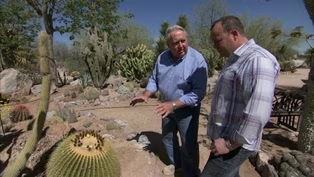
Then, it’s a sharp and spiny crop at this Arizona farm where one family is all about raising cacti. (6m 20s)
 New
NewVideo has Closed Captions
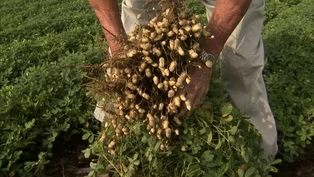
Come along on a peanut harvest in Georgia. (5m 2s)
 New
NewVideo has Closed Captions
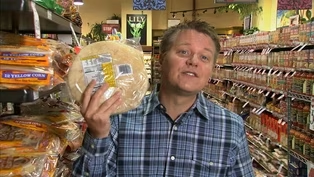
Learn how Tortilla-making is a billion-dollar industry. (1m 6s)
 New
NewVideo has Closed Captions
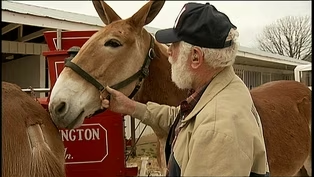
Travel to Tennessee to meet some folks who claim that mules are the best farm animal around. (4m 8s)
Providing Support for PBS.org
Learn Moreabout PBS online sponsorship

- Food
Christopher Kimball’s Milk Street Television
Transform home cooking with the editors of Christopher Kimball’s Milk Street Magazine.











Support for PBS provided by:
America's Heartland is presented by your local public television station.
Funding for America’s Heartland is provided by US Soy, Sustainable Agriculture Research and Education, Rural Development Partners, and a Specialty Crop Grant from the California Department of Food and Agriculture.