
Georgia Peanut Harvest
Clip: 4/27/2026 | 5m 2sVideo has Closed Captions
Come along on a peanut harvest in Georgia.
Come along on a peanut harvest in Georgia.
Problems playing video? | Closed Captioning Feedback
Problems playing video? | Closed Captioning Feedback
America's Heartland is presented by your local public television station.
Funding for America’s Heartland is provided by US Soy, Sustainable Agriculture Research and Education, Rural Development Partners, and a Specialty Crop Grant from the California Department of Food and Agriculture.
Georgia Peanut Harvest
Clip: 4/27/2026 | 5m 2sVideo has Closed Captions
Come along on a peanut harvest in Georgia.
Problems playing video? | Closed Captioning Feedback
How to Watch America's Heartland
America's Heartland is available to stream on pbs.org and the free PBS App, available on iPhone, Apple TV, Android TV, Android smartphones, Amazon Fire TV, Amazon Fire Tablet, Roku, Samsung Smart TV, and Vizio.
Providing Support for PBS.org
Learn Moreabout PBS online sponsorship>> Let's talk about another crop used in producing everything from food items to cosmetics and chemicals.
And what would a ball game be without them.
I'm talking about peanuts.
Georgia is well known as the "Peach State", but Georgia also leads the nation in the production of peanuts.
And Jason Shoultz says that means critical decisions on when to plant and when to harvest.
>> When it's slathered between bread slices, it's instant smiles all around!
I'm talking about peanut butter.
It continues to be a kid favorite.
>>(laughs) Americans will consume more than 700 million pounds of peanut butter a year.
>> So these nuts are just about ready to harvest?
>> Yes, yes.
>> Almost half of the peanuts grown in the US come from Georgia.
And farmers like Armond Morris are, well, nuts about their industry.
>> I'm about the sixth or seventh generation farmer, I reckon to say.
So, you know, my parents grew peanuts, my dad grew peanuts.
>> Spending a few hours touring peanut country with Armond, I quickly discover that growers here are part farmer - part peanut promoter.
>> We eat peanut butter on dry wheat toast every morning with our breakfast.
>> I bet.
>> And peanut butter makes oatmeal better, too.
It gives it some flavor.
And not only that, you get your protein too out of your peanut butter.
>> I bet since youre a peanut farmer I bet most everybody in Georgia that youre trying to put peanut butter on everything, aren't you?
>> You bet!
You bet!
>> Hamburgers, and... >> Peanut butter would make a hamburger better.
You bet!
[laughs] >> Peanuts are legumes that grow just under the soil.
You wouldn't know it looking at the green carpet that covers this state but there are millions of peanuts hidden underneath.
>> This one is ready to go.
>> Yes, yes.
It's ready to harvest.
>> Farmers in Georgia will grow more than a billion pounds of peanuts a year, most of which will find their way into peanut butter production.
The bigger "roasted" peanuts that you find at the ballpark are a different variety grown elsewhere in the South.
>> So these are peanuts that are gonna end up as peanut butter?
>> They wind up as peanut butter, ultimately, that's correct.
>> Fall in Georgia is peanut harvest time, and timing is critical.
Farmers must know exactly when their crop is ready.
>> So Armond and other farmers get help from the University of Georgia Extension Service.
Using the "hull scrape method", researchers test a small sample of nuts to see if they are ready.
Once they get the green light, it's digging time!
>> Armond uses a digger to pull up the plants and flip them over, sunny side up to heat them up and dry them out.
Then it's time to harvest and dry them even more.
But before these nuts ever become an essential ingredient in "ants on a log" they'll have to be dry roasted and ground.
While peanut allergies have impacted sales, peanut butter popularity remains high.
>> In an economy we're in, folks are looking for something that's good for you and doesn't cost a lot, our peanut butter consumption is at record levels right now.
>> That's good news to the 5000 farmers growing peanuts here in Georgia.
The state's most famous peanut farmer was our 39th President, Jimmy Carter!
>> If you look at Georgia and look at our processing, look at the peanut shelling, the peanut buying points, farm supplies, and things like that, we're about two and a half billion dollars just to the Georgia economy.
>> They're proud of their peanuts in these parts.
Farmers like Armond have found success carrying on a tradition and building on a legacy.
And that includes a southern snack you'll find at roadside restaurants.
>> These are fresh peanuts right out of the ground?
>> These are fresh peanuts.
There are some that we dug yesterday, picked them off and brought them in earlier this morning for y'all to have.
Some of the most famous and the freshest peanuts that there is available for consumption.
>> So these are boiled?
How do you boil them?
>> Uh, you boil them about an hour, hour-and-a-half, kinda like you won't just so far as your taste is and, uh, We like for them to be tender.
It's kinda like a pea.
It doesn't taste like a... it's not crunchy, like a nut.
>> That's right.
They do, they really.
It tastes kinda like a pea.
Exactly right.
>> Yeah.
>> If you eat peas, you're going to like boiled peanuts even better.
>> Boiled or whipped into peanut butter peanuts are one of Georgia's most famous claims to fame.
>>That's exactly right.
♪♪ >> Americans spend more than half a billion dollars each year on peanut butter.
60% of Americans like creamy best.
And get this, folks at a peanut butter promotion in Oklahoma City created a peanut butter and jelly sandwich that weighed 900 pounds!
♪♪
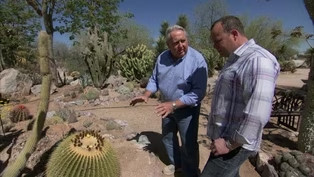 New
NewVideo has Closed Captions
Then, it’s a sharp and spiny crop at this Arizona farm where one family is all about raising cacti. (6m 20s)
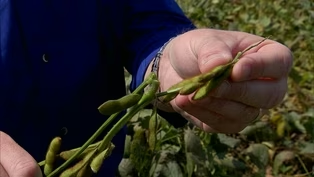 New
NewBrantley Farms Soybean Harvest
Video has Closed Captions
Discover how an Arkansas farm family is using technology to keep prices down for consumers. (5m 53s)
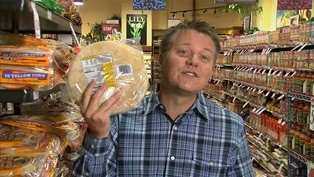 New
NewVideo has Closed Captions
Learn how Tortilla-making is a billion-dollar industry. (1m 6s)
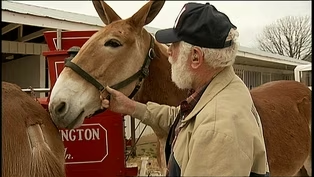 New
NewVideo has Closed Captions
Travel to Tennessee to meet some folks who claim that mules are the best farm animal around. (4m 8s)
Providing Support for PBS.org
Learn Moreabout PBS online sponsorship

- Food
Christopher Kimball’s Milk Street Television
Transform home cooking with the editors of Christopher Kimball’s Milk Street Magazine.












Support for PBS provided by:
America's Heartland is presented by your local public television station.
Funding for America’s Heartland is provided by US Soy, Sustainable Agriculture Research and Education, Rural Development Partners, and a Specialty Crop Grant from the California Department of Food and Agriculture.