
Tennessee Mule Days
Clip: 4/27/2026 | 4m 8sVideo has Closed Captions
Travel to Tennessee to meet some folks who claim that mules are the best farm animal around.
Travel to Tennessee to meet some folks who claim that mules are the best farm animal around.
Problems playing video? | Closed Captioning Feedback
Problems playing video? | Closed Captioning Feedback
America's Heartland is presented by your local public television station.
Funding for America’s Heartland is provided by US Soy, Sustainable Agriculture Research and Education, Rural Development Partners, and a Specialty Crop Grant from the California Department of Food and Agriculture.
Tennessee Mule Days
Clip: 4/27/2026 | 4m 8sVideo has Closed Captions
Travel to Tennessee to meet some folks who claim that mules are the best farm animal around.
Problems playing video? | Closed Captioning Feedback
How to Watch America's Heartland
America's Heartland is available to stream on pbs.org and the free PBS App, available on iPhone, Apple TV, Android TV, Android smartphones, Amazon Fire TV, Amazon Fire Tablet, Roku, Samsung Smart TV, and Vizio.
Providing Support for PBS.org
Learn Moreabout PBS online sponsorship>> You know, one of the great things about doing a show like America's Heartland is the fact that we get to go great places and meet great people.
You know, like the folks in one of our earlier stories.
Now we've taken you on cattle drives, sheep roundups and actually fed some big, big buffalo, but how often are you up close and personal with mules?
Our Sarah Gardner says that's the whole point of "Mule Days" in Tennessee.
♪♪ (Braying Mule) >>I take a week of from work.
It's a vacation for me to get to come to "Mule Days" >> Koy Flowers is one of thousands who converge on Tennessee to celebrate the virtues of a widely misunderstood animal.
>> If you would come to a halt right there please, sir.
>> They're a very smart animal.
They're not as stubborn as people want to believe them to be.
>> This whole country was based on mules.
I mean I don't believe the country would have survived without them.
>> You could say that, along with horses, mules pulled American agriculture through more than a century of growth right into the industrial age.
♪♪ >> "Mule Day" had its beginnings in Columbia as "Breeder's Day" way back in the 1840's.
Farmers and livestock breeders would bring their animals to market every April to show, buy and trade.
Millions of mules were still helping work farms throughout the Heartland right through the early 20th century and mules often brought higher prices than horses.
>> This was the way people worked years ago.
I mean this was a trucking outfit.
I mean if you look on your teamsters logo you'll see a big mule head, well that's how it all arrived.
>> How could a mule be worth more than a good horse?
The mule experts say these half-donkeys, half-mares have horses beat in the categories of strength, endurance, and disposition.
That's right.
Mule owners say they're downright even-tempered.
But what about that famous stubborn streak?
>> The thing about a mule is a mule is smart.
He never forgets anything you teach him and if a mule has a bad habit it's because someone taught it to him.
They're harder to break from a bad habit.
The stubbornness comes from the people that train them that don't know what they're doing.
(Braying Mule) >> Today owning mules is more of a hobby than a necessity.
But some farmers still haven't completely given up the old ways.
>> I still do some farm work with them.
What hay I put up I cut with mules.
>> John Skillington certainly knows the value of these creatures.
He's had mules ever since he was a child on the family farm.
Now a hobbyist, he's very particular about what he looks for in an animal.
>> Well, start with this mule's head.
She has a right good head.
See, it's fairly long.
She's good between the eyes.
Her ears are good.
And if you notice, it's just the least bit roving.
It's not straight or ditched.
I like that.
>> Mules come in all shapes and sizes from the mini to the mammoth.
>> This is a Leopard Appaloosa mule.
And his mother was a brown and white horse.
His father was a mammoth black jack.
He was a total surprise.
>> One highlight of Tennessee mule days is the gaited mule competition.
It involves some very special equine friends.
>> Gaited mules are often bred from the Tennessee Walking Horse and have a similar smooth gait.
Competitors try to show the judges that their mule has the best stride.
Fancy footwork from a one-of-a-kind animal.
>> Mules are the animal of choice for many outfitters hauling people and goods through rough terrain.
Mules are extremely sure footed even in mountainous areas.
And don't test this out, mules are supposedly able to kick with their hooves in any direction, even sideways.
 New
NewVideo has Closed Captions
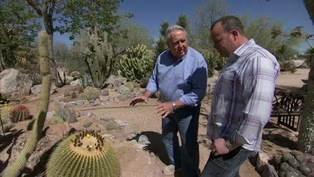
Then, it’s a sharp and spiny crop at this Arizona farm where one family is all about raising cacti. (6m 20s)
 New
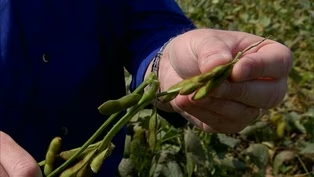
NewBrantley Farms Soybean Harvest
Video has Closed Captions
Discover how an Arkansas farm family is using technology to keep prices down for consumers. (5m 53s)
 New
NewVideo has Closed Captions
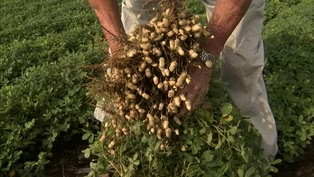
Come along on a peanut harvest in Georgia. (5m 2s)
 New
NewVideo has Closed Captions
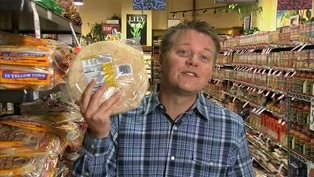
Learn how Tortilla-making is a billion-dollar industry. (1m 6s)
Providing Support for PBS.org
Learn Moreabout PBS online sponsorship

- Food
Christopher Kimball’s Milk Street Television
Transform home cooking with the editors of Christopher Kimball’s Milk Street Magazine.












Support for PBS provided by:
America's Heartland is presented by your local public television station.
Funding for America’s Heartland is provided by US Soy, Sustainable Agriculture Research and Education, Rural Development Partners, and a Specialty Crop Grant from the California Department of Food and Agriculture.