
Cactus Farming
4/27/2026 | 26m 30sVideo has Closed Captions
Cactus farm finds success. Georgia peanut harvest. “Mule Days” draws fans of the farm animal.
Discover how an Arkansas farm family is using technology to keep prices down for consumers. Come along on a peanut harvest in Georgia. Travel to Tennessee to meet some folks who claim that mules are the best farm animal around. Learn how Tortilla-making is a billion-dollar industry. Then, it’s a sharp and spiny crop at this Arizona farm where one family is all about raising cacti.
Problems playing video? | Closed Captioning Feedback
Problems playing video? | Closed Captioning Feedback
America's Heartland is presented by your local public television station.
Funding for America’s Heartland is provided by US Soy, Sustainable Agriculture Research and Education, Rural Development Partners, and a Specialty Crop Grant from the California Department of Food and Agriculture.
Cactus Farming
4/27/2026 | 26m 30sVideo has Closed Captions
Discover how an Arkansas farm family is using technology to keep prices down for consumers. Come along on a peanut harvest in Georgia. Travel to Tennessee to meet some folks who claim that mules are the best farm animal around. Learn how Tortilla-making is a billion-dollar industry. Then, it’s a sharp and spiny crop at this Arizona farm where one family is all about raising cacti.
Problems playing video? | Closed Captioning Feedback
How to Watch America's Heartland
America's Heartland is available to stream on pbs.org and the free PBS App, available on iPhone, Apple TV, Android TV, Android smartphones, Amazon Fire TV, Amazon Fire Tablet, Roku, Samsung Smart TV, and Vizio.
Providing Support for PBS.org
Learn Moreabout PBS online sponsorship>> Hi there, I'm Rob Stewart.
It's all about saddles, shells, beans and cactus on America's Heartland this time.
We'll take you from Arizona to Georgia with a stop in Arkansas to bring in the soybean harvest.
What does it take to keep down the cost of food for consumers like you?
Well, this Arkansas family says modern technology is helping farmers to do just that.
Do you like your peanuts salted in the shell or spread on bread in peanut butter?
One Georgia Farmer has some suggestions for you.
Some say they're stubborn but we'll introduce you to people who say that MULES are the best farm animals around.
And then, handle with care!!!
This Arizona family is all about raising cactus.
It's all coming up on America's Heartland.
>> America's Heartland is made possible by... >> America never stops.
Neither do the farmers and ranchers who call her home.
And as rural America grows further, Farm Credit will be there, just as we have for 100 years.
>> CropLife America, representing the companies whose modern farming innovations help America's farmers provide nutritious food for communities around the globe.
>> The Fund for Agriculture Education.
A fund created by KVIE to support America's Heartland programming.
Contributors include the following: ♪ You can see it in the eyes of every woman and man.
♪ ♪ In America's Heartland, living close to the land.
♪ ♪ There's a love for the country and a pride in the brand.
♪ ♪ In America's Heartland, living close, ♪ ♪ close to the land >> We're so glad you could join us on America's Heartland.
The great success of American agriculture reflects not only the hard work being done by the country's farmers and ranchers, but also their ability to utilize new technology to improve the methods of production and crop yields.
This makes it possible to produce food, fuel and fiber for consumers in the U.S.
and around the world.
But let's go back to that hard work for a moment.
Autumn is harvest time for the majority of American farmers and a time when entire families pull together.
For one family in Arkansas, that means non-stop action until the crop is in.
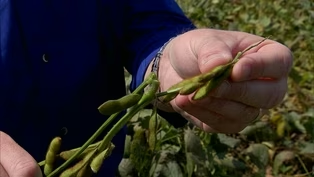
♪♪ >> Look in any direction on this central Arkansas farm and it's soybeans as far as the eye can see.
>> From sun up to sundown, huge combines comb these fields, cutting the beans from the ground.
Let's give you a view that you may never have seen before - inside the giant equipment hauling in this harvest of one of the most versatile crops in the world.
♪♪ >> Quarterbacking this soybean harvest team is Dow Brantley.
Dow and his dad are partners at Brantley Farms.
It's a big operation, growing more than 9000 acres of crops each year.
>> Dow we really came at the perfect time, harvest in full swing and here you see the soybean in the process of drying.
These are almost there and these are ready to go.
What did it take to get this plant to this level?
>> You, you know, it's a lot of hard work, and this year because of the situation, the drought, a lot of irrigation to make this crop, to make these beans.
Uh, on, on top of that we're working very hard to keep the weeds out of it and insects as well.
We're around 7 days a week to harvest.
>> So it's not just plant and pick?
>> No, no, no.
I wish it were that easy, but no there is a lot to see about these crops to get the high yields that we want to achieve.
>> Once harvested, the Brantley's beans are crushed and turned into oil or meal.
More than half of the soybeans produced in Arkansas are shipped down the Mississippi River, and exported worldwide through the Port of New Orleans.
Dow's career path took him off the farm for a time acquiring technology skills he was able to apply to the family business on his return.
Today, those computer programs, equipment enhancements and crop monitoring systems have improved yields.
>> Dow brought skills that we've really needed.
Uh, we had opportunity, we had, uh, land we could produce, we've been doing it.
Could we take it and move it forward.
Yeah we could with technology, with knowledge.
>> "Moving forward" meant more than doubling the four thousand acres his dad was then planting.
Today, the Brantleys raise soybeans, rice, corn and cotton - on land that stretches their farm more than 20 miles.
♪♪ (Crop Duster) >> The Brantley's crop duster took us high in the sky to overlook their expansive operation.
Technology plays a key role here even to managing the aerial spraying on the Brantley's cotton crop.
>> Computerized applications target specific rows - reducing the amount of chemicals needed.
Dow says it's all a matter of being efficient and effective.
>> Anywhere from guidance on the tractor or combine to computer programs in our office to help us keep up with input costs.
Who sprayed what field?
Things of that nature.
>> Juggling harvest time on this September day means going from one crop to another.
Their cotton is picked and rolled into these modules and sent straight to the mill, their grains, stored in a state of the art silo system.
Dow and his dad can oversee all their harvesting from the fields or from their home office with computers and GPS monitoring.
Dow says technology like this is expensive, but pays off in lower costs for consumers.
>> It allows us to keep an affordable, food and fiber supply here in the US.
Ah, keep those prices low.
Ah, our job is to produce at the lowest cost that we can and we do.
>> But make no mistake, what really holds this farm together is family.
A bond between father and son rooted in the land they love.
>> Well it's a noble, I've been in the farming thing and the family farm, that's very precious to me.
>> I enjoy every minute of it.
Working with family members.
And I hope he continues to be here for a long time.
So, we're both having fun together.
Um, we truly are.
We're blessed to have some good land.
We're blessed to some very good employees and without them we wouldn't be where we are today.
♪♪ >> You'll understand why soybeans are called the "miracle bean" when I tell you that soybeans are used in animal feed, hundreds of food and household products, ink, plastics, wood adhesives and candles.
More soybeans are grown in the U.S.
than anywhere else in the world.
And one more fun fact.
One acre of soybeans can produce 82 thousand crayons.
>> Let's talk about another crop used in producing everything from food items to cosmetics and chemicals.
And what would a ball game be without them.
I'm talking about peanuts.
Georgia is well known as the "Peach State", but Georgia also leads the nation in the production of peanuts.
And Jason Shoultz says that means critical decisions on when to plant and when to harvest.
>> When it's slathered between bread slices, it's instant smiles all around!
I'm talking about peanut butter.
It continues to be a kid favorite.
>>(laughs) Americans will consume more than 700 million pounds of peanut butter a year.
>> So these nuts are just about ready to harvest?
>> Yes, yes.
>> Almost half of the peanuts grown in the US come from Georgia.
And farmers like Armond Morris are, well, nuts about their industry.
>> I'm about the sixth or seventh generation farmer, I reckon to say.
So, you know, my parents grew peanuts, my dad grew peanuts.
>> Spending a few hours touring peanut country with Armond, I quickly discover that growers here are part farmer - part peanut promoter.
>> We eat peanut butter on dry wheat toast every morning with our breakfast.
>> I bet.
>> And peanut butter makes oatmeal better, too.
It gives it some flavor.
And not only that, you get your protein too out of your peanut butter.
>> I bet since youre a peanut farmer I bet most everybody in Georgia that youre trying to put peanut butter on everything, aren't you?
>> You bet!
You bet!
>> Hamburgers, and... >> Peanut butter would make a hamburger better.
You bet!
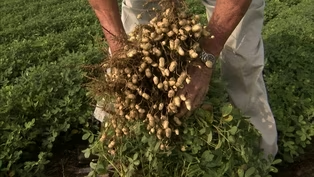
[laughs] >> Peanuts are legumes that grow just under the soil.
You wouldn't know it looking at the green carpet that covers this state but there are millions of peanuts hidden underneath.
>> This one is ready to go.
>> Yes, yes.
It's ready to harvest.
>> Farmers in Georgia will grow more than a billion pounds of peanuts a year, most of which will find their way into peanut butter production.
The bigger "roasted" peanuts that you find at the ballpark are a different variety grown elsewhere in the South.
>> So these are peanuts that are gonna end up as peanut butter?
>> They wind up as peanut butter, ultimately, that's correct.
>> Fall in Georgia is peanut harvest time, and timing is critical.
Farmers must know exactly when their crop is ready.
>> So Armond and other farmers get help from the University of Georgia Extension Service.
Using the "hull scrape method", researchers test a small sample of nuts to see if they are ready.
Once they get the green light, it's digging time!
>> Armond uses a digger to pull up the plants and flip them over, sunny side up to heat them up and dry them out.
Then it's time to harvest and dry them even more.
But before these nuts ever become an essential ingredient in "ants on a log" they'll have to be dry roasted and ground.
While peanut allergies have impacted sales, peanut butter popularity remains high.
>> In an economy we're in, folks are looking for something that's good for you and doesn't cost a lot, our peanut butter consumption is at record levels right now.
>> That's good news to the 5000 farmers growing peanuts here in Georgia.
The state's most famous peanut farmer was our 39th President, Jimmy Carter!
>> If you look at Georgia and look at our processing, look at the peanut shelling, the peanut buying points, farm supplies, and things like that, we're about two and a half billion dollars just to the Georgia economy.
>> They're proud of their peanuts in these parts.
Farmers like Armond have found success carrying on a tradition and building on a legacy.
And that includes a southern snack you'll find at roadside restaurants.
>> These are fresh peanuts right out of the ground?
>> These are fresh peanuts.
There are some that we dug yesterday, picked them off and brought them in earlier this morning for y'all to have.
Some of the most famous and the freshest peanuts that there is available for consumption.
>> So these are boiled?
How do you boil them?
>> Uh, you boil them about an hour, hour-and-a-half, kinda like you won't just so far as your taste is and, uh, We like for them to be tender.
It's kinda like a pea.
It doesn't taste like a... it's not crunchy, like a nut.
>> That's right.
They do, they really.
It tastes kinda like a pea.
Exactly right.
>> Yeah.
>> If you eat peas, you're going to like boiled peanuts even better.
>> Boiled or whipped into peanut butter peanuts are one of Georgia's most famous claims to fame.
>>That's exactly right.
♪♪ >> Americans spend more than half a billion dollars each year on peanut butter.
60% of Americans like creamy best.
And get this, folks at a peanut butter promotion in Oklahoma City created a peanut butter and jelly sandwich that weighed 900 pounds!
♪♪ >> Are you a fan of Mexican food?
It's a fast growing segment of the American diet.
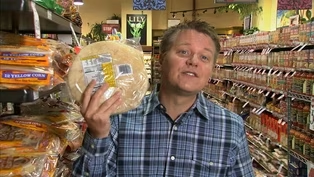
Head to the grocery store and you'll a variety of, salsas canned and fresh jalapeno peppers black beans, refried beans and of course, and you'll find tortillas.
>> Just a generation back, tortillas would only be found in ethnic grocery stores or in very limited offerings at your local supermarket.
But not today!
More than a thousand companies make tortillas across the U.S.
with annual sales in the billions of dollars!
Tortillas are an unleavened flatbread made from corn or flour, mixed with a little shortening and salt, then baked.
>> By the way, if you think about it, the tortilla looks a lot like French crepes or Eastern European blintzes.
Those, however, are made from flour, eggs and some kind of sweetener.
And while pizza makers may object, some pizza fans are even using tortillas as the base for mini pizzas made from cheese and your favorite toppings, Mexican or otherwise, Señor!
>> You know, one of the great things about doing a show like America's Heartland is the fact that we get to go great places and meet great people.
You know, like the folks in one of our earlier stories.
Now we've taken you on cattle drives, sheep roundups and actually fed some big, big buffalo, but how often are you up close and personal with mules?
Our Sarah Gardner says that's the whole point of "Mule Days" in Tennessee.
♪♪ (Braying Mule) >>I take a week of from work.
It's a vacation for me to get to come to "Mule Days" >> Koy Flowers is one of thousands who converge on Tennessee to celebrate the virtues of a widely misunderstood animal.
>> If you would come to a halt right there please, sir.
>> They're a very smart animal.
They're not as stubborn as people want to believe them to be.
>> This whole country was based on mules.
I mean I don't believe the country would have survived without them.
>> You could say that, along with horses, mules pulled American agriculture through more than a century of growth right into the industrial age.
♪♪ >> "Mule Day" had its beginnings in Columbia as "Breeder's Day" way back in the 1840's.
Farmers and livestock breeders would bring their animals to market every April to show, buy and trade.
Millions of mules were still helping work farms throughout the Heartland right through the early 20th century and mules often brought higher prices than horses.
>> This was the way people worked years ago.
I mean this was a trucking outfit.
I mean if you look on your teamsters logo you'll see a big mule head, well that's how it all arrived.
>> How could a mule be worth more than a good horse?
The mule experts say these half-donkeys, half-mares have horses beat in the categories of strength, endurance, and disposition.
That's right.
Mule owners say they're downright even-tempered.
But what about that famous stubborn streak?
>> The thing about a mule is a mule is smart.
He never forgets anything you teach him and if a mule has a bad habit it's because someone taught it to him.
They're harder to break from a bad habit.
The stubbornness comes from the people that train them that don't know what they're doing.
(Braying Mule) >> Today owning mules is more of a hobby than a necessity.
But some farmers still haven't completely given up the old ways.
>> I still do some farm work with them.
What hay I put up I cut with mules.
>> John Skillington certainly knows the value of these creatures.
He's had mules ever since he was a child on the family farm.
Now a hobbyist, he's very particular about what he looks for in an animal.
>> Well, start with this mule's head.
She has a right good head.
See, it's fairly long.
She's good between the eyes.
Her ears are good.
And if you notice, it's just the least bit roving.
It's not straight or ditched.
I like that.
>> Mules come in all shapes and sizes from the mini to the mammoth.
>> This is a Leopard Appaloosa mule.
And his mother was a brown and white horse.
His father was a mammoth black jack.
He was a total surprise.
>> One highlight of Tennessee mule days is the gaited mule competition.
It involves some very special equine friends.
>> Gaited mules are often bred from the Tennessee Walking Horse and have a similar smooth gait.
Competitors try to show the judges that their mule has the best stride.
Fancy footwork from a one-of-a-kind animal.
>> Mules are the animal of choice for many outfitters hauling people and goods through rough terrain.
Mules are extremely sure footed even in mountainous areas.
And don't test this out, mules are supposedly able to kick with their hooves in any direction, even sideways.
>> When you talk about crops, you probably think of corn, wheat, soybeans, even things like apples, oranges or blueberries.
How about something a bit more unusual?
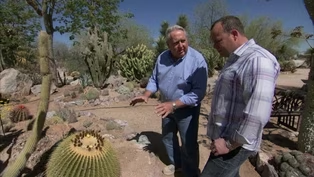
Well, I discovered a family in the Arizona desert who decided decades back that their crop was going to be sharp and spiny cactus.
♪♪ >> Meet Dianne and Dan Bach.
They own a sprawling cactus farm in the heart of America's Sonoran Desert, just outside Tucson.
For decades, they've been raising one of America's most unusual crops - pristine and prickly prized plants.
>> You came on an awesome day.
>> Well, I'm so glad that it, it worked out that way with Mother Nature.
Tell me how big this place is because I've never seen an operation this large with cactus?
>> Well, we're on 10 acres here.
And we have 20 green houses.
>> Some folks consider Dan Bach to be "the king of cactus."
The Bachs Arizona nursery business is well known and so large that we had to hop on board these makeshift carts to take a tour.
Our timing was perfect, however, since on this summer day, cactus flowers were in full bloom.
>> 10 acres Dan.
So much to see.
>> Lots and lots of cactus that I'm looking forward to showing you around.
>> Let's go.
>> We have a great tour planned for you today.
>> Okay.
>> A lot of pretty flowers.
>> Horticulturists estimate there are thousands of varieties of cacti.
On any given day Dan and Dianne have about 500 different kinds.
But over the course of the year, this nursery alone has more than 1200 varieties.
>> Dan, I had no idea there were so many varieties of cacti.
>> You know it's very important for a lot of varieties because people come in and they want to add color to their garden or shape or a form.
So they have, we have mounding plants.
We have tall columnar plants.
We have flowering plants.
We just have plants that make their yards beautiful.
And remember now, all of these plants are low water use.
This is perfect for the time where, we, everybody is concerned about water loss and water use and so everybody is going to xerophytic plants.
>> I keep seeing these huge beds along the way.
What is that over there?
>> Well, that's a, that's an area where we make cuttings.
And we probably get these plants, it accelerates the propagation and the speed if we can make a big cutting rather than growing it from a little tiny seed, which I'm going to show you a little bit later.
>> Well, can we go over there?
>> Let's go!
>> So here's that cutting bed.
And horticulturally I'm fascinated with the cactus because you can do so much so quick?
>> Well, the idea is to accelerate production so what we, we, we, where we can't grow things from seed quick enough, we produce them from cuttings.
>> Okay, how?
>> So this bed here, this bed here would produce, I I think about every year we get about 3,000 cuttings out here.
>> My goodness.
>> And the process is just a matter of doing this.
>> Oh wow.
And then does this just grow?
>> Yes.
>> Oh, it's prickly.
>> You see, yeah, it is prickly.
Right around inside here you can see where the roots would grow out around this ring in the center here.
>> The water storage tissue is out here.
And right around this center here is where the roots are going to grow out from.
>> And this is just one of the Bach's cacti cutting beds.
The nursery produces half a million cactus cuttings each year.
The grafting speeds up the growth process by about 3 years, but the Bach's also plant cactus seeds and graft their own cactus creations.
>> What I love showing is that people can do this at home.
>> Yeah, sure they can.
>> Now that's, people do it all of the time especially members of the local cactus club.
>> Mm-hm.
>> They do this a lot.
I mean they propagate their own plants.
And then share them with the other members of the club.
I'm sure this, we don't do anything here that would, would require smoke and mirrors.
We're just regular ordinary down-to-earth science, you know, basic science.
>> That "basic science" is what's behind these creations.
Dan and his son pollinate and propagate their own varieties of flowering cacti.
>> And perhaps one in a thousand will be worthy of a new name, for example, this is mango.
This is raspberry, epic back here.
And this is sunflower which Dan Jr.
developed doing this very same process.
>> Wow.
So do you name them after special people?
>> No, we name them after anybody you want.
If you grow them, that's the rule, you get to name them.
>> Have you named one after your sweet wife?
>> No, I haven't found one pretty enough yet.
>> Good man.
Many of these plants are show stoppers!
Some, like this prickly pear, can grow 15 feet tall but the star of the show the mighty saguaro.
They can grow to 60 feet tall and it takes decades for an individual saguaro to grow its recognizable arms.
Saguaros can live for more than a century.
>> You said it best when you said that the saguaro is iconic.
>> It is.
Yeah, it's almost hard to believe that this plant that can stand here in the heat in the summer time when the south side of the plant can get, you know, over 120 degrees, 130 degrees and how it can stand there and take all of that abuse.
It's just amazing to me.
I don't know, I don't know how it's possible.
♪♪ >> Rob, come here I want to show you something.
>> Okay.
>> I want to put out, point out this golden barrel cactus here.
>> It's beautiful.
>> As you can see the bright yellow color it's absolutely a spectacular plant, wouldn't you agree?
>> And the greens.
>> Absolutely beautiful.
But look at the flowers here, these flowers are open completely yet they're not very attractive aren't they.
I would just... >> Yeah, hard to see.
>> Yeah, they're hard to see.
They're hard to see them because the plant is so pretty.
Yet earlier, we saw the most in-ornate plants had such beautiful big flowers.
>> Big colorful ones, yes.
>> Big beautiful flowers.
This is, kind of reminds you of people, maybe are, maybe the most in-ornate person might have the most beautiful soul.
>> I like that.
Very well put.
Very well put relating our souls to something that comes right from the earth.
>> Thank you.
>> Definitely different.
Before we go let me tell about some great stuff that you can find on our America's Heartland website.
You'll find us at AmericasHeartland.org.
We have plenty of video there to share with you, recipes from our Farm to Fork segments and links to other ag information as well.
And don't forget you can find us on Facebook, Or check out our content on the America's Heartland channel on YouTube.
That's going to do it this time.
We're so glad you came along to travel the country with us on America's Heartland.
♪ You can see it in the eyes of every woman and man.
♪ ♪ In America's Heartland, living close to the land.
♪ ♪ There's a love for the country and a pride in the brand.
♪ ♪ In America's Heartland, living close, ♪ ♪ close to the land >> America's Heartland is made possible by: >> America never stops.
Neither do the farmers and ranchers who call her home.
And as rural America grows further, Farm Credit will be there, just as we have for 100 years.
>> CropLife America, representing the companies whose modern farming innovations help America's farmers provide nutritious food for communities around the globe.
>> The Fund for Agriculture Education.
A fund created by KVIE to support America's Heartland programming.
Contributors include the following:
 New
NewVideo has Closed Captions
Then, it’s a sharp and spiny crop at this Arizona farm where one family is all about raising cacti. (6m 20s)
 New
NewBrantley Farms Soybean Harvest
Video has Closed Captions
Discover how an Arkansas farm family is using technology to keep prices down for consumers. (5m 53s)
 New
NewVideo has Closed Captions
Come along on a peanut harvest in Georgia. (5m 2s)
 New
NewVideo has Closed Captions
Learn how Tortilla-making is a billion-dollar industry. (1m 6s)
 New
NewVideo has Closed Captions
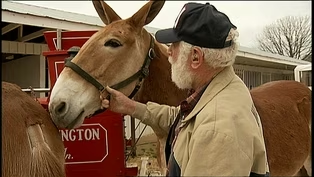
Travel to Tennessee to meet some folks who claim that mules are the best farm animal around. (4m 8s)
Providing Support for PBS.org
Learn Moreabout PBS online sponsorship

- Food
Christopher Kimball’s Milk Street Television
Transform home cooking with the editors of Christopher Kimball’s Milk Street Magazine.












Support for PBS provided by:
America's Heartland is presented by your local public television station.
Funding for America’s Heartland is provided by US Soy, Sustainable Agriculture Research and Education, Rural Development Partners, and a Specialty Crop Grant from the California Department of Food and Agriculture.